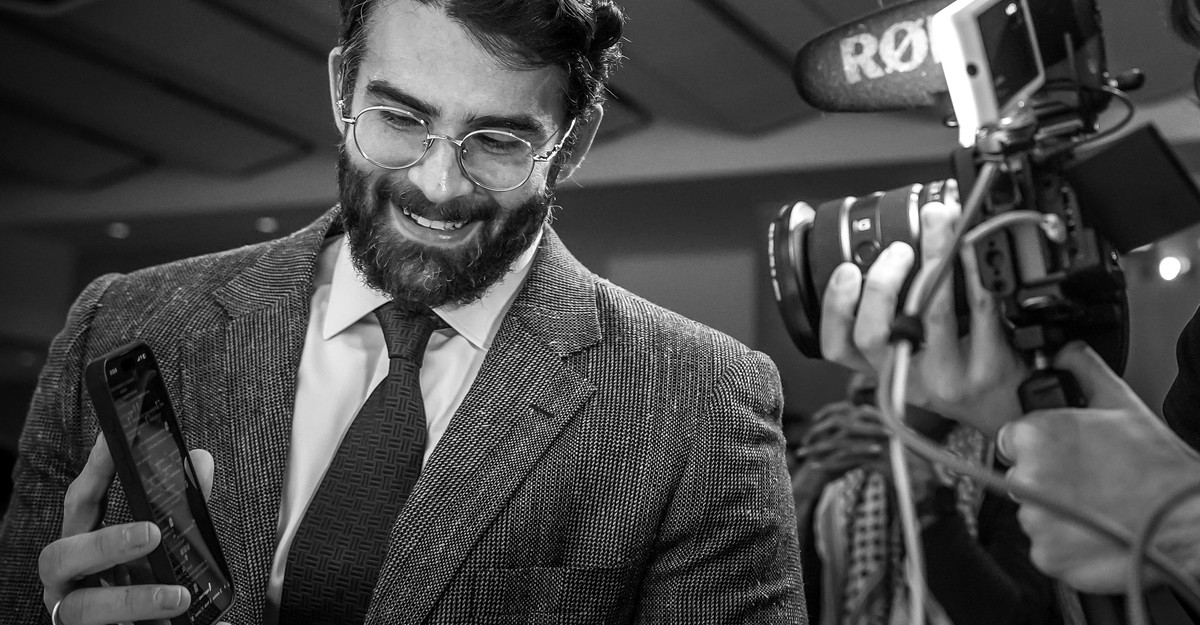
Last week, Pod Save America, the popular podcast founded by former Obama-administration staffers, hosted the influencer and leftist provocateur Hasan Piker. A charismatic and pugnacious socialist streamer, Piker has become a flash point in a broader debate among Democrats over how far their party’s big tent ought to extend. Unsurprisingly, Piker’s hourlong interview generated controversy. Critics on the right and left highlighted his refusal to condemn Hamas. Others were upset that the influencer said he would “vote for Hamas over Israel every single time,” even as he reiterated his reticence to back a progressive politician such as Gavin Newsom over J. D. Vance.
But a very different part of the podcast caught my attention, because it illustrates the problem with the wrangling over Piker: It revolves around his contentious opinions about a narrow subject—Jews and Israel—while giving short shrift to his broader worldview and his tendency to be wrong on the facts. The issue is not whether to engage with figures like Piker; it’s how to do so in a way that’s genuinely informative.
Read: The limits of the Democrats’ big tent
The Pod Save America appearance offers a case in point. While discussing his personal opposition to Israel’s founding, Piker marshals an unexpected ally: Albert Einstein. “My assessment on Zionism as an ideology is not that different from Albert Einstein’s assessment of Zionism,” he tells the co-host Jon Favreau. The Jewish physicist, Piker said, “was actually asked to be the first president of Israel.” But Einstein, in Piker’s account, assailed the Israeli project from the start: He saw “the violence that the early Zionist brigades were engaging in” before “the IDF existed, before Israel existed,” and “wrote about what Zionism was turning into, and he warned that what he was seeing was exactly what the Nazis were doing.”
Most listeners probably took little notice of this historical riff. Favreau does not remark on it. But for me, it was a flashing-neon sign. I wrote my undergraduate thesis about Einstein’s relationship to Judaism and Zionism, poring over the relevant documents in three languages on two continents. And just about every bit of Piker’s potted portrayal is either misleading or false.
Far from an opponent of the Zionist endeavor, Einstein assisted it for decades. In 1921, he raised money across America for the Hebrew University alongside Chaim Weizmann, the head of the World Zionist Organization. In 1923, he delivered a guest lecture at the school’s campus in Jerusalem. Weizmann, meanwhile, was tapped to be the first president of Israel, in 1948; Einstein, who had not been in the running, congratulated him. “Long before the emergency of Hitler, I made the cause of Zionism mine because through it I saw a means of correcting a flagrant wrong,” Einstein wrote to Indian Prime Minister Jawaharlal Nehru in 1947, in an attempt to persuade him to support the movement
In 1951, the physicist hosted David Ben-Gurion, Israel’s founding prime minister, at his home in Princeton, New Jersey. When Weizmann died the next year, Ben-Gurion offered his position to Einstein, who declined, writing that he was “deeply moved by the offer from our State of Israel, and at once saddened and ashamed that I cannot accept it.” (The notoriously absent-minded professor explained, “I lack both the natural aptitude and the experience to deal properly with people and to exercise official functions.”) Shortly before his death, Einstein told an interviewer that he had “great hopes for the future of the Jewish state.” He even planned to deliver a speech marking the seventh anniversary of Israel’s founding in 1955—but died days before he could deliver it. He bequeathed his valuable papers and the rights to his name and likeness to Hebrew University.
None of this is to say that Einstein was an uncritical booster of the Zionist project. On the contrary, he was a sharp public antagonist of the Israeli right. This ideological orientation was likely another reason Einstein turned down the ceremonial role of the country’s presidency, which is meant to be nonpartisan. He was also a deeply reluctant nationalist. Before Israel was founded, Einstein advocated for a shared state for Jews and Arabs, writing in 1946 that “what we can and should ask” is for “secured bi-national status in Palestine with free immigration.” But once Israel was established, Einstein strongly supported its continued existence, while insisting that its ultimate success depended on the pursuit of peace and fair treatment of the land’s Arab inhabitants. “International policies for the Middle East should be dominated by efforts to secure peace for Israel and its neighbors,” he wrote in the draft of his deathbed speech.
In other words, Einstein wasn’t an unapologetic Israel-right-or-wrong advocate or an ardent anti-Zionist, but something more interesting: a left-wing supporter of Jewish statehood who believed in Israel’s necessity but also in the fundamental rights of the region’s Palestinian citizens. This complex combination of commitments puts him in accord with many, if not most, Americans and American Jews today, according to survey data. In contemporary terms, one might call Einstein a liberal Zionist—the same category of people Piker has previously called “liberal Nazis.”
But listeners to Piker on Pod Save America will have learned none of this. The streamer’s cavalier characterization of the views of American Jews, living and dead, and his failure to genuinely reckon with what they think, help explain why some feel that Piker fosters anti-Jewish animus. But one need not reach a conclusion on the anti-Semitism question to arrive at the simpler determination that he speaks confidently about things that he does not know much about. And this phenomenon is not unique to Piker. It’s characteristic of the new-media landscape, which now includes smashmouth streamers and podcasters of all political persuasions who talk about everything but are experts in nothing, and whose incentives run toward incendiary virality rather than accuracy. Often, this means that these talkers leave listeners less informed than when they came in, as is the case here
Such pitfalls should not stop journalists and activists from interviewing these influential actors; doing so is part of the job and essential for democratic dialogue. The question is not whether such people should be engaged, but how. Interviewers should educate themselves about an influencer’s past arguments and be prepared to dig into the details, as CNN’s Elle Reeve did when she exposed the far-right podcaster Candace Owens’s conspiracy theories about Charlie Kirk’s killing. Tucker Carlson has broadcast elaborate Hitler apologetics and other anti-Semitic ideas; his interlocutors should be familiar with their refutations, and be able to raise them when confronting him.
Hosts could also bring on experts to complicate the simplistic narratives marketed by the streaming set: One imagines a medical researcher might have some thoughts about Piker’s recent claim that Cuba has come up with a treatment for Alzheimer’s that he alleges has been suppressed. Other interviewers might have someone else in the studio who is tasked with interrogating the claims of guests in real time. After all, even Joe Rogan has his producer serve as an on-air fact-checker; the people interviewing Rogan should too.
Other questions are worth posing to influencers such as Piker by those who are evaluating them as political partners. On Pod Save America, most of the run time was devoted to Piker holding forth about Jews and Zionism. This was less the fault of the show and more a response to the public discourse, which has obsessed over Piker’s every utterance on these subjects. But for the average voter considering the streamer as a potential ally, and wondering what the world would look like if he had more power, the tired anti-Semitism arguments obscure far more fundamental issues.
For instance, Piker has repeatedly exhibited a soft spot for left-coded expansionist authoritarian regimes. When he was asked recently if “there is a country that has done socialism in a way that you’d like,” he did not cite the Nordic states favored by the likes of Senator Bernie Sanders. He said, “China is probably the closest,” while acknowledging “plenty of issues within the Chinese system” that he did not detail before launching into praise of the country’s high-speed rail. Piker has likened China’s subjugation of Tibet to the North’s crushing of the South in the American Civil War, and argued that the takeover helped civilize the territory. (He has also compared Taiwan to the Confederacy.) He once referred to China’s mass-detention facilities for Uyghur Muslims as “concentration camps,” only to quickly revise that to “reeducation camps” and claim that they “are all closed now.” (They are not, and the detentions also continue throughout the formal justice system.)
Piker’s apologias for left-wing autocrats are not restricted to contemporary ones. Last month, he told his viewers that “Mao Zedong is one of the great leaders of this world.” And at the Yale Political Union this month, he declared that “the fall of the U.S.S.R. was one of the greatest catastrophes of the 20th century.” The tens of millions of victims of the Soviet Union went unmentioned.
Talking with Piker about a political coalition to save American democracy without discussing his affinity for China’s rulers is like teaming up with Carlson without interrogating his praise for Russian President Vladimir Putin—or with Donald Trump without examining his outlook toward Israeli Prime Minister Benjamin Netanyahu. And yet, only the debate over the latter tends to happen, such that Israel crowds out all other considerations, including extremely consequential beliefs that can end up going unchallenged. Favreau, the Pod Save America co-host, perceptively alludes to this very problem in his exchange with Piker. “Tucker Carlson’s a good example,” Favreau observes. “He’ll do, like, a very thoughtful critique of Israel and then suddenly, like, launch into a conspiracy.” The thing is, Carlson isn’t the only one whose Israel rhetoric attracts outsize attention that conveniently enables the rest of his ideology to evade scrutiny.
Many pundits and reporters are understandably unfamiliar with the oeuvre of some of the country’s biggest influencers. The content of these creators is spread out over incalculable hours of streaming video and is not easily searchable. But any productive conversation with or about these personalities requires an accurate understanding of their worldviews.
Perhaps liberal listeners align with Piker’s perspective on regimes such as China and the Soviet Union and consider his approach compatible with their fight against Trumpism. Perhaps they do not. But to make that call, they need to know what he actually believes. And that’s a conversation worth having.