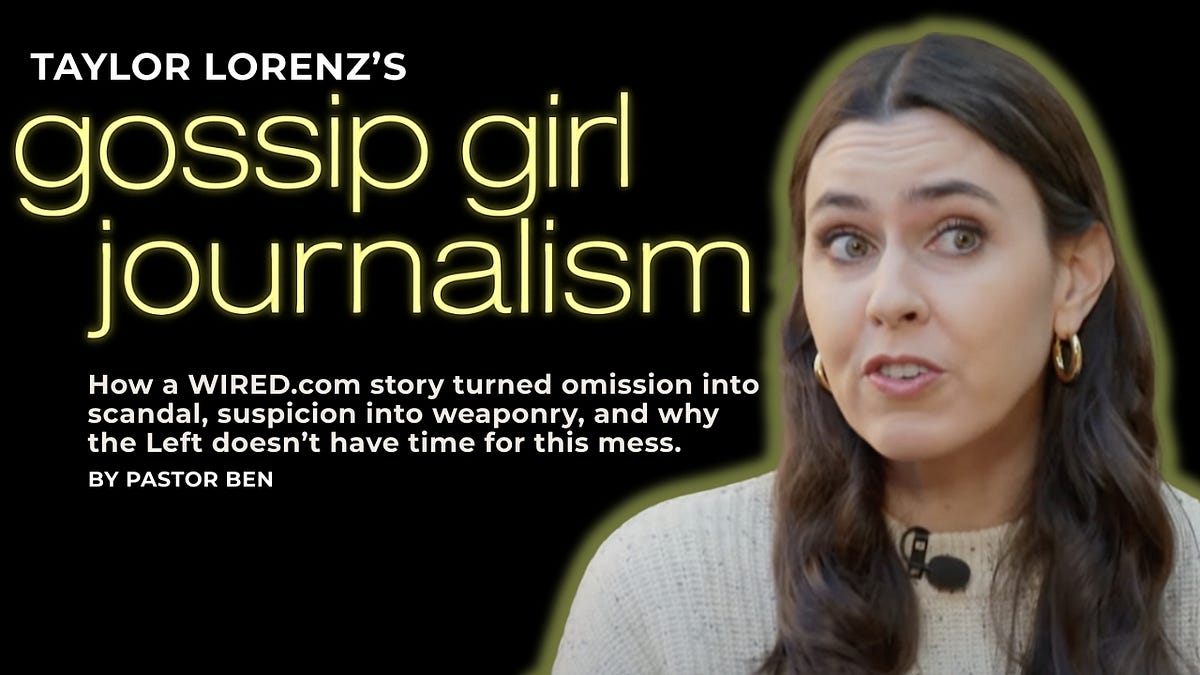
Taylor Lorenz's Gossip Girl Journalism
How a WIRED story turned omission into scandal, suspicion into weaponry, and why the Left doesn’t have time for this mess
PASTOR BEN
SEP 07, 2025
Disclaimer: When I first saw Brian Tyler Cohen’s promotion of Chorus, I refused to apply for two reasons. First, I assumed, incorrectly, that I would be discouraged from speaking up for Gaza. Second, while the original organizers of the program are fine enough in the fight against MAGA, they are not my ideological kin, and I did not want to be bound to their centrist politics or particular reputations, as many of the absolutely wonderful new and young creators that Taylor Lorenz’s article has introduced me to have, unfortunately, found out in the most difficult way imaginable.
A journalist doesn’t need to lie to mislead. All it takes is omission—just enough detail withheld, just enough context erased, just enough insinuation to pass for investigation to people seeking confirmation. The result feels like investigative journalism to those inclined, for whatever reason, to not see the glaring omissions, but it functions precisely like gossip. And gossip, when aimed at the fragile solidarity and infrastructure of the American Left, can do far more damage than easily detectable lies.
That’s what Taylor Lorenz’s
WIRED story on Chorus achieved. WIRED, who prides itself on demystifying complicated technology and issues, published an article with no primary documents, no full clauses quoted for context, not even honest paraphrasing. Just stray fragments surgically embedded into sentences carrying the framing Taylor Lorenz painstakingly curated through omission, suspicion, and insinuation. She didn’t respect readers enough to show her work. And she didn’t have to, because the outrage landed flawlessly without it.
The Right builds billion-dollar media pipelines to spread lies like:
All mass shooters are trans.And it sticks. Trump can deploy troops to Black-led cities with record-low crime and call it law and order—and the public applauds. That’s what narrative control looks like when you have infrastructure: funded, shameless, and flawlessly synchronized like a MAGA Misinformation Machine.
The Left has neither the capacity to set a single national narrative nor the infrastructure necessary to defuse the deadly false-narratives woven by MAGA in mere moments when their machinery is activated. And to be sure, MAGA activates this narrative engine dozens of times daily. And the Left can’t do anything about it but shout in the wind for disconnected silos and algorithmically suppressed social media accounts.
And yet, instead of building that capacity, we’re torching the few scaffolds we have over an article that offered more gossip than proof. No matter what you think of dark money, this piece was designed to make you feel like something corrupt had happened—without ever proving that it actually had. And the worst part? It worked.
1. If Chorus is Guilty by Structure…
Lorenz’s piece fixates on the Sixteen Thirty Fund and Chorus’s fiscal structure, hinting at nefariousness through phrases like “dark money” and “undisclosed funding.” But what goes entirely unmentioned is that
Sixteen Thirty is a 501(c)(4)—a tax designation so ubiquitous in U.S. advocacy it’s banal. This is the same legal classification used ubiquitous by organizations like:
And like Sixteen Thirty,
Our Revolution has not disclosed its largest donors—only its small-dollar base. That’s entirely legal. That’s entirely normal even if we all agree that
it absolutely should not be.
If Chorus is guilty by structure, then so is Our Revolution. And that is a political contradiction the piece could not afford for the reader to consider.
Journalism informs the reader of this critical detail necessary for proper context. Gossip knows that the story is just not as interesting if you include it.
2. If Chorus Is Guilty by Contract…
Seven times Lorenz references contracts with the phrase, “According to copies of the contract viewed by
WIRED.” But not a single contract was even shown. Not even transcribed segments of contracts were published preventing a single reader who was enraged by the article from forming their own opinion through context.
Instead, all the reader got was, at best, two or three word extracts from the contracts: “not publicize,” “no naming,” “funnel all bookings.” And at worst, all my comrades who have scorched the earth with this topic received Taylor Lorenz’s interpretation without any confirmation of the critical details for which you all were enraged.
Lorenz dropped these fragments of truth into paragraphs like chum in a shark-filled ocean, with no surrounding context, no baseline comparisons, and no ability for the reader to evaluate whether these are unusual or simply… standard.
In truth, the “bookings” clause—one of the most heavily cited in coverage—reads as basic operational logistics. It covers coordination with “lawmakers, nonprofit partners, government officials, and others,” ensuring that the Chorus newsroom could manage overlap and schedule efficiently across partners.
Included in Lorenz’s article:
“
According to copies of the contract viewed by WIRED, creators in the program must funnel all bookings with lawmakers and political leaders through Chorus. Creators also have to loop Chorus in on any independently organized engagements with government officials or political leaders.”
Omitted from Lorenz’s article:
“iv. Book Engagements. Chorus will provide Contractors with access to the Chorus Newsroom, which coordinates booking and engagement opportunities for creators with government officials, policy and nonprofit experts, and others whose expertise and experiences are relevant to Chorus’s progressive policy agenda. Contractor agrees to (1) utilize the Chorus Newsroom to book engagements, (2) disclose to Chorus Newsroom personnel any engagements with government officials or others on topics related to Chorus’s policy agenda that Contractor arranges through other means…”
If Chorus is guilty by clause, then so are nearly all progressive newsrooms, advocacy hubs, and campaign teams.
No one coordinating creators or staff across sensitive election periods skips this kind of clause. Planned Parenthood, Greenpeace, ACLU, Sunrise Movement—each uses versions of this language to prevent brand confusion, legal exposure, or duplicated efforts. None of them are accused of authoritarian control because of it.
What was missing wasn’t just the clause—it was the baseline. Without comparison, coordination looks like coercion. More importantly, none of my comrades-at-arms who are enraged by this article noticed this sleight of hand that Lorenz pulled seven times. This is an alarming lack of media literacy and critical analysis skills that we can all be guilty of when it forwards narratives we enjoy.
Journalistic integrity requires this context. Gossip requires this context to be left out.
3. If Chorus is Guilty through Control…
WIRED implied, heavily, that creators were barred speaking on various issues or criticizing the Democratic Party. This suggestion instantly resonates in the minds of those of us who already suspect this type of control everywhere in politics.
Yet, Lorenz either did not research to find examples that directly contradict this assertion, or chose to leave out of her “reporting” that multiple creators went viral criticizing Democrats and calling Gaza a genocide
while under contract as well
And now I have been introduced to many new and amazing
creators I didn’t know about before Taylor’s article that have exquisite critiques of the Democratic Party from the LEFT.
Included: The implication that creators were silenced.
Omitted: The actual public dissent that occurred during the program.
If Chorus is guilty by gag order, then these creators’ public posts would not exist. But they do. And they’re timestamped.
What’s most telling is that the dissent wasn’t hidden. It wasn’t leaked. It was on creators’ public feeds, in plain view. But acknowledging it would have forced Lorenz to explain why speech continued unimpeded.
The silence wasn’t from the contracts. It was from the reporting.
Yet, many of beloved comrades who have since seen the evidence of the freedom of speech of the Chorus cohort have instead rejected “the evidence of their eyes and ears.” This is alarming for our reputation as being the rational truth seekers who demand nuance before being outraged.
4. If Chorus Is Guilty by Funding Influence…
Lorenz’s scandal framework hinges on suspicion that the program was steered by powerful funders with nefarious intentions—there’s no evidence that messaging was dictated or constrained. No evidence that posts were suppressed. And most glaringly,
no mention of what the funding actually achieved.
The Sixteen Thirty Fund helped do what we on the Left often dreams of but rarely delivers:
- Flipped the House in 2018
- Defeated Trump and flipped the Senate in 2020
- Protected abortion access on ballots in 2022
- Blocked GOP suppression bills in Wisconsin, Georgia, and Pennsylvania
These victories were either not mentioned at all or buried deep within the broader narrative.
If Chorus is guilty by affiliation, then we must indict the very mechanisms that secured some of the most impactful Left victories in a generation.
Journalistic integrity demands that this be foregrounded for context. Gossip knows that you can’t say positive things about the person or group you’re gossiping about.



 you got it man, im helping republicans and not democrats who refuse to even get behind their most popular members. Clearly its me who got the popularity down

 . shyt if you gonna sell out at least be upfront with it. I'd respect it.





 in all of this.