
You are using an out of date browser. It may not display this or other websites correctly.
You should upgrade or use an alternative browser.
You should upgrade or use an alternative browser.
Democrats and Trans Rights
- Thread starter the next guy
- Start date
More options
Who Replied?Kamala Harris voters oppose trans kids participating in school sports more than they support them
Summarize
Equal access to sports education for trans kids remains broadly unpopular in the U.S.
Alex Bollinger
A new poll shows that even a plurality of people who voted for Kamala Harris in 2024 oppose equal sports education opportunities for trans youth.
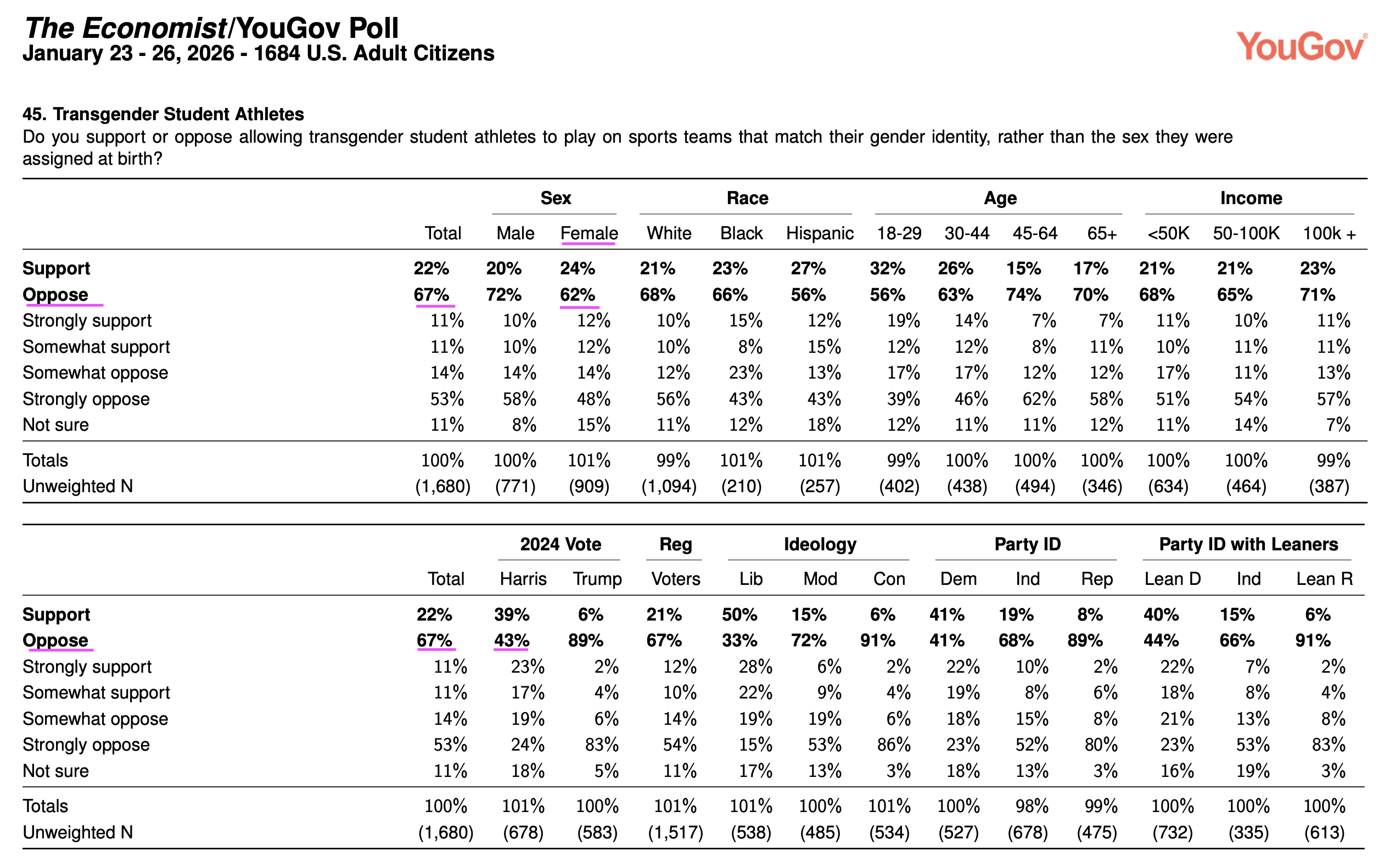
An Economist/YouGov poll asked U.S. adults if they support or oppose “allowing transgender student athletes to play on sports teams that match their gender identity, rather than the sex they were assigned at birth?” Overall, only 22% of respondents said they support it, while 67% said they opposed letting trans kids play with others of their gender.
Among people who voted for Harris, only 39% said they support trans student athletes, while 43% said they oppose them. The difference was more stark among people who voted for the current president; only 6% supported trans student athletes and 89% opposed.
Men (72%) were somewhat more likely to oppose trans student athletes compared to women (62%), despite how the issue is often presented as a battle for women’s rights.
People over the age of 45 were less likely to support trans student athletes than those who were younger. Meanwhile, Black and white respondents opposed trans student athletes at 66% and 68%, respectively, while Hispanic people were less opposed, at 56%.Never Miss a Beat
Subscribe to our newsletter to stay ahead of the latest LGBTQ+ political news and insights.
The poll was conducted from January 23 to 26 and involved 1,684 respondents.
Part of the reason that the poll may have found such low support for trans student athletes is that it presented letting trans kids participate as their gender or as their sex assigned at birth as two equally likely possibilities, when it’s unlikely that students who have already started transitioning will participate in sports at all if they can’t participate with others of their gender. A trans girl forced to play on the boys’ team or a trans boy forced to play on the girls’ team could be outed or feel very uncomfortable in such a situation.
Moreover, the science is less conclusive when it comes to a supposed competitive advantage than many Americans believe. Trans girls who take puberty blockers and hormone therapy before they undergo male puberty haven’t been shown to be any different from cis girls in terms of sports ability, something that many people who are not informed on the issue refuse to accept, even in the face of evidence. There is currently a Supreme Court case specifically about trans student athletes in this situation, and some Supreme Court justices refused to believe experts’ testimony saying that, absent male puberty, trans girls won’t have any sort of advantage.
The degree to which having undergone male puberty and then hormone therapy provides any advantage at all is in dispute, and there isn’t much research on the topic. Some studies have even found that transitioning could give trans women a disadvantage in sports compared to cis women.
Last, polls show an increasing hostility towards trans kids playing sports ever since Republicans started a national moral panic about the issue following their losses in the 2020 election.
A 2021 Gallup Poll found that only 34% of American adults believed that trans people should be allowed to play sports on a team that matched their gender, while 62% said that trans people should be forced to play sports on teams that match their sex assigned at birth. But a 2025 Gallup Poll found less support for trans student athletes, wtih 69% opposing letting them play as their gender and 24% supporting.
A 2025 NBC News poll found that only 25% of Americans supported trans women being allowed to participate in women’s sports, while 75% opposed. That survey did not specifically ask about students.
“Sports… is one of our most emotional touch points as Americans,” nonbinary ESPN journalist Katie Barnes told LGBTQ Nation last year. “Broadly, we love sports, and we love to hate sports and hate each other because of who we root for. And you know, sports and fandom is something that is both developed through participation and also is hereditary.”
“And then when you overlay that with ideas about gender norms… where folks have feelings about the way that things should be in this world, and that is being refracted through the dual lens of gender and sport. And when you couple that with a very clear argument from those who are in favor of a restrictive policy that ‘boys shouldn’t play girls’ sports,’ well, that is going to get a lot of people going, right?”
The Economist/YouGov poll also asked people whether they thought that “society has gone too far/been about right/not gone far enough in accepting people who are transgender.” 44% thought society has gone “too far” while 30% said that society “has not gone far enough.” Men, people over 45, and Republican voters were all more likely to say that society has gone “too far.”
The gates have opened. The AMA has reversed course too.

Pull Up the Roots
Talking? During horse head bookends?

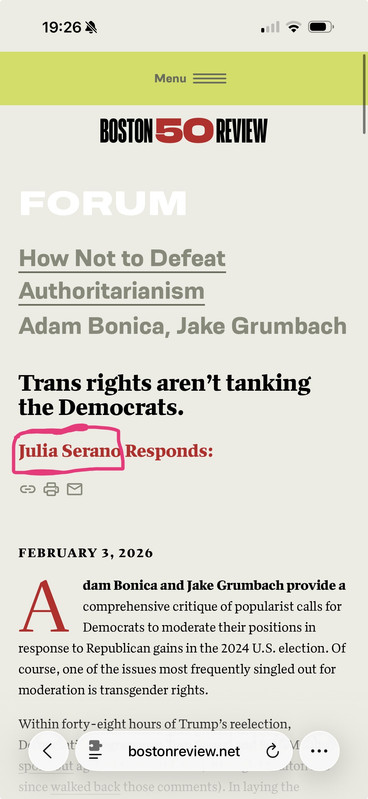
Trans rights aren’t tanking the Democrats.
Julia Serano responds in a forum on “How Not to Defeat Authoritarianism.”
 www.bostonreview.net
Adam Bonica and Jake Grumbach provide a comprehensive critique of popularist calls for Democrats to moderate their positions in response to Republican gains in the 2024 U.S. election. Of course, one of the issues most frequently singled out for moderation is transgender rights.
Within forty-eight hours of Trump’s reelection, Democratic congressmen Tom Suozzi and Seth Moulton spoke out against trans athletes (although Moulton has since walked back those comments). In laying the groundwork for his likely 2028 presidential campaign, California Governor Gavin Newsom has flirted with several far-right positions on trans youth, including banning transition until age twenty-six. Even prior to 2024, the New York Times, Matt Yglesias, and Ruy Teixeira—all highlighted in Bonica and Grumbach’s article as advocates for Democratic moderation—were promoting anti-trans talking points.
But the notion that retreating from trans rights will benefit Democrats in future elections rests on three false assumptions.
The first is that the current anti-trans backlash is the result of “activists going too far,” a trope that is levied against virtually every social justice movement. This framing allows opponents to cast the rolling back of rights as a “realignment” with public opinion and a return to the “natural order” of things. But that is not at all what has happened here.
The claim that Republican anti-trans ads and rhetoric are winning over Democratic and independent voters is simply not true.
I’ve been involved in trans communities since the early 1990s, and during that entire time trans people have acted locally—in their schools, workplaces, and communities—to increase awareness and challenge discriminatory practices. The International Olympic Committee began allowing trans athletes to compete way back in 2004, and gender-affirming care for trans youth is now almost three decades old. These are not by any means “novel” or “radical” developments.
What is new is that, starting around 2015—in the wake of increased trans visibility in the media (sometimes called the “transgender tipping point”) and the Supreme Court’s decision in Obergefell legalizing same-sex marriage—social conservatives began shifting their efforts toward targeting trans people instead. The attacks have since grown into a highly coordinated and well–funded movement that churns out both anti-trans and broader anti-LGBTQ legislation at unprecedented levels. This is the real reason why Republicans have become obsessed with “fairness in women’s sports,” “biological sex,” “social contagion,” “restrooms,” “grooming,” and other soundbites that didn’t exist ten or fifteen years ago.
In other words, there hasn’t been an organic shift in public opinion on trans people but rather a massive astroturfing campaign against us.
The second assumption made by advocates for moderation is that Republican anti-trans ads and rhetoric are winning over Democratic and independent voters. This is simply not true. In his “Modern Electoral History of Transphobia” series (parts 1, 2, and 3), Joshua A. Cohen of the Ettingermentum newsletter analyzed every major U.S. election from 2010 to 2023 in which Republicans campaigned on anti-trans positions and found zero evidence that such strategies were effective: those Republicans either lost or else won due to unrelated factors. And that trend continued across the country in November 2025, most notably in the Virginia and New Jersey gubernatorial elections.
In her Liberal Currents article “Trans Panic? More Like Trans Apathetic,” Katherine Alejandra Cross dispels two myths that persist among popularists: that the “Kamala is for they/them” ad helped get Trump elected and that opposing trans rights is an “80/20” issue. As Cross points out, poll after poll after poll has shown that voters reliably rank transgender issues among the least important to them. In mid-September 2024—a month and a half before the presidential election—Gallup asked registered voters how important twenty-two different issues were to their vote, from the economy and democracy to immigration, taxes, abortion, and crime; “transgender rights” ranked dead last on the share of people who considered it extremely, very, or somewhat important. In other words, voters are not casting their votes based upon their opinions of trans people. Furthermore, the small minority of voters who do consider transgender issues to be a high priority undoubtedly fall into both the pro-trans and anti-trans camps (the latter being disproportionately white Evangelicals who are unlikely to vote for Democrats under any circumstance).
Which brings us to the third mistaken assumption: that abandoning trans rights will have no negative ramifications for Democrats. Popularists act as though Democrats can excise trans sports or trans rights from their agenda without impacting other people and issues. This is extremely naive. Of the twenty-seven states that have passed trans sports bans, all but one has also banned gender-affirming care for trans youth. And many of these same red states are passing “don’t say gay” laws, banning drag performances, censoring LGBTQ books, and working to overturn same-sex marriage. The Republicans promoting this flurry of legislation don’t see these as distinct policies—for them, it’s a concerted effort to push LGBTQ people out of the public sphere en masse. If you think they will stop once they’ve rolled back transgender rights, you are out of your mind.
If you think Republicans will stop once they’ve rolled back transgender rights, you are out of your mind.
Given all this, the supposed strategic advantage for Democrats just doesn’t wash. While trans adults only constitute 0.8 percent of the population, that amounts to over 80,000 voters in a crucial swing state like Pennsylvania—enough to make a difference in a close election if they choose to stay home or cast third-party protest votes. Of course, trans people also have loved ones—our partners, family, friends—who may become disenchanted with Democrats if they abandon us. And if gay, lesbian, and bisexual people (correctly) interpret Democrats speaking out against trans athletes and gender-affirming care as a sign that they are retreating from LGBTQ rights more generally, it could have even more devastating effects at the ballot box. An NBC News Exit Poll of the 2024 presidential election found that LGBTQ people represented 8 percent of all voters and 86 percent of us voted for Harris. This is a fairly solid voting block that has the potential to grow, as a 2025 Gallup poll estimates that 23.1 percent of Gen Z identifies as LGBTQ.
Being Gen X myself—having grown up during a time when most LGBTQ people were forced into the closet—I can understand why many middle-aged and older Americans may feel confused or annoyed or disturbed by trans people suddenly having a voice and speaking up for ourselves. (Cross lucidly addresses this in her article.) But Americans under the age of 50, and especially between 18 and 29, are significantly more accepting of trans people. Any forward-thinking strategist would recognize that, if winning future elections is the goal, standing up for trans and LGBTQ rights is the best political approach in the long run.
Democrats can counteract Republican anti-trans talking points in a variety of ways: critique them as baseless fearmongering, as government overreach, as interfering with personal family decisions, or (to use a favorite popularist approach) dismiss them as a distraction from “kitchen table” issues. Anti-trans/LGBTQ policies can also be accurately and persuasively condemned as part of Republicans’ more general assault on science. While popularists tend not to be fans of calling Republicans “weird,” when they constantly post selfies of themselves “defending restrooms,” or when they propose trans sports bans that include genital inspections of children, perhaps that approach is apt. Declaring his veto of a bill that would have banned trans kids from restrooms and gender-affirming care, Kentucky Governor Andy Beshear said in March 2023, “My faith teaches me that all children are children of God and Senate Bill 150 will endanger the children of Kentucky.” He won reelection that November.
As Bonica and Grumbach emphasize, voters today are craving authenticity. In such an environment, a Democratic politician who unapologetically stands up for their trans and LGBTQ constituents is likely to benefit from such a stance.
Pull Up the Roots
Talking? During horse head bookends?
As far as the ASPS story:
This isn't a scientific consensus shift, it's a policy-driven realignment due to political pressure and threats of lawsuits. The ASPS is *not* a pediatric or adolescent medicine authority. They're a group of professional surgeons, not pediatric endocrinologists, adolescent psychiatrists, developmental specialists, pediatric ethicists, or gender dysphoria clinicians. They're practicing risk management, not evidence-based medical consensus. They’re also making claims outside their area of expertise. There has been no major new body of clinical outcome data that would justify the sudden reversal we're seeing here.
As far as the "evidence" they are citing -- the Cass "review" and the HHS "review" -- those are not seen as credible by the larger medical community. They both use a policy-oriented framing rather than clinical framing. The Cass "review" has been criticized for its misuse of evidence, methodological bias, framing of uncertainty as evidence of harm, and so on. The HHS "review" is even more sloppy and blatantly political. It's not peer-reviewed, not published in a medical journal, not conducted under PRISMA/Cochrane standards, and not independently replicated.
Here is an Evidence-Based Critique of the Cass Review from Yale: https://law.yale.edu/sites/default/files/documents/integrity-project_cass-response.pdf
 pmc.ncbi.nlm.nih.gov
The HHS Review: https://www.science.org/content/article/researchers-slam-hhs-report-gender-affirming-care-youth

 www.hrc.org
 www.genderjustice.us
This whole trans surgery panic is based on misinformation anyway. The numbers people cite don't measure trans youth surgeries, they measure procedure totals across ALL diagnoses. That means it's counting gynecomastia in cis boys, cancer treatment, congenital conditions, and reconstructive surgery. All those categories are being collapsed into one and treated as a catchall for "gender surgery on kids," which is a blatant distortion of data. Trans surgeries are exceedingly rare.
 www.them.us

 jamanetwork.com
It's the same with puberty blockers. They're prescribed for precocious puberty far more often than for trans care. Same with hormones being prescribed for endocrine disorders.
If people actually cared about children like they claimed, there would be even bigger outrage for surgeries on intersex infants -- that's right, infants. They are routinely subjected to non-medically necessary genital surgeries largely for the purpose of social normalization. They are irreversible, permanent, and made at birth, before there's any chance for consent.

 abcnews.go.com
Why are exceptions being carved out for that if the concern for children is genuine?
This isn't a scientific consensus shift, it's a policy-driven realignment due to political pressure and threats of lawsuits. The ASPS is *not* a pediatric or adolescent medicine authority. They're a group of professional surgeons, not pediatric endocrinologists, adolescent psychiatrists, developmental specialists, pediatric ethicists, or gender dysphoria clinicians. They're practicing risk management, not evidence-based medical consensus. They’re also making claims outside their area of expertise. There has been no major new body of clinical outcome data that would justify the sudden reversal we're seeing here.
As far as the "evidence" they are citing -- the Cass "review" and the HHS "review" -- those are not seen as credible by the larger medical community. They both use a policy-oriented framing rather than clinical framing. The Cass "review" has been criticized for its misuse of evidence, methodological bias, framing of uncertainty as evidence of harm, and so on. The HHS "review" is even more sloppy and blatantly political. It's not peer-reviewed, not published in a medical journal, not conducted under PRISMA/Cochrane standards, and not independently replicated.
Here is an Evidence-Based Critique of the Cass Review from Yale: https://law.yale.edu/sites/default/files/documents/integrity-project_cass-response.pdf
Cass Review does not guide care for trans young people - PMC
pmc.ncbi.nlm.nih.gov
The HHS Review: https://www.science.org/content/article/researchers-slam-hhs-report-gender-affirming-care-youth
In New Report, HHS Ignores the Facts & Again Looks to Hand Power to…
HRC responds: “Today’s sham report from HHS is far from a scientific review — it’s a political document”

What to Know About Trump Admin’s HHS Junk Science Report on Trans Health Care
The Trump administration’s Health and Human Services issued a “report” on trans health care, deliberately designed to spread misinformation about proven, often life-saving care. Importantly, the release of this report changes nothing about access to health care.
www.genderjustice.us
This whole trans surgery panic is based on misinformation anyway. The numbers people cite don't measure trans youth surgeries, they measure procedure totals across ALL diagnoses. That means it's counting gynecomastia in cis boys, cancer treatment, congenital conditions, and reconstructive surgery. All those categories are being collapsed into one and treated as a catchall for "gender surgery on kids," which is a blatant distortion of data. Trans surgeries are exceedingly rare.
The Vast Majority of Minors Getting Gender-Affirming Surgeries Are Cis Kids, Study Shows
The study dispels a well-worn anti-trans talking point about how healthcare providers treat gender dysphoria in kids.
Prevalence of Gender-Affirming Surgical Procedures Among Minors and Adults in the US
This cross-sectional study uses a national dataset to examine the prevalence of gender-affirming surgical procedures among minors and adults in the US.
jamanetwork.com
It's the same with puberty blockers. They're prescribed for precocious puberty far more often than for trans care. Same with hormones being prescribed for endocrine disorders.
If people actually cared about children like they claimed, there would be even bigger outrage for surgeries on intersex infants -- that's right, infants. They are routinely subjected to non-medically necessary genital surgeries largely for the purpose of social normalization. They are irreversible, permanent, and made at birth, before there's any chance for consent.
Amid transgender care bans, exceptions made for surgery on intersex children
Despite many gender-affirming care bans for trans youth across the U.S., controversial surgeries for intersex children to assign them a gender are often still allowed.
abcnews.go.com
Why are exceptions being carved out for that if the concern for children is genuine?
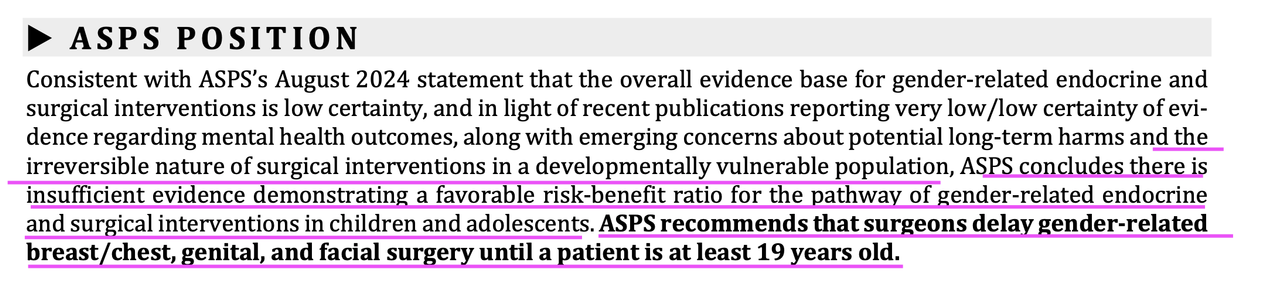
Read the actual numbered list from the ASPS document. It destroys your talking points. It’s quite direct.It's the same with puberty blockers. They're prescribed for precocious puberty far more often than for trans care. Same with hormones being prescribed for endocrine disorders.
Also the ASPS says that WPATH and other trans aligned entities can’t be trusted and have evidenced themselves to be operating in bad faith and presented poor evidence and maintained shoddy research standards
@Pull Up the Roots

No ambiguity. Straight and to the point.



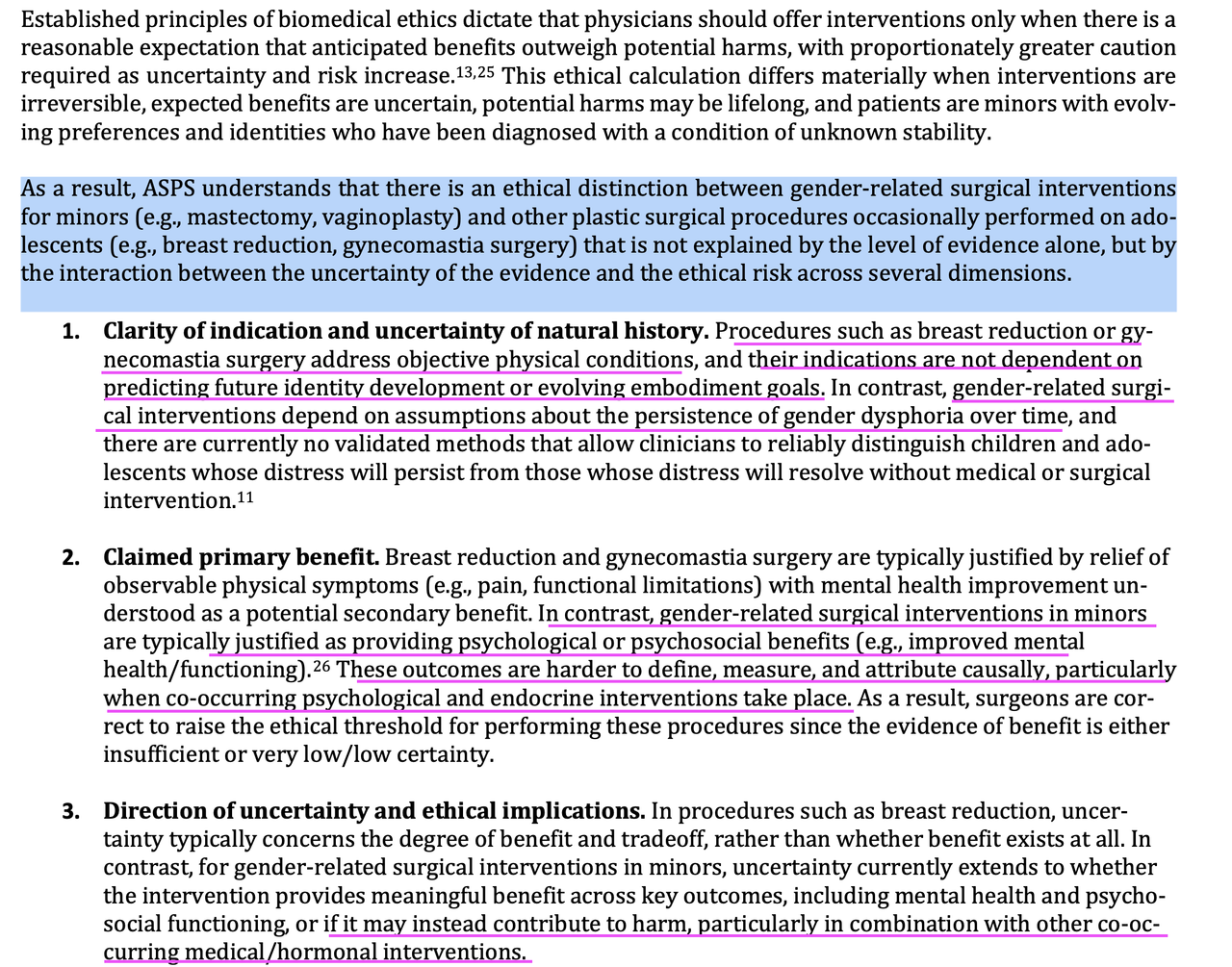
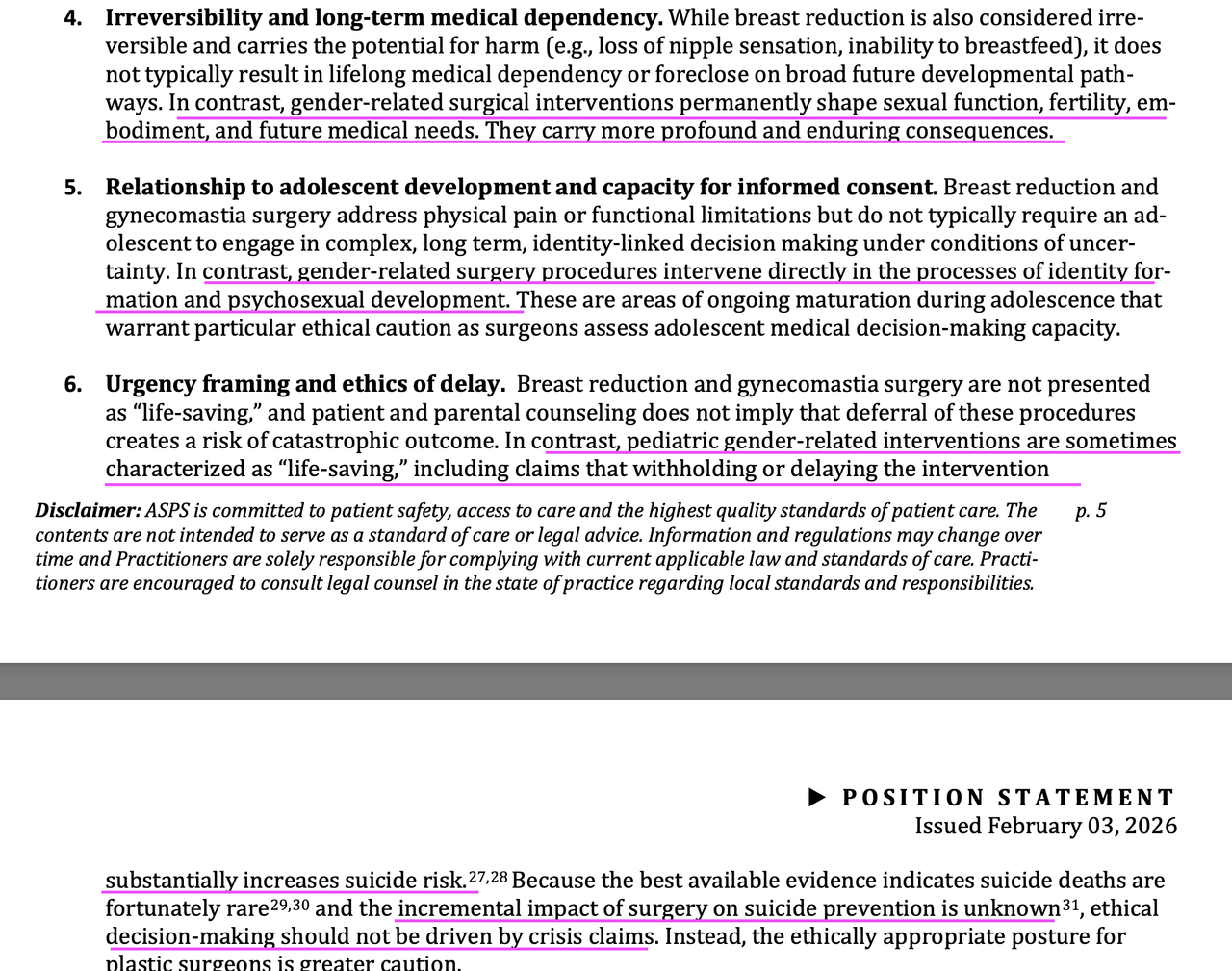
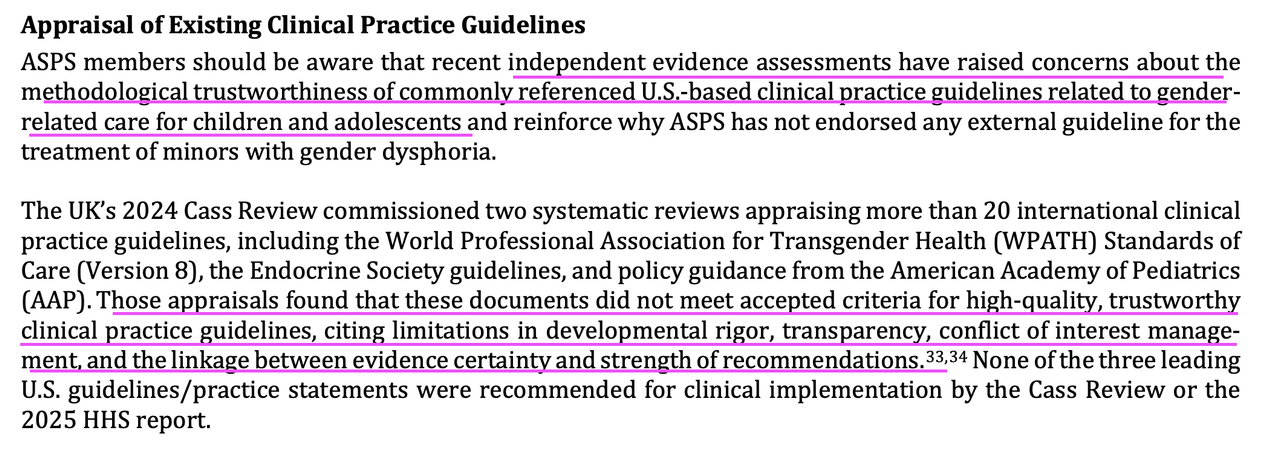
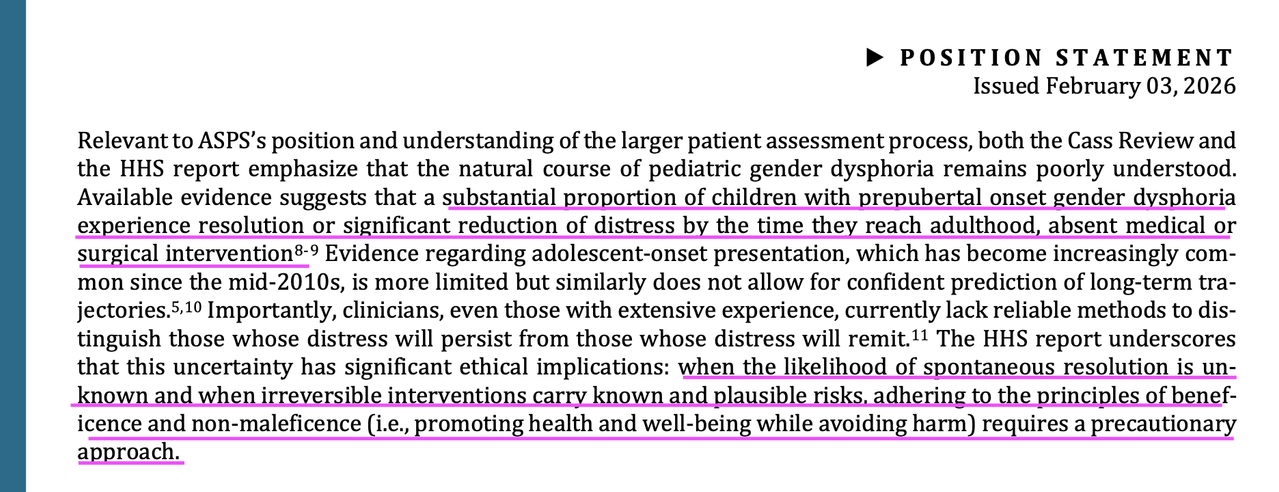

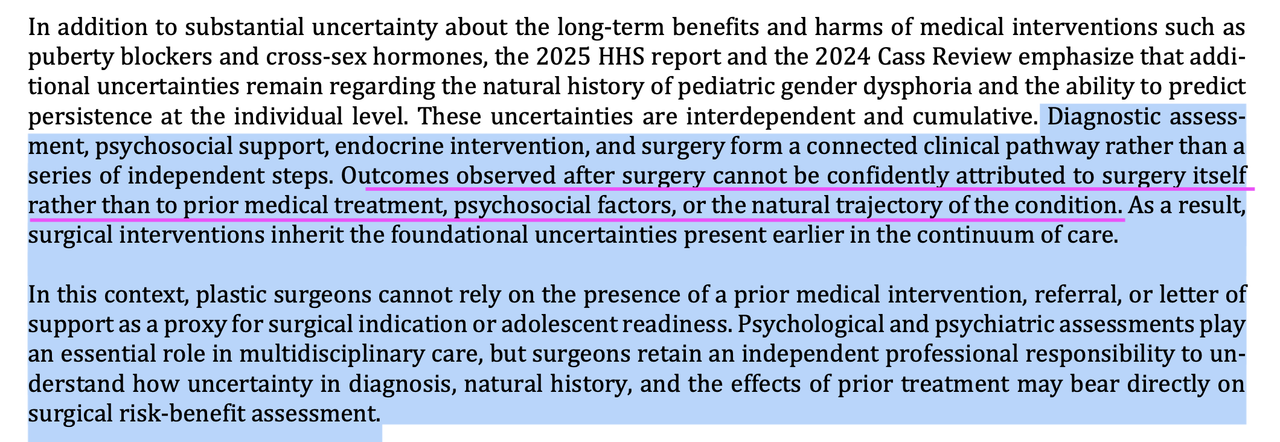

@A-dotty @Adeptus Astartes @dora_da_destroyer @Rekkapryde @Neo. The Only. The One. @the cac mamba @Uachet @Absolut @Sterling Archer @TheDarkCloud @Max Power @Pressure @Gloxina
You’ve got be jokingTrans rights aren’t tanking the Democrats.
Julia Serano responds in a forum on “How Not to Defeat Authoritarianism.”


Julia Serano - Wikipedia


Hey @Pull Up the Roots be honest. Is this a woman to you? :

@A-dotty @Adeptus Astartes @dora_da_destroyer @Rekkapryde@Neo. The Only. The One. @the cac mamba @Uachet @Absolut@Sterling Archer @TheDarkCloud @Max Power @Pressure@Gloxina


