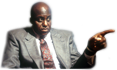
Of course, he was a product of his day. Good or bad, it's what he did. Curious to know more about that Black Yankees connection?
Bojangles could dance - and play baseball
COMMENTARY
November 25, 2008|By Shannon J. Owens, Sentinel Staff Writer
In memory of Luther Robinson
May 25, 1878 -- Nov. 25, 1949
There is an old expression that says, "There is a difference between people laughing with or at you."
Luther Robinson got both.
Robinson was a famous tap dancer who went by the nickname "Bojangles."
Historians said he picked that name to depict his jovial attitude, but his happy-go-lucky demeanor characterized him as an "Uncle Tom" to African Americans and a beloved entertainer outside of his race.
The world remembers Bojangles as
one of the best tap dancers to ever live.
But when he was a boy, all he really wanted to be was a professional baseball player.
Opportunities to play were limited for a black child born in 1878, raised by a grandmother who was a slave.
So he shined shoes and tap-danced for pennies.
He was just 12 years old when he started dancing alongside white men wearing black paint smeared across their faces in minstrel shows.
Bojangles' success was measured in laughs.
A short time later, he made audiences across America laugh with his fast feet and slow mind in his movies with a precocious 5-year-old named Shirley Temple.
But he was no fool.
While he created a national profile performing with the '30's version of Hannah Montana, he pursued his other great passion -- baseball.
Bojangles co-founded a Harlem-based team called the New York Black Yankees in 1936.
It was home to players like Negro League East all-stars Clarence Reginald "Fats" Jenkins, Theodore Roosevelt "Double Duty" Radcliffe and George "Mule" Suttles.
The team's biggest success was landing Hall of Fame pitcher Satchel Paige for a brief stint in 1943.
It finished at the bottom of the Negro National League by the time it disbanded in 1948.
Little information exists about his involvement with the Negro Leagues.
He was a minor figure in a sport marginalized by mainstream media.
The only printed stories about Bojangles and baseball involve him tap-dancing in the dugouts of Yankee Stadium.
Baseball gave many African Americans a respectable identity.
But Bojangles often struggled to gain the admiration of his peers.
Some called him an "Uncle Tom" because he always portrayed servants in his movies and was not outspoken about racial injustices.
Through the years, African Americans coined the phrase "bojanglin' " as the verb to mean an Uncle Tom.
There is a statue of Bojangles in his birthplace Richmond, Va.
His name and legacy, however, is most relevant to this generation as a four-piece chicken and biscuit meal at a popular fast-food chain.
He did not openly speak out against racial injustices -- a product of his times -- but is reported to have given away an estimated $1 million of his career earnings to various charities benefiting children of all races.
He also gave an annual money reward to the graduating class Public School 119 in Harlem.
The money he didn't give away to charities was lost to gambling.
After he died, a group of newspaper columnists and the New York elite made plans to organize a benefit performance to help Robinson's family pay for the funeral, according to an old New York Times article.
Bojangles danced until he was 70 years old and could no longer see the steps in his famous stair routine due to a cataract.
His obituary ran on the front page of The New York Times on Nov. 26, 1949, but that was a rare occurrence during a period when the only color in a newspaper was the black ink.
Bojangles didn't mind being laughed at. But maybe Luther Robinson cared.



 They delivered.

status




 Don't say nothing 'bout Mr. Bojangles

 Jesus....