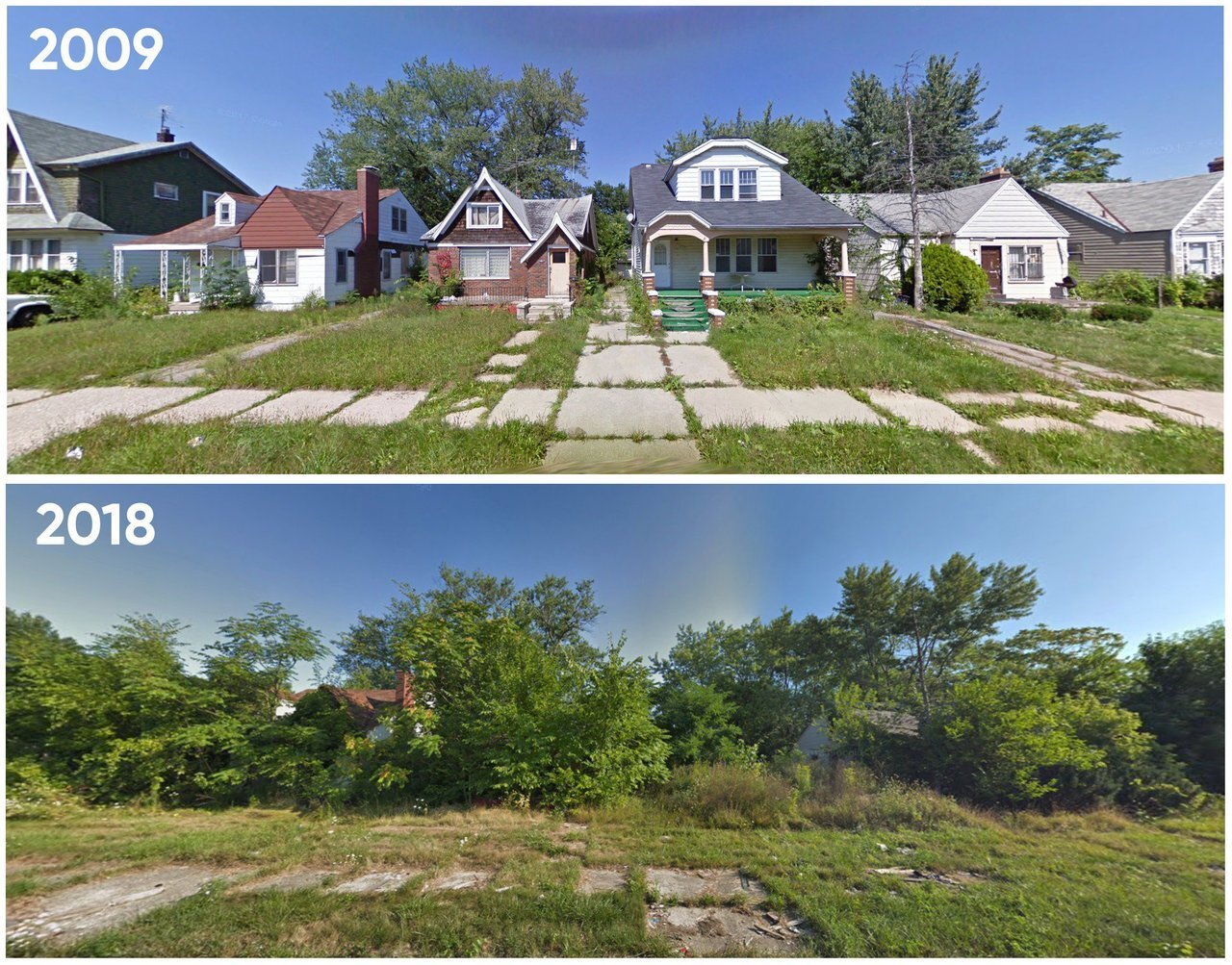
These disappearing blocks, and dozens more than Alsup has included on his site, chronicle Detroit’s foreclosure crisis. In particular, they are the wreckage of an epidemic of tax forfeitures—nearly 160,000 in Wayne County, which includes Detroit, since 2002. Homeowners who are delinquent on their property taxes are offered various options, such as repayment plans with interest, but if they cannot pay or cannot be reached, the house is foreclosed upon and goes to auction.
Tax foreclosures are incredibly pervasive in Detroit not only because of the city’s widespread poverty and long, steady loss of population, but also because they provide a short term cash infusion to a local government desperate for revenue. Either interest on repayment or the sale of a foreclosed property brings cash into the county’s coffers—at the cost of the further deterioration of once-stable neighborhoods. There has been some in-depth reporting on this problem in recent years, including
a piece by Bridge Michigan in 2017 titled, “Sorry we foreclosed your home. But thanks for fixing our budget,” and
another story by WDET, Detroit’s NPR affiliate. They paint a picture of a set of deeply perverse incentives for Wayne County, which in 2014 was forced into a consent agreement with the state of Michigan over its deficit. Bridge reported that the county’s turnaround plan “estimated it will collect $286 million from 2015 to 2019 from back taxes, fees and auctioned properties.”
Some of the foreclosed homes are abandoned, but many are occupied—and sometimes by renters, who find themselves evicted when their landlord cannot pay the taxes.
A former Wayne County executive told Bridge Magazine, “Foreclosing on people’s homes shouldn’t be a policy to sustain yourself. From a policy perspective, you hope it dries up. You don’t want to have to keep foreclosing in order to balance the budget.” This is true not least because this is no path to a solvent or stable future for Detroit. Rather, it falls into the category of what we’ve described at Strong Towns as “
transactions of decline"—decisions made out of
short-term financial desperation despite that they worsen a place’s long-term loss of prosperity.
Those in younger and faster-growing cities experienced the Great Recession as a temporary blip in housing prices before a return to a robust recovery (or
Bubble 2.0, depending on whom you ask). In a place like Detroit, it’s been a steady calamity, ignored in large part by the rest of America because “Detroit” was already so synonymous with “calamity” in their minds.