FDIC shuts down Silicon Valley Bank, crash incoming? Update: 2nd bank, Signature Bank in NY closed

beenz

Rap Guerilla
Joined
May 1, 2012
Messages
85,950
Reputation
11,654
Daps
200,918
Reppin
The Chi (South Side)


these politicians have been blatantly insider trading, like senator kelly loeffler of georgia, who happened to dump ALL her positions in companies that crashed right before the pandemic was made public as she was clearly trading on insider information. pelosi's husband also pulled insider trading. I don't tihnk ANYONE in politics should be allowed to trade individual stocks when they clearly have an advantage.
 

lib123

Superstar
Joined
Jun 16, 2015
Messages
9,184
Reputation
853
Daps
19,180
merge the banks and only a few mega banks remain ohh boy i wonder where this will lead too

At this point the mega banks have an incentive to let the regional banks fail. They’ll just buy their assets and branches for pennies on the dollar.
 

bnew

Veteran
Joined
Nov 1, 2015
Messages
69,236
Reputation
10,617
Daps
187,127

Credit Suisse’s Fund Outflows Continue With $6 Billion Pulled​


Steven Arons
Wed, June 28, 2023 at 3:14 AM EDT·1 min read


311ae89855ef6ce675c1570499f8b028

c74852c877dc4528029f53596a3980af

1 / 2

Credit Suisse’s Fund Outflows Continue With $6 Billion Pulled​


(Bloomberg) -- Credit Suisse Group AG’s asset management arm saw clients continue to pull money from its investment funds this quarter, underscoring the challenges for UBS Group AG as it integrates its former rival.

Most Read from Bloomberg

Investors took out about $6 billion through June 22 from open-end funds and ETFs tracked by Morningstar Direct. The data covers funds holding more than $150 billion worth of assets, which is roughly equivalent to 40% of the investment unit’s total assets under management. It excludes money market funds, feeders and funds of funds.

The figures are an early indication of the performance of Credit Suisse asset management unit, which has seen clients pull for five consecutive quarters amid a crisis of confidence that saw it collapse into the arms of UBS in March. Stemming those outflows has been a key priority for the leadership of the combined bank.

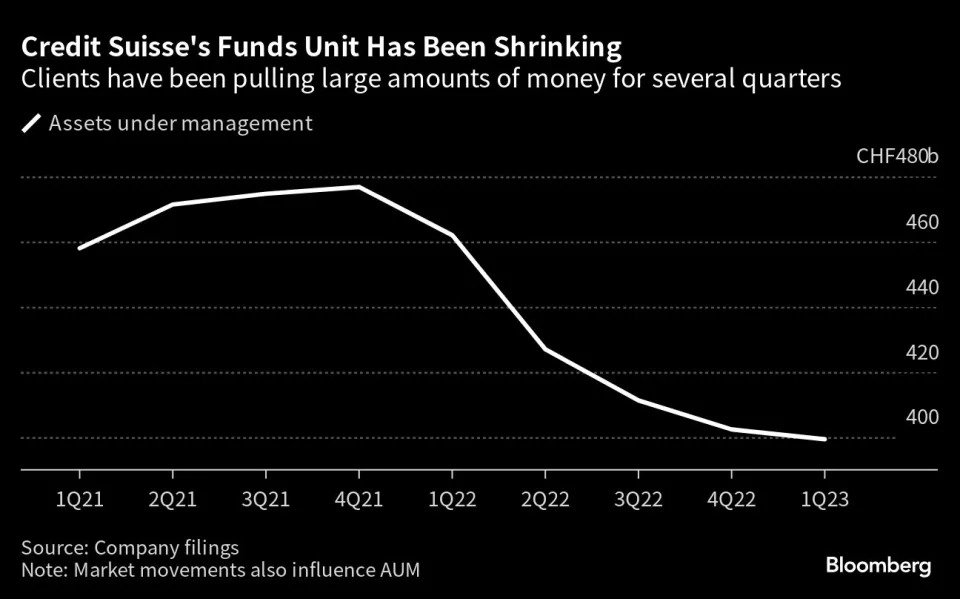
Assets under management at Credit Suisse’s investment unit have been dropping since the end of 2021 when they stood at 477 billion Swiss francs ($533 billion). They hit 399 billion francs at the end of the first quarter.

--With assistance from Marion Halftermeyer.

Most Read from Bloomberg Businessweek
 

bnew

Veteran
Joined
Nov 1, 2015
Messages
69,236
Reputation
10,617
Daps
187,127


UBS ‘preparing to cut more than half of inherited Credit Suisse workforce’​

Between 30,000 and 35,000 staff likely to leave combined group this year, according to report

Phillip Inman
@phillipinman
Wed 28 Jun 2023 06.42 EDT


The Swiss investment bank UBS is reportedly preparing to cut more than half the 45,000 staff it inherited from the takeover of stricken rival Credit Suisse, in a move that is expected to begin as early as next month.

Insiders have indicated that between 30,000 and 35,000 staff are likely to leave the combined organisation this year in three rounds of cuts beginning in July, according to Bloomberg News.

Credit Suisse employees will bear the brunt of the cuts, with about 25,000 posts held by its staff before the takeover expected to be removed.

The prospect of the huge job losses is a further blow to the City of London after rivals Morgan Stanley and Goldman Sachs announced a reduction in staff numbers earlier this year.

Credit Suisse offices in the capital are expected to be among of the worst hit as UBS seeks to protect operations in Switzerland. Senior executives, traders and thousands of support staff in New York and some parts of Asia are also expected to be told their positions are redundant, according to the report.

UBS has previously stressed that the bank is keen to reduce costs overall and has not set a target for a reduction in the workforce. It reluctantly agreed to buy Credit Suisse in a deal thrashed out with the Swiss government and local regulators in March, after the rival bank came close to bankruptcy.

The costs of the merger were expected to reach $17bn (£13.4bn), although UBS is estimated to have inherited a portfolio of assets from Credit Suisse worth $35bn, and in the immediate aftermath of the takeover the combined workforce rose to 120,000.

Shares of UBS rose 1.4% at the open on Wednesday, trading at 17.81 Swiss francs ($19.907) as of 9.05am in Zurich. A spokesperson for UBS declined to comment on the report of job cuts.

At an event in Zurich on Tuesday the UBS chief executive, Sergio Ermotti, said the integration was going “very well”
 

FaTaL

Veteran
Joined
May 2, 2012
Messages
106,334
Reputation
5,479
Daps
211,979
Reppin
NULL

Credit Suisse’s Fund Outflows Continue With $6 Billion Pulled​


Steven Arons
Wed, June 28, 2023 at 3:14 AM EDT·1 min read


311ae89855ef6ce675c1570499f8b028

c74852c877dc4528029f53596a3980af

1 / 2

Credit Suisse’s Fund Outflows Continue With $6 Billion Pulled​


(Bloomberg) -- Credit Suisse Group AG’s asset management arm saw clients continue to pull money from its investment funds this quarter, underscoring the challenges for UBS Group AG as it integrates its former rival.

Most Read from Bloomberg

Investors took out about $6 billion through June 22 from open-end funds and ETFs tracked by Morningstar Direct. The data covers funds holding more than $150 billion worth of assets, which is roughly equivalent to 40% of the investment unit’s total assets under management. It excludes money market funds, feeders and funds of funds.

The figures are an early indication of the performance of Credit Suisse asset management unit, which has seen clients pull for five consecutive quarters amid a crisis of confidence that saw it collapse into the arms of UBS in March. Stemming those outflows has been a key priority for the leadership of the combined bank.

Assets under management at Credit Suisse’s investment unit have been dropping since the end of 2021 when they stood at 477 billion Swiss francs ($533 billion). They hit 399 billion francs at the end of the first quarter.

--With assistance from Marion Halftermeyer.

Most Read from Bloomberg Businessweek
wheres all this cash flowing to?
 

bnew

Veteran
Joined
Nov 1, 2015
Messages
69,236
Reputation
10,617
Daps
187,127

Credit Suisse collapse inquiry to keep files secret for 50 years​

Swiss parliament declines to comment after time frame reported by newspaper Aargauer Zeitung​


OWXMDQYZUR7QPYY7OC4CV2KJ4M.jpg

The investigation will focus on the activities of the Swiss government, financial regulator and central bank in the run-up to the emergency takeover of Credit Suisse by UBS in March. Photograph: Yui Mok/PA Wire


John Revill
Sat Jul 15 2023 - 15:53


A parliamentary investigation into the collapse of Credit Suisse will keep its files closed for 50 years, according to a parliamentary committee document, a level of secrecy that has triggered concern among Swiss historians.

The document means the investigating commission would hand over its files to the Swiss Federal Archives after a longer gap than the usual 30 years to ensure high levels of confidentiality apply to the investigation, which has generated huge public interest.

The investigation will focus on the activities of the Swiss government, financial regulator and central bank in the run-up to the emergency takeover of Credit Suisse by UBS in March.

The investigation is only the fifth of its kind in the country's modern history and the committee of lawmakers conducting it has sweeping powers to call on the Swiss cabinet, finance ministry and other state bodies.

"After the completion of the investigation, the files shall be handed over to the Federal Archives and shall be subject to an extended protection period of 50 years," the committee said in a strategy paper outlining its communication policy.

The Swiss parliament declined to comment on Saturday after the 50-year requirement was first reported by newspaper Aargauer Zeitung.

The Swiss Society for History raised concerns about the length of time, with its president, Sacha Zala, writing to commission head Isabelle Chassot, a lawmaker from the Swiss upper house of parliament.

“Should researchers want to scientifically investigate the 2023 banking crisis, access to the CS files would be invaluable,” Mr Zala wrote, according to the newspaper.

"Ideally, it should be possible to secure and make accessible the archive after an appropriate protection period has expired and, if necessary, subject to historical research conditions," he added.

The committee held its first regular meeting in Bern on Thursday, where it stressed the confidentiality of its proceedings, which could include interviews with bankers.

"All persons participating in the meetings and the questioning are subject to the duty of secrecy, not only the members of the commission, but also the interviewees themselves," it said.

“Indiscretions complicate the work or damage the credibility of the commission and can have negative consequences for the Swiss financial centre,” the committee added. - Reuters

(c) Copyright Thomson Reuters 2023
 

null

...
Joined
Nov 12, 2014
Messages
33,662
Reputation
6,472
Daps
52,009
Reppin
UK, DE, GY, DMV

bnew

Veteran
Joined
Nov 1, 2015
Messages
69,236
Reputation
10,617
Daps
187,127

Fitch warns it may be forced to downgrade dozens of banks, including JPMorgan Chase​


“A Fitch Ratings analyst warned that the U.S. banking industry has inched closer to another source of turbulence — the risk of sweeping rating downgrades on dozens of U.S. banks that could even include the likes of JPMorgan Chase .

The ratings agency cut its assessment of the industry’s health in June, a move that analyst Chris Wolfe said went largely unnoticed because it didn’t trigger downgrades on banks.

But another one-notch downgrade of the industry’s score, to A+ from AA-, would force Fitch to reevaluate ratings on each of the more than 70 U.S. banks it covers, Wolfe told CNBC in an exclusive interview at the firm’s New York headquarters.

“If we were to move it to A+, then that would recalibrate all our financial measures and would probably translate into negative rating actions,” Wolfe said.

The credit rating firms relied upon by bond investors have roiled markets lately with their actions. Last week, Moody’s downgraded 10 small and midsized banks and warned that cuts could come for another 17 lenders, including larger institutions like Truist and U.S. Bank . Earlier this month, Fitch downgraded the U.S. long-term credit rating because of political dysfunction and growing debt loads, a move that was derided by business leaders including JPMorgan CEO Jamie Dimon.

This time, Fitch is intent on signaling to the market that bank downgrades, while not a foregone conclusion, are a real risk, said Wolfe.

The firm’s June action took the industry’s “operating environment” score to AA- from AA because of pressure on the country’s credit rating, regulatory gaps exposed by the March regional bank failures and uncertainty around interest rates.

The problem created by another downgrade to A+ is that the industry’s score would then be lower than some of its top-rated lenders. The country’s two largest banks by assets, JPMorgan and Bank of America , would likely be cut to A+ from AA- in this scenario, since banks can’t be rated higher than the environment in which they operate.

And if top institutions like JPMorgan are cut, then Fitch would be forced to at least consider downgrades on all their peers’ ratings, according to Wolfe. That could potentially push some weaker lenders closer to non-investment grade status.

Hard decisions

For instance, Miami Lakes, Florida-based BankUnited , at BBB, is already at the lower bounds of what investors consider investment grade. If the firm, which has a negative outlook, falls another notch, it would be perilously close to a non-investment grade rating.

Wolfe said he didn’t want to speculate on the timing of this potential move or its impact to lower-rated firms.

“We’d have some decisions to make, both on an absolute and relative basis,” Wolfe said. “On an absolute basis, there might be some BBB- banks where we’ve already discounted a lot of things and maybe they could hold onto their rating.”

JPMorgan declined to comment for this article, while Bank of America and BankUnited didn’t immediately respond to messages seeking comment.

Rates, defaults

In terms of what could push Fitch to downgrade the industry, the biggest factor is the path of interest rates determined by the Federal Reserve. Some market forecasters have said the Fed may already be done raising rates and could cut them next year, but that isn’t a foregone conclusion. Higher rates for longer than expected would pressure the industry’s profit margins.

“What we don’t know is, where does the Fed stop? Because that is going to be a very important input into what it means for the banking system,” he said.

A related issue is if the industry’s loan defaults rise beyond what Fitch considers a historically normal level of losses, said Wolfe. Defaults tend to rise in a rate-hiking environment, and Fitch has expressed concern on the impact of office loan defaults on smaller banks.

“That shouldn’t be shocking or alarming,” he said. “But if we’re exceeding [normalized losses], that’s what maybe tips us over.”

The impact of such broad downgrades is hard to predict.

In the wake of the recent Moody’s cuts, Morgan Stanley analysts said that downgraded banks would have to pay investors more to buy their bonds, which further compresses profit margins. They even expressed concerns some banks could get locked out of debt markets entirely. Downgrades could also trigger unwelcome provisions in lending agreements or other complex contracts.

“It’s not inevitable that it goes down,” Wolfe said. “We could be at AA- for the next 10 years. But if it goes down, there will be consequences.””


bnew

Veteran
Joined
Nov 1, 2015
Messages
69,236
Reputation
10,617
Daps
187,127

Exclusive: Swiss authorities, banks mull new rules to prevent bank runs -sources​

By Stefania Spezzati, Oliver Hirt and Elisa Martinuzzi

November 2, 202312:48 PM EDTUpdated 8 hours ago

A logo of Swiss bank UBS is seen in Zurich

[1/3]A logo of Swiss bank UBS is seen in Zurich, Switzerland March 29, 2023. REUTERS/Denis Balibouse Acquire Licensing Rights


LONDON/ZURICH, Nov 2 (Reuters) - Swiss authorities and lenders, including UBS (UBSG.S), are discussing new measures to prevent bank runs after Credit Suisse’s rescue earlier this year, four sources familiar with the matter said, a move that could affect billions in deposits.

The talks, which have not been previously reported and are part of a broader review of the country's banking rules, are intended for the top Swiss banks and could target mainly their wealth clients, two of the sources said.


Among the measures being discussed is the option to stagger a greater portion of withdrawals over longer periods of time, one of the sources said. Imposing fees on exits is also an alternative being discussed, two of the sources said.

Rewarding clients who tie up their savings for longer with higher interest rates is being debated, one of the sources said.

Discussions are in the early stages, according to two sources. The Swiss National Bank and the Swiss Finance Ministry are part of the conversations with lenders, one source said.


A representative for the finance ministry said that the issue of bank runs is part of an overall evaluation of the too-big-to-fail regulatory framework in Switzerland. The Swiss government is due to publish a report in spring next year, he added.

The SNB said the review of too-big-to-fail rules, which focuses on so-called systemically important banks, is ongoing. The central bank declined to comment on ongoing work.

UBS declined to comment.

Reuters could not determine which other banks were involved in the conversations with Swiss authorities.

In Switzerland, UBS, Raiffeisen Group, Zürcher Kantonalbank and PostFinance are deemed systemically important lenders as their failure could cause serious damage to the country’s economy and financial system.

A spokesperson for PostFinance said it is not involved in the discussions while a spokesperson for ZKB declined to comment. A representative for Raiffeisen did not have an immediate comment.

DEPOSIT RUNS​

Earlier this year, some regional U.S. banks and Credit Suisse suffered massive deposit runs, causing some to fail and regulators to intervene to prevent a broader financial crisis.

Regulators worldwide have since been grappling with the risk of bank runs, which in the era of digital banking have accelerated in speed.

In the case of Credit Suisse, the Swiss lender suffered unprecedented outflows and came close to a disorderly wind-down in March. Wealth managers tend to have a greater concentration of deposits than some of the retail banking competitors, which emerged as a weakness for the lender.

In the last three months of 2022, the bank, at the time Switzerland's second-largest lender, was hit by 111 billion Swiss francs of outflows. Another 61 billion Swiss francs left in the first quarter, with the wealth unit which caters to affluent clients hit the hardest.

Its near-implosion prompted the SNB to step in with emergency funding and to facilitate its takeover by UBS, making the country's biggest bank even larger.

While it’s early days, the measures under discussion in Switzerland are making some people nervous.

They risk penalizing Swiss banks if they were to be introduced only in Switzerland, one of the sources said.

UBS is trying to attract customers with above-market rates on deposits, Reuters reported in October.

The new rules could dent competitiveness or, in a more extreme scenario, push clients to withdraw their money preemptively, the person added.

Reporting Stefania Spezzati, Oliver Hirt and Elisa Martinuzzi; additional reporting by John O'Donnell; Editing by Paritosh Bansal and Nick Zieminski
 
Top