
You are using an out of date browser. It may not display this or other websites correctly.
You should upgrade or use an alternative browser.
You should upgrade or use an alternative browser.
Google scoops up another high-profile scientist for anti-death project
- Thread starter Ciggavelli
- Start date
More options
Who Replied?

What about the overpopulation that would ensue? We'd not be allowed to have kids anymore unless we colonize other planets
This is truly a mindfukk if Google pulls it off (and that's a big if)
This is truly a mindfukk if Google pulls it off (and that's a big if)

Torrential
LWO
get redman on this treatment ASAP


this is the first step toward annihilating the masses. i find it troubling that the leading tech firms are fukking with genetics and going against nature. This won't end well 
No it won't. Google is evil. What don't they have their hands in right now? shytthis is the first step toward annihilating the masses. i find it troubling that the leading tech firms are fukking with genetics and going against nature. This won't end well

What about the overpopulation that would ensue? We'd not be allowed to have kids anymore unless we colonize other planets
This is truly a mindfukk if Google pulls it off (and that's a big if)
Biological death isn't the only form. Read up on the immortal jellyfish. 6 million ways to die, choose one.
Even in a fairytale world, only the rich would afford this. Most likely nerds will try to transplant their minds into synthetic machines and lose sentience.
But yeah, this is a delusional wish that rich men have had since civilization began and it won't be fulfilled.
There is no such thing as anti death because all things eventually die. Infrastructure may not be available forever to keep friends alive and even immortality can be a curse if your say, locked in a safe thrown to the bottom of the ocean. I think its just demons wanting to preserve their way of life eternally which keeps humanity static. Fear of what awaits them on the other side. Demonic technosorcery, friend.

 I would not wish that on my worst enemy
they will work on shyt like this, but won't search for a cure for sickle cell, lupus, etc. their not trying to preserve life, they want to preserve white life.No it won't. Google is evil. What don't they have their hands in right now? shyt
Immortal jellyfishBiological death isn't the only form. Read up on the immortal jellyfish. 6 million ways to die, choose one.
Even in a fairytale world, only the rich would afford this. Most likely nerds will try to transplant their minds into synthetic machines and lose sentience.
But yeah, I thought we'd be going the synthetic route, but I'm assuming that will be much harder. It'd be more effective though
Their "don't be evil" motto is scary as shyt. You don't have a motto like that unless you are doing some evil shytthey will work on shyt like this, but won't search for a cure for sickle cell, lupus, etc. their not trying to preserve life, they want to preserve white life.
they will work on shyt like this, but won't search for a cure for sickle cell, lupus, etc. their not trying to preserve life, they want to preserve white life.
They work on those things too and fail which is why this is nonsense
matter of fact, majority of TED talk type shyt is rich people delusions
WTF Is Calico, And Why Does Google Think Its Mysterious New Company Can Defy Aging?
The sad truth is that, if everyone on the Forbes 400 list simultaneously (and tragically) got cancer, or Parkinsons (or any given disease for that matter), the world would probably be well on its way to finding a cure for these illnesses, thanks to the enormous wealth that would be incentivized to back those efforts.
Finding a cure for an intractable disease requires time, enormous amounts of human and financial capital, cooperation and research — and at least a few public-private partnerships. It’s costly, and it’s messy. This is why Calico, Google’s newest mad science project, is potentially so exciting.
In fact, Calico could represent the company’s largest health-care initiative since Google Health sprinted its way into obscurity. Of course, Google is a different company today than it was in 2008 (when it launched Google Health) and so are we. Our habits have changed: Today, 20 percent of smartphone users have downloaded at least one health app, and 60 percent of adults now look for health information online.
Led by former Genentech CEO and current Apple Chairman, Arthur D. Levinson, Calico has big plans in health care — at least over the long term. From what we’ve heard thus far, the new project will leverage Google’s massive cloud and data centers to help facilitate research on disease and aging by mining its trove of data for insight into their origins.

Apple Chairman, Arthur D. Levinson
Plus, thanks to its investment in 23andMe, Google already has access to a fast-growing genomic database, which could come in handy as it begins to focus on, in its words, “health and well-being — in particular the challenge of aging” and dive into the science, genetics and biochemistry behind longevity and disease.
In an interview with TIME Magazine, Google CEO Larry Page implied that dramatically extending human life is one of Calico’s main goals; not making people immortal per se, but, according to a source familiar with the project, increasing the lifespan of people born 20 years ago by as much as 100 years.
“Are people really focused on the right things?” Page muses in the interview. “One of the things I thought was amazing is that if you solve cancer, you’d add about three years to people’s average life expectancy. We think of solving cancer as this huge thing that’ll totally change the world, but when you really take a step back and look at it, yeah, there are many, many tragic cases of cancer, and it’s very, very sad, but in the aggregate, it’s not as big an advance as you might think.”
While his delivery is a bit confusing, Page’s thesis seems to be an optimistic one: While curing cancer has always seemed like an insurmountable obstacle, the goal is more within reach than many believe — if only someone would just put their mind to it, he seems to say. Yes, Larry Page is brilliant, but his message also seems to imply that diseases (and their cures) are reducible — that all of the world’s problems could be cured if we just had some snappier algorithms.
Really, it almost seems more of a reflection of how the enormous many-headed-beast that is Google has become, as well as a testament to its resources and the type of talent it’s able to attract — rather than pure, unbridled hubris. It’s as if they’re saying: “Hi, welcome to Google! Today, we’re going to turn your eyeglasses into a computer, tomorrow we’ll develop self-driving cars, the day after that, we’ll cure cancer and increase the average human lifespan by 100 years. Oh, and by the way, we’re still trying to organize all of the world’s information and make it easily searchable!!” N.B.D., everybody, N.B.D.
Interestingly, Calico doesn’t seem to be a Google company per se, more of an investment in a new company that will be affiliated with Google and become an extension of the company’s mad science lab, Google X. “Don’t be surprised if we invest in projects that seem strange or speculative compared with our existing Internet businesses,” Page warned readers on Google+, Google’s social network. [Yes, let's not forget that Google also has a social network. It's like Facebook except no one uses it!] “Please remember that new investments like this are very small by comparison to our core business.” Of course, with a market cap approaching $300 billion, Google could make a $1 billion investment in Calico and it would still be a very small investment “by comparison to its core business.”
Not satisfied with self-driving cars and Google Glass, Page says health is something the company needs to tackle, that he wants to “solve cancer” the same way Google X has tried to experiment and innovate in wearable computing and transportation. “It takes 10 or 20 years to go from an idea to something being real. Health care is certainly one of those areas,” he told TIME’s Harry McKracken. “We should shoot for the things that are really, really important, so 10 or 20 years from now we have those things done.”
Sources tell us that Calico is still very much in the exploratory phases and is seeking neither near-term profits nor has much of any idea about how to actually increase lifespans. So there’s that. It’s one thing to say “we’re going to increase the human lifespan by 20 years!” and another entirely to actually do that. Fortunately, Page and Levinson aren’t the first ones to attempt longevity: Immortality has long been the ambition of kings, super villains and pretty much anyone who enjoys waking up each morning.
While Google Calico is still a work in progress, given what we’ve learned so far and heard from our sources, here are a couple of ways the company could push us towards that goal — or at the very least, extend our lifespans.
The sad truth is that, if everyone on the Forbes 400 list simultaneously (and tragically) got cancer, or Parkinsons (or any given disease for that matter), the world would probably be well on its way to finding a cure for these illnesses, thanks to the enormous wealth that would be incentivized to back those efforts.
Finding a cure for an intractable disease requires time, enormous amounts of human and financial capital, cooperation and research — and at least a few public-private partnerships. It’s costly, and it’s messy. This is why Calico, Google’s newest mad science project, is potentially so exciting.
In fact, Calico could represent the company’s largest health-care initiative since Google Health sprinted its way into obscurity. Of course, Google is a different company today than it was in 2008 (when it launched Google Health) and so are we. Our habits have changed: Today, 20 percent of smartphone users have downloaded at least one health app, and 60 percent of adults now look for health information online.
Led by former Genentech CEO and current Apple Chairman, Arthur D. Levinson, Calico has big plans in health care — at least over the long term. From what we’ve heard thus far, the new project will leverage Google’s massive cloud and data centers to help facilitate research on disease and aging by mining its trove of data for insight into their origins.

Apple Chairman, Arthur D. Levinson
Plus, thanks to its investment in 23andMe, Google already has access to a fast-growing genomic database, which could come in handy as it begins to focus on, in its words, “health and well-being — in particular the challenge of aging” and dive into the science, genetics and biochemistry behind longevity and disease.
In an interview with TIME Magazine, Google CEO Larry Page implied that dramatically extending human life is one of Calico’s main goals; not making people immortal per se, but, according to a source familiar with the project, increasing the lifespan of people born 20 years ago by as much as 100 years.
“Are people really focused on the right things?” Page muses in the interview. “One of the things I thought was amazing is that if you solve cancer, you’d add about three years to people’s average life expectancy. We think of solving cancer as this huge thing that’ll totally change the world, but when you really take a step back and look at it, yeah, there are many, many tragic cases of cancer, and it’s very, very sad, but in the aggregate, it’s not as big an advance as you might think.”
While his delivery is a bit confusing, Page’s thesis seems to be an optimistic one: While curing cancer has always seemed like an insurmountable obstacle, the goal is more within reach than many believe — if only someone would just put their mind to it, he seems to say. Yes, Larry Page is brilliant, but his message also seems to imply that diseases (and their cures) are reducible — that all of the world’s problems could be cured if we just had some snappier algorithms.
Really, it almost seems more of a reflection of how the enormous many-headed-beast that is Google has become, as well as a testament to its resources and the type of talent it’s able to attract — rather than pure, unbridled hubris. It’s as if they’re saying: “Hi, welcome to Google! Today, we’re going to turn your eyeglasses into a computer, tomorrow we’ll develop self-driving cars, the day after that, we’ll cure cancer and increase the average human lifespan by 100 years. Oh, and by the way, we’re still trying to organize all of the world’s information and make it easily searchable!!” N.B.D., everybody, N.B.D.
Interestingly, Calico doesn’t seem to be a Google company per se, more of an investment in a new company that will be affiliated with Google and become an extension of the company’s mad science lab, Google X. “Don’t be surprised if we invest in projects that seem strange or speculative compared with our existing Internet businesses,” Page warned readers on Google+, Google’s social network. [Yes, let's not forget that Google also has a social network. It's like Facebook except no one uses it!] “Please remember that new investments like this are very small by comparison to our core business.” Of course, with a market cap approaching $300 billion, Google could make a $1 billion investment in Calico and it would still be a very small investment “by comparison to its core business.”
Not satisfied with self-driving cars and Google Glass, Page says health is something the company needs to tackle, that he wants to “solve cancer” the same way Google X has tried to experiment and innovate in wearable computing and transportation. “It takes 10 or 20 years to go from an idea to something being real. Health care is certainly one of those areas,” he told TIME’s Harry McKracken. “We should shoot for the things that are really, really important, so 10 or 20 years from now we have those things done.”
Sources tell us that Calico is still very much in the exploratory phases and is seeking neither near-term profits nor has much of any idea about how to actually increase lifespans. So there’s that. It’s one thing to say “we’re going to increase the human lifespan by 20 years!” and another entirely to actually do that. Fortunately, Page and Levinson aren’t the first ones to attempt longevity: Immortality has long been the ambition of kings, super villains and pretty much anyone who enjoys waking up each morning.
While Google Calico is still a work in progress, given what we’ve learned so far and heard from our sources, here are a couple of ways the company could push us towards that goal — or at the very least, extend our lifespans.

What about the overpopulation that would ensue? We'd not be allowed to have kids anymore unless we colonize other planets
This is truly a mindfukk if Google pulls it off (and that's a big if)
even if this somehow came true(experimentation on worms,c'mon now) there's no way the common man would have access to it,and by thee time this comes to close to fruition i'm sure this globe will be in shambles..
i'm sure thee Abrahamic religions will make hubbub over this interfering with the laws of G-d,access to heaven,etc but then Google will just buy off a few well known religious leaders behind thee scenes,they'll alter some interpretation of scriptures,and before you know it most of thee sheep will fall in line..
we all live forever anyways,just not in our current form,we disintegrate,re-generate,and reintegrate our current until tis takes another life form...
Immortal Worms, Telomeres & Cellular Clean Up
It may surprise you, but in the race to immortality, humans are in second place. But who is this agile and fleet-footed creature out-distancing we ever-powerful humans, you ask? Why that would be none other than the noble Planarian worm. Yes, in 2012, scientists from the University of Nottingham found a species of Planarian worm that could perpetually heal itself and divide.
“Usually when stem cells divide — to heal wounds, or during reproduction or for growth — they start to show signs of aging. This means that the stem cells are no longer able to divide and so become less able to replace exhausted specialized cells in the tissues of our bodies,” explained researcher Aziz Aboobaker. “Our aging skin is perhaps the most visible example of this effect. Planarian worms and their stem cells are somehow able to avoid the aging process and to keep their cells dividing.”
Cross-section of a Planarian Flatworm. Photo from The School of Molecular and Cellular Biology at the University of Illinois
Essentially, one of the keys to immortality lies in telomeres — which are essentially a region of nucleotide sequences that act as a protective cap, deterring the degradation of genes near the end of chromosomes by allowing their ends to shorten. Huh? In other words, as Science Daily points out, the telomere is like the protective plastic cap at the end of your shoelace; each time a cell divides, the telomere protects it from fraying or going on a five-day bender. However, each time it does divide, your telomere caps are reduced.
Theoretically, then, if someone can figure out a way to preserve or elongate these telomeres, then we would be one step closer to a veritable genetic fountain of youth. Unfortunately, the science is still scant. Back in 1996, a team of Nobel Prize-winning scientists explained that “telomere length is clearly not directly correlated with organismal aging” [PDF].
However, Elizabeth Blackburn, Carol Greider and Jack Szostak won the Nobel Price for Physiology and Medicine in 2009 for their work, which found that telomere length could potentially be maintained by catalyzing the activity of an enzyme known as “telomerase.” However, as Science Daily points out, in most organisms, the enzyme is really only turned on during those early developmental years. Planarian worms have managed to outfox this, and by studying the mechanics of their division and how they protect against degradation, Google Calico and anyone else for that matter could be on the right track.

Human Chromosomes capped by telomeres. Photo courtesy of U.S. Department of Energy’s Human Genome Program
It may surprise you, but in the race to immortality, humans are in second place. But who is this agile and fleet-footed creature out-distancing we ever-powerful humans, you ask? Why that would be none other than the noble Planarian worm. Yes, in 2012, scientists from the University of Nottingham found a species of Planarian worm that could perpetually heal itself and divide.
“Usually when stem cells divide — to heal wounds, or during reproduction or for growth — they start to show signs of aging. This means that the stem cells are no longer able to divide and so become less able to replace exhausted specialized cells in the tissues of our bodies,” explained researcher Aziz Aboobaker. “Our aging skin is perhaps the most visible example of this effect. Planarian worms and their stem cells are somehow able to avoid the aging process and to keep their cells dividing.”
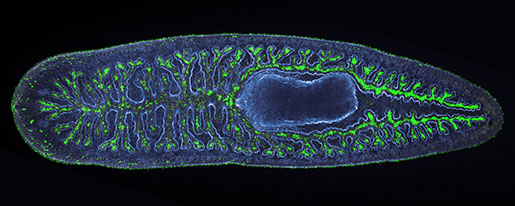
Cross-section of a Planarian Flatworm. Photo from The School of Molecular and Cellular Biology at the University of Illinois
Essentially, one of the keys to immortality lies in telomeres — which are essentially a region of nucleotide sequences that act as a protective cap, deterring the degradation of genes near the end of chromosomes by allowing their ends to shorten. Huh? In other words, as Science Daily points out, the telomere is like the protective plastic cap at the end of your shoelace; each time a cell divides, the telomere protects it from fraying or going on a five-day bender. However, each time it does divide, your telomere caps are reduced.
Theoretically, then, if someone can figure out a way to preserve or elongate these telomeres, then we would be one step closer to a veritable genetic fountain of youth. Unfortunately, the science is still scant. Back in 1996, a team of Nobel Prize-winning scientists explained that “telomere length is clearly not directly correlated with organismal aging” [PDF].
However, Elizabeth Blackburn, Carol Greider and Jack Szostak won the Nobel Price for Physiology and Medicine in 2009 for their work, which found that telomere length could potentially be maintained by catalyzing the activity of an enzyme known as “telomerase.” However, as Science Daily points out, in most organisms, the enzyme is really only turned on during those early developmental years. Planarian worms have managed to outfox this, and by studying the mechanics of their division and how they protect against degradation, Google Calico and anyone else for that matter could be on the right track.

Human Chromosomes capped by telomeres. Photo courtesy of U.S. Department of Energy’s Human Genome Program