
Heroin problems in America's Midwest: “We have never documented anything like it”

☑︎#VoteDemocrat

The Original
Bushed
WOAT
Supporter
Joined
Dec 9, 2012
Messages
338,367
Reputation
-35,073
Daps
641,708
Reppin
The Deep State


Heroin in the Midwest
A hydra-headed scourge
How the Midwest is battling a drug epidemic
From the print edition
20150919_USP005_0.jpg


EVEN street-savvy former gang members are shocked by the spread of heroin to Chicago’s suburbs. Earlier this year, when Roberto Hernández, a Puerto Rican, was in the final stages of preparation of a big push by Gangs to Grace, a church ministry on the west side, to save Latino gang members from lives of violent crime, he explained that white girls from the suburbs go to neighbourhoods even he wouldn’t set foot in to buy heroin. Many of them are as young as 14 or 15. Some prostitute themselves to fund their addiction.

“We have the worst heroin problem in the nation in the Chicago area,” says David Cohen, a recovering heroin addict who counsels addicts at Insight Behavioural Health, a treatment centre. Greater Chicago has the highest number of emergency-room visits related to heroin in the country with 24,627 visits in 2011 (the latest year for which records exist), compared with 12,015 in New York. In Chicago 35% of substance-abuse treatment admissions are for heroin, compared with 16% nationwide. And demand, especially from young women, keeps rising: on the city’s west side business is booming at what insiders say is the largest open-air drug market in the country.

Who owns the pope?
  • A hydra-headed scourge
Reprints
Related topics
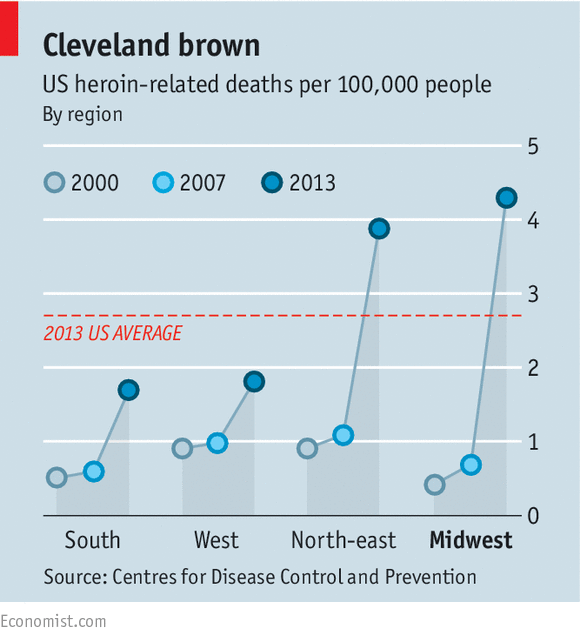
Heroin hit the Midwest harder than other places because the coasts learned to deal with the problem in the 1960s, and are thus better able to handle its resurgence, says David Ferguson, a medicinal chemist at the University of Minnesota (see chart). Midwesterners, especially in rural areas, are less aware of the dangers. They had to learn how to fight drug traffickers, mostly from Mexico, who use Chicago as a transport hub for their wares. The Midwest and the South also have far fewer treatment centres for addicts than the north-east.
20150919_USC900.png

The heroin epidemic in the Midwest is closely linked to the rampant opiate epidemic. As doctors prescribed opioid painkillers such as OxyContin more and more liberally, their abuse grew. Sales of prescription opioid painkillers have increased 300% since 1999, according to the federal Centres for Disease Control and Prevention (CDC), even though the amount of pain Americans report to their physicians has not changed.

Three-quarters of heroin addicts used to take prescription drugs and switched to heroin, which is cheaper and more easily available on the black market. A gram of pure heroin costs less than half what it did in the 1980s, in real terms. “This is a doctor-caused epidemic,” says Tom Frieden, boss of the CDC. In states with higher prescription rate of opioid painkillers, such as Michigan, Ohio and Indiana, the number of heroin addicts is higher too.

In depressed areas in the Rust Belt, where poverty and unemployment rates shot up as factories shut down and jobs disappeared, the drug epidemic is ravaging once-idyllic communities. Indiana had a brutal wake-up call earlier this year when Austin, a small rural community just off the interstate between Indianapolis and Louisville, was the epicentre of the largest outbreak of HIV infections ever seen in the state. Nearly 200 people were infected in a population of just 4,200 because addicts injecting Opana, a prescription painkiller that delivers a potent high, shared needles, which is the fastest way for an infection to spread. “We have never documented anything like it,” says Mr Frieden.

Indiana and Illinois are lagging behind in efforts to fight the drug epidemic. “If we want to make the heroin problem worse, we are headed in the right direction,” warns Kathie Kane-Willis, the director of the Illinois Consortium on Drug Policy at Roosevelt University. According to a study published last month by the consortium, Illinois dropped from 28th in the nation for providing state-funded treatment for addiction to 44th in just five years. Illinois is the least equipped state in the Midwest to provide treatment for the growing number of heroin addicts, says the study, and Indiana is only slightly better. This suggests the needles and spoons are here to stay.

From the print edition: United States
 

EndDomination

Veteran
Supporter
Joined
Jun 22, 2014
Messages
31,857
Reputation
7,432
Daps
111,955
Of course :yeshrug:
I've had a few friends and a relative that made the jump from Oxy to heroin after having been prescribed it for years, and suddenly being cut off. :yeshrug:
Its an issue that needs to be dealt with, not on a moral basis, but on an economic basis, because the majority of the heroin related hospital trips are not covered by insurance, but are instead shouldered by the hospital and the state. Plus heroin increases crime.
It unfortunately has quite the negative effect on the Black community as well.
 

.༼-◕_◕-༽.

.༼-◕_◕-༽.
Joined
May 30, 2013
Messages
5,480
Reputation
1,300
Daps
13,472
Reppin
Dona Nobis Pacem
Heroin was introduced to Harlem in the 1950s...


Ex-Judge’s Script Recalls Era When Heroin Came to Harlem


  • Edwin Torres, who retired from the bench in January, has written a new screenplay, set in East Harlem after World War II.
    DAVID GONZALEZ / THE NEW YORK TIMES
    A lot of actors who played wiseguys on screens silver or small have seen the script and told him they love it, he said. Then they take what can only be seen as some sort of actor’s omerta that goes something like this:

    “I sent him the script. He liked it. And then I never heard from him.”

    None of this seems to have dimmed Justice Torres’s enthusiasm. He knows this is how the business works, since three of his novels — “Q & A,” “Carlito’s Way,” and “After Hours” — became films (the latter two were combined into “Carlito’s Way,” the movie.) Al Pacino reportedly patterned Carlito Brigante’s speech after Justice Torres’s own soulful Nuyorican swagger.


    Lately, Justice Torres was named to the New York State Athletic Commission, helping to enforce safety standards in boxing, a sport he enjoys. And he has also tinkered with his script.

    The idea to write “Pleasant Avenue” came a few years ago during a conversation he had with a director, who had heard him talk about East Harlem over the decades. He had grown up in the area, living through some hard times. Later, as a judge, he sent some of the neighborhood guys away to do hard time. In between, he was a lawyer who knew how to have a good time.

    He remembers his childhood as one where people grew up knowing — and respecting, for better or worse — the dividing lines that kept the Italians, Puerto Ricans and African-Americans in their own little patches of East Harlem. These chunks of the city were fiercely defended.

    “In 1948, I was here in the midst of this, a cauldron of gangs,” he said. “Then the ethnic lines started to be crossed with the introduction of heroin. All of a sudden, mothers of some of my friends wanted to know why their sons were stealing clothes, appliances, anything. They didn’t know what heroin was. Even hip guys like me had never seen a street junkie.”

    But by the time he returned from serving in the military in the early 1950s, he and everybody else in East Harlem knew.

    His screenplay covers this turbulent era, framed in the story of two brothers, Mario and Nino LoPresti, the sons of a man who stood up to the mob and paid for it. One is a hero police officer; the other is a pug who gets lost in dope. They move through a world rendered in sharp detail, where people show up at house parties in suits and ties to dance to mambo, living rooms have plaster saints and sofas have plastic covers.

    The dialogue — especially the lines he wrote for the leading men — snap with the kind of gleeful profanity familiar to anyone who ever grew up in a neighborhood where different nationalities were bumping up against each other. Slurs are hurled fast and often, and one seven-letter curse is so common that it is becomes nothing more than a word that heralds the imminent arrival of a noun.

    Justice Torres’s ear for that banter is a gift he honed on the bench and on the streets. “Dialogue is my strong suit,” he said. “I’m a listener. I am a chronicler of El Barrio. I remember walking the streets listening to the different guys in the park.”

    Memories might be all that are left of the old neighborhood. On Monday afternoon he went over to Pleasant Avenue, which actually looked like it could live up to its name. “All this misery came out of here once,” he said. “Pleasant Avenue, they called it. It’s a nice name. It’s only six blocks.”

    From the corner of 115th Street, just down the block from where Fat Tony had his social club, Justice Torres spotted an old-timer. “They called him the Oarsman,” he said. “Before he got sent away, he used to mix up the heroin in a pot with a big paddle.”

    The Oarsman looked old and tired as he half-shuffled across the street, followed by a waddling pit bull.

    “These are the last guys around here,” Justice Torres said. “You can’t make this stuff up. You just can’t.”

    That’s why more than a few people have suggested he write a memoir, but he isn’t exactly thrilled by the idea. Apparently, some of his friends share that sentiment.

    “The best stuff, I can’t talk about,” he said. “I have to protect the guilty. Many of the guys I grew up with are still extant, and I don’t want to embarrass anybody. Maybe when they’re dead. And I swear, I’ll live to be an old man. My mother’s 96. So I’ll write it when they’re all gone. They know who they are.”
 

.༼-◕_◕-༽.

.༼-◕_◕-༽.
Joined
May 30, 2013
Messages
5,480
Reputation
1,300
Daps
13,472
Reppin
Dona Nobis Pacem
m the Civil War to the 70s, and Beyond
By Sean Gardiner | July 5, 2009
Email


Dr. Robert Newman, who opened New York City's pioneering methadone clinics in the early 1970s.

"Ah, when the heroin is in my blood, and that blood is in my head, then thank God that I'm as good as dead." —"Heroin," the Velvet Underground

America's long-running drug war has its roots in a real armed conflict, the Civil War. It was after that crisis that addiction to an opiate called morphine, which had been used as a painkiller and anesthetic for wounded soldiers, became a noticeable social problem in the country as its use moved from the battlefield into civilian society. Opium, the poppy product from which both morphine and heroin are derived, was the first drug that the U.S. legislated against, in an 1890 act of Congress that imposed taxes on opiates.

It was also the drug at the heart of the problem that President Nixon cited in 1969, when he laid out a 10-point plan for reducing illegal-drug use—an effort for which New York was the proving ground. "New York City alone has records of some 40,000 heroin addicts, and the number rises between 7,000 and 9,000 a year," Nixon wrote in his July 14, 1969, message to Congress. "These official statistics are only the tip of an iceberg whose dimensions we can only surmise." Two years later, Nixon also cited New York's drug problem when he pledged that "America's public enemy No. 1 in the United States is drug abuse. In order to fight and defeat this enemy, it is necessary to wage a new all-out offensive." In other words, a war.

Local officials echoed the president. By 1978, New York City special prosecutor Sterling Johnson announced that Harlem was the "drug-trafficking center of the nation," where dealers openly sold "to the blacks who walked into the streets and the whites who never got out of their cars." And that had been the case for nearly a decade.

In the early 1970s, Phillip Panzarella worked as a patrol officer in Harlem's 30th Precinct and later in the NYPD narcotics units that were assigned uptown. A Washington Heights native who retired as a lieutenant after a legendary 40-year career in the NYPD, Panzarella was known to other cops as "Sundance" after the movie Butch Cassidy and the Sundance Kid. He says people came from five states to buy heroin in Harlem. "There were a lot of good, hardworking people who wanted drugs off the streets, but it was just a losing battle. There was so much of it," says Panzarella, chewing on his trademark cigar butt one day in May as he sprayed the lawn of his suburban Long Island home to get rid of a horde of bugs. "It just drained the lifeblood out of Harlem, where there was no money to be made except off drugs."

At the time, flashy-dressing and high-living superdealers like Earl Foddrell, Frank Lucas (of "American Gangster" fame) and, most infamously, Nicky Barnes ruled the roost and became street idols. "Barnes is, police say, one of the biggest heroin dealers in the country," a 1977 New York Times Magazine article titled "Mister Untouchable" stated. "In his home base, Harlem, the center of the New York City drug traffic, he is regarded as perhaps the biggest. But he is more than that. To the police, to the drug community and to an extent in the uptown drug-related subculture, Nicky Barnes is a current legend ... his name alone inspires awe because of a spit-in-your-eye, flamboyant lifestyle that is perceived by the street people as Barnes' way of thumbing his nose at officialdom."

Heroin from southwestern Asia, mainly Pakistan and Afghanistan, often routed through Marseilles, France, was what most of the approximately 200,000 New York addicts were shooting in the early 1970s. John Gilbride, special agent in charge of the New York office of the Drug Enforcement Administration, says that back then the heroin was only about 3 percent pure, which was very low compared with the 50 to 70 percent purity levels that the drug went up to over the ensuing three decades.

Gilbride, a middle-aged man of average build who looks far more like a professor or banker than the state's top drug cop, says after law enforcement took down all the "big-personality drug dealers" like Barnes and Lucas, the city's heroin peddlers assumed a much lower profile. Along with their style, the source of their smack also changed. In the mid-'70s and early ‘80s, heroin from Southeast Asia, aka the Golden Triangle, that was sometimes referred to as "China white" was brought in by Chinatown gangs and dominated the New York heroin scene. During this period, the heroin market softened. According to the admissions records of treatment programs monitored by New York State drug officials, heroin was the primary drug of 92 percent of those treated for addiction in 1970, peaked at 95 percent in 1972, then slid to 46 percent by 1978. As the New York State Division of Substance Abuse Services reported back then, "There is a strong consensus that heroin activity is declining and new drugs of choice are emerging, such as PCP, cocaine and several other illicit substances." But while heroin use seemingly declined, the number of arrests for possessing or selling it increased, going up 24 percent from 1975 to 1978, 61 percent of which were felonies.

By 1990, the world's foremost cocaine traffickers, the Colombians, wanted in on the lucrative New York heroin market. Back then, a kilogram of cocaine could fetch anywhere from $30,000 to $65,000, while a kilo of heroin was going for about $150,000 wholesale, according to DEA records. Using the smuggling network and transportation routes they had already established to ship huge amounts of cocaine into this country, the Colombians made their first foray into the New York heroin market by giving their cocaine dealers samples of their super powerful heroin and telling them to simply give it away to their coke customers, Gilbride says. And once the demand was established, the Colombians flooded New York with heroin that was so cheap and high in purity that they owned the heroin market virtually overnight. "They basically created a market for their heroin in New York City," Gilbride says.

Some shipments were close to being 90 percent pure, meaning that very few chemical agents were used to "cut" the product to dilute it so dealers could sell more hits and increase their profits. The purer the heroin, the stronger the high (and the danger).

In fact, the heroin the Colombians originally brought into New York was so powerful that it not only made loyal users out of veteran addicts but also attracted a whole new crowd because it was so pure that they could snort it. This removed both the physical and psychological barriers of injecting heroin with a hypodermic needle, a line many recreational drug users refused to cross. "Snorting heroin does not have the stigma of putting a needle in your arm," Gilbride says. The fallacious thinking was, "snorting made them less of a drug user than injecting," he explains.

This less invasive way to use heroin lured college kids and hipsters in New York into trying it and reversed the decline in the city's heroin indicators. Treatment admissions to state-funded programs for those listing heroin as their primary addiction had been relatively stable between 1986 and 1990 but started to increase in 1991, rising 16 percent by 1994. Emergency-department cases involving heroin tripled during that same time frame. According to a state report by the Office of Alcoholism and Substance Abuse Services (or OASAS, the successor to the aforementioned State Division of Substance Abuse Services), heroin-involved deaths jumped from 557 in 1990 to 793 in 1993.

If there was a law enforcement response to the rebirth of heroin, the crack-obsessed media didn't record it. In fact, the heroin story of the 1990s was ignored, by and large, until it became so popular that some among the white celebrity set (like model Kate Moss, rocker Kurt Cobain and actor River Phoenix) developed addictions that subsequently received a good deal of publicity. (In 1993, Phoenix fatally overdosed while mixing heroin and cocaine, a practice known as speedballing, as did Saturday Night Live comedian Chris Farley four years later.) Eventually, Madison Avenue seized on the trend with its "heroin chic" look, as fashion ads featured strung-out-looking models.

The heroin-chic trend was so prevalent that President Clinton commented on it during a May 1997 meeting of mayors at the White House to discuss a plan to combat drug trafficking and use. "The glorification of heroin is not creative. It's destructive," the New York Times quoted Clinton as saying. "It's not beautiful. It's ugly. And this is not about art. It's about life and death. And glorifying death is not good for any society."

The heroin-chic look eventually faded away, as did the attendant publicity, but New York's heroin scene has soldiered on since with a remarkable low-key consistency.

According to Daliah Heller, assistant commissioner of the city's Bureau of Alcohol and Drug Use Prevention, Care and Treatment, the number of heroin or opiate users in New York has remained somewhere in the area of 150,000 to 200,000 since the early 1970s.

The state's Office of Alcoholism and Substance Abuse Services says that since the late 1990s, intranasal use of heroin has remained more popular than injection of it, with hospital admissions showing that about 61 percent of those who sought medical treatment for heroin snorted the drug. But OASAS's Street Study Unit has found anecdotal evidence that more heroin users under 30 might be turning to the needle these days.

Medical admissions show that heroin users are "overwhelmingly male (77 percent), older than 35 (76 percent), more likely to be Hispanic (49 percent) than Black (27 percent) or White (19 percent), and likely to report cocaine as a secondary drug of abuse (46 percent)." Heroin admissions to treatment programs increased 30 percent between 1995 and 2004 but have leveled off since, OASAS reported.

Since peaking when the Colombians took over the market, there has been a decline in purity levels and price over the past 10 years, according to DEA testing. In 2000, a kilo of heroin sold for between $64,000 and $80,000, and purity levels were somewhere in the area of 81 percent. In 2009, a kilo goes for between $48,000 and $70,000, and the purity level has dropped to 69 percent.

Most people buy the drug in small glassine envelopes, each containing about a tenth of a gram, for $5 to $12 apiece. One disturbing trend that Hezi Allen, a drug counselor at ACI—the nation's oldest private drug treatment center, in midtown Manhattan—says he has seen is an increase in the number of clients being treated for both heroin and pharmaceutical drugs like Oxycontin and Xanax. He says that some dealers are cutting their heroin with these crushed pills to make it stronger. In some cases, he says, these dealers aren't telling their customers what they're doing. So in addition to increasing the likelihood of an overdose, Allen says, this new mixture also makes it harder to kick the habit, because pharmaceuticals take longer to get out of a person's system than heroin does.

Allen says it takes about a week to detox from heroin, which is usually followed by a week or two of rehabilitation therapy and counseling. Most of this is done on an outpatient basis, whereas years ago, inpatient treatment was dominant. Insurance used to cover 60 days of recovery; now it covers 28, he says.

And if you can't go cold turkey, there's methadone.

Dr. Robert Newman and Gordon Chase were a strange pair to pioneer the city's use of methadone to treat addiction. Newman says he had "zero training in addiction" and "zero experience in methadone" when Chase hired him in 1970 to run the city's first methadone maintenance program. And Chase, even though he was the New York City Health Services Administration commissioner, had previously served as an assistant to the national security adviser in both the Kennedy and Johnson administrations but had no health care experience whatsoever.

Methadone is a liquid that the user drinks, usually mixed with juice. A synthetic form of morphine, it was invented by the Germans during World War II as a palliative for wounded troops and was introduced in the United States as a painkiller in the late 1940s. But in 1964, Dr. Vincent Dole and Dr. Marie Nyswander of the East Side's Rockfeller Institute found that methadone blocked the effects of heroin—suppressing withdrawal symptoms and reducing cravings.

With heroin addiction rampant, Chase hired Newman (who is now the head of a hospital consortium that runs Beth Israel Medical Center and St. Luke's-Roosevelt Hospital Center) to start methadone programs in the city.

Newman admits that the clinic system was flying by the seat of its pants at first, but by 1974, it had more than 32,000 patients receiving methadone in New York City. The number would eventually reach a high of about 38,000. Currently, there are roughly 35,000 people in the city receiving methadone. Most people in the city receive their doses at methadone clinics, with the treatment funded by the state and Medicaid. According to the National Drug Intelligence Center, methadone stays in the body from 24 to 36 hours, meaning that people have to get a dose every day.

That's one reason that some believe methadone is no better than heroin. In 1973, three years after the city started methadone treatment, Gov. Nelson Rockefeller had already grown tired of the new program. "Let's be frank," he told the state legislature a month before passing his famously harsh anti-drug laws. "We have achieved very little permanent rehabilitation. We have found no cures."

Twenty-five years later, Mayor Rudy Giuliani would take what he claimed was a "moral" and "decent" stand by trying to gradually phase the patients receiving methadone at city hospitals into abstinence programs. Giuliani said that opponents of his plan had "surrendered" and opted to "deal with heroin addiction by making people addicted to methadone, which maybe even is a worse drug addiction."

Though Giuliani later abandoned the plan after a five-month experiment showed that only 21 of 2,100 patients quit methadone, he's not alone in his thinking. Methadone itself is categorized as a controlled substance under the Federal Controlled Substances Act, just like heroin. People get addicted to it and even overdose. (One study showed that between 1999 and 2004, methadonerelated deaths jumped 390 percent nationwide, though illegal use of the drug accounted for a large chunk of that.) And it is true that most people on methadone are trading one habit for another.

But Newman says that argument completely misses the point.

"People first have to accept the reality that we do not know how to cure this problem," Newman says. "But we don't know how to cure a lot of things—hypertension, diabetes, cardiology problems—and we accept that. We don't tell someone with diabetes, ‘You're not really curing it, so we're not going to give you your insulin anymore.' "

Instead, methadone, which doesn't produce the stupefying effects of heroin, allows opiate addicts to live somewhat normal lives and, studies show, reduces crime, the doctor says. Newman also believes that the city's health department, which he commended as being "enlightened" for its strict anti-tobacco campaign, is "seemingly ignoring the heroin addiction problem." He called for the department to reach out to heroin users through an aggressive public service campaign that will show them how and where to receive treatment.

The health department's Heller does agree that "there is a level of dependence that's not being addressed" when it comes to heroin addiction. But instead of a public service campaign, the health department is concentrating on educating physicians on a new alternative to methadone: buprenorphine.

Buprenorphine comes in pill form and can be prescribed by private doctors, offering a different way to reach addicts who are hesitant to be part of a methadone treatment program. But though the pill has been legal to prescribe since 2002, only 1,000 doctors in the city have attained the certification (which requires an eight-hour course) to prescribe it, and only about 100 of those physicians are regularly prescribing the drug, Heller says.

Buprenorphine is a semi-synthetic opiate that was invented by the British pharmaceutical company Reckitt & Colman in 1982 as a painkiller. Congress cleared it for use in the United States in 2000, and in 2002, the FDA approved it under the names of Subutex and Suboxone. The drug works in the same manner as methadone, blocking the brain receptors that produce the craving for heroin and limiting the withdrawal symptoms. Each pill lasts between 24 and 60 hours.

Buprenorphine can be addictive, especially in those who aren't already addicted to opiates, but is far less so than methadone. Buprenorphine also has been shown to cause fewer overdoses than methadone does, but for those addicts who have built up a high tolerance, buprenorphine is not as effective a treatment as higher doses of methadone are, according to the health department.

Heller says she believes the main reason more doctors aren't prescribing the drug is that they haven't received enough training to be able to detect signs of drug use and generally aren't comfortable talking to their patients about substance abuse issues. To remedy that, Heller's office sent bulletins to 127,000 doctors and nurse practitioners in June as a way "to raise awareness among healthcare providers about the importance of talking about drug use with their patients." Health care experts interviewed for this story say buprenorphine is the only new drug used in addiction therapy since the war on drugs began—which reflects the fact that the focus of American anti-narcotic policies is enforcement (where billions have been spent and myriad new agencies, task forces and laws have been employed) rather than treatment. So little attention has been paid to the health care aspect of the narcotics problem that prior to buprenorphine, the major medical achievement in drug treatment was the slow, begrudging acceptance of needle exchange programs.

In 1992, after a 12-year fight by activists like Jon Parker, a former addict turned Yale public health student who challenged the law criminalizing needle exchange by claiming that passing out clean needles saved lives, New York State finally authorized needle exchange programs, though possession of hypodermic needles was still illegal. Eight years later, the same activist forces, which included ACT UP, were able to win another needle exchange battle when they persuaded legislators to pass a law allowing pharmacies to sell needles without a prescription and permitting people to possess 10 or fewer of them. Since needle exchange began, statistics show the share of drug users in New York with HIV dropped from 52 percent to 6 percent, in 2006, according to Allan Clear, head of the Harm Reduction Coalition.

Nevertheless, the NYPD continued to arrest addicts as they walked into needle exchange facilities on possession charges for the trace amounts of narcotics found in the used needles, until a state appeals court judge ordered a stop to the practice in 2002. Two years later, Mayor Michael Bloomberg's administration quietly began allowing addicts to check their needles at the door of homeless shelters and then retrieve their "works" when they leave, Clear says.

According to his 2007 book "Mr. Untouchable: My Crimes and Punishment," Nicky Barnes, who received his heroin from members of the Lucchese crime family, cleared $5 million a year at the top of his game. That was before being hit with a life sentence for racketeering in 1978, which he shortened to 21 years by ratting on the other members of his organization, known as "the Council."

A small piece of that fortune came from the pockets of James Howard, who first tried heroin when he was 15, in 1968—"just experimenting"—when he was living in the Johnson Houses at 112th Street and Lexington Avenue, right in Barnes' territory. In no time, he was hooked. Out of the approximately 50 users he knew in and around the Johnson Houses, "there's only seven of us left." It could have easily been six.

"The stronger it was, the more you wanted it," says Howard, a polite 56year-old man with "been there" eyes and a big laugh who teaches computer skills at the Bowery Mission these days. "People would die from this stuff, and you'd be like, ‘Where did they get that?' Instead of running away from it, you'd be running toward it."

Dealers often stamped their products with fatalistic names like Black Death or Could Be Fatal or Black Out. Howard remembers his final time using heroin. "I was 17. We was chasing this guy with this superdrug all day long for about six hours, all over the place. We finally found him," Howard says. The next thing Howard knew, he woke up in the hospital after overdosing. "Turned out I was chasing death all day long," Howard says. That's when he went straight.

Drug dealers today rarely stamp their glassine bags of heroin with brand names—a move to avoid bringing attention to their operations. But those operations persist. "Heroin in New York City continues to be highly available, and the demand for heroin continues to be high," the OASAS report states. "Regular users report that they would be able to purchase heroin within a 10-minute walk from anywhere in the city."

Most heroin used in New York is still grown in Colombia, shipped to Mexico and driven across the border in trucks or cars. The DEA's Gilbride says his agents have not recently seen much heroin from Afghanistan in New York.
 

EndDomination

Veteran
Supporter
Joined
Jun 22, 2014
Messages
31,857
Reputation
7,432
Daps
111,955
The Midwest (Utah) is also struggling with a prescription drug problem. shyt is big in the suburbs, from what I read...


When people really spiral out of control or need harder drugs, then they turn to heroin as well.....
Prescription Drug Overdoses | Utah Violence & Injury Prevention Program
In Utah, part of the issue stem from the Church of Latter-Day Saints allowing prescription drug usage. Even the abuse of these drugs doesn't carry the same stigma as the use of "lesser" drugs like marijuana.
 

re'up

Veteran
Joined
May 26, 2012
Messages
21,384
Reputation
6,663
Daps
67,313
Reppin
San Diego
I read Sam Quinones 'Dream Land' earlier in the year, he is a reporter from the NY Times, and has covered the heroin epidemic and a major distribution network for years....it's really fascinating, explains the heroin epidemic through the big pharma companies, the Mexican networks, and the suburbs. The Xalisco Boys are not nearly the sole source of heroin in the US, but their networks def. expanded into the midwest and non traditional markets.....also a factor is the drop in marijuana crops from legalization, the farmers in Sinaloa and Guerrero just produce more opium paste, bought by the cartels and then processed into heroin. So the price is lower.

In San Diego, it's really hit hard too.....it's not my generation (born in 85) it's the 90 and above generation, because they all went from scripts to heroin, and other factors like availability and price....my friends little brother from my old neighborhood, he was like my little bro too, played hide n seek, shot BB guns at each other, is an addict. Dude's been smoking H for like 5 years. In his parents house. Stole the little jewelry and appliances all that shyt. At least a dozen from my high school got hooked on heroin and never came back, died or just addicts now.
 

Serious

Veteran
Supporter
Joined
Apr 30, 2012
Messages
81,185
Reputation
14,898
Daps
193,314
Reppin
1st Round Playoff Exits
In Utah, part of the issue stem from the Church of Latter-Day Saints allowing prescription drug usage. Even the abuse of these drugs doesn't carry the same stigma as the use of "lesser" drugs like marijuana.
Yeah and I find it hilarious, because it's like they're trying beat the system / church to indulge in vices :russ:

shyt ain't that serious.
 

Wise

All Star
Joined
Jun 30, 2012
Messages
7,652
Reputation
777
Daps
11,114
Reppin
NULL
I really didn't know Chicago has a drug problem, let alone the largest open air market in the country, thought Baltimore still had that.

Is a lot of the violence in Chicago related to heroin sales?
 

NERO

All Star
Joined
Jul 29, 2013
Messages
1,867
Reputation
550
Daps
4,567
Reppin
Commiefornia
Just desserts for all the crack the Alphabet boys injected into the Urban community in the 80s. What goes around comes around.
 

GunRanger

Veteran
Joined
May 17, 2014
Messages
32,726
Reputation
5,210
Daps
107,874
not just the midwest. there was a big bust in williamsburg for that shyt. staten island has a problem too
 
Top