How African Americans View Immigration Reform

theworldismine13

God Emperor of SOHH
Joined
May 4, 2012
Messages
22,799
Reputation
570
Daps
22,758
Reppin
Arrakis
How African Americans View Immigration Reform

For as much as immigration reform is talked about as an unqualified good for Democrats (who need to protect their standing with Latinos) and Republicans (who need to improve it), it’s not nearly that simple. The GOP relies on high support from working-class whites to win elections. These are the same people who view increased immigration with trepidation—after all, a large influx of low-wage workers means new competitors for jobs, housing, and education. Given the wage stagnation of the last 20 years, there is real fear of increased immigration and its implication for their livelihoods.

On the other side are African Americans, who are disproportionately working-class, and more likely to view Latino immigrants as economic competitors. Economic interest suggests strong support for a more restrictionist immigration regime from this group of blacks. And given the role “linked fate” plays in shaping African American public opinion—in short, perceptions of racial group interests serve as heuristics for individual interests, and vice versa—this support should cut across class barriers and come from all sides of the black community, thus presenting a problem for reform-minded Democrats.

It turns out, however, that immigration is one issue where self-interest might matter more than group interest for African Americans. While linked fate can reliably predict black opinion on a whole range of issues—from high support for the Democratic Party to high support for President Obama’s health care law—Tatishe Nteta, a political scientist at the University of Massachusetts, Amherst, finds that it’s less reliable when the question comes to immigration. There, views differ by class: Working-class blacks, like working-class whites, show substantially more support for restrictive immigration policies:

immigration%20and%20blacks.png


Middle-class blacks, by contrast, are less driven by economic self-interest when assessing immigration reform proposals. “For African Americans who lost a job to an immigrant,” writes Ntete, “working-class membership resulted in a 13 percentage point increase” in support for more restrictive laws, compared to middle-class blacks, who show a similar level of support regardless of their employment situation vis-à-vis immigrants.

As far as practical politics goes, this suggests two things. First, Democrats probably won’t have a “black” problem if they go forward with comprehensive immigration reform. What they might have, however, is a working-class problem, as lower-income blacks and whites show resistance to plans for more immigration. Given the Democratic Party’s weakness with working-class whites, that isn’t a huge concern. But losing black voters—even if it’s just a few percentage points—could disadvantage the party in southern states like Virginia and North Carolina, where overwhelming black support is required to stay competitive. A little less enthusiasm, and a few fewer votes, could keep a statewide candidate from reaching a majority.

And indeed, if Republicans are feeling ambitious, this divide could form the basis for outreach to working-class blacks. Historically, Republicans have been able to win 10 percent of African Americans in presidential elections. A return to that performance would make several states—Ohio and Pennsylvania, for instance—far more competitive than they are at the moment. Insofar that the GOP wants to cleave the Democratic coalition, immigration might offer a way to reach one group of working-class voters.
 

☑︎#VoteDemocrat

The Original
Bushed
WOAT
Supporter
Joined
Dec 9, 2012
Messages
338,367
Reputation
-35,063
Daps
641,706
Reppin
The Deep State


Building Afromerica

America’s fastest-growing migrant group may challenge the country’s fraught race relations
From the print edition
20150711_usp008.jpg
Blacks who came freely

THE Eritrean Cultural & Civic Centre in Washington, DC is housed in a modest building near the city’s convention centre. Despite its name, it is less of a centre and more of a bar and restaurant where Eritrean cab-drivers, students and pensioners chat politics and chow down on lamb stews served on spongy “injera” bread. On its notice board are adverts from a shipping company, an immigration lawyer and a taxi firm seeking drivers. Eritrean flags hang from the ceiling and the walls are lined with trinkets from the country.

With roughly 170,000 African residents, Washington and its surrounding suburbs have, proportionately, the largest African-born population of any large city in America. Their numbers are still small: even in Washington, Africans make up just 14% of all immigrants, and 3% of the total population. But they are among the fastest growing. Between 2000 and 2013—the latest available figures—the number of people from sub-Saharan Africa in the United States more than doubled, from 690,000 to 1.5m. Since 1980 it has increased more than tenfold. Their experience reveals the successes of America’s unusual legal-immigration policies. Over time, their growing numbers may help to change what it means to be “African-American”.

Reinvention in the rust belt
  • Building Afromerica
Reprints
Related topics
The free migration of Africans (as opposed to the slave trade) has existed since the 19th century, when New England whaling ships picked up crew members from the Cape Verde islands. Even today, Cape Verdeans are among the most common African migrants in Boston and Providence. Since the 1980s, however, plenty more have joined. In Washington, DC, Ethiopians and Eritreans are the most numerous. In New York, Egyptians and Ghanaians are. Around Houston there are plenty of Nigerians. In Minneapolis there is a substantial Somali community.

Relatively few Africans are illegal immigrants (those who are have almost all overstayed their visas). Instead, they have particularly benefited from the Refugee Act of 1980, which brought more refugees to America, and the Immigration Act of 1990, which created special diversity visas, issued by lottery, for people from under-represented countries. According to analysis by the Pew Research Centre, 28% of legal African immigrants who arrived between 2000 and 2013 came as refugees; 19% of them arrived on diversity visas. For all legal immigrants, the equivalent figures were 13% and 4%.


As the migrants have put down roots, they have inspired others. Bahda Gide, an Eritrean-born retired social worker, arrived in America in the 1970s. Now Eritrean migrants go home for visits, he says, and impress their friends and relatives with their smart clothes and plump wallets. An established community helps penniless people find their way in an expensive foreign land: “Traditionally, you cannot ignore any countryman in a foreign country,” says Mr Gide. America’s relatively generous system of family reunion, which allows citizens and migrants with legal residency to apply to bring siblings and parents to America, helps to keep up the flow.

African migrants stand out from American-born blacks. Indeed, on most measures, they have little in common but their colour. With the exception of some refugees, who are often resettled in areas with cheap housing, they live mostly in the suburbs, rather than in inner cities. In Washington Ethiopians and Eritreans cluster in Silver Spring, a part of Maryland at the edge of the District of Columbia. They are older—the average African-born black in America is 37, against 29 for American-born blacks. And they are far more likely to be married: 52% are, against a figure of just 28% for American-born blacks.

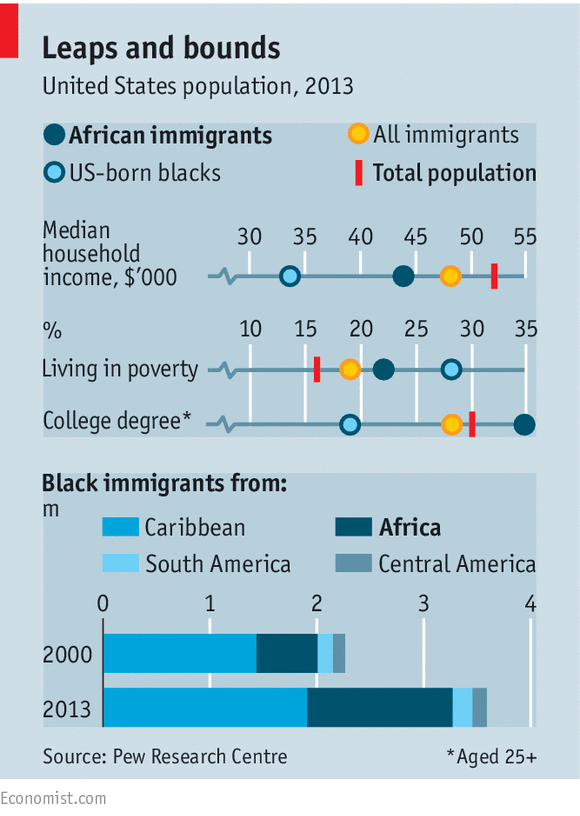
They also tend to be well educated, according to Pew’s data. In 2013 35% had a bachelor’s degree or better, against a figure of 30% for all Americans and just 19% of American-born blacks (see chart).
But despite these qualifications, they earn slightly less than most Americans. In 2013 the average household income for black Africans was $43,000. That is sharply higher than the $33,500 American-born blacks earn, but lower than the amounts earned by other immigrants and by white Americans. In Washington, Ethiopian and Eritrean men disproportionately work as taxi drivers, or in the city’s many East African restaurants.

20150711_usc001.png

Still, over time, they find their way. Research by Randy Capps of the Migration Policy Institute, a think-tank, found that in 2009 more-established African immigrants were far less likely to be working in unskilled jobs than new arrivals. This suggests that well-qualified migrants are getting on in the world, says Mr Capps. He thinks that those Africans who have settled in relatively affluent suburbs may face some discrimination, but they will succeed nonetheless, because their education and motivation will allow them to climb into the middle class.

What does this mean for America as a whole? Africans are just one group of black immigrants in America—Caribbeans and people from Latin America bring the total of people who identify as black and were born overseas to around 3.8m. One possibility is that their growth in numbers may help soften the historical racialised division of America’s population between those whose descendants moved willingly and those whose descendants were enslaved. In the meantime, the definition of the term African-American may already be changing. In a few weeks, Barack Obama will pay his first visit as president to Kenya, the homeland of his father. However Americans see him, there he will be both African and American.

From the print edition: United States
 

theworldismine13

God Emperor of SOHH
Joined
May 4, 2012
Messages
22,799
Reputation
570
Daps
22,758
Reppin
Arrakis


Building Afromerica

America’s fastest-growing migrant group may challenge the country’s fraught race relations
From the print edition
20150711_usp008.jpg
Blacks who came freely

THE Eritrean Cultural & Civic Centre in Washington, DC is housed in a modest building near the city’s convention centre. Despite its name, it is less of a centre and more of a bar and restaurant where Eritrean cab-drivers, students and pensioners chat politics and chow down on lamb stews served on spongy “injera” bread. On its notice board are adverts from a shipping company, an immigration lawyer and a taxi firm seeking drivers. Eritrean flags hang from the ceiling and the walls are lined with trinkets from the country.

With roughly 170,000 African residents, Washington and its surrounding suburbs have, proportionately, the largest African-born population of any large city in America. Their numbers are still small: even in Washington, Africans make up just 14% of all immigrants, and 3% of the total population. But they are among the fastest growing. Between 2000 and 2013—the latest available figures—the number of people from sub-Saharan Africa in the United States more than doubled, from 690,000 to 1.5m. Since 1980 it has increased more than tenfold. Their experience reveals the successes of America’s unusual legal-immigration policies. Over time, their growing numbers may help to change what it means to be “African-American”.

Reinvention in the rust belt
  • Building Afromerica
Reprints
Related topics
The free migration of Africans (as opposed to the slave trade) has existed since the 19th century, when New England whaling ships picked up crew members from the Cape Verde islands. Even today, Cape Verdeans are among the most common African migrants in Boston and Providence. Since the 1980s, however, plenty more have joined. In Washington, DC, Ethiopians and Eritreans are the most numerous. In New York, Egyptians and Ghanaians are. Around Houston there are plenty of Nigerians. In Minneapolis there is a substantial Somali community.

Relatively few Africans are illegal immigrants (those who are have almost all overstayed their visas). Instead, they have particularly benefited from the Refugee Act of 1980, which brought more refugees to America, and the Immigration Act of 1990, which created special diversity visas, issued by lottery, for people from under-represented countries. According to analysis by the Pew Research Centre, 28% of legal African immigrants who arrived between 2000 and 2013 came as refugees; 19% of them arrived on diversity visas. For all legal immigrants, the equivalent figures were 13% and 4%.


As the migrants have put down roots, they have inspired others. Bahda Gide, an Eritrean-born retired social worker, arrived in America in the 1970s. Now Eritrean migrants go home for visits, he says, and impress their friends and relatives with their smart clothes and plump wallets. An established community helps penniless people find their way in an expensive foreign land: “Traditionally, you cannot ignore any countryman in a foreign country,” says Mr Gide. America’s relatively generous system of family reunion, which allows citizens and migrants with legal residency to apply to bring siblings and parents to America, helps to keep up the flow.

African migrants stand out from American-born blacks. Indeed, on most measures, they have little in common but their colour. With the exception of some refugees, who are often resettled in areas with cheap housing, they live mostly in the suburbs, rather than in inner cities. In Washington Ethiopians and Eritreans cluster in Silver Spring, a part of Maryland at the edge of the District of Columbia. They are older—the average African-born black in America is 37, against 29 for American-born blacks. And they are far more likely to be married: 52% are, against a figure of just 28% for American-born blacks.

They also tend to be well educated, according to Pew’s data. In 2013 35% had a bachelor’s degree or better, against a figure of 30% for all Americans and just 19% of American-born blacks (see chart).
But despite these qualifications, they earn slightly less than most Americans. In 2013 the average household income for black Africans was $43,000. That is sharply higher than the $33,500 American-born blacks earn, but lower than the amounts earned by other immigrants and by white Americans. In Washington, Ethiopian and Eritrean men disproportionately work as taxi drivers, or in the city’s many East African restaurants.

20150711_usc001.png

Still, over time, they find their way. Research by Randy Capps of the Migration Policy Institute, a think-tank, found that in 2009 more-established African immigrants were far less likely to be working in unskilled jobs than new arrivals. This suggests that well-qualified migrants are getting on in the world, says Mr Capps. He thinks that those Africans who have settled in relatively affluent suburbs may face some discrimination, but they will succeed nonetheless, because their education and motivation will allow them to climb into the middle class.

What does this mean for America as a whole? Africans are just one group of black immigrants in America—Caribbeans and people from Latin America bring the total of people who identify as black and were born overseas to around 3.8m. One possibility is that their growth in numbers may help soften the historical racialised division of America’s population between those whose descendants moved willingly and those whose descendants were enslaved. In the meantime, the definition of the term African-American may already be changing. In a few weeks, Barack Obama will pay his first visit as president to Kenya, the homeland of his father. However Americans see him, there he will be both African and American.

From the print edition: United States


This is legal immigration, this is a seperate issue from illegal immigration
 

88m3

Fast Money & Foreign Objects
Joined
May 21, 2012
Messages
93,441
Reputation
3,905
Daps
166,713
Reppin
Brooklyn
this is my point...illegal immigration hurts the black community and no one wants to even lend even an iota of legitimacy to the idea.

this is my point...legal immigration hurts the black community and no one wants to even lend even an iota of legitimacy to the idea.
 
  • Dap
Reactions: IVS

88m3

Fast Money & Foreign Objects
Joined
May 21, 2012
Messages
93,441
Reputation
3,905
Daps
166,713
Reppin
Brooklyn
My stances show who I am and what I defend...do you.

Illegal immigration is a serious problem.

Its way harder when you have to take a plane or boat to get to this country i.e. legally ...not take a hiking trip.


Was this supposed to pass as an argument?

Seriously?
 

Jello Biafra

A true friend stabs you in the front
Supporter
Joined
May 16, 2012
Messages
46,184
Reputation
4,958
Daps
120,924
Reppin
Behind You
The problem for Republicans is that they are incapable of taking any type of advantage of this immigration issue to make inroads with black voters because they have spent too long being entrenched in using "blacks are lazy/scary/welfare abusers" to gin up their angry white voter base.
 
Top