According to a 2017 analysis of government figures by the Center for Economic and Political Reforms, a Moscow think tank, the number of hospitals in Russia halved between 2000, Putin’s first year as president, and 2015.
Features and analysis, videos, and infographics explore how the COVID-19 pandemic is affecting the countries in our broadcast area.
The official justification for many of the closures is a so-called “optimization” of health care into a smaller network of high-tech institutions -- but for Russia’s provinces, where many live in poverty, the disappearance of clinics can spell the end to affordable, accessible care, and a serious liability when epidemics like this one hit.
At one hospital in Ufa, in the Bashkortostan region, doctors faced with a sudden influx of patients with severe pneumonia have complained of inadequate PPE supplies and indifference from hospital management.
“We’ve been reporting to our management at every stage, but it took no measures,” Rimma Kamalova, a rheumatologist at the Kuvatov Clinical Hospital, told RFE/RL’s Tatar-Bashkir Service. “They told us we’re working badly.”
But it is Moscow that has so far been hit hardest by the coronavirus, and where the attention of the medical community is focused.
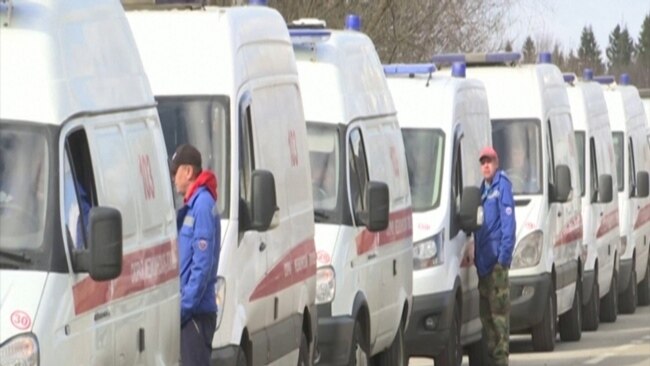
Over the past week, as COVID-19 cases spiked in the city, social-media users have been fed jarring images showing a concerning pattern: rows of ambulances standing in long lines outside hospitals full with patients.
1.00
In one widely shared video, an ambulance driver leaves a hospital outside Moscow after a nine-hour wait to deliver a patient, and the camera pans round to show a huge line of other ambulances waiting to enter.
Belyakov said the lines were a temporary bottleneck resulting from the opening of two hospitals north of Moscow that are dedicated to treating COVID-19.
“All the drivers from Moscow and the region flocked there,” he said, adding that the situation has since improved.
He has now been assigned to a special ambulance brigade handling patients with suspected COVID-19. But he’s still faced with the same problems, he says: “All the hospitals are full.”
Plans are in place to turn a maternity clinic in Zheleznodorozhny into a COVID-19 hospital, which Belyakov says is his “only hope.”
Until that happens, he’s been taking to the road in hopes that the hospital he’s directed to will still have a free bed when he, and his patient, arrive.





 and the end of the 15 days is next monday