
You are using an out of date browser. It may not display this or other websites correctly.
You should upgrade or use an alternative browser.
You should upgrade or use an alternative browser.
Mayor Eric Adams: King of NY Official Thread (2022-2026)
- Thread starter HoldThisL
- Start date
More options
Who Replied?
88m3
Fast Money & Foreign Objects

Secret Recordings Indicate Adams Aides Tried to Get Alleged Mob Tow Trucks Back on the Road
Frank Carone and Ingrid Lewis-Martin were allegedly involved in efforts to restore an indicted firm’s ability to do business on city highways, according to transcripts in a bribery case against a former Adams official.
 www.thecity.nyc
jfc


The New York Times (@nytimes.com)
In New York City, flash floods inundated the subway and sent cars floating down city streets. nyti.ms/3Li90ko
 bsky.app
1/13
 nytimes.com
In New York City, flash floods inundated the subway and sent cars floating down city streets. nyti.ms/3Li90ko
https://video.bsky.app/watch/did:pl...yj2a6pn3wswkezxts7762bfwptetque/playlist.m3u8
The New York Times - Breaking News, US News, World News and Videos
2/13
antifatemptress.bsky.social
3/13
edhirsch.bsky.social
bsky.app/profile/dana...


https://www.nytimes.com/2025/10/29/nyregion/bloomberg-cuomo-super-pac.html
[QUOTED POST]
@danarubinsteinbsky.bsky.social
NEWS: Mike Bloomberg is back off the sidelines, suggesting he may see some movement in the NYC mayor's race. He just gave $1.5 million to Fix the City, the pro-Cuomo, anti-Mamdani super PAC. W/ Nick Fandos www.nytimes.com/2025/10/29/n...
4/13
edhirsch.bsky.social

5/13
jswca.bsky.social
Yikes!
6/13
arbecca.bsky.social
Dear Lord. That's it.
7/13
alexahawaii.bsky.social

8/13
paul-0-o-baker.bsky.social
bsky.app/profile/paul...

[QUOTED POST]
@paul-0-o-baker.bsky.social
www.youtube.com/shorts/Uo5ly...
9/13
nzheretic.bsky.social


Devastating floods highlight need and challenges for warnings
[QUOTED POST]
@nzheretic.bsky.social
About that ...
10/13
la-denizen.bsky.social
Happening more and more often
11/13
explainhimjim.bsky.social

12/13
middlerage.bsky.social
Where’s Trump????
13/13
sue19721954.bsky.social


To post tweets in this format, more info here: https://www.thecoli.com/threads/tips-and-tricks-for-posting-the-coli-megathread.984734/post-52211196
nytimes.comIn New York City, flash floods inundated the subway and sent cars floating down city streets. nyti.ms/3Li90ko
https://video.bsky.app/watch/did:pl...yj2a6pn3wswkezxts7762bfwptetque/playlist.m3u8
The New York Times - Breaking News, US News, World News and Videos
2/13
antifatemptress.bsky.social3/13
edhirsch.bsky.socialbsky.app/profile/dana...
https://www.nytimes.com/2025/10/29/nyregion/bloomberg-cuomo-super-pac.html
[QUOTED POST]
@danarubinsteinbsky.bsky.socialNEWS: Mike Bloomberg is back off the sidelines, suggesting he may see some movement in the NYC mayor's race. He just gave $1.5 million to Fix the City, the pro-Cuomo, anti-Mamdani super PAC. W/ Nick Fandos www.nytimes.com/2025/10/29/n...
4/13
edhirsch.bsky.social
5/13
jswca.bsky.socialYikes!
6/13
arbecca.bsky.socialDear Lord. That's it.
7/13
alexahawaii.bsky.social8/13
paul-0-o-baker.bsky.socialbsky.app/profile/paul...
[QUOTED POST]
@paul-0-o-baker.bsky.socialwww.youtube.com/shorts/Uo5ly...
9/13
nzheretic.bsky.social
Devastating floods highlight need and challenges for warnings
[QUOTED POST]
@nzheretic.bsky.socialAbout that ...
10/13
la-denizen.bsky.socialHappening more and more often
11/13
explainhimjim.bsky.social
12/13
middlerage.bsky.socialWhere’s Trump????
13/13
sue19721954.bsky.socialTo post tweets in this format, more info here: https://www.thecoli.com/threads/tips-and-tricks-for-posting-the-coli-megathread.984734/post-52211196

Chris Sommerfeldt (@c-sommerfeldt.bsky.social)
Mayor Adams is delivering a streamed speech at City Hall condemning an art exhibit that happened on Governor's Island last weekend that included pieces saying "fukk Israel" & "Hamas lover." "This right here is beyond the pale," he says, calling it "a vile, antisemtic exhibit."
bsky.app
1/3
c-sommerfeldt.bsky.social
Mayor Adams is delivering a streamed speech at City Hall condemning an art exhibit that happened on Governor's Island last weekend that included pieces saying "fukk Israel" & "Hamas lover."
"This right here is beyond the pale," he says, calling it "a vile, antisemtic exhibit."
2/3
c-sommerfeldt.bsky.social
Adams says the exhibit was "thankfully" removed within hours.
The mayor is displaying basically all the art as part of this video (the New York Post wrote about the exhibit a few days ago).
3/3
c-sommerfeldt.bsky.social
Adams, for instance, displayed & condemned a painting featuring Israeli and American flags on a Klansman hood.
A new lawsuit accusing Adams of discriminating against Muslim employees says he in late 2023 compared pro-Palestine protests to KKK rallies:
www.nydailynews.com/2025/10/28/l...

To post tweets in this format, more info here: https://www.thecoli.com/threads/tips-and-tricks-for-posting-the-coli-megathread.984734/post-52211196
c-sommerfeldt.bsky.socialMayor Adams is delivering a streamed speech at City Hall condemning an art exhibit that happened on Governor's Island last weekend that included pieces saying "fukk Israel" & "Hamas lover."
"This right here is beyond the pale," he says, calling it "a vile, antisemtic exhibit."
2/3
c-sommerfeldt.bsky.socialAdams says the exhibit was "thankfully" removed within hours.
The mayor is displaying basically all the art as part of this video (the New York Post wrote about the exhibit a few days ago).
3/3
c-sommerfeldt.bsky.socialAdams, for instance, displayed & condemned a painting featuring Israeli and American flags on a Klansman hood.
A new lawsuit accusing Adams of discriminating against Muslim employees says he in late 2023 compared pro-Palestine protests to KKK rallies:
www.nydailynews.com/2025/10/28/l...
To post tweets in this format, more info here: https://www.thecoli.com/threads/tips-and-tricks-for-posting-the-coli-megathread.984734/post-52211196

Mayor Adams’ legacy? Look to the future of affordable housing in NYC.
Adams achieved zoning and housing reforms that could help future mayors address New York City’s affordable housing shortage.
 gothamist.com
Mayor Adams’ legacy? Look to the future of affordable housing in NYC.
https://gothamist.com/staff/david-brand
By
David Brand
Published Nov 5, 2025 at 6:30 a.m. ET

SAUL LOEB/AFP via Getty Images
Gothamist is funded by sponsors and member donations
Mayor Eric Adams took office nearly four years ago with seemingly inexhaustible energy, a mission to drive down crime and a vow to breathe life back into a city still recovering from the COVID-19 pandemic.
What he lacked, however, was a sweeping policy goal that could reshape the city long after he left Gracie Mansion.
The swagger he brought to local politics was soon overshadowed by criminal investigations and convictions of top City Hall officials, including Adams' own indictment on federal corruption charges. Collaboration with President Donald Trump in exchange for dismissal of those charges sealed Adams' fate as a one-term mayor.
And yet, Adams will leave office having achieved a lasting legacy despite the dysfunction and scandal that swirled around him for the better part of four years. On Tuesday, voters approved a set of far-reaching changes to land use rules that, combined with new zoning regulations passed late last year, could make it much easier to build housing across the city.
The outcome now depends on whether the reforms lead to the construction of even more homes out of reach of most renters, or if they can be harnessed to alleviate a deep shortage of affordable apartments.
“When future generations look back at this time, the last four years of the work on housing, they might say this was the moment New York stopped managing a housing crisis and really started solving it,” said Maria Torres-Springer, who served as first deputy mayor before resigning when Adams sidled up to Trump. “We didn't just do the same things over and over again.”
In true Adams fashion, his record on housing is filled with contradictions.
While voters’ approval of the housing questions represents the latest achievement when it comes to easing development, the city’s long-lasting housing crisis has only worsened during the mayor's time in office.
Rents and home prices have continued surging to record highs across the five boroughs. So has the number of people entering homeless shelters, an increase explained in part by the spike in newly arrived migrants that dissipated later in his term.
Unaffordability became the issue that animated the race to replace Adams and pointed to the “parallel stories” of his administration, said Samuel Stein, policy analyst at the Community Service Society.
On the one hand, Stein said, apartments in the city became more and more unaffordable and Adams opposed strategies to aid tenants, like expanding housing vouchers, capping rents in stabilized apartments and improving emergency assistance programs. But on the other, he paved the way for future housing construction, at least some of it for low- and middle-income tenants.
“Government has to do things for 10 years down the road, but you also need to be able to address people’s immediate needs even as you do stuff for the long-term,” Stein said.
City Hall spokespeople did not make Adams available for an interview for this story.
'Most pro-housing' mayor?
Adams has touted his tenure as the “most pro-housing administration in city history,” but it's those long-term efforts that came to define his housing policy. In a break from past practice, he even included nearly 200,000 “planned” or potential units in this year’s annual production figures — a tally usually reserved for housing that has actually been approved or built.
Last year, Adams administration officials negotiated with the City Council to approve his “City of Yes” plan, which changed zoning rules, like lifting off-street parking requirements to make room for more housing and allowing some property owners to add an extra unit on their lots as a way to squeeze more housing into every section of the city. The changes could lead to the creation of more than 80,000 new homes, according to Department of City Planning estimates.
Less than a week after the Council approved the package, Adams empowered a charter revision commission to propose additional rule changes meant to make it easier to build new housing. The changes would speed up the approval process for projects where all apartments are reserved for low- and middle-income renters and any new housing in neighborhoods producing little new housing compared to the rest of the city. They will also allow developers or city officials to appeal rejections by the City Council. Voters approved those by a wide margin in a referendum on Tuesday.
New Yorkers will benefit from the groundwork the Adams administration has laid
James Whelan, president of the Real Estate Board of New York
Over the past two years, Adams and city planners pursued multiple neighborhood rezonings, like blueprints for turning the Garment District into a new residential neighborhood, adding more housing along the Bronx Metro-North corridor and building more in Jamaica andLong Island City, Queens.
At least early on in his administration, Adams used his political capital to support specific housing proposals deeply unpopular among residents, like a plan to allow new apartment buildings in a suburban section of the Bronx along Bruckner Boulevard. Over the past few months, however, he reversed himself on two contentious housing plans in Lower Manhattan and the Northeast Bronx.
He advocated for major changes to the funding stream for thousands of New York City Housing Authority apartments and a controversial plan to rebuild and demolish two adjacent public housing complexes in Chelsea.
He and his deputies worked with state leaders to change rules and create tax incentives for building owners who turned offices into condos and apartments, fueling a conversion boom in Manhattan.
And he pushed the legalization of other types of housing, like basement apartments and other “accessory dwelling units.” More recently, the city’s housing agency began pursuing legislation to allow new single-room occupancy units — tiny dorm rooms with shared bathrooms and kitchens that once served as vital housing for low-income New Yorkers.
“Future elected officials and all New Yorkers will benefit from the groundwork the Adams administration has laid on housing policy issues,” said Real Estate Board of New York President James Whelan in an email to Gothamist.
Paul Williams, executive director of the economic development group Center for Public Enterprise, credited Adams for installing deputies, commissioners and creative policy experts focused on housing.
“It’s up to the future administrations to make the fullest and best use of their reforms,” Williams said.
Those reforms could come in handy. Mayor-elect Zohran Mamdani has vowed to oversee the construction of 200,000 new homes for low- and middle-income tenants, all financed and funded by the city. He has also worked behind the scenes to quell private developers’ suspicions that his democratic socialist views would spoil their luxury construction plans.
But none of the zoning changes initiated under Adams will guarantee new housing gets built, especially for the lowest-income New Yorkers most in need.
In 10 years, New York will be more expensive.
Darius Gordon, director of the Met Council on Housing Executive Director
Citizens Housing and Planning Council Executive Director Howard Slatkin said it will all depend on Mamdani and his successors’ approaches to investment and development, along with many factors outside their direct control. Those include whether the state offers policy and tax incentives to build more affordable housing, what happens in Washington under the Trump administration, and unpredictable market forces that can make development cheaper or much more expensive.
“Great ambitious accomplishments have been achieved by this administration on housing,” Slatkin said. “But there’s no endzone dances at this stage of the game.”
Slatkin pointed to the ongoing examination of Mayor Michael Bloomberg’s zoning and housing policies, which he helped craft. The changes drove production, especially market-rate apartments in sections of the city near Manhattan, while sharply curtailing construction in many more neighborhoods. Under Adams, city planners attempted to reverse some of those limits.
Only more gentrification?
Many organizers and tenant leaders have already made up their mind on Adams’ impact on housing. They find him guilty of fueling gentrification through future luxury housing construction.
Met Council on Housing Executive Director Darius Gordon, whose nonprofit organizes tenants citywide, said the zoning changes under Adams will reshape neighborhoods and drive up home prices without protecting longtime residents, especially people of color who rent.
“In 10 years, New York will be more expensive,” Gordon said. “That’s the only thing I can promise you.”
Gordon’s organization and a range of other groups, from tenant advocates to conservative civic associations, found common cause with the City Council in opposing the ballot measures Adams initiated. They warn that the measures will limit community input and take leverage away from individual councilmembers to secure deeper affordability or local investments in new developments.
Supporters say the changes are essential for getting more housing, including income-restricted apartments, approved and built much faster.
It will take years to determine the effect Adams’ policies and reforms will have on the city, and whether they were enough to put a dent in the housing shortage.
Jessica Katz, who served as Adams’ first chief housing officer and drafted his 2022 housing plan, said the administration is allowing future leaders to address the affordability crisis. But she said the mayor leaves office with a mixed record.
“The current administration is handing the next mayor tools that will really lay the groundwork of success,” Katz said. “I want to make sure the next mayor is focused on the real dangers at NYCHA and the day-to-day experience of being homeless and low-income in New York City.”

DeuceZ
Li pitit gason
Dump should make him ambassador to Turkey 



Striving For Greatness
Get Certs or Die Tryin

Mayor Eric Adams vetoes four City Council bills
The legislation under the axe includes bills that would require pay equity reporting for large private companies and limit rent contributions for certain voucher recipients.
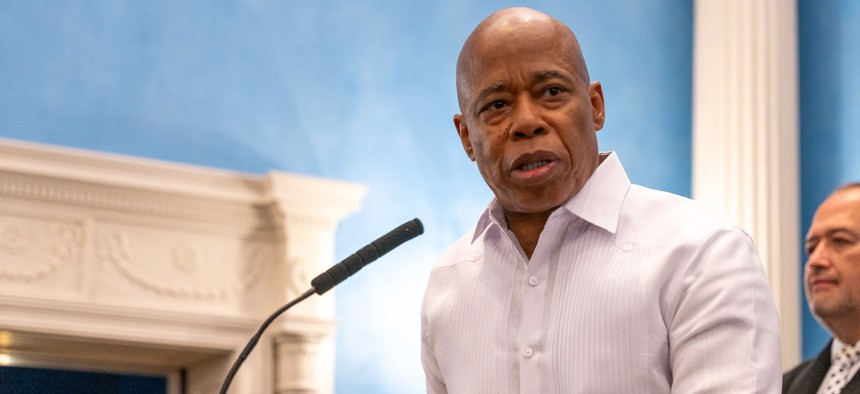
New York City Mayor Eric Adams vetoed four bills passed by the City Council. Benny Polatseck/Mayoral Photography Office
By Sahalie Donaldson and Annie McDonough
November 7, 2025 06:31 PM ET
With roughly 50 days left in office, New York City Mayor Eric Adams isn’t ready to put down his veto pen. On Friday, Adams vetoed four City Council bills.
The vetoed legislation includes two bills that would expand pay equity reporting requirements to large private companies, a bill limiting how much certain housing voucher recipients have to contribute toward rent and a bill codifying the Mayor’s Office of Contract Services and giving it new authorities in a bid to get nonprofits paid on time.
A spokesperson for the Adams administration confirmed that the vetoes have been sent. A spokesperson for the City Council said that the council is expected to override all four of them. The four bills all originally passed with veto-proof majorities on Oct. 9.
“These vetoes are just the latest display of governing incompetence and a profoundly ignorant rejection of policies that would directly benefit working-class New Yorkers,” City Council spokesperson Julia Agos said in a statement. “By blocking these bills that strengthen pay equity, protect tenants from being rent burdened, and bring long-overdue accountability to the City’s contracting system, the mayor is once again abandoning the people he claims to represent.”
The pay equity bills are sponsored by Council Members Amanda Farías and Tiffany Cabán, the bill addressing housing voucher contribution limits is sponsored by Diana Ayala, and the Office of Contract Services bill is sponsored by Julie Won.
The Adams administration suggested the Office of Contract Services bill would interfere with existing work being done to speed contract payments. “Unfortunately, Intro. 1248-B would stall this critical progress by creating a new office with an overly-rigid structure and without real power over city procurement, thus potentially splitting various contracting functions, sowing confusion over roles, and wasting valuable government resources,” a City Hall spokesperson said in a statement.
As for Ayala’s housing voucher legislation, the Adams administration pointed to a need to be fiscally responsible to ensure the CityFHEPS voucher program’s longevity. “The Adams administration has operated CityFHEPS in the best interests of the most vulnerable New Yorkers, and we have consistently maintained that the state and (Department of Social Services) – not the City Council – has the authority to regulate this program,” a City Hall spokesperson said in a statement.
The Adams administration called the pair of pay equity bills burdensome and argued they wouldn’t achieve their intended results because there isn’t a mechanism to force private employers to institute equitable pay. “While we support the intent of these two bills, this legislation imposes a burdensome and unnecessary data collection effort on New York City’s employers and businesses without meaningful results, which is why the mayor has vetoed these bills,” a City Hall spokesperson said in a statement.
There are just four stated meetings to go this year until Mayor-elect Zohran Mamdani takes office and a new City Council speaker is appointed. Council members only have a limited time to pass legislation – and Mayor Adams only has limited time to veto anything he doesn’t want in play when the Mamdani administration sweeps into City Hall. Come January, any bills still in the legislative pipeline will have to be re-introduced.
The mayor and City Council have been locked in multiple fights over vetoed legislation – including over eight vetoes that members went on to override. Tensions have steadily intensified between the two wings of City Hall over the past four years. Just two months ago, the City Council overrode three of Adams’ vetoes pertaining to decriminalizing street vending and raising wages for grocery delivery workers.
If the vetoes proceed, the City Council will officially receive them during their next stated meeting, which is scheduled for Wednesday. At that point, members would have 30 days to override them.

