

Memes and Misogynoir
by Laur M. Jackson August 28, 2014
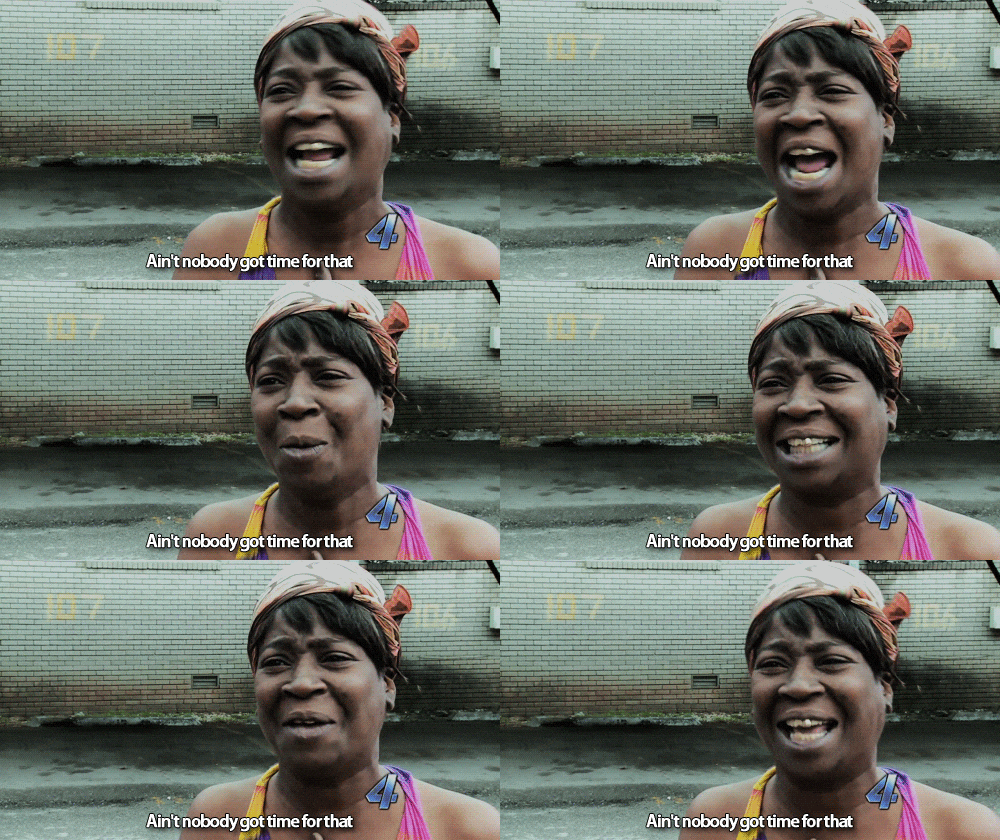
On April 7, 2012, a fire broke out at the Chateau Deville Apartments, a complex located in Oklahoma City, Oklahoma. Though no serious injuries were reported, one woman—in whose home the fire started—was treated for smoke inhalation and five units were damaged, displacing several families and depriving many more of electricity.
The story reported by NBC-affiliate KFOR-TV included a brief interview with resident Kimberly Wilkins, who ran for her life as the building as the building burned:
You probably know her better as Sweet Brown. Her closing line, “ain’t nobody got time for that,” is sure to ring a bell.
How is it that a witness to an alarming event—a fire or sexual assault—becomes one of America’s favorite punchlines, a catchphrase, that proliferates everyday vernacular so thoroughly as to make her testimony unrecognizable?

Many have used the phrase “digital blackface” to describe the odd and all-too-prevalent practice of white and non-Black people making anonymous claims to a Black identity through contemporary technological mediums such as social media. It often involves masquerading behind the Black face of a fictional profile picture. These attempts, while hilariously transparent, take advantage of the relative anonymity of the internet to perpetuate decontextualized stereotypes and project an image of Black people that fits the desire of anti-Black individuals.

It goes undocumented and unaddressed in most cases, though occasionally the people behind the blackface are unmasked. When musician, alleged feminist, and keen event planner Ani Defranco came under censure after revealing a former slave plantation as the locale for her Righteous Retreat, a workshop for creatives, fans flocked to the event’s Facebook page in support of the gathering (and to attack its detractors), including “LaQueeta Jones.”
LaQueeta Jones’ comments include gratuitous usage of grammatically incorrect African American Vernacular English (AAVE), an evocation of MLK, and the bulletproof phrase of authenticity, “as a black woman.” An altogether weak attempt at internet minstrelsy, it prompted a skeptical Facebook user, MF Addaway, to track the IP address of “LaQueeta Jones,” and bust the actual account holder, Mandi Harrington—a white woman who had posted earlier in support of Defranco.
But most similar ventriloquism goes unchecked. On Twitter lie countless handles featuring a Black person’s image, run by users who are most assuredly not Black. These accounts, which often include a “ghetto” name—the formula prefix “La+” is a favored trope—are riddled with poor attempts at Black vernacular, and feature stereotypes from the minstrel stage. Unlike Harrington, whose contained, time-sensitive purpose was only to legitimate her own stance by replicating it with a Black voice, these users perform recyclable—retweetable—acts of humor on a worldwide stage.
After Cleveland hero Charles Ramsey became the latest in Black-people-relating-serious-events-set-to-autotune last year, Slate’s Aisha Harris scrutinized the ease with which Black interviewees—such as Ramsey, such as Brown, such as Dodson—are subject to processes of memeification. Harris’ sense, as is mine, is that the phenomenon “has something to do with a persistent, if unconscious, desire to see black people perform,” and in so doing, reaffirm a simplistic idea of what Black people are. In their memeification, Dodson and Brown were stripped of context or any possibility that these individuals could be seen as human, and reconstructed as a caricature, as farce.
In the final evolution of the meme, the soundbite falls away and ventriloquism robs these individuals of the ownership of their own words. For a good while, I don’t think a week went by without the echo of “ain’t nobody got time for that” departing from the throat of some white suburbanite in my presence. So entrenched are Sweet Brown’s words in common vernacular—much like the many, many, many appropriated hallmarks of AAVE—this particular iteration of the meme appears to have a long shelf life ahead of it. (Fortunately, “Hide your kids / Hide your wife,” seems to have truly died.)

In Righteous Discontent, Evelyn Brooks Higginbotham coined the phrase “politics of respectability” to describe the an inventive method used by women of the Black Baptist Church during the Progressive Era to gain foothold in ongoing struggles for civil rights during the Progressive Era. Thereafter abridged to “respectability politics,” Higginbotham’s concept identifies racial progressive efforts whereby the “reform of individual behavior” is in fact the “a goal in itself” as well “as a strategy for reform.” The logic of respectability politics has since morphed into thus: If we look like master and talk like master, master will stop killing us and give us the rights we deserve. If we prove ourselves worthy of a humanity, they will see us as human. Chris Rock’s “nikkas vs. Black People” bit, which appeared his 1996 HBO special Bring the Pain still remains the often-cited proverbial example of respectability political rhetoric in action—though writers often fail to include Rock’s decision to retire the bit and his later acknowledgement of its dangerous implications amongst a mixed audience. (I prefer Don Lemon as the truly insidious modern example of this logic at work.) Unlike regular, old-fashioned anti-Black racism, respectability politics operates under the guise of progress and racial uplift. Those who find faith in its dogma love to bemoan the fate of a community who considers Beyoncé a role model, chastising us all with quotes and images of MLK and Maya Angelou, conveniently forgetting that they still shot King, and Maya Angelou had moves in her day that would give Queen B a run for her money.
Respectability politics are toxic and inherently anti-Black because they blame Black people for the racism they encounter. (For those who need a primer, Loryn C. Wilson at hoodfeminism sums up the major trademarks of respectability politics and why they suck.). Respectability politics place responsibility on already extra-vulnerable segments of the Black community and claim that the very existence of these people robs the entire community of deserved human rights. And while there are no shortage of lectures railing against sagging pants and expensive sneakers, and we’re still circulating the myth that more black men occupy prisons than university classrooms, a disproportionate portion of this responsibility falls on Black women; thus, respectability politics are not only anti-Black, they are also anti-Black women.
Scholar Moya Bailey of Crunk Feminist Collective invented the term “misogynoir” to succinctly describe the anti-Black misogynist intersection of racism and misogyny that uniquely impacts the lived experiences of Black women. More than just a combination of those two oppressive regimes, misogynoir lives in a realm apart from general-use sexism—which often acts as a placeholder for strictly white women’s experiences with misogyny—and anti-Black racism that targets Black men. Misogynoir acknowledges that while white women have been fighting for the chance to prove themselves in the workplace, Black women are considered the workhorse of both white and Black America. Misogynoir explains why an eight-year-old Academy Award nominee can be called a “c*nt” with nary a peep from white feminists, while Lil Wayne’s reference to Emmett Till is considered out of line, and “Rich as fukk” makes the mainstream airwaves.

cont.
by Laur M. Jackson August 28, 2014
On April 7, 2012, a fire broke out at the Chateau Deville Apartments, a complex located in Oklahoma City, Oklahoma. Though no serious injuries were reported, one woman—in whose home the fire started—was treated for smoke inhalation and five units were damaged, displacing several families and depriving many more of electricity.
The story reported by NBC-affiliate KFOR-TV included a brief interview with resident Kimberly Wilkins, who ran for her life as the building as the building burned:
You probably know her better as Sweet Brown. Her closing line, “ain’t nobody got time for that,” is sure to ring a bell.
How is it that a witness to an alarming event—a fire or sexual assault—becomes one of America’s favorite punchlines, a catchphrase, that proliferates everyday vernacular so thoroughly as to make her testimony unrecognizable?
Many have used the phrase “digital blackface” to describe the odd and all-too-prevalent practice of white and non-Black people making anonymous claims to a Black identity through contemporary technological mediums such as social media. It often involves masquerading behind the Black face of a fictional profile picture. These attempts, while hilariously transparent, take advantage of the relative anonymity of the internet to perpetuate decontextualized stereotypes and project an image of Black people that fits the desire of anti-Black individuals.
It goes undocumented and unaddressed in most cases, though occasionally the people behind the blackface are unmasked. When musician, alleged feminist, and keen event planner Ani Defranco came under censure after revealing a former slave plantation as the locale for her Righteous Retreat, a workshop for creatives, fans flocked to the event’s Facebook page in support of the gathering (and to attack its detractors), including “LaQueeta Jones.”
LaQueeta Jones’ comments include gratuitous usage of grammatically incorrect African American Vernacular English (AAVE), an evocation of MLK, and the bulletproof phrase of authenticity, “as a black woman.” An altogether weak attempt at internet minstrelsy, it prompted a skeptical Facebook user, MF Addaway, to track the IP address of “LaQueeta Jones,” and bust the actual account holder, Mandi Harrington—a white woman who had posted earlier in support of Defranco.
But most similar ventriloquism goes unchecked. On Twitter lie countless handles featuring a Black person’s image, run by users who are most assuredly not Black. These accounts, which often include a “ghetto” name—the formula prefix “La+” is a favored trope—are riddled with poor attempts at Black vernacular, and feature stereotypes from the minstrel stage. Unlike Harrington, whose contained, time-sensitive purpose was only to legitimate her own stance by replicating it with a Black voice, these users perform recyclable—retweetable—acts of humor on a worldwide stage.
After Cleveland hero Charles Ramsey became the latest in Black-people-relating-serious-events-set-to-autotune last year, Slate’s Aisha Harris scrutinized the ease with which Black interviewees—such as Ramsey, such as Brown, such as Dodson—are subject to processes of memeification. Harris’ sense, as is mine, is that the phenomenon “has something to do with a persistent, if unconscious, desire to see black people perform,” and in so doing, reaffirm a simplistic idea of what Black people are. In their memeification, Dodson and Brown were stripped of context or any possibility that these individuals could be seen as human, and reconstructed as a caricature, as farce.
In the final evolution of the meme, the soundbite falls away and ventriloquism robs these individuals of the ownership of their own words. For a good while, I don’t think a week went by without the echo of “ain’t nobody got time for that” departing from the throat of some white suburbanite in my presence. So entrenched are Sweet Brown’s words in common vernacular—much like the many, many, many appropriated hallmarks of AAVE—this particular iteration of the meme appears to have a long shelf life ahead of it. (Fortunately, “Hide your kids / Hide your wife,” seems to have truly died.)
In Righteous Discontent, Evelyn Brooks Higginbotham coined the phrase “politics of respectability” to describe the an inventive method used by women of the Black Baptist Church during the Progressive Era to gain foothold in ongoing struggles for civil rights during the Progressive Era. Thereafter abridged to “respectability politics,” Higginbotham’s concept identifies racial progressive efforts whereby the “reform of individual behavior” is in fact the “a goal in itself” as well “as a strategy for reform.” The logic of respectability politics has since morphed into thus: If we look like master and talk like master, master will stop killing us and give us the rights we deserve. If we prove ourselves worthy of a humanity, they will see us as human. Chris Rock’s “nikkas vs. Black People” bit, which appeared his 1996 HBO special Bring the Pain still remains the often-cited proverbial example of respectability political rhetoric in action—though writers often fail to include Rock’s decision to retire the bit and his later acknowledgement of its dangerous implications amongst a mixed audience. (I prefer Don Lemon as the truly insidious modern example of this logic at work.) Unlike regular, old-fashioned anti-Black racism, respectability politics operates under the guise of progress and racial uplift. Those who find faith in its dogma love to bemoan the fate of a community who considers Beyoncé a role model, chastising us all with quotes and images of MLK and Maya Angelou, conveniently forgetting that they still shot King, and Maya Angelou had moves in her day that would give Queen B a run for her money.
Respectability politics are toxic and inherently anti-Black because they blame Black people for the racism they encounter. (For those who need a primer, Loryn C. Wilson at hoodfeminism sums up the major trademarks of respectability politics and why they suck.). Respectability politics place responsibility on already extra-vulnerable segments of the Black community and claim that the very existence of these people robs the entire community of deserved human rights. And while there are no shortage of lectures railing against sagging pants and expensive sneakers, and we’re still circulating the myth that more black men occupy prisons than university classrooms, a disproportionate portion of this responsibility falls on Black women; thus, respectability politics are not only anti-Black, they are also anti-Black women.
Scholar Moya Bailey of Crunk Feminist Collective invented the term “misogynoir” to succinctly describe the anti-Black misogynist intersection of racism and misogyny that uniquely impacts the lived experiences of Black women. More than just a combination of those two oppressive regimes, misogynoir lives in a realm apart from general-use sexism—which often acts as a placeholder for strictly white women’s experiences with misogyny—and anti-Black racism that targets Black men. Misogynoir acknowledges that while white women have been fighting for the chance to prove themselves in the workplace, Black women are considered the workhorse of both white and Black America. Misogynoir explains why an eight-year-old Academy Award nominee can be called a “c*nt” with nary a peep from white feminists, while Lil Wayne’s reference to Emmett Till is considered out of line, and “Rich as fukk” makes the mainstream airwaves.
cont.


