

You are using an out of date browser. It may not display this or other websites correctly.
You should upgrade or use an alternative browser.
You should upgrade or use an alternative browser.
Minneapolis police kill black man #RIPGeorgeFloyd
- Thread starter newarkhiphop
- Start date
More options
Who Replied?

no, people are talking about the dozens of whites we see ON video across the US inciting riots
shyt gonna go down in Ohio, tonight.. already seeing these white folks dressed in antifa costumes and the tension is building, tear gas, etc
the crowd is huge
live stream of it
Watch @fox8news's broadcast: Cleveland protest
Fox8News @fox8news
the crowd is huge
live stream of it
Watch @fox8news's broadcast: Cleveland protest
Fox8News @fox8news
voltronblack
Superstar
As protests over the police killing of George Floyd engulfed Minneapolis for a third night on Thursday, and solidarity protests broke out in cities across the country, there was both a sense that the country had been through this before — too many times — and that the stakes had begun to shift.
In the Twin Cities, where Floyd’s killing at the hands of officer Derek Chauvin was just the latest in a series of high-profile police killings in the last five years, those who took to the streets in the middle of a coronavirus pandemic were tired and exasperated. Years of misconduct and brutality by local police had brought many protests and much talk of reform. But Floyd’s death was an urgent reminder that here, as across the country, police reform had failed, and that the time had come for something different.
“They call for training, but are they doing the training, and is the training being internalized?” said Moriah Stephens, a special education teacher, as she stood near a highway overpass in St. Louis Park, the suburb where Floyd had lived, waving as passing cars honked in support. “I can tell you 50 times over that my life matters and I would like you to speak out about the fact that my life matters, and you can hear me say that 50 times, but are you going to do it?”
“I’m tired of being angry, and I’m tired of being tired, and I’m tired of seeing new hashtags,” she added, referring to a recent wave of police killings and other racist incidents across the country. “I’m lucky I’m alive. I can stand here. I can shout. There’s part of me that’s like, I need to use what I have — I have my life and I need to use it, but I’m also tired of doing that.”
Stephens, who had joined protests after the police killings of Philando Castile in a Minneapolis suburb in 2016, said her father was currently undergoing chemotherapy treatment. She was reluctant to go out in the middle of a Covid-19 outbreak that had already taken nearly 1,000 lives in Minnesota, and like many protesters was wearing a mask and standing at a distance from others. “I’m not supposed to be around people. But that’s where I’m at.”
In Floyd’s neighborhood, the signs people carried recalled protests following earlier police killings while also raising new demands. They said “I can’t breathe” — George Floyd’s last words as Chauvin kneeled on his neck for more than seven minutes, but also the last words of Eric Garner, who was killed six years ago by a New York police officer, igniting a movement against police violence of which Floyd’s death is just the latest chapter. After Garner’s death, as after the death of Michael Brown the same year in Ferguson, Missouri, and those of scores of other black men and women killed by police since then, protesters called for the officers to be held accountable. But there were new calls at Thursday’s protests — such as “Fund Community Not Police” — that tapped into a more recent and growing movement demanding not so much police reform and accountability as abolition, through the defunding of police departments.
“In the wake of George Floyd’s murder by MPD officer Derek Chauvin, and the Minneapolis Police Department’s escalated violence against the city’s grieving Black community, Minneapolis is in desperate need of visionary leadership,” the Minneapolis group Reclaim the Block wrote in a statement calling on the city council to defund the police department. “Now is the time to invest in a safe, liberated future for our city. We can’t afford to keep funding MPD’s attacks on Black lives.”
There were signs some local leaders were starting to see it the same way. Under pressure from students, the University of Minnesota announced this week that it would scale back its contract with the Minneapolis Police Department. The University of Minnesota was the first public institution to cut ties with MPD after the killing of George Floyd. On Friday afternoon, Minneapolis public schools board members issued a resolution to terminate the school district’s contract with the Minneapolis Police Department. And protesters called for more action to curtail the role of police altogether.
“The system is not broken. It’s doing exactly what it was designed to do; that’s what people need to wrap their heads around,” said Imani Jackson, who grew up in St. Louis Park. “We need to create an entire new one.”
Reform Is Not the Answer
“People weren’t having it no more,” said Sam Martinez, an organizer with the Twin Cities Coalition for Justice 4 Jamar. “The system knew that.”
A number of law enforcement and elected officials across the country also quickly denounced the Minneapolis officers’ actions — public criticism that would have been unthinkable just a few years ago.
In New York City, where Floyd’s death carried echoes of Eric Garner’s and where at least 72 protesters were arrested last night in a solidarity demonstration, Police Commissioner Dermot Shea and Mayor Bill de Blasio took to Twitter to condemn Floyd’s killing. “What we saw in Minnesota was deeply disturbing. It was wrong,” tweeted Shea. “This is not acceptable ANYWHERE.” “I am horrified,” tweeted de Blasio. “George Floyd was murdered in broad daylight and the man who killed him was a police officer.”
De Blasio’s and Shea’s comments stood in stark contrast with their defense of Daniel Pantaleo, the officer who killed Garner. Pantaleo was fired last summer, five years after Garner’s death.
“It took him five years to take any action in the Eric Garner case, and now he wants immediate action in Minneapolis,” said Alex Vitale, who runs the Policing and Social Justice Project at Brooklyn College, echoing widespread criticism of de Blasio’s statement.
Even the National Fraternal Order of Police, the largest police union in the country and a staunch defender of officers involved in killings of unarmed people in the past, released a statement criticizing the Minneapolis officers’ actions. “Based on the by-stander’s video from this incident, we witnessed a man in distress pleading for help,” the group wrote in a statement that was soon echoed by many local chapters of the union. “There is no doubt that this incident has diminished the trust and respect our communities have for the men and women of law enforcement.”
But critics warned that the public condemnations, including by law enforcement, were more a matter of political expediency than anything else. “I think that is politically convenient for all of them,” said Kandace Montgomery, director of Black Visions Collective, a Minnesota-based racial justice group, which is affiliated with Reclaim the Block and the Movement for Black Lives. “Until they actually offer real solutions and offer real policies that address the inherent violence of police departments, it’s all talk.”
“That’s all well and good, but it means nothing to me until they actually start making concrete changes in how they do business in their police department,” echoed Neill Franklin, a retired police major and the executive director of the Law Enforcement Action Partnership. Franklin pointed to the long history of complaints of abuse and excessive force filed against the officers responsible for Floyd’s death — and to the fact that reports of police misconduct, nationwide, are kept from public view largely because of union contracts that protect officers no matter their conduct.
“There are police chiefs who are now voicing their disgust about what happened in Minneapolis. Well, how about you now move to make these personnel records public?” said Franklin. “If you really are concerned as a police leader in what’s happening, not just with Mr. Floyd, but case after case, rework the union contracts. … We need to change these laws so that we have the ability to take swift action.”
But while calling for greater transparency — including a national database tracking officers terminated for misconduct so they wouldn’t just move from department to department — Franklin acknowledged efforts to reform police had largely fallen short.
“Reform is not the answer, we’ve been trying it for decades, and as you can see, we’re just not getting anywhere,” he said. “We need a new paradigm of policing in the United States. It needs to be completely dismantled and reconstructed, not changing a policy here or there.”
“We are still working with a model of policing in this country that was born out of slavery in this country, that was born out of a white supremacy in this country,” he added. “That’s why reform won’t work and that’s why we haven’t made any traction whatsoever on this issue of race, as we’ve seen with the death of Mr. Floyd.”
In fact, the swift condemnation of the Minneapolis officers was largely a testament to the deep crisis policing has been facing for years. That crisis was only exacerbated by the current health and economic emergency, which has left communities reeling and feeling that their government, across institutions, has failed them in unprecedented ways.
“Police have realized that their basic legitimacy is being challenged here, and they had better figure out some way to get out from under this,” said Vitale, who wrote a book that has both anticipated and informed the growing national movement to defund police. “So if that means throwing a few individual officers under the bus, they are happy to do that.”
The reluctance of prosecutors to charge the officers responsible for Floyd’s killing was yet another sign of how little has changed. “There is other evidence that doesn’t support a criminal charge,” said County Attorney Mike Freeman, who compared Floyd’s death to that of Freddie Gray, who died in the custody of Baltimore police in 2015 — a rare case in which the officers involved were charged with murder 12 days after the incident. That prosecution was ultimately unsuccessful. “It was a rush to charge, it was a rush to justice,” Freeman said of Gray’s case, despite the fact that Floyd’s death, unlike Gray’s, was clearly caught on camera.
“When it’s the average citizen who gets arrested and charged for something, the arrest is made immediately as soon as you have probable cause for an arrest,” noted Franklin, the retired cop.
In Ferguson, the top prosecutor’s refusal to charge officer Darren Wilson in 2014 led to weeks of protests as a grand jury sifted through evidence in the case before declining to bring charges. In Minneapolis, it took three days of protests for Chauvin to be arrested and charged. Some protesters set several buildings on fire, including the Third Precinct headquarters, where Chauvin worked. And as they did after protests erupted in Ferguson, Missouri, police responded to protests of Floyd’s death with tear gas and rubber bullets, at one point spraying tear gas out of a moving vehicle onto an apparently peaceful crowd. Several protesters, as well as some journalists, were arrested. Minnesota Gov. Tim Walz mobilized the National Guard, and after Chauvin was arrested, Frey set an 8 p.m. curfew for the weekend. President Donald Trump, as Barack Obama did after Freddie Gray’s killing in Baltimore, called protesters who looted stores “thugs” — though unlike Obama, Trump also called for them to be shot.
In fact, Michael Brown’s death in Ferguson ushered in an era of police reform that saw federal and local governments invest heavily in police training, including on racial bias, and in technology like body cameras that officials promised would bring about accountability. Floyd’s death was yet another reminder that those reforms have failed.
“This is happening after five years of being told, ‘Don’t worry, we’re getting the training,’” said Vitale. “The de-escalation training, the anti-bias training, the mindfulness training … why aren’t things getting any better?”
As evidence mounts of the failures of police reform, some departments and unions are beginning to embrace calls for individual accountability for “bad cops” who they continue to insist are not representatives of their institutions as a whole. But while protesters continue to call for individual officers to be arrested and prosecuted, there is a growing recognition that police misconduct will continue, no matter how many reforms politicians enact, as long as policing exists at the present scale.
“They are desperate. They see that they’ve got a major credibility problem and that there are active campaigns to take their money away,” said Vitale. “This whole idea of jailing killer cops as a way to fix policing is completely naive and misguided. Even when they are convicted, as rare as that is, there’s really no evidence that this feeds back into changes in how policing is done.”
Reducing the size of police departments by curbing their resources, he and others argue, will be far more effective at reducing police violence than any costly effort to improve the police. “These ‘defund and fund alternatives’ kinds of movement are much more threatening to police chiefs, which is why I think they are bending over backwards to try to get out ahead of this thing,” said Vitale. “People in the movement are shifting: They are not calling for body cameras and more training. More and more people are like, ‘fukk that, take their money away.’”

ALonelyDad
Veteran

Insensitive
Superstar
This whole situation is really in need of nuance.
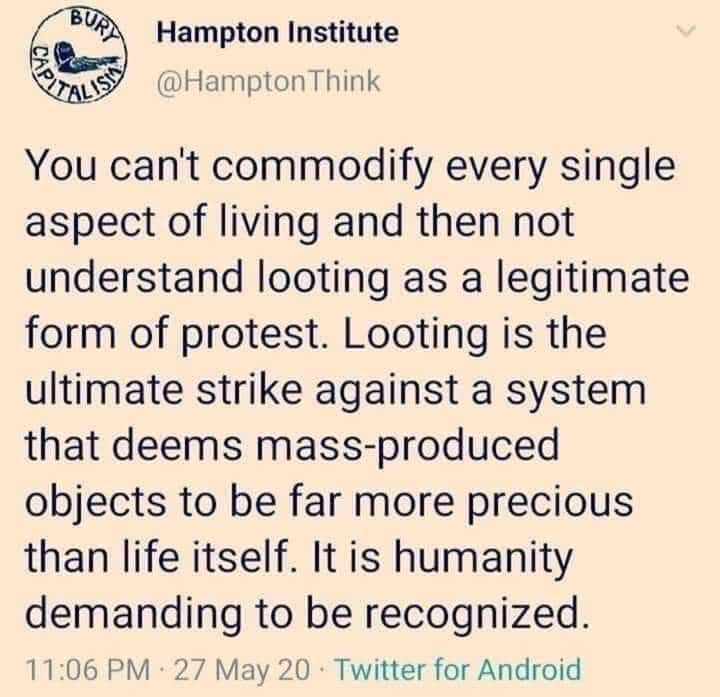
It's not as simple as people are looting to loot or people looting in protest.
Some people are there with a clear political agenda and a goal to get their point across.
Others are simply pissed off and fukking shyt up without fear of repercussion.
Others are stealing without impunity.
That's what I saw last night, there are some there with a specific point while others are just disorganized
and only there for the chaos or potential chaos.
And not everyone showing up is about "Black People" per say.
I do feel there are individuals who have their own political beliefs that are simply using the
justified outrage of Black Americans to act out their anarchist fantasies.

God Almighty
Your Lord
High quality poster
Veteran
Listen man. It’s either people are peacefully protesting or we causing mayhem.
 I think the consensus is that we on demon time.
Once you cross that threshold then it ain’t no turning back, can’t apply rules to this shyt.
I think the consensus is that we on demon time. Once you cross that threshold then it ain’t no turning back, can’t apply rules to this shyt.


I'm sure this has been posted already but it's worth sharing again:
She was spitting the truth and CNN cut her off :Camby:

So they closed Arden Fair Mall here in Sacramento for the weekend after hearing about a meetup to loot the mall today 


This country is so goofy in this day and age.
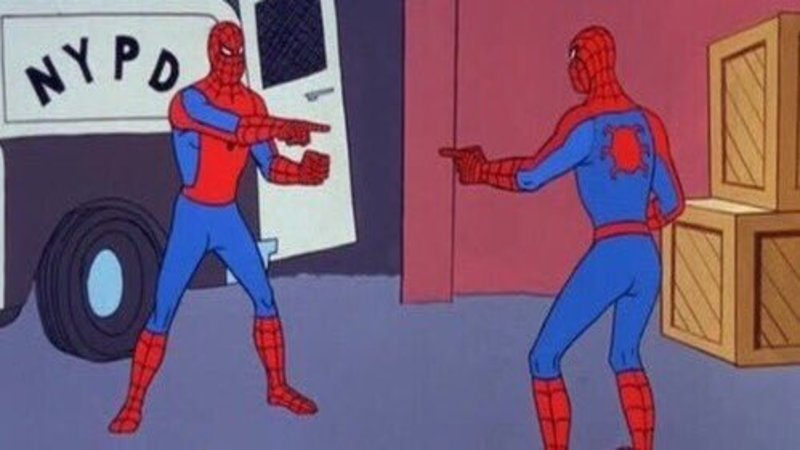
liberals saying it’s white supremacist, cartels and out of state instigators looking to destabilise the city
conservatives saying it’s the Radical left, Antifa, and out of state instigators looking to destabilise the city..
it’s like they’re saying the same but the opposite all while pointing fingers at each other
Lupe Fiasco streets on fire not only was eerily accurate when applied to the Covid-19 outbreak but to this current moment as well if taken out of the context of a virus and put back to the original concept of misinformation, hysteria and use of pyops when he wrote it in 07
The poor say the rich have the cure
The rich say the poor are the source
Revolutionaries say it's psychological war
Invented by the press, just to have something to report
Some say the first case came from a maternity ward
Some say a morgue, some say the skies, some say the floors
Whores say the nuns, nuns say the whores
And everybody is sure
God Almighty
Your Lord
And here comes the proof the government is lying about "outside agitators"

