Lives shattered by concussions: former NHL players share their stories
Rick Westhead, TSN Senior Correspondent
Published Friday, February 12, 2016 4:00PM EST
Mike Peluso says he is damaged goods. The 50-year-old former NHL enforcer, who played in the league from 1990 until 1998 with five NHL teams including the Chicago Blackhawks, Ottawa Senators and New Jersey Devils, says he has suffered eight grand mal seizures and has brain damage after playing in the NHL.
He holds the NHL responsible. He believes team doctors and trainers rushed him back onto the ice far too soon.
It was Mike’s job to protect the skilled players by being physical and put on a show for the fans.
RELATED STORIES
PHOTOS

A special W5-TSN investigation into brain injuries suffered by NHL players features emotional interviews with two of the more than 100 former players who are suing the National Hockey League, claiming it put profits ahead of their health.

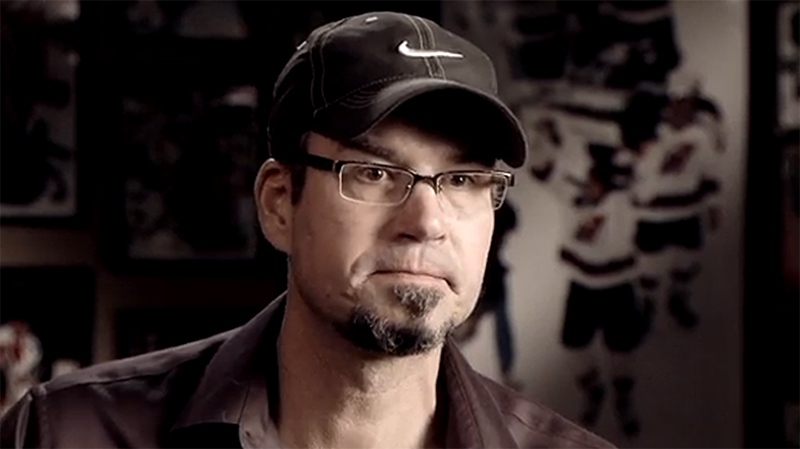
Former NHL enforcer Mike Peluso (left) speaks with TSN's Rick Westhead (W5)

"I'm 50 years old, I will die young," Peluso tells Westhead in an interview (W5).

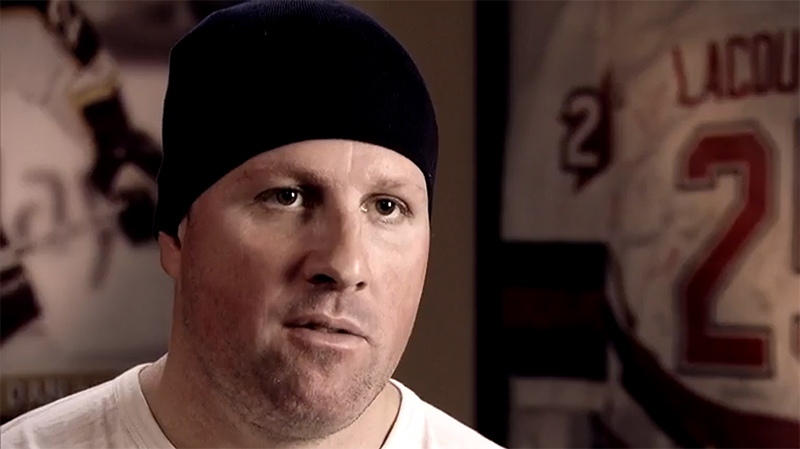
Former hockey player Dan LaCouture on the set of W5, talking to Rick Westhead about his days in the NHL (W5)

"It seems like every year, somebody ends up dying because of what they've gone through playing hockey," Dan LaCouture tells Rick Westhead (W5).
He never hesitated to drop his gloves, take a punch and get smashed into the boards to keep the stars of the game safe.
Mike says he is now tired of feeling broken, and tired of being told by the NHL that the brain problems he battles -- he is so quick to anger, suffers from repeated grand mal seizures and constantly forgets people’s names and his appointments -- had nothing to do with more than 175 fights and countless on-ice collisions in the NHL.
Mike hit rock bottom when his symptoms grew so bad, that one day, he says he sat in the basement of his home on the outskirts of Minneapolis, upended bottles of prescription drugs into a popcorn bowl, and planned to end his life.
Just then, his dog Coors came down the stairs and walked past him.
If Peluso died, who would look after Coors?
“God works in really good ways and he actually did save my life, there’s no question about it,” Peluso says. “That dog came down and I looked at him and I said, ‘I’m sorry, man. And I took out the pills and I put them back in the bottle. And I said I’d never do that to that dog again."
Peluso is among more than 100 former NHL players who are suing the NHL, arguing that the league for decades has put profits ahead of player safety.
On one side, lawyers for the former NHL players, who also include Bernie Nichols, Joe Murphy, Gary Leeman and Craig Muni, allege the league has not taken seriously the health problems of its former players. They charge that the league’s high-profile working concussion group, headed by Dr. Ruben Echemendia of Penn State University, has been a whitewash. Even though this working group began its concussion study in 1997, it wasn’t until 2011 that the group published its findings.
Moreover, the former players allege, it wasn’t until 2013 that the NHL changed concussion protocols to require a concussed player not to return to the same game in which the concussion occurred.
A number of emails exchanged by NHL executivesincluding Commissioner Gary Bettman, deputy commissioner Bill Daly and NHL lawyer Julie Grand have already been released by the court and paint a picture of league officials seemingly as concerned about public relations benefits as they have been about player health and safety.
If the lawsuit ever makes it to trial, a jury will surely be asked to consider the following questions: What did NHL neurologists, doctors and medical trainers know about the dangers of repeated severe head injuries, and when did they know it?
Did team doctors put the financial interests of their employers ahead of the health concerns of players? And did NHL executives put their collective heads in the sand when it came to learning more about the dangers of repeated head trauma, and about possible rule changes that might have better protected players, even if it meant popular tough guys were sidelined longer between fights.
The NHL has said that players, Peluso included, who wanted to learn about the long-term dangers of repeated head trauma, could have done their own homework, researching medical journals and put “two and two together."
Public opinion seems to support the league, at this point, with some fans remarking that no one forced NHL players to play the game, and that they could have walked away from the game at any moment.
In the NHL concussion case, violence in hockey won't be on trial. But the way doctor and trainers who handled injured players will come under scrutiny.
"The NHL team doctors and medical trainers worked for team owners and have been ordered to get players back on the ice," said Allan Walsh, a prominent NHL player agent. "They should have been looking out for the long term health of players."
While NHL executives insist there is no "smoking gun" hidden within the reams of evidence already introduced, some have already made headlines.
In November 2009, an NHL lawyer named Julie Grand wrote an email to league Commissioner Gary Bettman asking for input about what direction the NHL’s concussion working group should take. One of the options Grand mentioned included studying “the long neurocognitive and physiological effects of repeated concussions among retired NHL players”.
But Grand wasn’t that interested in the idea. “I’d rather focus on the here and now and leave the dementia issues up to the NFL!” she wrote in the Nov. 30, 2009, email. “I think it is important that we continue to move in more than one direction … and appear to both the players/Clubs and the public that we are actively engaged in the issue.” Bettman responded to Grand’s email the same day.
“Good job,” he wrote. “Thanks. You should give it to pr — good idea.”
In 2014, a year after the NHL’s introduced a policy calling for concussed players to be removed from games in which they were concussed, a few high profile cases have occurred where teams should have followed the new protocol to protect players.
Case in point, Montreal’s Dale Weise was left visibly disoriented, woozy and unsteady, after a crushing bodycheck during a playoff game against the New York Rangers.
Weise returned to play in the same game, violating the league’s concussion protocol.
In Montreal, the Canadiens tough guy Nathan Beaulieu was left wobbly kneed during a fight. Protocol called for him to be taken to a dark room and examined by a team doctor. But instead, Canadiens coach Michel Therrien left Nathan on the bench.
Finally, in St. Louis, rookie Robbie Fabbri was rocked by a bodycheck during a game against the Minnesota Wild. He kept on playing. The concussion spotters never called for his removal, and after the game his coach said Fabbri should have come out.
This lawsuit between the NHL and over 100 former players is currently before the United States Supreme Court in Minnesota.