

Energy Secretary Jennifer Granholm is expected to announce a major step forward in nuclear fusion energy on Tuesday.
Why it matters: Decades of effort have gone into fusion energy, which promises almost limitless carbon-free power — without the dangerous waste from traditional fission reactors.
Driving the news: The breakthrough came in the past two weeks at the National Ignition Facility of the federal Lawrence Livermore National Laboratory in California, the Financial Times reported in a scoop.
What's next: Granholm's announcement tomorrow is billed as a "major scientific breakthrough."
Go deeper: Axios' Alison Snyder explored fusion energy earlier this year
 www.axios.com
For the first time ever, US scientists at the National Ignition Facility at the Lawrence Livermore National Laboratory in California successfully produced a nuclear fusion reaction resulting in a net energy gain, a source familiar with the project confirmed to CNN.
The US Department of Energy is expected to officially announce the breakthrough Tuesday.
The result of the experiment would be a massive step in a decadeslong quest to unleash an infinite source of clean energy that could help end dependence on fossil fuels. Researchers for decades have attempted to recreate nuclear fusion – replicating the fusion that powers the sun.
ADVERTISING
US Energy Secretary Jennifer Granholm will make an announcement Tuesday on a “major scientific breakthrough,” the department announced Sunday. The breakthrough was first reported by the Financial Times.
Nuclear fusion happens when two or more atoms are fused into one larger one, a process that generates a massive amount of energy as heat. Unlike nuclear fission that powers electricity all over the world, it doesn’t generate long-lived radioactive waste.
Scientists across the globe have been inching toward the breakthrough, using different methods to try to achieve the same goal.
https://www.cnn.com/2022/02/09/uk/nuclear-fusion-climate-energy-scn-intl/index.html
A giant donut-shaped machine just proved a near-limitless clean power source is possible
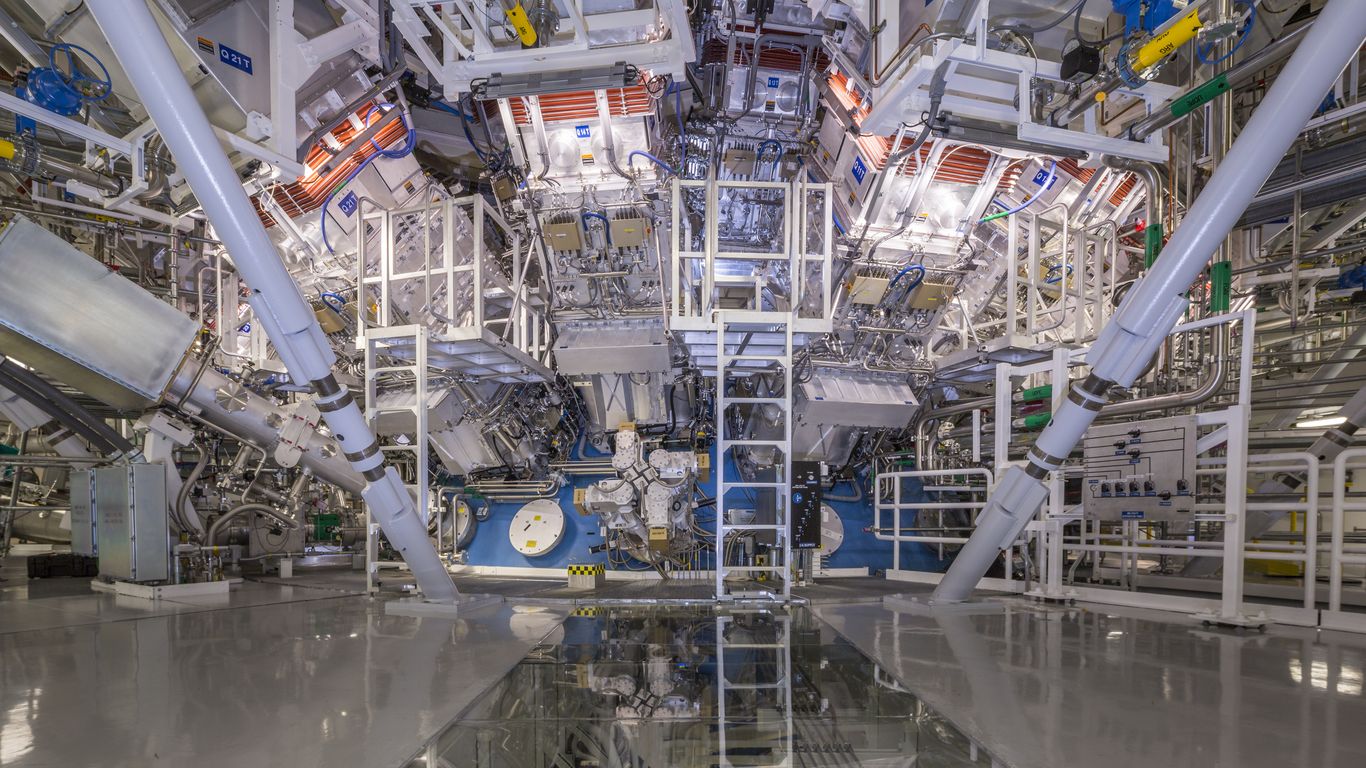
The National Ignition Facility project creates energy from nuclear fusion by what’s known as “thermonuclear inertial fusion.” In practice, US scientists fire pellets that contain a hydrogen fuel into an array of nearly 200 lasers, essentially creating a series of extremely fast, repeated explosions at the rate of 50 times per second.
The energy collected from the neutrons and alpha particles is extracted as heat, and that heat holds the key to producing energy.
“They contain the fusion reaction by bombarding the outside with lasers,” Tony Roulstone, a fusion expert from the University of Cambridge’s Department of Engineering, told CNN. “They heat up the outside; that creates a shockwave.”
Even though getting a net energy gain from nuclear fusion is a big deal, it’s happening on a much smaller scale than what’s needed to power electric grids and heat buildings.
“It’s about what it takes to boil 10 kettles of water,” said Jeremy Chittenden, co-director of the Centre for Inertial Fusion Studies at Imperial College in London. “In order to turn that into a power station, we need to make a larger gain in energy – we need it to be substantially more.”
Why it matters: Decades of effort have gone into fusion energy, which promises almost limitless carbon-free power — without the dangerous waste from traditional fission reactors.
Driving the news: The breakthrough came in the past two weeks at the National Ignition Facility of the federal Lawrence Livermore National Laboratory in California, the Financial Times reported in a scoop.
- Granholm will announce scientists for the first time have produced "a fusion reaction that creates a net energy gain — a major milestone in the decades-long, multibillion-dollar quest to develop a technology that provides unlimited, cheap, clean power," the Washington Post adds.
What's next: Granholm's announcement tomorrow is billed as a "major scientific breakthrough."
Go deeper: Axios' Alison Snyder explored fusion energy earlier this year
Nuclear fusion "breakthrough" reportedly arrives
Decades of effort have gone into fusion energy, which promises almost limitless carbon-free power.
www.axios.com
For the first time ever, US scientists at the National Ignition Facility at the Lawrence Livermore National Laboratory in California successfully produced a nuclear fusion reaction resulting in a net energy gain, a source familiar with the project confirmed to CNN.
The US Department of Energy is expected to officially announce the breakthrough Tuesday.
The result of the experiment would be a massive step in a decadeslong quest to unleash an infinite source of clean energy that could help end dependence on fossil fuels. Researchers for decades have attempted to recreate nuclear fusion – replicating the fusion that powers the sun.
ADVERTISING
US Energy Secretary Jennifer Granholm will make an announcement Tuesday on a “major scientific breakthrough,” the department announced Sunday. The breakthrough was first reported by the Financial Times.
Nuclear fusion happens when two or more atoms are fused into one larger one, a process that generates a massive amount of energy as heat. Unlike nuclear fission that powers electricity all over the world, it doesn’t generate long-lived radioactive waste.
Scientists across the globe have been inching toward the breakthrough, using different methods to try to achieve the same goal.
https://www.cnn.com/2022/02/09/uk/nuclear-fusion-climate-energy-scn-intl/index.html
A giant donut-shaped machine just proved a near-limitless clean power source is possible
The National Ignition Facility project creates energy from nuclear fusion by what’s known as “thermonuclear inertial fusion.” In practice, US scientists fire pellets that contain a hydrogen fuel into an array of nearly 200 lasers, essentially creating a series of extremely fast, repeated explosions at the rate of 50 times per second.
The energy collected from the neutrons and alpha particles is extracted as heat, and that heat holds the key to producing energy.
“They contain the fusion reaction by bombarding the outside with lasers,” Tony Roulstone, a fusion expert from the University of Cambridge’s Department of Engineering, told CNN. “They heat up the outside; that creates a shockwave.”
Even though getting a net energy gain from nuclear fusion is a big deal, it’s happening on a much smaller scale than what’s needed to power electric grids and heat buildings.
“It’s about what it takes to boil 10 kettles of water,” said Jeremy Chittenden, co-director of the Centre for Inertial Fusion Studies at Imperial College in London. “In order to turn that into a power station, we need to make a larger gain in energy – we need it to be substantially more.”