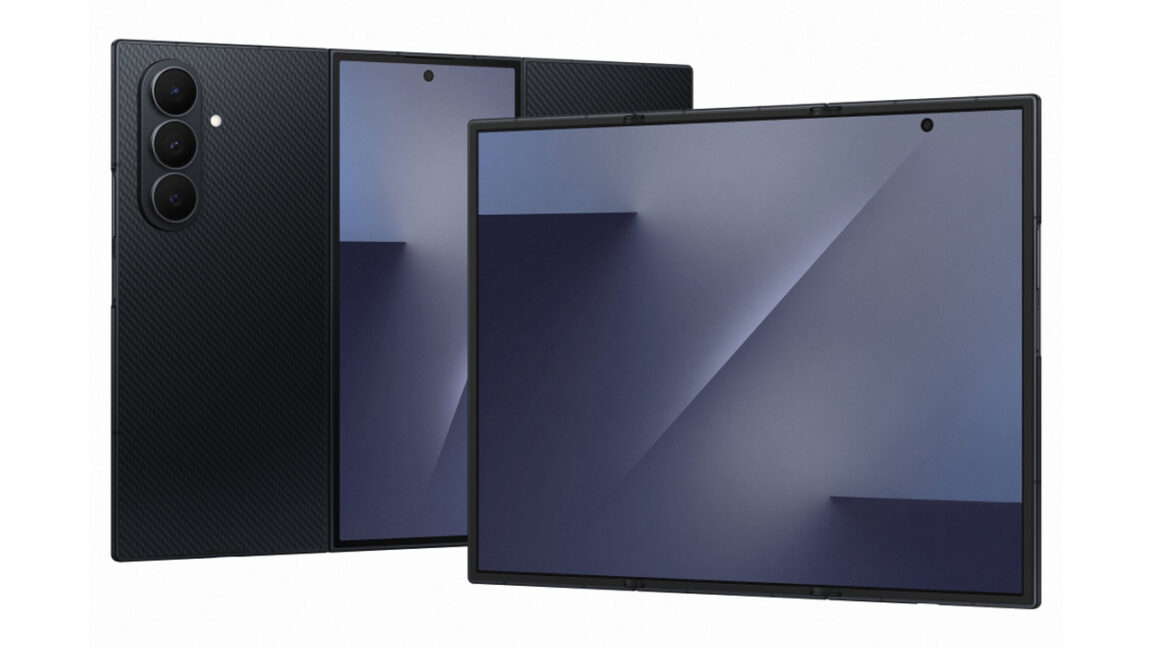
Samsung’s long-awaited tri-fold phone is launching in Korea this month, with a US launch early next year.

arstechnica.com
Samsung has a new foldable smartphone, and it’s not just another Z Flip or Z Fold. The Galaxy Z TriFold has three articulating sections that house a massive 10-inch tablet-style screen, along with a traditional smartphone screen on the outside. The lavish new smartphone is launching this month in South Korea with a hefty price tag, and it will eventually make its way to the US in early 2026.
Samsung says it refined its Armor FlexHinge design for the TriFold. The device’s two hinges are slightly different sizes because the phone’s three panels have distinct shapes. The center panel is the thickest at 4.2 mm, and the other two are fractions of a millimeter thinner. The phone has apparently been designed to account for the varying sizes and weights, allowing the frame to fold up tight in a pocketable form factor.
Huawei’s impressive Mate XT tri-fold phones have been making the rounds online, but they’re not available in Western markets. Samsung’s new foldable looks similar at a glance, but the way the three panels fit together is different. The Mate XT folds in a Z-shaped configuration, using part of the main screen as the cover display. On Samsung’s phone, the left and right segments fold inward behind the separate cover screen. Samsung claims it has tested the design extensively to verify that the hinges will hold up to daily use for years.
While this does push the definition of “pocketable” for some people, the Galaxy Z TriFold is a tablet that technically fits in your pocket. When folded, it measures 12.9 mm thick, which is much more unwieldy than the Galaxy Z Fold 7‘s 8.9 mm profile. However, the TriFold is only a little thicker than Samsung’s older tablet-style foldables like the Galaxy Z Fold 6. The 1080p cover screen measures 6.5 inches, which is also quite similar to the Z Fold 7. It is very, very heavy for a phone, though, tipping the scales at 309 g.
The extra heft and hinge get you a much larger main display, clocking in at 10 inches and 2160 x 1584 pixels. The 120 Hz foldable OLED can run three apps side-by-side in portrait orientation, and it supports the full version of Samsung DeX for a more PC-like interface without the need for an external monitor. However, you may not get much use per charge with the screen unfurled and running multiple apps. The device has a triple-cell battery system that comes out to 5,600 mAh, which is only a bit larger than batteries in smartphones that only have to power one small screen.
On the inside, the Galaxy Z TriFold is essentially identical to Samsung’s Z Fold 7. There’s a Snapdragon 8 Elite chipset, 512GB of storage, and 16GB of RAM. The camera setup looks unchanged from the Z Fold 7, helmed by the 200 MP sensor we see on most Samsung flagships today. It’s backed up by a 12 MP ultrawide and a 10 MP 3x telephoto. Like the smaller foldable, the camera module protrudes quite a lot from the back of the phone.
Samsung plans to launch the Galaxy Z TriFold in South Korea on December 12, with other Asian markets following in the ensuing weeks. A US launch is on the agenda for the first quarter of 2026, but there’s no pricing available yet. The Korean price will be KRW 3,590,400, which works out to a little shy of $2,500, or $500 higher than the Galaxy Z Fold 7. So expect something in that range if you want to get your hands on the Galaxy Z TriFold next year.