

88m3
Fast Money & Foreign Objects
Preparing for the Majority-Minority Economy
Alejandra Castillo, the national director of the Minority Business Development Agency, talks about small-business ownership and the U.S.’s changing demographics.
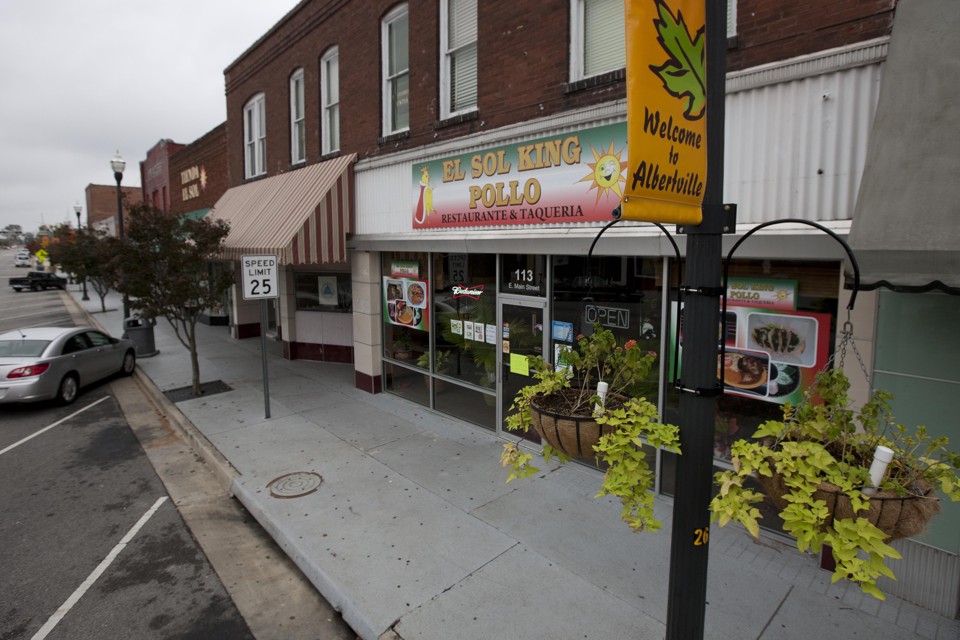
A row of Hispanic-owned businesses in Albertville, AlabamaDave Martin / AP
The American workforce is getting more diverse. By 2024, it’s expected that the share of workers who are women will increase to 47.2 percent, up from 46.7 percent in 2014. The number of minority workers is projected to increase rapidly over the same time period, and Hispanics in particular will go on to make up one fifth of the labor force, according to estimates from the Bureau of Labor Statistics.
Meanwhile, business owners are also getting more diverse. In the aftermath of the financial crisis, business creation was sluggish: Between 2007 and 2012, the number of U.S. businesses grew only 2 percent. But in that same period, the number of minority-owned firms increased by 38 percent—driven largely by businesses owned by Hispanic women. Overall, the number of women-owned firms has grown by 68 percent since 2007, and the number of minority-women-owned firms in particular has seen a 265 percent increase since 1997.
Still, there’s a lot to be done to make sure that minority workers and businesses prosper. Alejandra Castillo was appointed the national director of the Minority Business Development Agency (MBDA) at the U.S. Department of Commerce in 2014, and she is the first Hispanic woman to hold the position. Until her stint as national director ends in January, she’s tasked with helping minority-owned businesses grow in size and scale and advocating for programs that could make them globally competitive. I spoke with Castillo about her job, how her father’s small business in New York inspired her, and some of the distinct challenges minority business owners face. The interview that follows has been lightly edited for length and clarity.
Entrepreneurs, Don’t Call Your Business 'Your Baby'
continued in link worth a read for sure
Alejandra Castillo, the national director of the Minority Business Development Agency, talks about small-business ownership and the U.S.’s changing demographics.
A row of Hispanic-owned businesses in Albertville, AlabamaDave Martin / AP
The American workforce is getting more diverse. By 2024, it’s expected that the share of workers who are women will increase to 47.2 percent, up from 46.7 percent in 2014. The number of minority workers is projected to increase rapidly over the same time period, and Hispanics in particular will go on to make up one fifth of the labor force, according to estimates from the Bureau of Labor Statistics.
Meanwhile, business owners are also getting more diverse. In the aftermath of the financial crisis, business creation was sluggish: Between 2007 and 2012, the number of U.S. businesses grew only 2 percent. But in that same period, the number of minority-owned firms increased by 38 percent—driven largely by businesses owned by Hispanic women. Overall, the number of women-owned firms has grown by 68 percent since 2007, and the number of minority-women-owned firms in particular has seen a 265 percent increase since 1997.
Still, there’s a lot to be done to make sure that minority workers and businesses prosper. Alejandra Castillo was appointed the national director of the Minority Business Development Agency (MBDA) at the U.S. Department of Commerce in 2014, and she is the first Hispanic woman to hold the position. Until her stint as national director ends in January, she’s tasked with helping minority-owned businesses grow in size and scale and advocating for programs that could make them globally competitive. I spoke with Castillo about her job, how her father’s small business in New York inspired her, and some of the distinct challenges minority business owners face. The interview that follows has been lightly edited for length and clarity.
Entrepreneurs, Don’t Call Your Business 'Your Baby'
continued in link worth a read for sure

