
President Maduro of Venezuela urges US diplomats to leave country within next 72hrs

loyola llothta

☭☭☭
Joined
Apr 17, 2014
Messages
35,064
Reputation
7,040
Daps
80,059
Reppin
BaBylon
Russia Establishes Attack Helicopter School in Venezuela


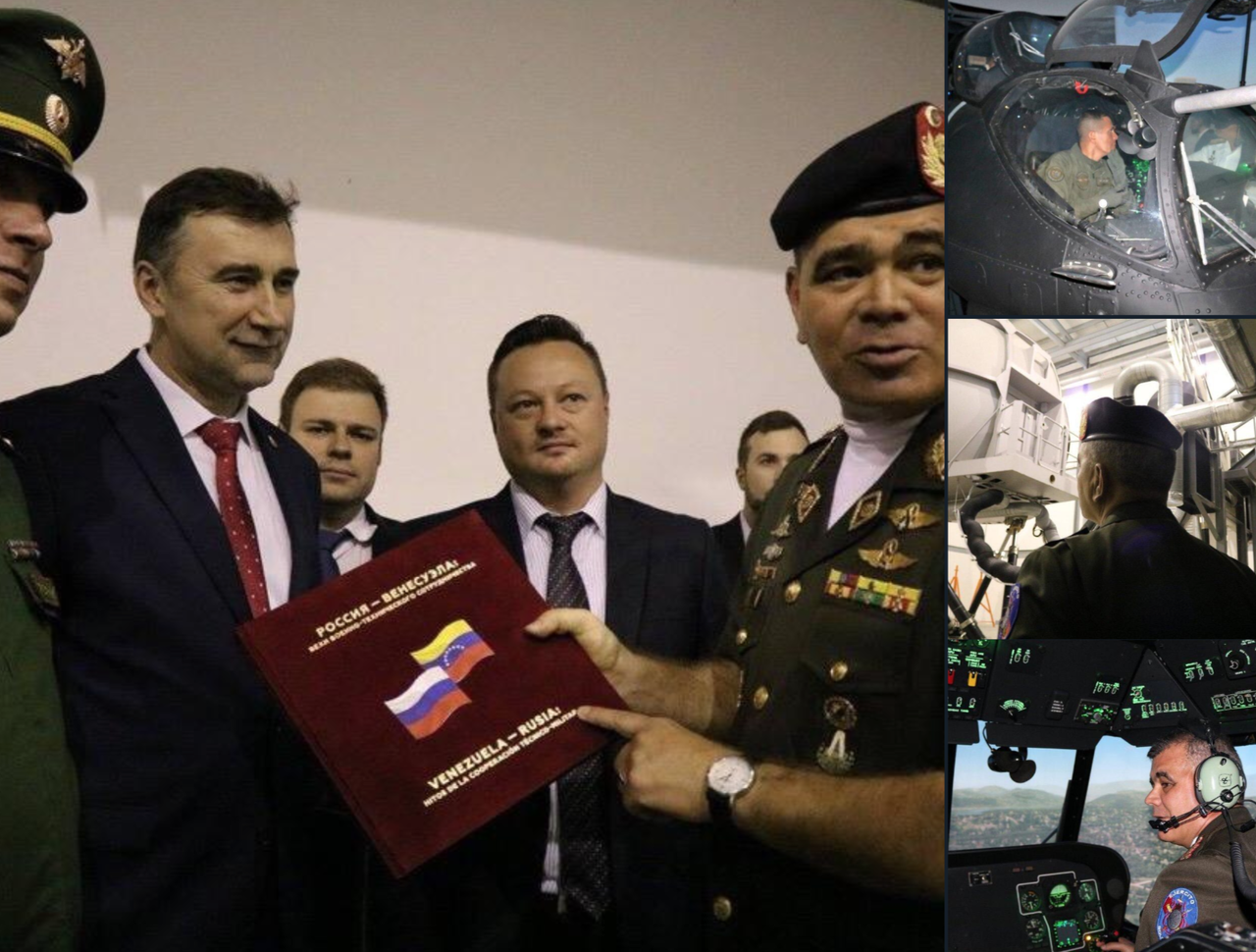
A military helicopter training facility, constructed by Russia’s Rosoboronexport, was revealed in Venezuela Friday, several days after Moscow deployed troops and equipment to the crisis-stricken South American country, reported TASS News.

“A modern helicopter training center was built under Rosoboronexport’s contract with Venezuelan state-owned defense manufacturer (CAVIM). Its opening ceremony took place on March 29,” Rosoboronexport said.
opening%20day.png


The statement added that the training facility had opened earlier in the week “with Russian and Venezuelan specialists participating.”

“At present, Russian helicopters supplied to Venezuela not only take part in operations against smugglers, but also successfully perform aerial survey of wildfires, take part in rescue and evacuation missions in areas hit by natural disasters and deliver humanitarian cargo to remote regions of the country,” Rosoboronexport added.

A source within Venezuela’s Army Aviation told TASS that the facility would make the training process more efficient for future helicopter pilots and crews.
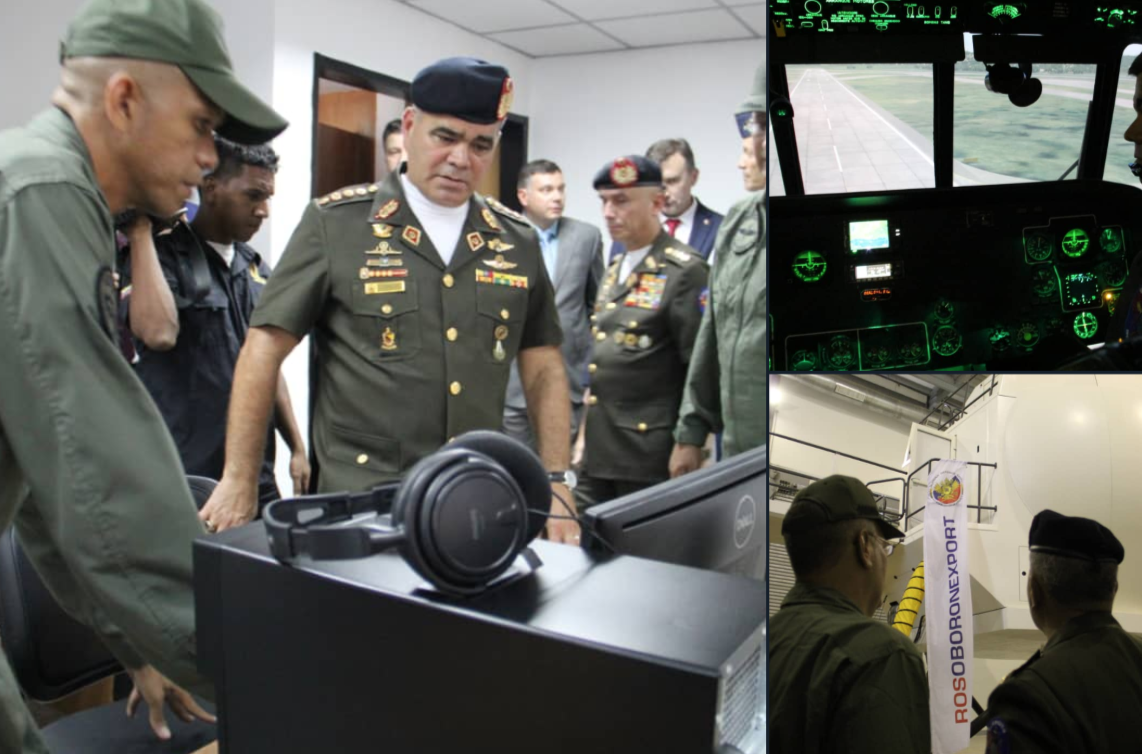
helio%20facility.png


Rosoboronexport will supply Russian-made Mi-35M multi-role combat attack helicopters for missions related to targeting illicit drug production facilities, the source said.

“One Mi-35M2 helicopter is capable of delivering a special group of five or six officers, providing fire support if necessary and evacuating the team after the task is fulfilled,” the source said.

The announcement came several days after Venezuelan President Nicolas Maduro announced the build-up of Russian troops and equipment in the country.

The Trump administration condemned President Maduro on Friday for what it said was his cozy relationship with Moscow.

President Trump’s national security adviser John Bolton and U.S.


special envoy for Venezuela Elliott Abrams said Russia’s presence in the country is extremely destabilizing for the Western Hemisphere.

“We strongly caution actors external to the western hemisphere against deploying military assets to Venezuela, or elsewhere in the hemisphere, with the intent of establishing or expanding military operations,” the national security adviser said in a statement.

Russia responded over the weekend by indicating it had sent military personnel to the Latin American country based on a military-technical cooperation agreement from 2001.

Russian Foreign Ministry spokeswoman Maria Zakharova said approximately 100 troops have been sent to the country “for as long as needed.”

Russia and China both support the Maduro regime. President Maduro has said,” American imperialists want to kill me.”

Moscow has recently accused Washington of engineering a violent coup in Venezuela in violation of the United Nations Charter.


The original source of this article is Zero Hedge
Copyright © Zero Hedge, Zero Hedge, 2019
 

loyola llothta

☭☭☭
Joined
Apr 17, 2014
Messages
35,064
Reputation
7,040
Daps
80,059
Reppin
BaBylon
China’s PLA Troops in Venezuela Is Game Changer
By M. K. Bhadrakumar


The reported arrival of Chinese military personnel in Venezuela last weekend is undoubtedly a major event in world politics.

Unlike Russia, which has a history of force projection abroad, this is an extremely rare Chinese move. Although vital Chinese interests are at stake in the war against terrorist groups in Afghanistan and Syria, China refrained from publicising any such deployment.

The reports mention that the group of Chinese military personnel is 120-strong and arrived on the Margarita Island in the Caribbean Sea off the Venezuelan mainland on March 28 ‘to deliver humanitarian aid and military supplies to the government forces.’ After delivering the humanitarian supplies, the Chinese PLA troops were apparently transferred to a Venezuelan military facility.

While the delivery of aid is one of many expected shipments, according to government officials, the arrival of Chinese military personnel was under-reported in international press.

According to the Stockholm International Peace Research Institute, Venezuela imported $349 million worth of arms from China between 2010 and 2014 alone — initially, with less sophisticated equipment such as radars and aircraft to train pilots, reinforced vehicles and replacement parts, etc. but military goods that arrived in 2017 including armoured tanks, ammunition, uniforms and infantry equipment, as well as replacement and service parts for Russian-made pieces.

A week ago, around 100 Russian military personnel were deployed to Venezuela to instal a military helicopter training facility, but details of the Chinese PLA mission have not been disclosed. There is close coordination between Moscow and Beijing on foreign policy issues and it is entirely conceivable that the two countries’ deployments are synchronised moves.

Both Russia and China have heavily invested in Venezuela, the latter by far outstripping the former. According to a recent report in the LA Times,

“Over the decade ending in 2016, China loaned Venezuela approximately $62 billion, much of which Caracas could repay with oil. Moscow in the last several years gave Venezuela $17 billion in loans and investment, and in December the two governments signed a new deal in which Russia will invest $6 billion in Venezuela’s oil and gold sectors.”

“China and Russia are Venezuela’s two main creditors, and they have been the principal economic force keeping the Maduro government afloat, making the difference between solvency and bankruptcy, financial experts say.”

Image on the right: Chinese PLA Navy’s hospital ship “The Peace Ark” arrives at the port in la Guaira, Venezuela, September 22, 2018.

PLA-3.jpg


Interestingly, the LA Times report, however, made a distinction that China and Russia pursued different attitudes toward their financial commitments in Venezuela, with China being “more pragmatic” and Russia “more ideological”. Whereas for its investment, Beijing sought to receive raw materials, cheap oil and other returns, Moscow was credited with having greater interest in “in extending its military presence and setting up a beachhead in the Americas — and within spitting distance of the United States…”

“For Russia, investments and military saber-rattling about protecting Venezuela has always been about showing strength in America’s neighbourhood… The Kremlin has tried to mimic what it sees as U.S.


and NATO foreign policy of entering and meddling in Moscow’s perceived sphere of influence, such as Eastern Europe and the former Soviet Union, particularly Ukraine.”

Indeed, Moscow’s condemnation of US interference in Venezuela has been conspicuously more forceful than that of China, which actually called for dialogue and a negotiated resolution to the crisis. Many US analysts assumed that China might even be losing faith in President Nicolas Maduro and decided to keep its head beneath the parapet preferring to focus on its lending practices in Venezuela and even scouring for bargain-basement deals.

But such facile hypotheses have been turned on their head with the sudden arrival of the Chinese PLA troops on the languid Margarita Island famous as a popular holiday destination for its sand and mangroves, windsurfing and kiteboarding. One reason could be that in the Chinese assessment, although tensions are rising in Venezuela and uncertainties remain due to the duality of power, and a criticality may well be reached in the nearest future with the refugee problem causing disaffection among neighbouring countries and with no signs of Washington easing the pressure for regime change in Caracas, there is also at the same time an inherent balance or equilibrium that has come to prevail in the situation insofar as neither side in the conflict enjoys a decisive advantage.

A war of attrition is under way which can end only if either side loses patience and forces a showdown, which seems unlikely as things stand.

In the assessment of the Russian experts, while a lot of shadow boxing is going on from the American side with the US’ Latin American allies even expecting swift and tough action by the US, the fact of the matter is that there is no stomach for anyone really for demanding an outright military intervention to change the regime in Venezuela.

Washington seems to fear that any military intervention may prove to be counterproductive and could have chaotic outcome, and, worse still, even unite the Venezuelan people against the US, apart from causing turbulence among Latin American countries.

Nonetheless, the arrival of Russian military personnel in Venezuela “caused a nervous reaction in Washington”, as the foreign ministry in Moscow noted on March 30 in response to a sharply-worded statement by the US National Security Advisor John Bolton the previous day strongly cautioning the Kremlin against “deploying military assets to Venezuela, or elsewhere in the Hemisphere, with the intent of establishing or expanding military operations.” Bolton warned Moscow, “We will consider such provocative actions as a direct threat to international peace and security in the region.”

But the Russian foreign ministry brushed off Bolton’s warning and claimed that although geographically, Russia’s Chukotka Peninsula is located in the Western Hemisphere, Moscow had no intentions to “establish or expand military operations” in Venezuela. Having said that, “any (US) attempts to intimidate Russia with sanctions for its legitimate cooperation with Venezuela look absurd.”

The foreign ministry underscored that the US “plans for a rapid change of regime in Caracas have failed. By its self-assurance, Washington has let down those in Latin America and Western Europe who unwisely hastened to recognise an impostor, whom the people had not elected, as the head of Venezuela. By taking this step, they have deprived themselves of any room for diplomatic manoeuvre.” Furthermore, Moscow asserted that it proposed to do “everything within our power” to promote a national dialogue in Venezuela. However, Moscow has also signalled indirectly that any ideas of establishing a military base in Venezuela so close to the US shores is far from its thoughts.

Clearly, the firm but prudent Russian stance went a long way to encourage China to shift to an overt proactive role. Needless to say, Russia (and Cuba) will welcome this Chinese shift.

PLA-2.jpg


(China’s PLAAF conducted its first airdrop and air delivery training exercise using the Y-20 strategic transport aircraft last year circa May.)

If the Russian and Cuban presence in Venezuela has been bad enough for the Trump administration, the arrival of the PLA troops will be a bitter pill to swallow, given extensive Chinese involvement in Latin America. Indeed, China is joining Russia to assert the intention to safeguard its vital interests in Venezuela.

To be sure, both Moscow and Beijing have taken note of President Trump’s recent remark that he intended to talk things over with his Russian and Chinese counterparts regarding Venezuela, which is as good as saying that he isn’t considering any military intervention, no matter the rhetorical remarks by US officials.

No doubt, the PLA deployment to Venezuela is at once a game changer in the crisis situation surrounding that country. At a substantive level, China has conveyed its readiness and capability to salvage the besieged Maduro government. Beijing has not only underscored that it is a stakeholder but also asserted its expanding global influence. Of course, China firmly repudiates the Monroe Doctrine. Thus, in many ways, this becomes a watershed moment in world politics.


The original source of this article is Indian Punchline
Copyright © M. K. Bhadrakumar, Indian Punchline, 2019
 

Bawon Samedi

Good bye Coli
Supporter
Joined
Mar 28, 2014
Messages
42,473
Reputation
18,715
Daps
166,532
Reppin
Good bye Coli(2014-2020)
China’s PLA Troops in Venezuela Is Game Changer
By M. K. Bhadrakumar


The reported arrival of Chinese military personnel in Venezuela last weekend is undoubtedly a major event in world politics.

Unlike Russia, which has a history of force projection abroad, this is an extremely rare Chinese move. Although vital Chinese interests are at stake in the war against terrorist groups in Afghanistan and Syria, China refrained from publicising any such deployment.


The original source of this article is Indian Punchline
Copyright © M. K. Bhadrakumar, Indian Punchline, 2019
If this is true then this is gonna start something BIG. USA is gonna more than ever start intensifying the Monroe doctrine.
 

loyola llothta

☭☭☭
Joined
Apr 17, 2014
Messages
35,064
Reputation
7,040
Daps
80,059
Reppin
BaBylon
What Monroe Doctrine?
By Philip Giraldi

Because there is a presidential election coming up next year, the Donald Trump Administration appears to be looking for a country that it can attack and destroy in order to prove its toughness and willingness to go all the way in support of alleged American interests. It is a version of the old neocon doctrine attributed to Michael Ledeen, the belief that every once in a while, it is necessary to pick out some crappy little country and throw it against the wall just to demonstrate that the United States means business.

“Meaning business” is a tactic whereby the adversary surrenders immediately in fear of the possible consequences, but there are a couple of problems with that thinking. The first is that an opponent who can resist will sometimes balk and create a continuing problem for the United States, which has a demonstrated inability to start and end wars in any coherent fashion.

This tendency to get caught in a quagmire in a situation that might have been resolved through diplomacy has been exacerbated by the current White House’s negotiating style, which is to both demand and expect submission on all points even before discussions begin. That was clearly the perception with North Korea, where National Security Advisor John Bolton insisted that Pyongyang had agreed to American demands over its nuclear program even though it hadn’t and would have been foolish to do so for fear of being treated down the road like Libya, which denuclearized but then was attacked and destroyed seven years later. The Bolton mis-perception, which was apparently bought into by Trump, led to a complete unraveling of what might actually have been accomplished if the negotiations had been serious and open to reasonable compromise right from the beginning.

Trump’s written demand that Kim Jong Un immediately hand over his nuclear weapons and all bomb making material was a non-starter based on White House misunderstandings rooted in its disdain for compromise. The summit meeting with Trump, held in Hanoi at the end of February, was abruptly canceled by Kim and Pyongyang subsequently accused Bolton and Secretary of State Mike Pompeo of making “gangster-like” demands.

The second problem is that there are only a few actual casus belli situations under international law that permit a country to attack another preemptively, and they are usually limited to actual imminent threats.


The current situation with Venezuela is similar to that with North Korea in that Washington is operating on the presumption that it has a right to intervene and bring about regime change, using military force if necessary, because of its presumed leadership role in global security, not because Caracas or even Pyongyang necessarily is threatening anyone. That presumption that American “exceptionalism” provides authorization to intervene in other countries using economic weapons backed up by a military option that is “on the table” is a viewpoint that is not accepted by the rest of the world.

In the case of Venezuela, where Trump has dangerously demanded that Russia withdraw the hundred or so advisors that it sent to help stabilize the country, the supposition that the United States has exclusive extra-territorial rights is largely based on nineteenth and early twentieth century unilaterally declared “doctrines.” The Monroe Doctrine of 1823 and the Roosevelt Corollary of 1904 de facto established the United States as the hegemon-presumptive for the entire Western Hemisphere, stretching from the Arctic Circle in the north to Patagonia in the south.

John Bolton has been the leader in promoting the Monroe Doctrine as justification for Washington’s interference in Venezuela’s politics, apparently only dimly aware that the Doctrine, which opposed any attempts by European powers to establish new colonies in the Western Hemisphere, was only in effect for twenty-two years when the United States itself annexed Texas and then went to war with Mexico in the following year. The Mexican war led to the annexation of territory that subsequently became the states of California, New Mexico, Nevada, Utah, Arizona and Colorado. In the same year, the United States threatened war with Britain over the Oregon Territory, eventually accepting a border settlement running along the 49th parallel.

Meanwhile the march westward across the plains continued, forcing the Indian tribes back into ever smaller spaces of open land. The US government in the nineteenth century recognized some Indian tribes as “nations” but it apparently did not believe that they enjoyed any explicit “Monroe Doctrine” rights to continue to exist outside reservations when confronted by the “manifest destiny” proponents who were hell bent on creating a United States that would run from the Atlantic to the Pacific Ocean.

The Roosevelt Corollary of 1904 amended the Monroe Doctrine, making it clear that the United States believed it had a right to interfere in any country in the western Hemisphere to maintain good order, which inevitably led to exploitation of Latin American nations by US business conglomerates that could count on a little help from US Marines if their trade agreements were threatened. In 1898, Washington became explicitly imperialist when it defeated Spain and acquired effective control over Cuba, a number of Caribbean Islands and the Philippines. This led to a series of more than thirty interventions by the US military in the Caribbean and Central America between 1898 and 1934. Other states in the region that were not directly controlled by Washington were frequently managed through arrangements with local autocrats, who were often themselves generals.

Make no mistake, citing the Monroe Doctrine is little more than a plausible excuse to get rid of the Venezuelan government, which is legitimate, like it or not. The recent electrical blackouts in the country are only the visible signs of an aggressive campaign to destroy the Venezuelan economy. The United States is engaging in economic warfare against Caracas, just as it is doing against Tehran, and it is past time that it should be challenged by the international community over its behavior. Guns may not be firing but covert cyberwarfare is total warfare nevertheless, intended to starve people and increase their suffering in order to bring about economic collapse and take down a government to change it into something more amenable to American interests.


The original source of this article is Strategic Culture Foundation
Copyright © Philip Giraldi, Strategic Culture Foundation, 2019
 
Joined
Apr 7, 2014
Messages
360
Reputation
270
Daps
850
I read somewhere that BRIC is involved beacause far north of Venezuela is a part of land that is important to space travel. South of Brazil so they want it but so does the US and Richard Branson.

These duckers really want to kill everyone and live like Elroy jetson.
 

loyola llothta

☭☭☭
Joined
Apr 17, 2014
Messages
35,064
Reputation
7,040
Daps
80,059
Reppin
BaBylon
I read somewhere that BRIC is involved beacause far north of Venezuela is a part of land that is important to space travel. South of Brazil so they want it but so does the US and Richard Branson.

These duckers really want to kill everyone and live like Elroy jetson.
Idk about that. Russia and China got alot investment in Venezuela tho

It’s widely known that China wants security of supplies for its oil and draws from a wide variety of countries for that from Iran to Russia, from Saudi Arabia to Angola. And from Venezuela.

China is a, in fact the major creditor to the Venezuela Maduro regime, perhaps as much as $61 billion worth of loans by some estimates. Since the Washington declarations in support of Guaido, China has been unusually outspoken in defense of Maduro, unusual for a state that claims never to involve in local politics.


What is not public is what detailed agreements China has from Maduro in return for being Venezuela’s main financial supporter. Are there concessions to Venezuela’s rich untapped deposits of gold or of rare earth minerals such as Coltan?

Coltan, sometimes called “blue gold,” has been confirmed in the Amazon region of Venezuela near the border to Brazil and Guyana, of an estimated $100 billion worth. Coltan is the source for tantalum which sometimes is priced higher than gold.

Tantalum is a metal used in capacitors that store energy in modern electronics like smart phones and tablets. Tantalum capacitors are also essential in powering modern military weaponry because the metal resists corrosion and can withstand the extreme temperatures generated by the new military applications. Without it, weapons systems would overheat.

The US relies on tantalum to build the basic circuitry in guidance control systems in smart bombs, the on-board navigational systems in drones, anti-tank systems, robots and most weapons systems.

The metal is vital to US defense. Yet, it has no domestic mines to mine coltan. According to the US Geological Survey most of world tantalum from coltan today comes from Rwanda and Congo in Africa followed by Brazil, Nigeria and China. In terms of tantalum reserves, Australia is world largest and its major tantalum-coltan mine, the Bald Hill lithium-tantalum mine in Western Australia, opened in 2018 with its total output pledged to a Hong Kong company.

Gold is another huge untapped resource in Venezuela estimated at some 15,500 tons. But this alone does not explain the US intervention.
 

loyola llothta

☭☭☭
Joined
Apr 17, 2014
Messages
35,064
Reputation
7,040
Daps
80,059
Reppin
BaBylon
Another Reason for Washington in Venezuela? Monroe Doctrine: “This Country is in Our Hemisphere”

By F. William Engdahl

Many myself among them have pointed to the vast hydrocarbon reserves of Venezuela as a possible driving motive behind the otherwise bizarre Washington intervention in Venezuela. The more I look into the situation, the more I suspect a quite other explanation for the intervention from a President who campaigned on a call to end US regime change interventions into other countries. The President’s NSC advisor, John Bolton openly stated it was about the oil. Could there be another reason as well? What then could it be?

Bolton also declared recently,

“In this administration, we’re not afraid to use the word Monroe Doctrine. This is a country in our hemisphere.“

The last President to invoke the Monroe Doctrine, something going back to 1823, was Ronald Reagan. Before Reagan, JFK did so to justify US measures against the growing influence of the Soviet Union in the region after the Bay of Pigs fiasco.

The Monroe Doctrine was drafted by US Secretary of State John Quincy Adamsand proclaimed in the State of the Union address by President James Monroe at a point most all South American colonial nations had achieved independence from Spain or Portugal. It declared that any attempts by European powers to try to establish new colonies there would be considered by Washington as “the manifestation of an unfriendly disposition toward the United States.” In effect it declared that the New World would be a separate sphere of influence from that of the colonial Old World of Europe. Notably, the immediate trigger for the 1823 declaration was a Russian Ukase of 1821 asserting rights to the Pacific Northwest and forbidding non-Russian ships from approaching the coast.

Historically the original Monroe Doctrine was largely a bluff, as the US at the time had no serious navy and relied on the British Royal Navy informally to keep other powers out. What then could be the basis of invoking the Monroe Doctrine in 2019, nearly 200 years later?

Target China?

Given the track record in brutal regime change of US operators such as Elliott Abrams and others in the present effort to oust President Maduro in favor of Assembly President Juan Guaidó as interim president, it seems something other than supporting free and fair elections is involved to put it mildly. If we look at the role of foreign governments not only in Venezuela but in the broader region as a possible US motive, what comes into focus is the potential and very significant presence of China and its economic stake in Venezuela and the entire region, one receiving little attention to date.

It’s widely known that China wants security of supplies for its oil and draws from a wide variety of countries for that from Iran to Russia, from Saudi Arabia to Angola. And from Venezuela.

China is a, in fact the major creditor to the Venezuela Maduro regime, perhaps as much as $61 billion worth of loans by some estimates. Since the Washington declarations in support of Guaido, China has been unusually outspoken in defense of Maduro, unusual for a state that claims never to involve in local politics.


What is not public is what detailed agreements China has from Maduro in return for being Venezuela’s main financial supporter. Are there concessions to Venezuela’s rich untapped deposits of gold or of rare earth minerals such as Coltan?

Coltan, sometimes called “blue gold,” has been confirmed in the Amazon region of Venezuela near the border to Brazil and Guyana, of an estimated $100 billion worth. Coltan is the source for tantalum which sometimes is priced higher than gold.

Tantalum is a metal used in capacitors that store energy in modern electronics like smart phones and tablets. Tantalum capacitors are also essential in powering modern military weaponry because the metal resists corrosion and can withstand the extreme temperatures generated by the new military applications. Without it, weapons systems would overheat.

The US relies on tantalum to build the basic circuitry in guidance control systems in smart bombs, the on-board navigational systems in drones, anti-tank systems, robots and most weapons systems.

The metal is vital to US defense. Yet, it has no domestic mines to mine coltan. According to the US Geological Survey most of world tantalum from coltan today comes from Rwanda and Congo in Africa followed by Brazil, Nigeria and China. In terms of tantalum reserves, Australia is world largest and its major tantalum-coltan mine, the Bald Hill lithium-tantalum mine in Western Australia, opened in 2018 with its total output pledged to a Hong Kong company.

Gold is another huge untapped resource in Venezuela estimated at some 15,500 tons. But this alone does not explain the US intervention.

Guyana Infrastructure

If we add to China’s major Venezuela presence the fact that China also signed neighbor Guyana to its Belt, Road Initiative in 2018, it begins to take on a larger dimension than mere oil supply lines or tantalum sources. Chinese companies and money are presently building a highway link from Manaus in Northern Brazil through Guyana, giving Brazil far more efficient access to the Panama Canal, cutting thousands of miles off the shipping route. Talks are reportedly also underway for China to build a deep-water port in Guyana’s northern coast to link to China’s highway to the Brazil Amazon region bordering Venezuela, with its vast untapped mineral riches. People in Guyana say the road-port will benefit China far more than Guyana. It would enable efficient ship transport from the Amazon through the Panama Canal to China.

A recent report from the Washington CSIS think tank describes what larger design China seems to be engaged in around its Venezuela presence. Author Evan Ellis states, “In South America, a transcontinental infrastructure that includes a network of highways, train, and river routes will connect Brazil to the Atlantic, the Caribbean, and the Pacific. Such connections will probably include train linkages across the Amazon to Peru’s northern cost, and a more southerly train route through Bolivia to southern Peru and northern Chile.”

Notable also are Chinese efforts in Panama, the central shipping crossing between Atlantic and Pacific Oceans. In 2016 China’s Landbridge Group bought Panama’s Margarita Island Port, the largest port, on the canal’s Atlantic side, giving the Chinese company intimate access to one of the most important goods distribution centers in the world.

With China deeply engaged in Venezuela, Guyana, and Brazil as well as owning Panama’s largest port, it can well be that Washington believes that by forcing China to dramatically scale back its presence in Maduro’s Venezuela, pressure on China to scale back her global strategic agenda could markedly increase. That would add to the pressure that is coming over US sanctions on Iran, another major oil source for China. A Washington policy, undeclared, of strategic denial to China in Venezuela would fit with the remarks of John Bolton in citing the Monroe Doctrine. If so the target is not so much Maduro and his alleged dictatorship, but its growing dependence on China and China’s growing geopolitical ambitions in South America.

Copyright © F. William Engdahl,
 

loyola llothta

☭☭☭
Joined
Apr 17, 2014
Messages
35,064
Reputation
7,040
Daps
80,059
Reppin
BaBylon
Venezuela: Reasons Why the U.S. Does Not Consider the “Military Option”
April 7th. 2019


milicias_bolivarianas_0.jpg


Venezuela expects to have more than two million militiamen by the end of the year (Photo: Diario Popular)


The military threat against Venezuela escalated in 2019 with Juan Guaidó’s self-proclamation. His leadership, manufactured in the corridors of the White House, is tarnished by frequent indications from various emissaries of the U.S. government, including President Donald Trump, that “all options are on the table”.

This allusion to the direct use of military force has been used as a form of intimidation until now. Irregular actions of destabilization have not eroded popular support for the government of Nicolás Maduro. On Thursday, Donald Trump’s delegate for Venezuela, Elliott Abrams, said: “It would be premature for the Venezuelan opposition to ask for an intervention because in Europe, Latin America and the United States we are not considering it”.

Why the U.S. Cannot Win Wars by Military Means

A glance at the results of the latest US military operations in Afghanistan, Iraq and Syria, with considerable military expenditure involved, confirms the military failure of the Empire in its attempt to maintain dominance over vital commercial spaces and its privileged position, at a time when the centre of power is shifting towards Russia and China.

According to U.S. author Stephen B. Young, U.S. failures in war campaigns are due to the fact that it uses only the extremes of hard and soft power, namely military and financial siege operations to directly assault a country or covert “Arab spring” type actions.

Young argues that in national security policies “both hard and soft power are unilaterally applied”, so the burden of success (or failure) falls primarily on ourselves.

It is not that every point of conflict is only addressed by Americans, but rather, increasingly, Washington’s alliances with other political actors around the world are formed in terms of subordination and orders are dictated without prior consensus. When they fail in operations, they undermine the image of unipolar power that they project into culturally conquered countries, jeopardizing blind loyalties.

On most occasions, NATO member countries have obeyed US orders to attack countries in Africa, the Middle East and Eastern Europe, but on recent occasions, as in the approach to the siege of Iran, they have opted for diplomatic solutions.

In such circumstances, imitating this model in the Latin American region, taking advantage of the public backing of extreme right-wing factions that have installed themselves in previously progressive governments, is a reckless pursuit.

Eurasian position in the face of the decline of the Western threat

Once neoconservatives regained the main positions of power within the Trump administration, the lines drawn in the map of strategic objectives for the nation were settled with a simultaneous escalation of conflicts.

The official communiqués of taking violent paths in the China Sea, North Korea, Iran, Crimea and now Venezuela, have alternated in retaliation to the steps coordinated by Moscow and Beijing to build new ways of relating commercially with other regions.

Both Russia and China defend themselves against the multimensional siege of the United States with a strengthened national identity and respect for that which they build with other nations under their own codes, offering military and commercial relations under diplomatic agreements based on mutual approval. This abysmal difference only aggravates U.S. liberal hegemony.
 

loyola llothta

☭☭☭
Joined
Apr 17, 2014
Messages
35,064
Reputation
7,040
Daps
80,059
Reppin
BaBylon
Intervention in Venezuela: variables against, negative factors and costs

Against this unfavourable geopolitical backdrop for the United States, the military option is presented in Venezuela. The corporate media have contributed a great part of the analyses weighing the variables of a war in South American territory. They emphasize the massive rejection that this suggestion generated in international public opinion, even with the propagandized argument that Venezuela is experiencing a humanitarian crisis comparable to Yemen.

Neither the countries most obstinate when it comes to changing the Chavista government, nor the multilateral organizations, have any intention of publicly endorsing the allegation. Thus, Elliot Abrams himself, Washington’s special envoy for Venezuela, had to recalibrate the war discourse, denying the development of this scenario as the next immediate action.

However, the lack of global consensus or the evident diplomatic backing of the governments of China and Russia to Venezuela are not the only factors that impede the White House. In a January 2019 article published by The Guardian, an account was taken of previous open military interventions in Latin American countries. The most immediate references are the interventions in Grenada and Panama in 1983 and 1989, respectively, and then in Haiti in 1994.

In all cases, the United States embarked with a high probability of success because they were small countries with a much less relevant military preparation. Faced with these references, the report states that “Venezuela is not Grenada or Panama, the two Latin American countries invaded by the United States during the last days of the Cold War”, adding the clear differences with the Venezuelan military composition.

By reviewing only the statistical aspects, the country currently has greater military proximity to the Arab region than to Central American and Caribbean countries, even being placed in the global ranking of the Global Firepower website above Syria and Iraq, that defeated on the ground the mercenary groups of the Islamic State financed by the United States, in addition to forcing the withdrawal of its military forces installed there.

More worrisome is the fact that Colombia is located several positions below, since it is the only border candidate that has lent its territory and its soldiers in special operations to train and supervise terrorist cells that enter the country, unlike Brazil, a country with greater military proportions that, since the rise of Bolsonaro, reinforces the relations between the two countries.

In addition to the technological endowment of military armament, provided mainly through agreements with Russia, Venezuela has a strong civil-military union. The unsuccessful attempts to achieve significant defection from the Bolivarian National Armed Force (FANB) reveal that the United States is not overlooking this factor.

An opinion article by Shannon K. O’Neil, published by Bloomberg, explains that by estimating the size of Chavismo at 20 percent, “it is almost certain that these people would fight an unconventional campaign” in the event of a military intervention. A civilian attaché, organized in social and political movements, complements the 160,000 active FANB combatants would require the deployment of 150,000 regular U.S. troops.

The multinational operations which have been developed in the Latin American region are also no guarantee of any advantage. In recent years, the U.S. Southern Command has increased military exercises around Venezuela. Such is the case with “Trade Winds” (with the participation of Caribbean countries) and the ” United America Operation” (on the triple border of Brazil, Colombia and Peru) both developed in 2017 under the premise of handling disaster situations.

Despite this, the countries involved maintain their reticence to engage in armed conflict, as they do not feel militarily prepared to face a scenario similar to that of Iraq, recognizing that the campaign would last for years.

On the other hand, the effects of a massive wave of migration unleashed by an invasion is not neglected by Washington’s political leaders either, being so close to the point of conflict.

Taking into account the migration policies that the United States implemented against Venezuelan economic migrants between 2017 and 2018, denying them political asylum and in some cases deporting them, it is unlikely that in a hypothetical case of exodus they would be willing to provide logistical support to war refugees.

Other contradictions emerge. The Guardian warns that “If Syria is a point of reference, then supporting one million refugees will cost between $3 billion and $5 billion a year”. So far, less than $70 million has been disbursed to finance humanitarian aid.

It is precisely the management of all these variables that motivates Canada to emerge, alongside the pro-war discourse of the United States, to lead diplomatic actions that add support to Guaidó’s fictitious government in the region, compensating for the lack of drive that pushes for open confrontation.

The ineffectiveness of the soft coup methods (entrusted to local anti-Chávez figures) to engage with Venezuelan society in the destabilizing incursions of 2014 and 2017, stemmed from the anarchy and ungovernability that prevailed in areas where the government was at a disadvantage. The experience of those moments of extreme violence moved undecided sectors towards the proposals for a return to peace that the Venezuelan State was able to bring to the table.

That Juan Guaidó, the commercial face of foreign interference, now openly calls for military intervention, makes it difficult for non-conventional operations to catalyze the unrest produced by sabotage of basic services and transform it into violent protests that obscure the infiltration of illegal armed groups, emulating previous colour revolutions.

Translation by Internationalist 360°

[/QUOTE]
 

loyola llothta

☭☭☭
Joined
Apr 17, 2014
Messages
35,064
Reputation
7,040
Daps
80,059
Reppin
BaBylon
The US Government has been Monitoring Venezuela’s Electricity System for Over a Decade

Posted by INTERNATIONALIST 360° on APRIL 8, 2019

The North American intelligence agencies and their government’s attention and monitoring of the electricity situation in Venezuela is long-standing. This was confirmed by more than 1,000 documents released by Wikileaks which mention the status of the National Electric System in Venezuela and the Simón Bolívar Hydroelectric Plant located in Guri.

A sample of this leak is the diplomatic telegrams of the then U.S. Ambassador to Venezuela, Patrick Duddy, reporting on the state of the National Electric System (SEN) in Venezuela in 2009, when it was strongly affected by the El Niño phenomenon.

In a memorandum dated October 23, 2009, Duddy highlights the actions taken by President Chavez who, with his proactive response, “revealed a concern about the potential gravity of the situation”. Among the actions taken by the Bolivarian Government were an energy saving campaign, energy “rationing” throughout the country -except in Caracas-, the penalization of those who had high consumption and mandatory independent energy generation for private and public companies.

In another communication dated November 20, 2009, the then ambassador explains a detailed SEN study highlighting the ways in which electricity is produced in Venezuela, how it is transmitted, the patterns of consumption and the correlation with the El Niño phenomenon; through a presentation by Eduardo Rosas and Oscar Zambrano, both belonging to a consulting firm and former advisors of Electricidad del Caroní (EDELCA).

The consultants expose that the failure of the electrical system would generate a secondary problem which is the distribution of fuel, necessary to operate the production of energy in the private sector.

Faced with this, Duddy did not hesitate to assert that the conditions of the SEN are a “perfect storm” that should be taken advantage of, naturally, in favour of the interests of the United States to overthrow the Bolivarian Government.

TAKING ADVANTAGE OF THE SITUATION

Other leaked information from Wikileaks about Venezuela’s National Electric System (SEN) is part of the Global Intelligence Files (TGIF) series. There are more than 5 million e-mails, released in 2012, that belong to an international espionage network operated by Stratfor, known as the CIA of Shadows.

One of these documents is a special report, which was subsequently published on the Stratfor website with infographics and multimedia features. It states that “Venezuela was not at a tipping point, but if it was on a red line” due to a possible electrical collapse that would bring with it economic hardship since it would paralyze the country’s industry and commerce, the indexes of insecurity would skyrocket due to the absence of lighting, and the lack of water due to power failure necessary for pumping it from reservoirs.

As a consequence of the situation of the SEN, these difficulties would weaken the government of Commander Chávez, which “the opponents of the Bolivarian Revolution should take advantage of” in order to form an integral part of the political panorama. They mention Henry Falcón as the opposition leader who stood out the most at that time.

On the other hand, the American journalist Max Blumenthal published a journalistic investigation on the Wikileaks leaks with the Venezuelan SEN and Stratfor’s relationship with CANVAS, the latter organization trained in techniques of political regime change to the self-appointed president of Venezuela, Juan Guaidó.

In the e-mail Srdja Popovic, member of CANVAS, writes to Reva Bhalla, then vice-president of Stratfor, that the “key to Chávez’s weaknesses is the deterioration in the Venezuelan electricity sector”, and also suggests that a well-trained opposition group could weaken the Bolivarian government by that time and thus take advantage of the situation to channel discontent towards satisfying its needs.

According to Blumenthal, 10 years later this coincided with the blackout generated by the cybernetic and electromagnetic sabotage of the SEN and Guaidó’s calls to protest, utilizing the electrical crisis in their favour and in the interests of the United States.

Other revelations about Venezuela’s SEN that were filtered by Wikileaks – which do not belong to the GIF series – date back to the 1970s, revealing data on technology acquired in the United States by the Venezuelan government at the time, for the construction, by a U.S. company, of the recently sabotaged hydroelectric plant.
Source:

ALBA TV
 
Top