

loyola llothta
☭☭☭
Zero Percent of US Corporate Media Commentators Oppose Regime Change in Venezuela
By Teddy Ostrow
May 1 2019
A FAIR survey of US opinion journalism on Venezuela found no voices in elite corporate media that opposed regime change in that country. Over a three-month period (1/15/19–4/15/19), zero opinion pieces in the New York Times and Washington Post took an anti–regime change or pro-Maduro/Chavista position. Not a single commentator on the big three Sunday morning talkshows or PBS NewsHour came out against President Nicolás Maduro stepping down from the Venezuelan government.
Of the 76 total articles, opinion videos or TV commentator segments that centered on or gave more than passing attention to Venezuela, 54 (72 percent) expressed explicit support for the Maduro administration’s ouster. Eleven (14 percent) were ambiguous, but were only classified as such for lack of explicit language. Reading between the lines, most of these were clearly also pro–regime change. Another 11 (14 percent) took no position, but many similarly offered ideological ammo for those in support.
Zero Percent of Elite Commentators Oppose Regime Change in Venezuela
By Teddy Ostrow
May 1 2019
A FAIR survey of US opinion journalism on Venezuela found no voices in elite corporate media that opposed regime change in that country. Over a three-month period (1/15/19–4/15/19), zero opinion pieces in the New York Times and Washington Post took an anti–regime change or pro-Maduro/Chavista position. Not a single commentator on the big three Sunday morning talkshows or PBS NewsHour came out against President Nicolás Maduro stepping down from the Venezuelan government.
Of the 76 total articles, opinion videos or TV commentator segments that centered on or gave more than passing attention to Venezuela, 54 (72 percent) expressed explicit support for the Maduro administration’s ouster. Eleven (14 percent) were ambiguous, but were only classified as such for lack of explicit language. Reading between the lines, most of these were clearly also pro–regime change. Another 11 (14 percent) took no position, but many similarly offered ideological ammo for those in support.
Link:The Times published 22 pro–regime change commentaries, three ambiguous and five without a position. The Post also spared no space for the pro-Chavista camp: 22 of its articles expressed support for the end to Maduro’s administration, eight were ambiguous and four took no position. Of the 12 TV opinions surveyed, 10 were pro-regime change and two took no position.
(The Times and Post pieces were found through a Nexis search for “Venezuela” between 1/15/19–4/15/19 using each paper as a source, narrowed to opinion articles and editorials. The search was supplemented with an examination of each outlet’s opinion/blog pages. The TV commentary segments were found through Nexis searches for “Venezuela” and the name of the talkshow during the same time period, in the folders of the corresponding television network: NBC News/CBS Newstranscripts, ABC News transcripts, and PBS NewsHour. Non-opinion TV news segments were omitted. The full list of items included can be found here.)
Corporate news coverage of Venezuela can only be described as a full-scale marketing campaign for regime change. If you’ve been reading FAIR recently (1/25/19, 2/9/19, 3/16/19)—or, indeed, since the early 2000s (4/18/02; Extra!, 11–12/05)—the anti-Maduro unanimity espoused in the most influential US media should come as no surprise.
This comes despite the existence of millions of Venezuelans who support Maduro—who was democratically elected twice by the same electoral system that won Juan Guaidó his seat in the National Assembly—and oppose US/foreign intervention. FAIR (2/20/19) has pointed out corporate media’s willful erasure of vast improvements to Venezuelan life under Chavismo, particularly for the oppressed poor, black, indigenous and mestizo populations. FAIR has also noted the lack of discussion of US-imposed sanctions, which have killed at least 40,000 Venezuelans between 2017–18 alone, and continue to devastate the Venezuelan economy.
Many authors in the sample eagerly championed the idea of the US ousting Maduro, including coup leader Juan Guiadó himself, in the Times (1/30/19) and Post (1/15/19), and on the NewsHour (2/18/19).
The Times made its official editorial opinion on the matter crystal clear at the outset of the attempted coup (1/24/19): “The Trump administration is right to support Mr. Guaidó.” Followed by FAIR’s favorite Times columnist, Bret Stephens (1/25/19):
The Trump administration took exactly the right step in recognizing National Assembly leader Juan Guaidó as Venezuela’s constitutionally legitimate president.
It’s generally a nation’s supreme court that has the final say on who is constitutionally legitimate, but in this case they can apparently be overruled by a foreign government—or a foreign newspaper columnist.
The Post editorial board also joined Team Unelected President (1/24/19):
The [Trump] administration’s best approach would be to join with its allies in initiatives that would help Venezuelans while bolstering Mr. Guaidó.
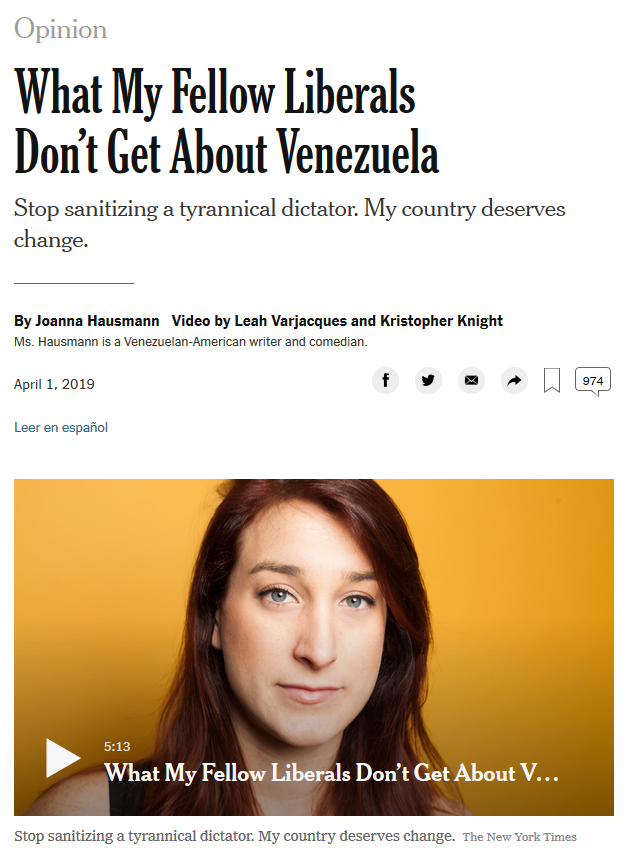
The Times even produced an opinion video (4/1/19) with Joanna Hausmann, “a Venezuelan American writer and comedian,” as she is described in her Times bio. Between sarcastic stabs at Venezuela’s “tyrannical dictator” and cute animations of “Ruth Bader Ginsburg in workout clothes”—Hausmann’s self-described “spirit animal”—come more serious declarations about the nation’s political situation:
Juan Guiadó is not an American right-wing puppet leading an illegitimate coup, but a social democrat appointed by the National Assembly, the only remaining democratically elected institution left in Venezuela…. Let’s provide humanitarian aid and support efforts to restore democracy.
Zero Percent of Elite Commentators Oppose Regime Change in Venezuela
Last edited:


 CNN stay doing fake news


