
You are using an out of date browser. It may not display this or other websites correctly.
You should upgrade or use an alternative browser.
You should upgrade or use an alternative browser.
Rev. Jesse Jackson is hospitalized /* He has passed away
- Thread starter get these nets
- Start date
More options
Who Replied?

feelosofer
#ninergang
Rest in Power.
I was 14-15 when he ran for Democratic Primary and it was a very important imagr to see a Black man run for a chance as the Democratic primary and his platform was very Progressive, he wanted to end poverty especially in the African American community and was a big proponent of education and jobs programs that allowed people to upskill as well as fighting for social justice with the belief that more opportunities would lead to less drug selling and drug use. He was a man ahead of his time.
I was 14-15 when he ran for Democratic Primary and it was a very important imagr to see a Black man run for a chance as the Democratic primary and his platform was very Progressive, he wanted to end poverty especially in the African American community and was a big proponent of education and jobs programs that allowed people to upskill as well as fighting for social justice with the belief that more opportunities would lead to less drug selling and drug use. He was a man ahead of his time.

Plankton
Superstar


Westbama Heartthrob
Irregular Zero
R.I.P.
Ironic how he almost passed on presidents day at that
Ironic how he almost passed on presidents day at that
Westbama Heartthrob
Irregular Zero
Yeah, it's one thing to critique and look at leaders without rose tinted glasses. But to be so callous when people who have done way worse don't get half the disrespect on here. Just unnecessaryAll you can do is shake your fukking head at the blatant disrespect being displayed in this thread.
Man went out there and put his life on the line for the freedoms some of you ignorant nikkas take for granted and lived long enough to become disrespected by you uneducated ingrates.

get these nets
Veteran
South Africa remembers Rev. Jackson
Tuesday, 17 February 2026
South Africa joins the international community in mourning the passing of United States human rights activist and anti-apartheid struggle flagbearer the Rev Dr Jesse Louis Jackson Sr.
President Cyril Ramaphosa has expressed his deep sadness at the passing of Rev Jackson at the age of 84.
On behalf of all South Africans, President Ramaphosa extends his condolences to the Jackson family, the Rainbow PUSH Coalition and the many organisations within the American Civil Rights Movement and in causes elsewhere in the world who were inspired by the Rev Jesse Jackson’s principles and leadership.
President Ramaphosa says the Rev Jesse Jackson’s irrepressible campaigns against apartheid and his support for the liberation struggle was a towering contribution to the global anti-apartheid cause.
In 2013, the Rev Jesse Jackson was awarded South Africa’s National Order of the Companions of O.R. Tambo in Silver for dedicating his life to challenge societies and governments to recognise that all people are born equal, and that everyone is in equal measure entitled to life, liberty, prosperity and human rights. The award honoured his excellent contribution to the fight against apartheid.
President Ramaphosa said: “We are sad to bid farewell to a global moral authority who gave voice to struggles within the United States as well as struggles for fundamental human rights and democracy around the world, including our own.
“Mentored by the equally resolute and charismatic Dr Martin Luther King Jr, Jesse Jackson devoted himself to the cause of justice as a human endeavour without borders.
“In 2026, we reflect with deep appreciation and admiration on Jesse Jackson’s visit to Southern Africa 40 years ago this year to share his support for our liberation struggle with leaders and citizens in Nigeria, Angola, Botswana, the then Congo, Mozambique, Tanzania, Zambia and Zimbabwe.
“From Selma in the American South to Soweto in 1979, where he visited following the death of Steve Biko, Jesse Jackson defied the architects of apartheid and executors of brutality to declare that all people are equal and that justice would ultimately triumph over injustice.
“His campaigns for an end to apartheid included disinvestment from the apartheid economy and challenging the support the regime enjoyed in certain circles and institutions internationally.
“We are deeply indebted to the energy, principled clarity and personal risk with which he supported our struggle and campaigned for freedom and equality in other parts of the world.
“I will treasure the opportunity I had to do the 33rd Gandhi Walk with Jesse Jackson in April 2018, where he shared with me his deep commitment to his continuing vision for a better world as well as his special relationship with South Africa.
“He has fought a good fight and run the race which his Baptist ministry inspired him to run. He made the world a better place but he has also influenced us to maintain his good fight in places where injustice and inequality persist.
“May his soul rest in peace.”
President Ramaphosa pays tribute to eminent human rights campaigner Dr Jesse Louis Jackson Sr
Tuesday, 17 February 2026
South Africa joins the international community in mourning the passing of United States human rights activist and anti-apartheid struggle flagbearer the Rev Dr Jesse Louis Jackson Sr.
President Cyril Ramaphosa has expressed his deep sadness at the passing of Rev Jackson at the age of 84.
On behalf of all South Africans, President Ramaphosa extends his condolences to the Jackson family, the Rainbow PUSH Coalition and the many organisations within the American Civil Rights Movement and in causes elsewhere in the world who were inspired by the Rev Jesse Jackson’s principles and leadership.
President Ramaphosa says the Rev Jesse Jackson’s irrepressible campaigns against apartheid and his support for the liberation struggle was a towering contribution to the global anti-apartheid cause.
In 2013, the Rev Jesse Jackson was awarded South Africa’s National Order of the Companions of O.R. Tambo in Silver for dedicating his life to challenge societies and governments to recognise that all people are born equal, and that everyone is in equal measure entitled to life, liberty, prosperity and human rights. The award honoured his excellent contribution to the fight against apartheid.
President Ramaphosa said: “We are sad to bid farewell to a global moral authority who gave voice to struggles within the United States as well as struggles for fundamental human rights and democracy around the world, including our own.
“Mentored by the equally resolute and charismatic Dr Martin Luther King Jr, Jesse Jackson devoted himself to the cause of justice as a human endeavour without borders.
“In 2026, we reflect with deep appreciation and admiration on Jesse Jackson’s visit to Southern Africa 40 years ago this year to share his support for our liberation struggle with leaders and citizens in Nigeria, Angola, Botswana, the then Congo, Mozambique, Tanzania, Zambia and Zimbabwe.
“From Selma in the American South to Soweto in 1979, where he visited following the death of Steve Biko, Jesse Jackson defied the architects of apartheid and executors of brutality to declare that all people are equal and that justice would ultimately triumph over injustice.
“His campaigns for an end to apartheid included disinvestment from the apartheid economy and challenging the support the regime enjoyed in certain circles and institutions internationally.
“We are deeply indebted to the energy, principled clarity and personal risk with which he supported our struggle and campaigned for freedom and equality in other parts of the world.
“I will treasure the opportunity I had to do the 33rd Gandhi Walk with Jesse Jackson in April 2018, where he shared with me his deep commitment to his continuing vision for a better world as well as his special relationship with South Africa.
“He has fought a good fight and run the race which his Baptist ministry inspired him to run. He made the world a better place but he has also influenced us to maintain his good fight in places where injustice and inequality persist.
“May his soul rest in peace.”
get these nets
Veteran

Lucky_Lefty
Dreams Are Colder Than Death...
In my heart of hearts, this is the thing truly dividing Black America. The enemy and end goal are the same, there’s just different approaches taken to get there and achieve it. But to some of these dumb smart nikkas, if it ain’t their way then it’s in the way of achieving their sides goals. I know some folks who love Malcolm to death. I know some who call him a coward because he mostly stayed up north. Neither knew Malcolm was in Alabama when Martin got locked up and sent him a message thru Coretta to him. But let them tell it, Malcolm was timid or MLK was a sellout. It’s akin to the kids I met in South Africa who were born after apartheid ended who labeled Mandela a sellout and only know of him post Robben and not the bomb planting, communist idealist before his incarceration. The ignorance and refusal to learn their history on this side of the pond and theirs astounds me.Every Black activist, leader, and figure of the past had their own style/methods to complement the movement and educate the Black community, for example W. E. B. Du Bois had his way in fighting and educating Black people that differed from Booker T. Washington's, but regardless, both played crucial roles and made contributions in fighting for the Black community's Civil Rights, etc.
get these nets
Veteran


 P...
P...
get these nets
Veteran
Ghana Mourns a Son of the African World
Feb. 23, 2026
Accra, Ghana— “Reverend Jackson legacy, his spirit, belonged to the world,” said Kofi Okyere Darko, Director of the Diaspora Affairs Office of the President, during a ceremony honoring the life of Reverend Jesse L. Jackson. The tribute was arranged by the Diaspora African Forum Diplomatic Mission (DAF), the only diaspora diplomatic mission of its kind in the world. Founded in 2007 by Ambassador Erieka Bennett, with Reverend Jesse Jackson among the co-founders.
Jackson was a frequent visitor to Accra and had met every Ghanaian president since Jerry John Rawlings (president, 1979–2001). His ties to the continent deepened in 2007, when the DAF mission opened in conjunction with the African Union’s annual summit, a landmark gathering at which African diaspora representatives were invited for the very first time to sit on the summit floor to observe the proceedings with continental African regional representatives. Reverend Jackson was then invited into a private session with the Heads of State, an honor without precedent in the history of the African Union. The delegation that accompanied him included DAF cofounder and board member Claudette Perry, Ambassador Andrew Young, Rabbi Nathaniel Kohain, jazz musician Herbie Hancock, Minister Akbar Muhammad, London fashion designer Ozwald Boateng, the late Dr. Al Munsour, and former Chairman of the People’s Democratic Party Dr. Bamanga Tukur of Nigeria.
In Reverend Jackson’s own words, the Black American struggle and the African struggle were one and the same. It was a conviction he lived by. Central to his mission (and to that of the DAF) was the work of building bridges between Africans on the continent and those of the diaspora. That work was never abstract. Reverend Jackson was a major force in the international campaign to end apartheid in South Africa, garnering support from the presidents of eight neighboring nations that had won their own independence from colonial rule. He pressed the Reagan administration to impose economic sanctions on the South African government and stood before South African crowds in the wake of Stephen Biko’s murder. From Russia to the Middle East, there were moments when Reverend Jackson appeared to be the only figure capable of opening a door, including negotiating the release of Americans held captive abroad.
News of his passing reverberated around the world. In keeping with Ghanaian custom, the Head of the DAF Mission assembled a delegation to formally call on the Diaspora Affairs Office of the President and announce the death of Reverend Jackson, a man Ghana had long claimed as one of its own. The delegation was received by Deputy Director Nana Kyere Agyemang and Director Darko. Remarks were offered, photographs taken, and the ceremonial condolence book was signed by both officials. Once the President and Vice President have added their signatures and written their condolences, the book will be delivered to Mrs. Jackson, with whom the DAF remains in direct contact—a final, formal expression of a bond that stretched across decades and oceans.
By the end of the day, everyone’s heart was full. Ambassador Erieka Bennett, Head of Mission, reflected on what had been lost and what endures: “Reverend Jackson’s civil and human rights contributions to the world were endless. His name will always be associated with Hope—and Hope is still alive.”
Long live the voice of hope.
get these nets
Veteran
Miami’s Haitian activists honor Jesse Jackson as deportation fears rise: ‘Keep hope alive’
03/23/26
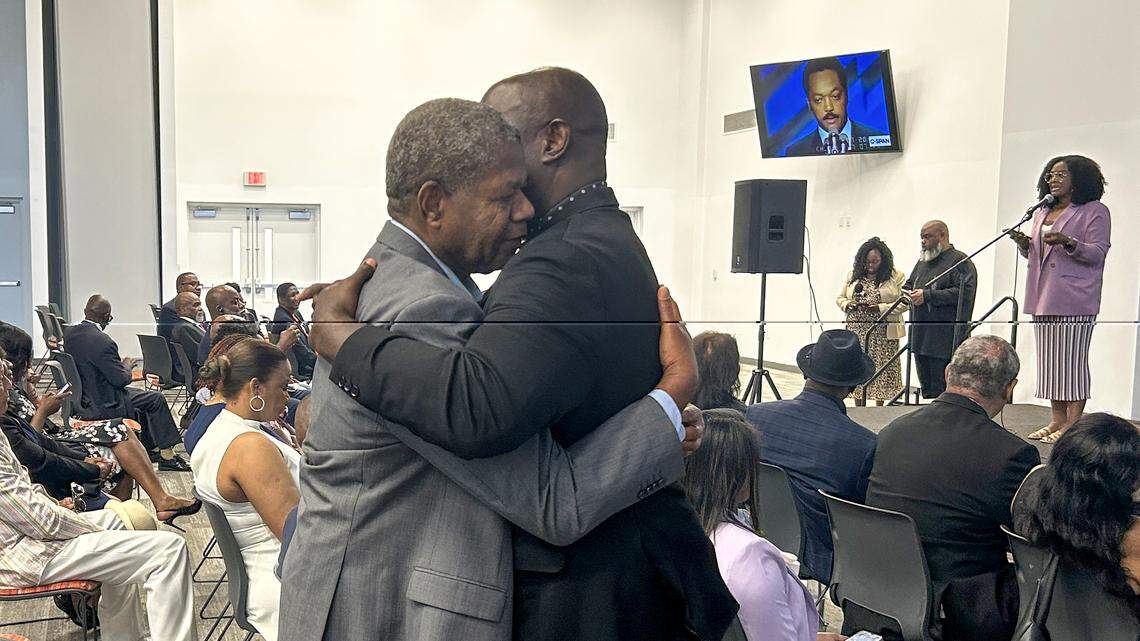
Pioneers of Miami’s Haitian rights movement paid homage Saturday to the late Rev. Jesse Jackson, recalling his support for their struggle while drawing parallels to renewed challenges their community faces amid the threat of detention and deportation.
The gathering, rich with personal anecdotes and reflections on the civil rights leader’s multiple visits to South Florida and Haiti, underscored his decades-long advocacy on behalf of Haitian refugees, particularly his push to have those fleeing the troubled Caribbean country recognized as political refugees rather than economic migrants.
Jackson died Feb. 17 at the age of 84 at his home in Chicago. Alongside his advocacy for voting rights and the poor, he championed the rights of Haitian migrants, leading prayer vigils and protest marches in the ‘80s and ‘90s as he called attention to their unequal treatment in comparison to arriving Cubans and other migrants.
Though the icon has been remembered in tributes across the country, Saturday’s gathering at the Father Gerard Jean-Juste Community Center in North Miami-Dade carried particular resonance. The event brought together African Americans and Haitians, elected leaders and Democratic Party organizers, longtime immigration advocates and residents whose lives were shaped by those efforts.
“This is a celebration, and I’m grateful for a life so powerfully lived,” Miami-Dade County Commissioner Marleine Bastien said, citing the local, national and global impact of Jackson’s fight for justice. “The Rev. Jesse Jackson was not only the towering figure of a civil rights movement. He was the force of good who stood boldly for the marginalized, the voiceless, the underserved, and he never, never withered in his pursuit of justice.”
Bastien spoke of the honor of knowing Jackson personally and “working alongside him in moments that mattered deeply for our community.”
Those moments included the fight for Temporary Protected Status for Haiti before it was granted by the Obama administration after the country’s devastating 2010 earthquake. During a trip with Jackson to her homeland, Jackson didn’t want to just remain inside the presidential palace or visit Pétion-Ville, the affluent suburb where many of Haiti’s wealthy live, Bastien recalled. He insisted on meeting with ordinary Haitians, which he did when they visited Cité Soleil, the country’s largest slum.
“He made an indelible impact on all of our lives,” Bastien said. “And this impact will continue to live on.”
Still, the speakers reflected on the moment the community now faces: More than 50 years after Haitian refugees began arriving in South Florida in boatloads, prompting court challenges and street demonstrations for immigration protections, the community again finds itself in the throes of an immigration fight.
“We have lost Jesse Jackson, a pillar, a powerful icon,” said state Rep. Marie Paule Woodson, D-Hollywood. “But Jesse Johnson has worked with so many in this community, and we know we have won. ... We will continue this fight. We will continue the struggle.”
A room of fighters
She then proceeded to highlight some of the stalwarts in the room who had been “in the trenches” with Jackson, including former North Miami Councilman Jacques Despinosse; activist and singer Farah Juste, who performed; former Haitian Refugee Center director Guy Victor, activist Tony Jeanthenor, one of the event’s lead organizers; and Bastien.
They were joined not only by a crowd of Haitians who became permanent U.S. residents and citizens because of their efforts, but also by some of the African Americans who stood by them, including the Rev. Charles S. McKenzie Jr., Florida coordinator for Jackson’s Rainbow/PUSH Coalition; the Rev. Richard Dunn; and former state Sen. Dwight Bullard, who co-emceed the event. Also present were the families of Jack Lieberman and Bernard Fils-Aimé, longtime activists who died within a month of each other in 2020 from COVID-related illness.
McKenzie, who served as vice president of the Haitian Association Foundation of Tampa Bay, knew Jackson for 38 years. In 2012, he accompanied him on a visit to Haiti. There is still much work to be done, the pastor said as he spoke directly to the room.
“Our Haitian brothers and sisters, God loves you,” he said. “I would encourage you to pray around the Temporary Protected Status or whatever challenges we’re having in our communities.”
Then McKenzie invoked one of Jackson’s signature refrains: “Keep hope alive, keep hope alive by understanding that God loves you no matter who is in power.”


