
You are using an out of date browser. It may not display this or other websites correctly.
You should upgrade or use an alternative browser.
You should upgrade or use an alternative browser.
So people really think Black ICE agents should not exist. Where does this thinking come from?
- Thread starter Voice of Reason
- Start date
More options
Who Replied?
Trump moving it up to 42"Every accusation is an indirect confession "
By your logic, you should get drafted FIRST since you love Trumps anti immigration policies. By law, I was opposed to such things from Trump and an Anti Zionist. According to Israel, I'm a traitor and would be a bad soldier.
Im 40 years old and have a couple of minor health conditions preventing me from going to basic training.

Stop fleeing

GreenGhxst
Veteran
I got perma banned from blackpeopleofreddit sub for saying black folk need jobs too


Trump moving it up to 42
Stop fleeing
I also said "minor health conditions " as well

You, on the other hand, gonna be on the front lines with the Star of David on your chest and gonna go Call of Duty with a gun with no ammo in it

Its good to be a shill and anti Trump. The US Army doesnt want me anyway.


beenz
Rap Guerilla
a black person being in ICE makes ZERO sense knowing good and damn well a ton of your co-workers are criminal J6'ers, nazi's, racists and other deplorables. 

Kingshango
Veteran
Oh my god they look like fakkits.

xiceman191
Superstar
If y'all had this much energy on nikkas who kill other black people or sell drugs
You will be alrightI also said "minor health conditions " as well
You, on the other hand, gonna be on the front lines with the Star of David on your chest and gonna go Call of Duty with a gun with no ammo in it
Its good to be a shill and anti Trump. The US Army doesnt want me anyway.
stop tryin to flee
HarlemHottie
Uptown Thoroughbred
a black person being in ICE makes ZERO sense knowing good and damn well a ton of your co-workers are criminal J6'ers, nazi's, racists and other deplorables.
 You think they only work for ICE?
beenz
Rap Guerilla
If y'all had this much energy on nikkas who kill other black people or sell drugs
who in here is championing black folks who terrorize their own community?
xiceman191
Superstar
nikkas on this site love drug dealers. Let a nikka say he want to hear music that don't talk about drug dealin and hear some positive shyt he labeled a loser. Let a nikka say that these street nikkas that kill and sell drugs deserve to die they getting a whole bunchwho in here is championing black folks who terrorize their own community?
nikkas on this site love drug dealers. Let a nikka say he want to hear music that don't talk about drug dealin and hear some positive shyt he labeled a loser. Let a nikka say that these street nikkas that kill and sell drugs deserve to die they getting a whole bunch
For the past decade or so, they getting called out and challenged as the parasites of the black community. Even bloodshed and crips in Cali are called out for being anti black while letting other races roam free.
You will be alright
You first. You get drafted and die for a pedophile. I made my stance back in 2016.

voltronblack
Superstar
Right here have been numerous reports, studies, and research dating back to the 2000s that discuss how working in law enforcement often means working alongside individuals with who are
. There is no area within law enforcement where such attitudes are absent .
White supremacists and militias have infiltrated police across US, report says
A former FBI agent has documented links between serving officers and racist militant activities in more than a dozen states
 www.theguardian.com

Law Enforcement and the White Supremacists Within - Policing Equity
Black, Brown, and Indigenous people have long warned of the entanglement between White supremacist groups and law enforcement agencies. The Jan 6 Committee Final Report underscores the threat to public safety. It’s past time to act.
 policingequity.org
Hidden in Plain Sight: Racism, White Supremacy, and Far-Right Militancy in Law Enforcement
The government’s response to known connections of law enforcement officers to violent racist and militant groups has been strikingly insufficient.
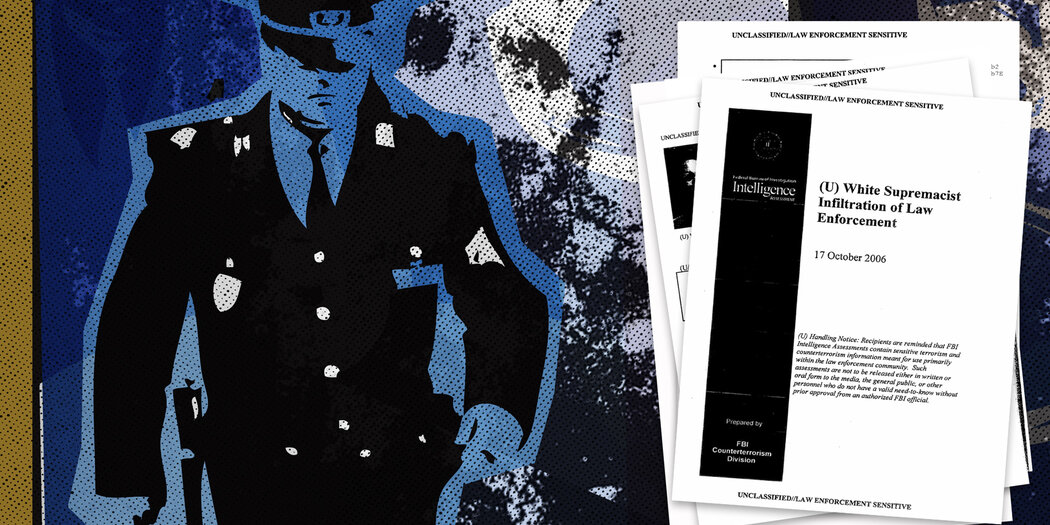
In 2017, the FBI reported that white supremacists posed a “persistent threat of lethal violence” that has produced more fatalities than any other category of domestic terrorists since 2000. 3 Alarmingly, internal FBI policy documents have also warned agents assigned to domestic terrorism cases that the white supremacist and anti-government militia groups they investigate often have “active links” to law enforcement officials. 4
The harms that armed law enforcement officers affiliated with violent white supremacist and anti-government militia groups can inflict on American society could hardly be overstated. Yet despite the FBI’s acknowledgement of the links between law enforcement and these suspected terrorist groups, the Justice Department has no national strategy designed to identify white supremacist police officers or to protect the safety and civil rights of the communities they patrol.
Obviously, only a tiny percentage of law enforcement officials are likely to be active members of white supremacist groups. But one doesn’t need access to secretive intelligence gathered in FBI terrorism investigations to find evidence of overt and explicit racism within law enforcement. Since 2000, law enforcement officials with alleged connections to white supremacist groups or far-right militant activities have been exposed in Alabama, California, Connecticut, Florida, Illinois, Louisiana, Michigan, Nebraska, Oklahoma, Oregon, Texas, Virginia, Washington, West Virginia, and elsewhere. 5 Research organizations have uncovered hundreds of federal, state, and local law enforcement officials participating in racist, nativist, and sexist social media activity, which demonstrates that overt bias is far too common. 6 These officers’ racist activities are often known within their departments, but only result in disciplinary action or termination if they trigger public scandals.
Few law enforcement agencies have policies that specifically prohibit affiliating with white supremacist groups. Instead, these officers typically face discipline, if at all, for more generally defined prohibitions against conduct detrimental to the department or for violations of anti-discrimination regulations or social media policies. Firings often lead to prolonged litigation, with dismissed officers claiming violations of their First Amendment speech and association rights. Most courts have upheld dismissals of police officers who have affiliated with racist or militant groups, following Supreme Court decisions limiting free speech rights for public employees to matters of public concern. 7 Courts have given law enforcement agencies even greater latitude to restrict speech and association, citing their “heightened need for order, loyalty, morale and harmony.” 8
Some officers who have associated with militant groups or engaged in racist behavior have not been fired, however, or have had their dismissals overturned by courts or in arbitration. Such due process is required to ensure integrity and equity in the disciplinary process and protect falsely accused police officers from unjust punishments. Certainly, there will be cases where an officer’s behavior can be corrected with remedial measures short of termination. But leaving officers tainted by racist behavior in a job with immense discretion to take a person’s life and liberty requires a detailed supervision plan to mitigate the potential threats they pose to the communities they police, implemented with sufficient transparency to restore public trust.
Progress in removing explicit racism from law enforcement has clearly been made since the civil rights era, when Ku Klux Klan–affiliated officers were far too common. But, as Georgetown University law professor Vida B. Johnson argues, “The system can never achieve its purported goal of fairness while white supremacists continue to hide within police departments.” 9 Trust in the police remains low among people of color, who are often victims of police violence and abuse and are disproportionately underserved as victims of crime. 10 The failure of law enforcement to adequately respond to racist violence and hate crimes or properly police white supremacist riots in cities across the United States over the last several years has left many Americans concerned that bias in law enforcement is pervasive. 11 This report examines the law enforcement response to racist behavior, white supremacy, and far-right militancy within the ranks and recommends policy solutions to inform a more effective response.


