

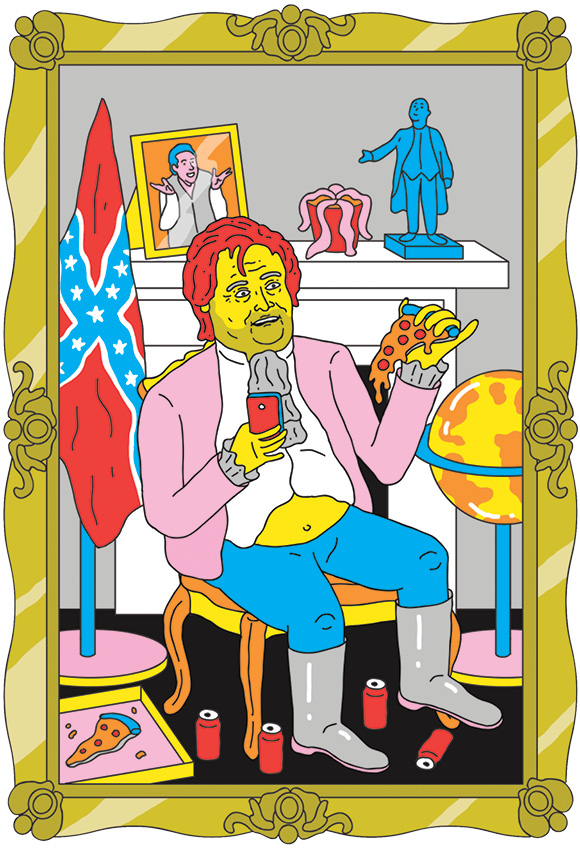
There is no doubt that Steve Bannon is a bulging sack of shyt.
With his chin fuzz and sloppy gray mane, he looks like an alcoholic stepdad grimly watching a History Channel special on Rommel in the desperate hope of an erection. In Bannon, President Trump has found his very own jack-booted Wormtongue. He will whisper darkly about “race realism” and the evils of birth control.
His ascent to the White House should indeed send chills down all of our spines. But what’s dangerous about Bannon isn’t that his loony, far-right politics have reached such high places. After all, that’s practically an American tradition.
Have we already forgotten about Congressman Dan Burton of Indiana, who reenacted Bill Clinton’s supposed assassination of Vince Foster with a pistol and a cantaloupe? What about Reagan’s secretary of the interior James G. Watt, the man who banned the Beach Boys from playing on the National Mall because they attracted “the wrong element”? Ultra-right John Birch Society president and conspiracy theorist Larry McDonald came to Congress in 1975 — during that supposed era of reasonable bipartisan consensus. A few years later, he urged the nomination of Nazi war criminal Rudolf Hess for the Nobel Peace Prize on anticommunist grounds. Before he made his way to the Senate, Ted Cruz declared a war on dildos, stating in a legal brief: “There is no substantive due-process right to stimulate one’s genitals for non-medical purposes.” And in 1980, Ronald Reagan stood just seven miles from Philadelphia, Mississippi — where three civil rights activists were murdered in a conspiracy involving the county sheriff’s office, the local police, and the Ku Klux Klan — and promised to “restore to states and local governments the power that properly belongs to them.”
If terrifying right-wing loonies at the levers of state power could bring about the Fourth Reich, it would’ve happened decades ago, during a truly raging wildfire of American class conflict, at the behest of powerful oilmen like Clint Murchison Sr, who rumor has it funded the American Nazi Party, and Texaco chairman Torkild Rieber, who helped cinch Franco’s victory in the Spanish Civil War with shipments of much-needed oil and a telegram that read, “Don’t worry about payments.” Despite fascist sympathies in high places, none of these uber-powerful slimeballs tilted our constitutional oligarchy into fascism.
So “far-right racist” doesn’t make Bannon particularly unique or worrying. It’s how devastatingly well he understands liberalism’s failures and how willing he is to craft a fraudulent and reactionary program for those who’ve only experienced decline during the Clinton and Obama years.
Like a mutant weed growing out of a shyt-covered pile of compost, Bannon has cultivated his particular brand of reaction entirely within the decomposing corpse of American liberalism. In no other soil could it ever have blossomed.
Summing up the Democratic Party’s embrace of Silicon Valley and finance, he gloats: “[The Democrats] were talking to these people with companies with a $9 billion market cap employing nine people. It’s not reality. They lost sight of what the world is about.” For the most part, he’s right: the Democrats abandoned — even went to war with — labor, embracing the professional classes instead. Bannon’s rise on the back of a candidate who barely won more votes than Mitt Romney was only possible with the collapse of turn-of-the-century liberalism and its agents in the Democratic Party. Bannon (and Trump) would be nothing and nowhere without that implosion.
In a Hollywood Reporter interview that appeared shortly after Trump’s surprise victory, Bannon outlined his agenda for America — something he calls “economic nationalism.”
We’re going to build an entirely new political movement. . . . It’s everything related to jobs. The conservatives are going to go crazy. I’m the guy pushing a trillion-dollar infrastructure plan. With negative interest rates throughout the world, it’s the greatest opportunity to rebuild everything. Shipyards, ironworks, get them all jacked up. . . . It will be as exciting as the 1930s.
Except it won’t look anything like that. Trump and the Republican legislature are no more likely to enact Bannon’s program than Obama was going to launch a Green New Deal. Trump’s actual infrastructure plan consists of nothing but tax credits. Private investors might jump on pipeline expansions, but they won’t be interested in overhauling municipal water systems.
This is hardly the Tennessee Valley Authority, which modernized and developed the most backward regions of the United States, despite being an “unprofitable venture” for the private sector. The New Deal, which Bannon cites as inspiration, wasn’t a mere giveaway to construction and building-trades hustlers like Trump’s proposal or even like much of Obama’s American Recovery and Reinvestment Act (ARRA). Instead, it employed Americans with public oversight. Between 1935 and 1943, the Works Progress Administration hired 8.5 million men and women, not to mention the 3 million who worked for the Civilian Conservation Corps.
As the Hurricane Katrina fiasco demonstrated, without effective federal regulation and oversight, infrastructure cash alone creates a race to the bottom in terms of wages and workplace protections. In December, a worker died at one of the new affordable-housing units going up in New York City. Unions had demanded that all workers be covered, but de Blasio’s City Hall wanted to “maximize production” rather than pay union wages. And now someone is dead because that worker was not adequately protected. Whatever projects Trump launches, workers’ pay, safety, and well-being won’t matter. They’ll be just as disposable as the tens of thousands of employees the president has already scammed throughout his miserable career.
Nevertheless, what Bannon said about negative interest rates creating the perfect opportunity for a massive infrastructure upgrade is true. (Even the increasingly worthless Paul Krugman agrees on this point.) And yet President Obama — who ushered in ARRA when interest rates were even lower — refused to fully fund a plan to rebuild the country when he had the perfect chance.
Obama’s economic adviser Christina Romer estimated at least $1.2 trillion was needed to pull the country out of the Great Recession. His political team, fearing the t-word (which apparently does not frighten Bannon), whittled it down to less than $800 billion, much of it tax cuts. But even Romer’s initial estimate was far too conservative — she later said the country needed at least $2 trillion in stimulus money. Obama shunned a New Deal, and now a reactionary is riding into office promising the Herrenvolk version.
What made the New Deal effective — and nothing like ARRA or Trump’s proposals — was that millions went from unemployed to employed within a matter of weeks. It prioritized well-paying jobs for workers, not handouts to construction tyc00ns. Labor union militancy, much of it shaped by the Communist Party, made this possible. As much as we might loathe Obama for having no plan to revive the American working class, we should never have believed he or the Democratic Party would. Liberalism failed in the twenty-first century not because of any new developments but because it always had wild deficiencies, even at the peak of its powers. It was only worth a damn when there was a radical labor movement for it to co-opt and, reluctantly, invite into a political coalition.
Without working-class militancy, there was never going to be a new New Deal under Obama. And there certainly won’t be one under Trump. Does the Donald have a plan to spur a new wave of unionization with his very own Wagner Act? Or a proposal to go after the “donor class” Bannon claims to despise?
Of course not. Trump’s already targeting union leaders from his Twitter account and inviting corporate America into his administration with unparalleled vulgarity. He wants to make a working-class paradise by bringing back manufacturing jobs that can compete with developing-world wages. It makes Obama’s food stamps and Uber economy look like 1970s Sweden.
A true right-wing “economic nationalism,” on the model of early twentieth-century fascism, is a dead letter in twenty-first-century America. The Republican Party may be the hard right of our ruling class, but it’s still a thoroughly capitalist ruling class — no Prussian dueling scars or epaulets these days. And these dull, business-minded captains of industry have no interest whatsoever in a new New Deal, reactionary or otherwise. Neither TVA nor autobahn. They’re far too bourgeois for anything like that.


