The Historian Behind Slavery Apologists Like Kanye West

CodeBlaMeVi

I love not to know so I can know more...
Supporter
Joined
Oct 3, 2013
Messages
40,586
Reputation
3,808
Daps
111,043
No. It takes time to learn about the different elements of enslavement. Most people just think of picking cotton.

- The types of crops (Cotton, Indigo, Sugar, Tobacco)

- The locations of plantation and farms (i.e. South, Deep South, Border States) and why runaway wasn’t possibly for many due to location.

- Plantation, Small/Mid-Size Farm, Urban Slavery

- The process from capture to middle passage to slave block, to being sold, to held in bondage.

- The types of punishment - physical, spiritually and mentally (flogging, starvation, amputation, selling kin, types of punishment tools, rape)

- Rape, violation and breeding.

- Abuse of children.

- Daily Resistance, Maroons in the South, and of course revolts/uprising. Plus, the types of consequences for doing so.

- Medical testing and abuse of elderly.

I can go on...

I can list resources and books that go more into depth.
It’s deep and heavy on the soul but a lot of people talk on it without being truly read on it.

I know enough, though.
 
Joined
Apr 2, 2014
Messages
457
Reputation
-135
Daps
946
Subservient? Not really. They were terrorized and lived under threats, violence, family being sold and killed daily. By not only their enslaver but the whole county, state and South. Again, it was an institution- a well run one - that was on code at all times.

The resources are available - it just takes effort and desire to learn about their stories and how the system worked.
But how did it ever get to that point? How were they able to make continuous trips to Africa and get more slaves? What were the Africans doing? Did they not wonder what happened to the others?
 

xoxodede

Superstar
Joined
Aug 6, 2015
Messages
11,068
Reputation
9,290
Daps
51,676
Reppin
Michigan/Atlanta
It's literally thousands of known accounts of the enslaved killing their masters. It wasn't rare.


Daily Resistance:


Maroons:


Types of Maroon Societies:

Sylviane Diouf of Slavery’s Exiles describes the different types of maroons that were in the United States in great detail.

Borderland Maroonage:

  • Borderland maroons did not wonder off too far from where they escaped from. They made their maroon colonies close to the farms and plantations thus, their presence was known. [8]There were many reasons for staying close and risk being captured and returned to slavery, one being family connections. Escaping enslavement, but still wanting to see family members who were enslaved was crucial. Another instance would be for a slave to hover in the area of a different plantation where a spouse was sold. [9] In this case the a subcategory of maroonage called petit maroonage where slaves would runaway to see a loved ones, but eventually return.[10].
  • Violence was another reason slaves would escape to the borderlands. The violence that slaves were subjected to does not need explanation, but what is important is to note that many did not accept the violence from slaveowners. Many decided to flee in the face of violence instead of submitting to the humiliation and torture of a beating.[12] The opposite was also true, many would find themselves on the borderland because they had inflected violence on a white person. Borderland maroons would also be the source of much stealing of food and tools to to ensure their survival.

Hinterland Maroonage:
  • Another form of maroonage was hinterland maroonage, where the person or colony would enter deep into the woods where they could have a stronger sense of security and freedom. The hinterlands maroons unlike the borderland maroons were harder to track thus, providing mystery to the slavocracy. Usually found in communities for optimal survival, they were able to accomplish a lifestyle some would say was better than plantation life.

-------

Plantation Owners and Officials Knew of Maroon Communities:

Charles Manigault, owner of the Silk Hope plantation on the Cooper River near Charleston, commented that “no overseer, or Planter should speak on such subjects even before a small house boy, or girl, as they communicate all that they hear to others, who convey it to the spies of the runaways, who are still at home.”19 Indeed, it was rare for maroon settlements to be taken by surprise and far more common for attacking forces to find settlements abandoned because they had been forewarned of an assault.20 To those remaining enslaved we might anticipate that maroons became heroic, perhaps even mythic, figures. The retention and practice of African traditions (particularly religious ones) among maroon communities secured them a privileged position in slave societies with high proportions of Africans. Maroons who struck against planter authority and power were quite possibly fulfilling the secret desires of the oppressed, for while overt resistance could spell summary execution for slaves, maroons had the capacity to fight back.

Planters north of Charleston described how the success of one runaway in 1822 had resulted in another joining him in 1824 and a further five, parents with three children, “joined the same ring leader” in 1825.25
Source: http://latinamericanhistory.oxfordr...199366439.001.0001/acrefore-9780199366439-e-5

In November 1822 travelers in St. Andrew’s Parish just outside Charleston were being “continually robbed by a gang of armed runaway Negroes.” Among their victims were “several negroes [who] were stopped and money and clothes taken from them and their persons kept in custody ’till after night.”27 Targeting slaves was an obvious avenue whereby maroons could lose the support of the black community that remained enslaved. When maroons near Wilmington, North Carolina, were reported to be “frequently robbing slaves” and “threatening to perpetrate more atrocious crimes” it did not take long before “people of their own color informed against them.” A white posse swiftly captured all of these maroons as a direct result of the information given by slaves.28

--------

Maroons and Conflict with the White Community
  • For white planters, masters, militias, and governments, maroon communities posed a particular problem. Masters certainly did not want to lose valuable property to marronage, but the rewards of recapturing maroons had to be weighed against significant effort and risks. Maroon settlements were located in remote and deliberately inaccessible areas. Days spent hunting maroons were days lost from managing the plantation which might mean that remaining slaves were able to damage crops, and therefore profits, either through willful vandalism or, perhaps more likely, through simple inaction while unsupervised. Some slaves might even take advantage of the absence of the master to flee themselves. The swamps, woods, and mountains where maroons resided were formidable environments full of dangerous fauna that preyed on the unwary. It is doubtful that many whites ventured anywhere near these locales, except when they absolutely had to, and these zones in effect became spaces which were traversed and occupied only by Africans and African Americans.
  • New settlements could be constructed quickly: soldiers who oversaw the destruction of one maroon village near Savannah in October 1786 found an even larger settlement had been constructed just six months later a few miles further into the swamps.
  • Fighting was an option when the maroons outnumbered the attackers, but most often occurred when the maroons were either surprised, or when they had no choice. A military response could also buy vital time for the escape of women and children since if nothing else it gave the attackers pause for thought. Many whites grudgingly recorded their respect for maroon bravery, reporting that one maroon group just north of Mobile “fought like Spartans, not one gave an inch of ground, but stood and was shot dead or wounded, and fell on the spot.”35
  • A maroon group in North Carolina successfully deterred planters from joining patrols by singling them out for revenge attacks. A petition to the North Carolina General Assembly urging a reform of the patrol law lamented that “patrols are of no use on Account of the danger they Subject themselves to and their property. Not long since three patrols two of which for Executing their duty had their dwelling and Out houses burnt down, the Other his fodder stacks all burnt.” It took considerable determination, and an investment of both time and substantial amounts of money, for whites to completely destroy a maroon community.

-------

Maroon Colonies Traded in New Orleans and South Carolina

In the fall of 1827 a maroon colony in New Orleans was discovered where the cultivation of corn, sweet potatoes, hogs, and chicken were being raised.[15] Diouf makes it a point to establish that maroon colonies would trade, especially in South Carolina where maroons dominated the fishing business.[16] Although this was illegal because the maroons themselves were bandits, it was less illegal than, stealing goods and trading them which was also done.[17]

Source(s): Diouf, Slavery’s Exiles, 145 and Resistance to Slavery : Warfare and Maroonage
 

xoxodede

Superstar
Joined
Aug 6, 2015
Messages
11,068
Reputation
9,290
Daps
51,676
Reppin
Michigan/Atlanta
But how did it ever get to that point? How were they able to make continuous trips to Africa and get more slaves? What were the Africans doing? Did they not wonder what happened to the others?

You should know this sis.

But, money, goods and weapons.

They traded and purchased us from African traders/kidnappers. They also had relationships with different kingdoms chiefs - that allowed them to set up shop to hold, select and purchase our ancestors.

Yes, they knew people were disappearing- some even helped sell them - but most were trying to protect themselves and their families from being captured. But, yes many knew what was up and what was happening - but it wasn’t their tribe or people so they didn’t have a connection.

The African Slave Trade was abolished in 1807 - even though they still made illegal trips to the continent - the number of slaves in the US tripled due to breeding and reproduction. Therefore, they didn’t have to go to Africa because they have the internal slave trade.

More info: Interregional slave trade - Wikipedia

They literally had slave marts - all over the south and other parts of the US. Slave Traders in the US were called “Speculators” and it was a big business as well.


Books on the topic are:

Speculators and Slaves: Masters, Traders, and Slaves in the Old South
The Chattel Principle: Internal Slave Trades in the Americas

The Price for Their Pound of Flesh: The Value of the Enslaved, from Womb to Grave, in the Building of a Nation
Soul by Soul: Life Inside the Antebellum Slave Market
Sold Down the River: Slavery in the Lower Chattahoochee. Valley of Alabama and Georgia
A Troublesome Commerce: The Transformation of the Interstate Slave Trade
 

DakotaRed

Pro
Joined
Nov 18, 2016
Messages
114
Reputation
140
Daps
788
I definitely agree. I have felt that all through out my genealogy research. Doing that made me re-educate myself on slavery and reconstruction.

It’s depressing and it’s really taxing spiritually and emotionally.
I would like to eventually do some research on my background but I wouldn't even know where to start.

If you don't mind me asking where would a good starting point be for someone trying to get that kind of information?
 

xoxodede

Superstar
Joined
Aug 6, 2015
Messages
11,068
Reputation
9,290
Daps
51,676
Reppin
Michigan/Atlanta
I would like to eventually do some research on my background but I wouldn't even know where to start.

If you don't mind me asking where would a good starting point be for someone trying to get that kind of information?

Start with your Grandparents names - maternal and paternal. If you don't know, ask your parents or other family members that may know.

From there - start your tree and search on Ancestry or FamilySearch.Org. FamilySearch.Org is free. Ancestry is not.

Search the Freedmen's Bureau Records here: Freedmen’s Bureau Project


Search each name. Example: Say your maternal Grannie's maiden name is Linda Brown - from Macon, GA. Put that in the search and you should be able to find either Census records, Birth Records or Death Records connected to her or her parents. You may find her on the 1950 Census living with her parents Tom and Mary Brown and your Uncle (Linda's brother) - your Great Uncle -- therefore you know that's your Grannie's family and your Great Grandparents are Tom and Mary Brown. Then you search Tom Brown and Mary Brown - and so on...looking for their parents, etc.

Do that for each Grandparent on both sides. You will run into blocks - but it's normal. When you get there -- you have to do some hard work. Either looking through estate papers/inventory records of plantations in the county.

I have been working on mine for now almost 4 years - and every week I have work to do - it's never ending - but rewarding. It's very challenging and emotional. You will have to see your ancestors name's listed next to mules as property. But, you will also find stuff like your 2nd, 3rd 4th Great Grandfathers fighting in the United States Colored Troops in the Civil War. You will possibly find pictures of your ancestors in records. Or stories about your ancestors -- or just be able to finally know their names.
 

xoxodede

Superstar
Joined
Aug 6, 2015
Messages
11,068
Reputation
9,290
Daps
51,676
Reppin
Michigan/Atlanta
Dear Kanye: Runaways and violent rebels were NOT the only enslaved peoples who resisted, and who deserve our admiration
MAY 3, 2018 / GDBRASHER


11518u-1080x675.jpg

These people did not choose to be enslaved, so let’s talk about what they did choose . . .

Dear Kanye West,

You’ve recently demonstrated that you have some educational deficiencies when it comes to understanding American slavery. “400 years” of enslavement, you said, “that sounds like a choice.”

When you said it, you were quickly shot down by TMZ‘s Van Lathan, in a “mic drop” moment that seemed to warrant no additional comment.

Yet you wouldn’t let it go at that. “To make myself clear” you tried to clarify later on Twitter, “Of course I know that slaves did not get shackled and put on a boat by free will. My point is for us to have stayed in that position even though the numbers were on our side (they weren’t) means that we were mentally enslaved.”

You also tweeted that people were attacking you for having original thoughts. Further, you claimed that had you lived during slavery, you would have been a “Harriet,” meaning a runaway, or a “Nat,” meaning a rebel that violently resisted and went down fighting. You’d never be “mentally enslaved!”

But these aren’t original and new thoughts that you’ve stumbled upon. Honestly, the first thing that came to my mind was Eddie Murphy’s 1987 “Raw” performance, when he comically and frankly confronted the idea that you just put forth as new.

“The first dude that got off the boat said that,” Murphy joked.

WARNING: VERY foul language:


Murphy’s comedy aside, I could spend my time trying to educate you about the extensive mechanisms that white Southerners put into place to subjugate and control the enslaved– from laws, to slave patrols, to militia companies, (all of which continued in various forms to maintain white supremacy after the Civil War and explain, in some part, the gun culture of the South). The failure of Nat Turner’s revolt, and especially the subsequent brutal retribution meted out to the mostly uninvolved black community afterwards, is evidence of just how well-prepared and equipped Southern whites were for dealing with large-scale violent slave resistance. John Brown’s Raid further makes the point. The enslaved understood this, because it was their reality.

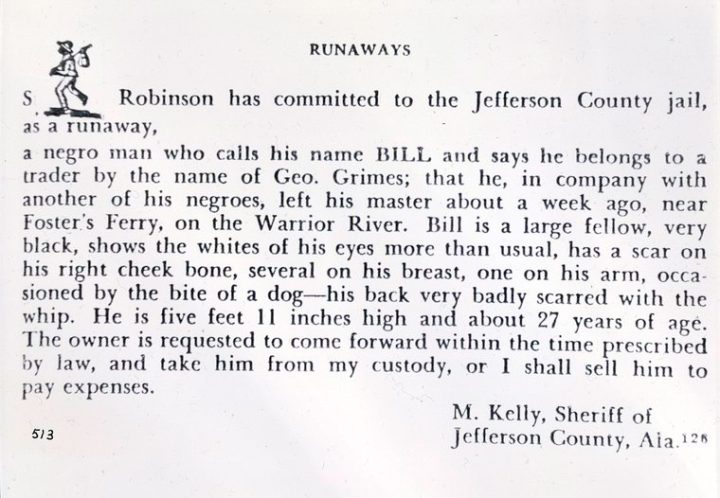
Or, I could use this time to point out that the chances of escaping slavery by running away were just too great to expect very many to be successful.

10_reward.jpg

Amos, and thousands like him, were clearly not mentally enslaved. But neither were the ones that didn’t run.

Historians are now heavily involved in collecting, quantifying, and digitizing slave runaway ads from period newspapers, and the more they find, the more we see just how many enslaved peoples made the attempt, despite the odds against success. Yet the truth is that successful runaway attempts were relatively rare, which is why Tubman is justly famous. For most, the risks were too high, and the punishments and separation from families too great a deterrent. The enslaved also understood this.

So does this mean that the vast majority of the enslaved who were not Harriet or Nat were weak? Were they mentally enslaved, as you asserted? Were they so completely dominated and subjugated that we should consider them unworthy of honor and admiration?

Kanye, your recent words imply just that, and THAT is what pisses me off. So please let me address that here.

Listen, you are definitely not the first one that thinks this way. In fact, many white Americans during and after slavery pointed to the relative lack of Harriets and Nats as proof of the docility and inferiority of the race–and thus they viewed that fact itself as justification for black enslavement. Your words implied the same thing.

Is that really how you want to use your high profile voice–making the same argument as the defenders of slavery? That’s the point Van Lathan was making when he took you down.

But you’re also not the only person in our present time that seems to make the same point for which you have received so much backlash. Anyone that has read many of my blog postings knows that I am annoyed by much of our recent pop cultural depictions of slavery. Thankfully, Hollywood no longer peddles the image of happy and contented slaves like we used to get prior to the Civil Rights movement (à la Gone With the Wind). And that is definitely a good thing. But recent exceptional films and TV shows like 12 Years a Slave, Django Unchained, the Roots remake, and WGN’s Underground, have painted most of the enslaved as essentially subhuman, non-resistent drones, all the while casting violent rebels and runaways as the heroes.

In telling their stories that way, these films miss the same point you do, Kanye. The enslaved did not choose to be enslaved, but what the vast majority of them did choose was to not let enslavement define them, their culture, or their race.

They resisted the complete domination of their lives not by risking death or separation from family by becoming Nat or Harriet, but by constructing and living in a culture largely of their own making, much of it outside of white control.

As I have insisted before: “Slaves routinely played tricks on their owners, covertly left the plantation for moonlit social and religious gatherings, entertained themselves, and created strong bonds that enabled them to maintain sanity and hope.

unknown.jpeg

There are no Harriets or Nats here, but make no mistake, these are heroes.

Slaves laughed at their master’s expense; told stories to teach their young how to outwit, control, and fool their owners; engaged in slowdowns and “laid out” to negotiate their work load; and worshipped a Christian God that they believed would one day free their people and damn their masters to hell.”

Unfortunately, there are few glimpses of this type of resistance, self-determination, and hope depicted in our current pop cultural depictions of slavery. And yet this is how most of the enslaved resisted. They were resilient, powerful people, taking the worst of what man can do to man and surviving it. African Americans live and thrive today BECAUSE of THEM.

In surviving this way, they built and passed along lessons to their descendants about self esteem, self reliance, and hope. And the culture they built has shaped America’s pop culture to a remarkable degree, especially considering all the mechanisms long in place to fortify white supremacy. Such things as America’s religious practices, foods, fashions, entertainments, and music are largely constructed upon, or heavily influenced by, what the enslaved and their descendants built and shaped in order to resist domination. (The irony, Kanye, is that your own career is part of that story).

Thus the enslaved deserve our acknowledgement and appreciation for all of this, as well as our respect and admiration. They made choices that all of America, black and white, have benefitted from and have been shaped by.

What they certainly do not deserve is your derision because they could not all be Harriets, or Nats.

Peace,

Glenn David Brasher

 
Last edited:

baker928

Pro
Joined
Sep 22, 2014
Messages
849
Reputation
25
Daps
1,983
I dont think thats the only reason though.

Learning about slavery is emotionally and physically draining.


I know for me I have to space out how much information I take in when I read stories/books involving chattel slavery, because all it does is make me angry and I end up buggin out when I read too many of the stories.

So I can personally can understand why some people don't want to learn about it. They should but I can understand why alot don't.

I don't get emotional watching movies/tv shows, except for when I watched Roots. I binge-watched it some years back and I was legitimately heated afterwards.
 

im_sleep

Superstar
Joined
Jan 29, 2017
Messages
3,336
Reputation
1,642
Daps
18,001
No. It takes time to learn about the different elements of enslavement. Most people just think of picking cotton.

- The types of crops (Cotton, Indigo, Sugar, Tobacco)

- The locations of plantation and farms (i.e. South, Deep South, Border States) and why running away wasn’t a possibly for many due to location.

- Plantation, Small/Mid-Size Farm, Urban Slavery

- The process from capture to middle passage to slave block, to being sold, to held in bondage.

- The types of punishment - physical, spiritually and mentally (flogging, starvation, amputation, selling kin, types of punishment tools, rape)

- Rape, violation and breeding.

- Abuse of children.

- Daily Resistance, Maroons in the South, and of course revolts/uprising. Plus, the types of consequences for doing so.

- Medical testing and abuse of elderly.

I can go on...

I can list resources and books that go more into depth.
This just made me think about how common it is for most people’s idea about slavery to be very cut and dry. Or even our history in general.

It is hard to really go in depth at times. I maintain that we all should have a thorough understanding of our history and what our ancestors went through, but I also understand that being overwhelmed with emotion while researching can take a toll.
 

010101

C L O N E*0690//////
Joined
Jul 18, 2014
Messages
87,929
Reputation
21,988
Daps
232,195
Reppin
uptXwn***///***///
if they showed the ills committed within groups it'd change how folks feel

it's a extended form of mental abuse how they try & push slavery as ours & ours alone

show how euros brutalized other euros asians brutalized other asians africans brutalized other africans

there are no excuses

but if others are allowed to move beyond their past so should we

*
 

xoxodede

Superstar
Joined
Aug 6, 2015
Messages
11,068
Reputation
9,290
Daps
51,676
Reppin
Michigan/Atlanta
Top