Half in U.S. Support Publicly Financed Federal Campaigns
Vast majority supports limiting campaign spending and contributions
by Lydia Saad
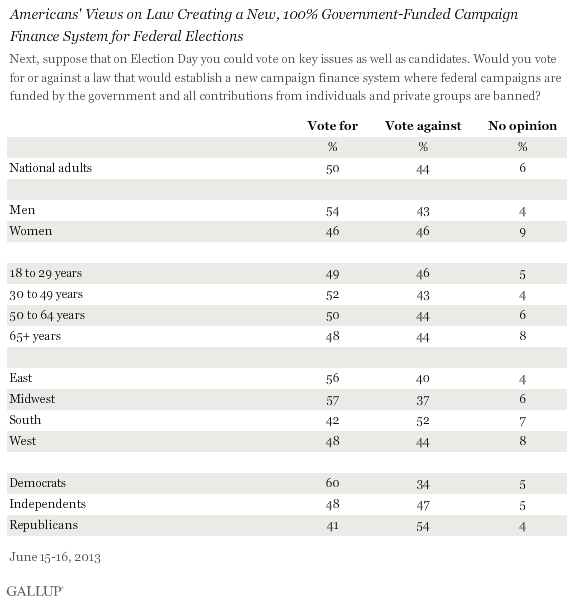
PRINCETON, NJ -- Half of Americans say they would personally vote for a law that establishes government funding of federal campaigns, while 44% would vote against it.
The poll was conducted June 15-16, just days before the New York State Senate narrowly defeated a comprehensive campaign reform bill for that state that would have included public financing of campaigns. Most key subgroups of Americans express fairly tepid support for this type of reform proposal. But Democrats, Easterners, and Midwesterners offer somewhat higher support; roughly six in 10 among these groups say they would vote for it. Among their counterparts, support drops below half. The only groups expressing majority opposition are those living in the South and Republicans.
Americans Would Limit Campaign Fundraising
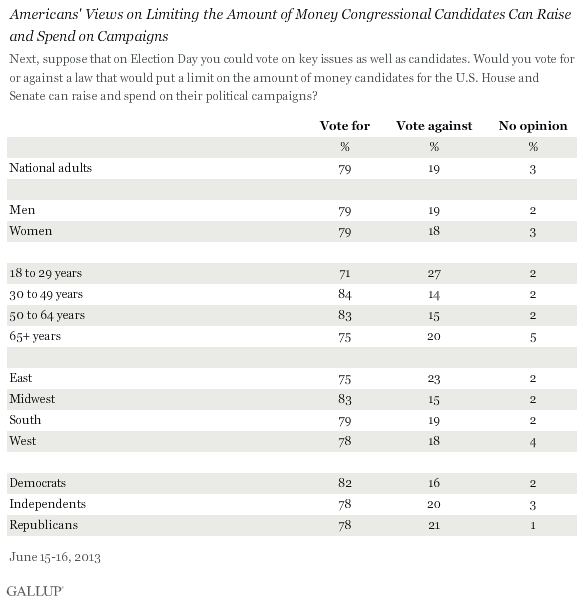
Americans are much more likely to support limiting the amount of money that U.S. House and Senate candidates can raise and spend for their campaigns.
Nearly eight in 10 say they would vote for such a limit, whereas 19% would oppose it.
This proposal is also far less controversial, with close to 80% of nearly every major demographic and political group favoring it.
Bottom Line
Campaign finance reform is an area of public policy seemingly plagued by the law of unintended consequences. Case in point: While the 2002 McCain-Feingold law was supposed to put an end to the influence of big money in politics, eager donors turned to independent expenditures financed through Super PACs as a way to conduct unlimited political advertising. And given the legal protection these received as "free speech" in the Supreme Court's 2010
Citizens United decision, there is more money than ever flowing into politics.
Over the years, Gallup has consistently found Americans dissatisfied with the way campaigns are financed, but
not especially eager for Congress to make addressing it a high priority. Similarly, while Americans have supported a whole host of campaign reform proposals involving enhanced disclosure and caps on what candidates can raise and spend, they have shown more reluctance toward footing the bill through federal financing. That was clearly the case in 2007, when
57% called public financing "unacceptable." There may be less objection today, with fewer than half, 44%, now saying they would vote "no" if given the chance to vote on implementing a public financing system, and
public confidence in Congress historically low. Nevertheless, it remains to be seen how hard Americans will press Congress to enact such a major reform.



 . Have you even read that article


 Not only are you asking people to forego potential lucrative careers as lobbyists or positions in industries they gave kickbacks to while they were in office, but you're asking them to bite the hand that feeds them while they're running, and campaigns cost money. Campaign finance reform is the ultimate example of how the will of the people doesn't translate into desired legislative outcomes.
