

http://www.sbnation.com/2013/11/21/5126774/nba-luxury-tax-2013-repeater-chicago-bulls
Next season, the repeater tax, which penalizes teams for being over the luxury tax for multiple seasons, comes into force. It is thought to be one of the toothiest new pieces of apparatus for revenue sharing and attempted market equality that the 2011 CBA has to offer. How toothy will it be?
Potentially, very.
The first challenge any franchise has is to build a good team. The second challenge is to keep it good. The first challenge is hard enough that about 20 franchises fail at it every season. The repeater tax is a direct and emphatic attack upon the second.
Under the first two seasons of this CBA, the luxury tax rates stayed the same as they were under the previous one. Teams paid $1 for every dollar they were over the luxury-tax threshold, and there was no repeater tax in force. As of this year, the rates of tax have changed, depending on how far over you are. These incremental ranges go from a $1.50/$1 dollar ratio from teams up to $5 million over, up to $3.75-$1 for teams between $20-$25 million over and increasing by an extra $.50 for every extra $5 million over that.
These rates are incremental. If you are $25 million over the tax, you don't pay $3.75 for every dollar you are over the tax, but instead only for every dollar more than $25 million over the tax, plus the appropriate rates for all increments up to that one. Confusing though it may be, the point is apparent: Teams considerably over the tax are going to really, really pay for it.
×
The first challenge any franchise has is to build a good team. The second challenge is to keep it good. The first challenge is hard enough that about 20 franchises fail at it every season. The repeater tax is a direct and emphatic attack upon the second.
Under the first two seasons of this CBA, the luxury tax rates stayed the same as they were under the previous one. Teams paid $1 for every dollar they were over the luxury-tax threshold, and there was no repeater tax in force. As of this year, the rates of tax have changed, depending on how far over you are. These incremental ranges go from a $1.50/$1 dollar ratio from teams up to $5 million over, up to $3.75-$1 for teams between $20-$25 million over and increasing by an extra $.50 for every extra $5 million over that.
These rates are incremental. If you are $25 million over the tax, you don't pay $3.75 for every dollar you are over the tax, but instead only for every dollar more than $25 million over the tax, plus the appropriate rates for all increments up to that one. Confusing though it may be, the point is apparent: Teams considerably over the tax are going to really, really pay for it.
Brooklyn's tax problem
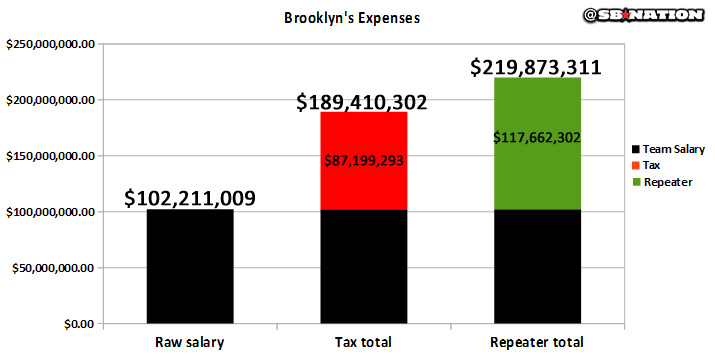
To put those numbers in a real context, we can use that most obvious example: the Brooklyn Nets and their tax number this season of $102,211,009 against a tax threshold of $71,748,000. Using the 2012-13 tax rates, they would have paid $102,211,009 in salary and $30,463,009 in luxury tax for a total expenditure of $132,674,018. Using this season's tax rates, though, they are due to pay the $102,211,009 in salary, but pay the tax at the various incremental rates. After some maths, this means a total tax bill of $87,199,293, for a total player payroll expenditure of $189,410,302.
As for the important part here, the same payroll and the same threshold with the repeater tax invoked would hypothetically mean a total tax bill of $117,662,302 in 2013-14, for a total player payroll expenditure of $219,873,311. This is astronomical and far in excess of Brooklyn's actual revenue. There is a reason Brooklyn is paying all that tax this season and not next: This year, the Nets aren't paying the repeater. The amount of tax they are already due to pay is outlandish. The repeater would push it into the ridiculous.
The above is a load of numbers, confusing ones at that. But the practical implications of it are more pertinent. How, exactly, do these numbers stop good teams from staying good?


