
RamsayBolton
Veteran
Well here we go


Well here we go


Especially that c00n poster with his fat Mexican box-shaped wife


Have never heard the term "red mirage" before today, as I don't watch a lot of the cable news shows.Just be ready for the bullshyt and know just like 2020 they won't count the mail in ballots initially so the results will look like Democrats didn't do well most likely until a day or so later.

It's basically the shyt Trump was complaining about in 2020 it was votes that just simply weren't counted yet because Republicans changed laws that they can't be counted until the election day counts are done.Have never heard the term "red mirage" before today, as I don't watch a lot of the cable news shows.
I will say this, though, John King aka John Madden's "son" did a good job of detailing what the election maps show and don't show.
"this district is red, but we're not done"
Gonna watch thegrio for election coverage, hope they have a separate election map analyst


Did a mail in ballot myself.Voted yesterday to beat the crowds
I don't have a good feeling about my state

For people on here who believe the GOP aren't working to weaken the Black vote - What is this?
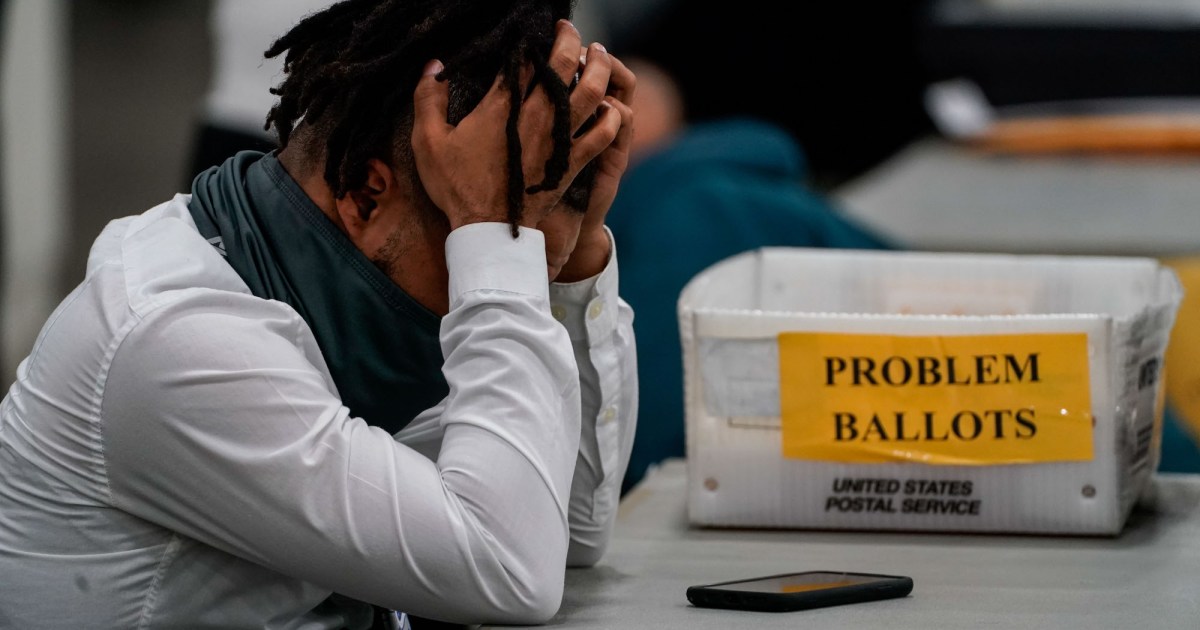
The GOP is trying to throw out thousands of votes in—you guessed it—Detroit
It's 2020 redux.www.motherjones.com
Why was Detroit the only target here? Why was the goal here to subject absentee voters in Detroit to a different set of rules compared to the rest of the state?

 www.detroitnews.com
Michigan’s Tuesday general election is poised to produce, depending on voter preference, historic firsts up and down the ballot and across both peninsulas — in Congress and the state Legislature, in Grand Rapids and Flint, in constitutional rewrites and executive branch races.
After a shakeup of district lines in December, long-held patterns in Congress and the state Legislature could be disrupted and a close attorney general race could see the ouster of an incumbent for the first time in 68 years.
Three separate measures on Tuesday’s ballot seek to amend Michigan’s state constitution — with one seeking to rewrite term limits voters adopted in 1992, and another seeking to secure abortion access after decades of debate.
Here are some of the historic firsts Michigan could see:
1. A 'seismic shift' in the Senate?
Michigan Democrats haven’t controlled the state Senate since 1984, but the party’s leaders are hoping that new district lines will help provide a landmark win and break the streak of GOP supremacy on Tuesday.
There are 38 seats in the Senate, and lawmakers from both sides of the aisle acknowledge the fight for power will likely come down to five of them, including the 30th District, which is based in Kent County, and the 35th District, which features Bay City, Midland and Saginaw.
In Metro Detroit, Democrats and Republicans are both targeting the 11th and 12th districts. Democrats will need to win a few of the swing seats to be successful. If they do, Michigan will likely also have its first female Senate majority leader, either state Sen. Winnie Brinks, D-Grand Rapids, or Sen. Stephanie Chang, D-Detroit.
Sen. Jeremy Moss, D-Southfield, said his party has a “historic opportunity” to push forward its values, such as continuing record investments in K-12 public education and protecting abortion rights. He described the potential change in power as a “seismic shift.”
“You take the youngest senators,” Moss said. “We have lived under a Republican majority our entire lives.”
But current Senate Majority Leader Mike Shirkey, R-Clarklake, also voiced optimism on the eve of the election.
“I am confident we have laid out and executed a compelling campaign demonstrating Senate Republicans offer the best antidote to the disastrous policies of (Gov. Gretchen) Whitmer-(President Joe) Biden,” Shirkey said.
2. Abortion proposal would nix 1846 ban
Voters on Tuesday could invalidate an abortion ban that’s effectively been on the books in Michigan for more than 175 years if a proposal seeking to enshrine abortion rights in the state constitution is adopted.
While the exact reach of Proposal 3 has been hotly debated, both supporters and opponents agree that it would — at the very least — invalidate Michigan’s abortion ban, which was most recently updated in 1931.
The ban has been largely unenforceable since 1973, when the U.S. Supreme Court in the landmark Roe v. Wade case declared abortion was a protected right under the U.S. Constitution. In June, the Supreme Court reversed that decision and sent the question of abortion rights back to the states.
Since the June decision, Michigan’s abortion ban has been blocked from enforcement by a series of court injunctions.
Proposal 3 would not only rewrite the state constitution; it’s likely, if it passes, to rewrite the terms of Michigan's debate over abortion rights.
3. Gov election gets absentee treatment
Michigan is likely to see the largest absentee vote in a gubernatorial election in state history.
As of Monday, Michigan clerks had received a little more than 2 million absentee ballot requests and had received nearly 1.7 million filled-out absentee ballots, according to data from Secretary of State Jocelyn Benson's office. Benson estimated last week that 4.3 million individuals would participate in Tuesday’s election — putting predicted turnout on par with the 2018 gubernatorial election.
Since 2020, Michigan has seen about 50% of voting take place via absentee in both primary and general elections, but Tuesday’s election will mark the first time the governor's race is subject to a similar dynamic.
No-reason absentee voting was not in place during the 2018 gubernatorial election, the year voters approved the measure allowing for expanded absentee voting and same-day registration.
On the Friday before the 2018 gubernatorial election, Michigan clerks reported receiving roughly 1.2 million absentee requests and had received about 927,000 ballots back.
4. First Black Republican in Congress
Two Black Republicans are running in competitive U.S. House races in Michigan: John James in the 10th District encompassing parts of Macomb and Oakland counties, and John Gibbs in the 3rd District, which includes parts of Kent, Ottawa and Muskegon counties.
If either or both win, they would be the first Black Republicans to represent Michigan in Congress. Gibbs would also be the first Black person to represent the Grand Rapids area, a district that is majority White but has become more diverse over the last several years.
“Democrats’ worst nightmare is that Black people start to think and look at the situation and say, ‘Maybe we can try something new,’” Gibbs told former President Donald Trump adviser Steve Bannon on his show “War Room” last week. “Someone like me is a threat to (Democrats) because of what I represent, the potential beginning of a movement away from the Democrat party.”
If neither James nor Gibbs wins their contests, it would be the first time in 68 years no Black individual represented Michigan in Congress. Former U.S. Rep. Charles C. Diggs Jr., a Detroit Democrat, became the first Black person to represent the state in 1955.
5. Scholten looking for firsts in Grand Rapids
Democrat Hillary Scholten, a Grand Rapids immigration attorney, would be the first woman ever to represent her hometown in Congress if she prevails on Tuesday.
She is running against Gibbs to represent the new 3rd District that's centered around Michigan's second-largest city.
If she wins, Scholten would also be the first Democrat to win a congressional seat in the area since 1974, when attorney Richard Vander Veen won a special election to succeed former President Gerald Ford, who once held the seat but stepped down to become Richard Nixon's vice president.
It would be a historic first that Scholten has raised on the campaign trail to rally supporters: “We finally have fair, competitive lines that will allow us to send the first Democrat to Congress in almost 50 years,” she told volunteers Saturday.
6. First Indian American congressman likely headed to D.C.
Democratic state Rep. Shri Thanedar of Detroit is the favorite to win election to Congress in the heavily Democratic 13th District representing parts part of Detroit, the Grosse Pointes and Downriver communities.
That would make Thanedar, 67, the first Indian-American lawmaker to represent Michigan in the U.S. House. He moved to the United States from India at age 24 to pursue a doctorate, later becoming a citizen. The businessman won a nine-candidate Democratic primary in August.
"I am the most unlikely person to become a representative in Congress — an immigrant who came with nothing, someone who grew up in poverty. So I just feel honor and tremendous responsibility to deliver for my district," Thanedar said.
While Thanedar would be the first Indian American to represent Michigan in the House, he would not be the first Asian American to do so. That distinction, according to the Office of the Historian, goes to former U.S. Rep. Hansen Clarke, a Democrat who represented Detroit in the House for one term.
Thanedar faces GOP nominee Martell Bivings — a third Black Republican running for Congress this cycle — in Tuesday's election.
7. AG race could produce upset
Attorney General Dana Nessel and Kalamazoo lawyer Matt DePerno are locked in one of the tightest races in the state — the results of which could upset a streak of Michigan attorneys general winning their reelection campaigns that dates to the late 1950s.
An incumbent attorney general has not lost reelection since 1954, according to Bill Ballenger, a political commentator and former state senator. Republican Frank Millard lost his reelection bid that year to Democrat Thomas Kavanaugh.
An Oct. 26-28 statewide poll commissioned by The Detroit News and WDIV-TV (Channel 4) found Nessel held a one percentage point lead over DePerno, 44%-43%. The margin of error for the poll was plus or minus four percentage points.
In her first race in 2018, Nessel eked out a 3-percentage point win over Republican former House Speaker Tom Leonard.
8. Could Flint lose a Kildee?
U.S. Rep. Dan Kildee, D-Flint Township, is in a hotly contested race for the U.S. House with Republican Paul Junge in the new 8th District, which encompasses Genesee, Bay and Saginaw counties and portions of Midland County.
If Junge prevails, it would topple a 45-year streak of Kildees representing the area in Congress. Kildee took over the seat in 2013 from his uncle Dale Kildee, who had held it since 1977.
Kildee has leaned into his longstanding ties to the district during the campaign, highlighting his roots in the area while hammering Junge for moving to the district for the first time to run for Congress.
Junge has argued Kildee’s policies aren’t working for the area.
“As I've been campaigning, I certainly hear from a lot of people who feel like after 46 years of Kildees in Congress, it's time for something new and something different,” Junge told The News earlier this year.
9. Electing them young?
Candidates for the state Legislature who would be among the youngest lawmakers in Michigan history could also win on Tuesday.
Democrat Maurice Imhoff, 20, of Jackson is running in the 46th House District against Republican Kathy Schmaltz of Jackson. If he’s victorious, Imhoff would be the youngest legislator in modern political times in Michigan. He halted his campaign for office in October after news broke that he was once the subject of at least three investigations into threats against a Jackson-area middle school and high school he attended. Later, he relaunched his bid.
In the 4th state Senate District, Republican Houston James of Flat Rock is in a competitive race against state Rep. Darrin Camilleri, D-Trenton.
James is 23 years old. If James wins, he’d be one of only a handful of Michigan senators to get seats in the Senate at age 23 or younger, according to data tracked by the Library of Michigan.
David Plawecki was 22 when he was elected in 1970 and became the youngest state senator in Michigan history, according to the Michigan Manual.
10. GOP wants U.P. sweep
Michigan’s shifting political dynamics could be on display in the Upper Peninsula. The region has sent at least one Democratic state lawmaker to Lansing for at least the last 95 years, according to a review of biographies from the Library of Michigan.
The Upper Peninsula’s Democratic legislators have built a reputation of working across the aisle and have included former House Appropriations Chairman Dominic Jacobetti, who served for nearly 40 years. But Republicans are hoping to sweep the six legislative seats that cover portions of the U.P. on Election Day as voters there show signs of shifting away from the Democratic Party.
The most competitive seat will be in the new 109th District, where Democrat Jenn Hill of Marquette is facing Republican Melody Wagner of Gwinn. Over the last decade, Marquette County has been represented by Democrats in the state House, but state Rep. Sara Cambensy, D-Marquette, can’t run for reelection because of term limits.
State Sen. Ed McBroom, R-Vulcan, said he’s not sure whether voters in the U.P. are changing or the Democratic Party is stepping away from the types of candidates who’ve won there before. An anti-abortion, pro-gun and pro-hunting Democrat could still win, he said.
“I think it has more to do with how both parties have changed,” McBroom said.

Who you talking about my g?

That fraud c00n that has me on ignore. He the "bootstraps" kind of c00n that loves when other (poor black) people struggle while he screams "traditionalism" with his box-shaped Mexican wife.

It will be absolutely shocking if the Democrats don't lose the House. Biggest upset of my life other than Trump.
Senate could go anywhere now. A month or two ago I was convinced the Dems were gonna come out with 51-52 seats but now they might struggle to hold on to 50. Georgia, Nevada, Arizona and Pennsylvania voters really need to step up (and hopefully a hail mary in Wisconsin or Ohio with luck).


