US and UK conducting war games for banking collapse

Scientific Playa

Superstar
Supporter
Joined
Oct 13, 2013
Messages
13,930
Reputation
3,310
Daps
24,908
Reppin
Championships
:sadcam:

US and UK conducting war games for banking collapse
October 12, 2014

Regulators from the United States and the United Kingdom will get together in a war room next week to see if they can cope with any possible fall-out when the next big bank topples over, the two countries said on Friday.
Treasury Secretary Jack Lew and the UK’s Chancellor of the Exchequer, George Osborne, on Monday will run a joint exercise simulating how they would prop up a large bank with operations in both countries that has landed in trouble.

Also taking part are Federal Reserve Chair Janet Yellen and Bank of England Governor Mark Carney, and the heads of a large number of other regulators, in a meeting hosted by the U.S. Federal Deposit Insurance Corporation.

“We are going to make sure that we can handle an institution that previously would have been regarded as too big to fail. We’re confident that we now have choices that did not exist in the past,” Osborne said at the International Monetary Fund’s annual meeting.

Six years after the financial crisis, politicians and regulators around the globe are keen to prove they have created rules that will allow them to let a large bank go under without spending billions in taxpayer dollars.

Currency-money.jpg


They have forced banks to ramp up equity and debt capital buffers to protect taxpayers against losses, and have told them to write plans that lay out how they can go through ordinary bankruptcy. The plans are so-called living wills.

Yet salvaging a bank with operations in several countries – which is the norm for most of the world’s largest banks such as Deutsche Bank, Citigroup Inc and JPMorgan – has proven to be a particularly thorny issue.

Because the failure of a big bank is such a rare event, regulators may not be used to talking to each other. There have also been suspicions that supervisors would first look to save the domestic operations of a bank, and would worry less about units abroad.

The exercise comes as regulators are about to bring to fruition further initiatives to make banking safer.

The first would force banks to have more long-term bonds that investors know can lose their value during a crisis, on top of their equity capital, to double their so-called Total Loss-Absorbing Capacity (TLAC).

A second measure, expected to be announced this weekend, will force through a change in derivative contracts, which in their current form protect investors, and complicate the winding down of a bank across borders.

Source: http://www.reuters.com/article/2014/10/10/banks-regulations-collapse-idUSL2N0S52LK20141010

:whoo:
 

Scientific Playa

Superstar
Supporter
Joined
Oct 13, 2013
Messages
13,930
Reputation
3,310
Daps
24,908
Reppin
Championships
"Prepare For Runs", IMF Warns Policymakers Of "Elevated Financial Stability & Liquidity Risks"
Submitted by Tyler Durden on 10/12/2014

The extended period of monetary accommodation and the accompanying search for yield are leading to credit mispricing and asset price pressures, increasing the chance that financial stability risks could derail the recovery.


Concerns have shifted to the shadow banking system, especially the growing share of illiquid credit in mutual fund portfolios.

Should asset markets come under stress, an adverse feedback loop between outflows and asset performance could develop, moving markets from a low- to a high-volatility state, with negative implications for emerging market economies.


Funds investing in credit instruments have a number of features that could result in elevated financial stability risks.

First is a mismatch in liquidity offered by investment funds with redemption terms that may be inconsistent with the liquidity of underlying assets. Many credit funds hold illiquid credit instruments that trade infrequently in thin secondary markets.


Second is the large amount of assets concentrated in the hands of a few managers. This concentration can result in “brand risk,” given that end-investor allocation decisions are increasingly driven by the perceived brand quality of the asset management firm. Sharp drawdowns in one fund of an asset manager could propagate redemptions across funds for that particular asset manager if its brand reputation is damaged, for example through illiquidity or large losses.


Third is the concentration of decision making across funds of an individual fund manager, which can reduce diversification benefits, increase brand risk, or both.


Fourth is the concentrated holdings of individual issuers, which can exacerbate price adjustments.


Fifth is the rise in retail participation, which can increase the tendency to follow the herd.

These features could exacerbate the feedback loop between negative fund performance and outflows from the sector, leading to further pressure on prices and the risk of runs on funds. These risks could become more prominent in the coming year as the monetary policy tightening cycle begins to gain traction.


Such stress might be triggered as part of the exit from unconventional monetary policy or by other sources, including a sharp retrenchment from risk taking due to higher geopolitical risks.

And, as we have discussed numerous times previously, less liquidity is available from traditional liquidity
providers...


The IMF is worried...

Policymakers and markets need to prepare for structural higher market volatility. Doing so requires strengthening the system’s ability to absorb sudden portfolio adjustments, as well as addressing structural liquidity weaknesses and vulnerabilities.


Advanced economies with financial markets at risk for runs and fire sales may need to put in place mechanisms to unwind funds should they come under substantial pressure that threatens wider financial stability.

Source: IMF
 

Scientific Playa

Superstar
Supporter
Joined
Oct 13, 2013
Messages
13,930
Reputation
3,310
Daps
24,908
Reppin
Championships
War On Wall Street And London...China will use gold and gold pricing to force global currency reset


Date: Sunday, 12-Oct-2014 19:52:36


On Sept. 30, statistician and economist Dr. Jim Willie was a guest on the Caravan to Midnight radio show to talk about current financial, economic, and geo-political events. During his three hour interview, Dr. Willie stated that one of the purposes behind China's creation of the new Shanghai gold exchange is to eventually take over global price controls for the monetary metal away from the Comex, and then force a global currency reset by raising the price of gold to its true or actual value.

The way this will come about in the near future according to Dr. Willie, is that China will re-price gold to near or above twice the current price, which will have a devastating effect on derivatives and ongoing use of the Comex futures market to suppress gold prices, and protect the dollar. And based upon supply details for the Comex over the past two years, America's primary gold exchange no longer settles their contracts through the delivery of physical gold, but instead settles in cash payments or through the hedging of gold using derivatives. Subsequently, once this failure to deliver takes place, then China, through the Shanghai gold exchange, will become the default market for price discovery, and at that point will re-adjust gold to its true value, instantly causing massive chaos in the fiat currency markets and leaving the world little alternative but to implement a complete currency reset.

Dr. Jim Willie: When we get this next global currency reset, it's going to be a complete reset. It apparently will happen predominantly in the gold world. They are going to change the price of gold, and jam it down the U.S.'s throat.

Take a look at the Comex. Since the middle of 2012 or so, they've been forcing gold contracts to settle not in metal, but in cash. And if you don't like it, they'll ban you from the Comex. There's been very little if any settlement of gold futures contracts for two years in gold metal. They're not a gold market anymore, they're a derivative market for gold instruments.

So, in late September... about a week ago, Shanghai started offering a gold and futures contract, and they're settling in metal. And this is rabidly threatening the United States and London. And interestingly, you will notice shortly after this new exchange opened there are now uprisings in Hong Kong.

But this is the final phase... the end game of the next reset. They are going to do this in Shanghai and with their global gold contracts, with the real big event that's going to create mass disruptions in the currency markets. And those disruptions will be from the Asians declaring what the gold price is, and with the Asians delivering and supplying physical metals at that gold price. - Caravan to Midnight, Sept. 30

Several economic analysts, including John Williams, Peter Schiff, Dr. Paul Craig Roberts, and Gerald Celente all gave predictions earlier this year that a global currency reset event was going to take place in 2014, with most believing it would come before the end of summer. However, with the U.S. not on board with the rest of the world, and instead seeking military conflicts to delay the end of the petro-dollar system, both Russia and China have had to accelerate their efforts to create infrastructures that will allow a more fluid transition for global trade once a currency reset actually takes place.

Over the past several weeks, the dollar has grown in strength at the same time the rest of the world's currencies have been collapsing. And because of this, global accumulation of physical gold at depressed levels is running at or near historic highs in an attempt to hedge sovereign currencies that have run out of muster from years of low interest rates and slow money velocities. And as several global financial indicators begin to reach a nexus, and threaten once again to bring the world into another economic crisis, China is recognizing that physical gold is the ultimate catalyst to force an end to the domination of purely fiat finance, and that by revaluing gold to its rightful price will have the effect of both protecting their own currency, and wresting financial control away from the West and the system of dollar hegemony.

http://www.examiner.com/article/china-will-use-gold-and-gold-pricing-to-force-global-currency-reset
 

Scientific Playa

Superstar
Supporter
Joined
Oct 13, 2013
Messages
13,930
Reputation
3,310
Daps
24,908
Reppin
Championships
What the Heck just Happened in Global Stock Markets?
October 12th, 2014

Wolf Richter wolfstreet.com, www.amazon.com/author/wolfrichter


Bitter ironies are piling up – with very crummy consequences.


It was a crummy week for the world’s major stock markets:


One, volatility came roaring back. Forget complacency. People are still rubbing their necks from whiplash.


Two, the Fed hype-effect fizzled. The publication of the FOMC minutes – designed to pump up markets with their ambiguities – was able to generate a rally that lasted less than a day, followed by a terrific swoon. The ECB too tried to goose markets, which failed miserably. And the Bank of Japan, well, I call it Bank of Japandemonium for a reason.


Three, the relentlessly successful strategy, nay religion, that worked without fail for the last couple of years and allowed traders to earn instant bucks in a seemingly risk-free manner – “Just buy the frigging dip” – turned into a vicious back-biting monster.


The Nasdaq, after dropping 4.5% for the week, the worst since May 2012, closed on Friday below its 200-day moving average. So did the Dow. For chart decipherers and trend prophesiers, those are not exactly propitious signs.


The thing is, if everyone believes that everyone believes in this sort of line crossing and reacts to it, then a simple line either bouncing off or crossing over another line can become a magic signal for a lot of people. And they react to it in unison, and it becomes a self-fulfilling prophesy. It worked wonderfully on the way up. And because it worked so wonderfully and made people rich, more and more traders and investors became chartists, and even economists switched to becoming chartists because economic and corporate fundamentals had become irrelevant to stocks, which soared no matter what, and they had to find something else that their clients actually wanted to hear.


But it’s not just in the US. The European Stoxx 600 dropped 4.1% for the week, also its worst week since May 2012. Most of the national indices were splattered with red. Germany’s Dax dropped 4.4% to the lowest level since October last year. It’s down 12.6% from its all-time peak in January. It’s in a full-blown correction.


The UK’s FTSE 100 dropped 2.9% for the week and closed at its lowest point in a year, down 8.4% from its peak in early August. France’s CAC40 dropped 4.9% and is down 11.4% from its June high, now mired in a correction and in the hole for the year. Even India’s SENSEX, which had been on a politically motivated tear, swooned nearly 5%.


The Nikkei deserves a special word: it dropped 2.6% for the week and is now down 6% for the year. It has been in the red practically all year. The historic money-printing binge that came with Abenomics caused stocks to soar for the first seven months after it became clear in late 2012 that Shinzo Abe and his economic religion would run the show. Then the sheen wore off. What’s left? The same old economy, huge government deficits, an untenable national debt, and consumers who are learning the meaning of what I call “inflation without compensation,” the gradual process of impoverishment via inflation.


Oh, and at a time when annual inflation is 3.3% (goods inflation at 4.9%, service inflation at 1.8%), 10-year Japanese Government Bonds yield 0.50%. It’s the world’s most brutal financial repression. So, despite the pile of money the Bank of Japan has been printing, the Nikkei is now below where it was in May 2013.


The only two major indices that came out ahead were China’s Shanghai Composite (up 0.4%) and Hong Kong’s Hang Seng (up 0.1%). Maybe the markets were just lucky. It was a holiday week with only three trading sessions in Shanghai and four in Hong Kong. Did these folks simply run out of time to dump stocks?


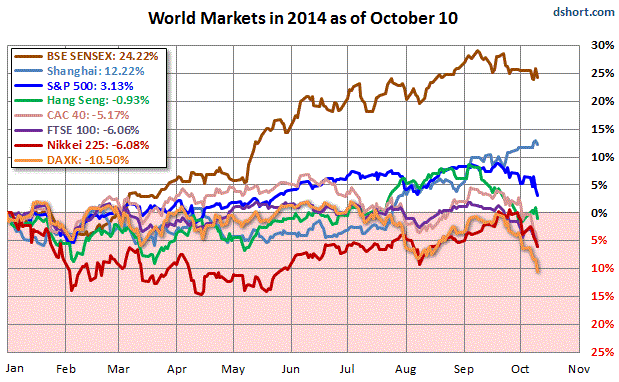
Here are the sinners (chart by Doug Short):


Germany’s DAXK is the orange line that is sagging out at the bottom. The DAXK is the price-only version of the DAX, which includes dividends. The other indices are price-only as well, so the DAXK is an apples-to-apples comparison. This DAXK is down 12.5% from its peak in July. And it’s 11% in the hole for the year.


German stocks are smelling a rat. The economy is on the verge of heading into a recession. When it shrank in the second quarter, pundits fanned out across the planet to claim vociferously that it was just a blip, and they blamed the weather which had been unusually nice in the first quarter! But more recent economic data has been lousy, so lousy that they evoked unnerving comparisons to the unforgettably terrible year of 2009 [read... “There’s no Reason to Panic” about the German Miracle Economy].


Now unnamed sources in the ruling coalition leaked that the German government would cut its growth forecast for this year and next year on Tuesday, when it announces its twice-a-year projections. It would amount to a “sharp cut” from the already tepid 1.8% growth projections made in April.


This despite the all-out ZIRP and QE central banks have inflicted on conservative investors and aging baby boomers in order to force them into stocks and junk-bond funds and asset-backed securities and other chimera of Wall Street. The purpose was to drive up asset prices. And it worked. Now that these folks have stashed their money in stocks at peak valuations, the whole thing is unraveling.


The bitter irony in all this? The global economy is drifting off despite massive and global application of policies that have consistently been described as “bold actions” to stimulate the economy: dizzying government deficits, massive QE, and brutal ZIRP. These “bold actions” have driven up asset values, but that’s all they’ve done. And now as things are once again wobbling, global organizations like the IMF along with various central bankers and of course the wusses on Wall Street are clamoring for more “bold action.”


In the US, mega-startups have gone parabolic as the bubble blooms into its full splendor. Read… Last Time It Was This Crazy, the Stock Market Crashed


Content From The Web:

Read more at http://investmentwatchblog.com/what...-in-global-stock-markets/#YctEA1Q5KDViPJf0.99
 

KingTut

Green diamonds like a dill pickle
Joined
Sep 17, 2014
Messages
7,667
Reputation
3,021
Daps
54,544
Reppin
TX
I been saying 2007 was just a teaser of what was to come soon. Student loan bubble is the next to burst and shyt will probably just get worse from there.
 
Top