March 19, 2026
Historically Black Land-Grant Universities Celebrate USDA Agreement as âBig Winâ
Leaders of historically Black land-grant universities are celebratingâand breathing a sigh of reliefâafter they signed an agreement with the U.S. Department of Agriculture earlier this month to reaffirm and deepen their collaboration with the federal agency.
The USDA has signed such agreements with these institutions since Ronald Reaganâoften at the start of a new administrationâbut the new memorandum of understanding reassures the universitiesâ leaders that the Trump administration will continue to support and work with their institutions, said Harry Williams, CEO of the Thurgood Marshall College Fund, which represents public HBCUs.
Felecia M. Nave, president and CEO of the 1890 Universities Foundation, which advocates for historically Black land-grant institutions, said the MOU âbuilds on prior efforts while placing a stronger emphasis on ensuring that our work is not just symbolic, but truly actionable.â
The agreement reaffirms the âcritical role we play in advancing this administrationâs America First agenda, particularly through its recognition of the importance of agriculture to our nationâs economic strength, food security, and long-term sustainability,â she wrote to
Inside Higher Ed. âOur work is not on the margins; it is at the core of the issues that shape our countryâs future.â
In the agreement, the USDA committed to exploring opportunities for historically Black land-grant faculty and administrators to work within and contribute their expertise to the department. The department will also continue its network of USDA liaisons on campuses with the goal of âproviding regional supportâ to the universities and âincreasing the number of students in the areas of food, agricultural science, natural resources, environmental sciences, and other agriculture-related fields.â
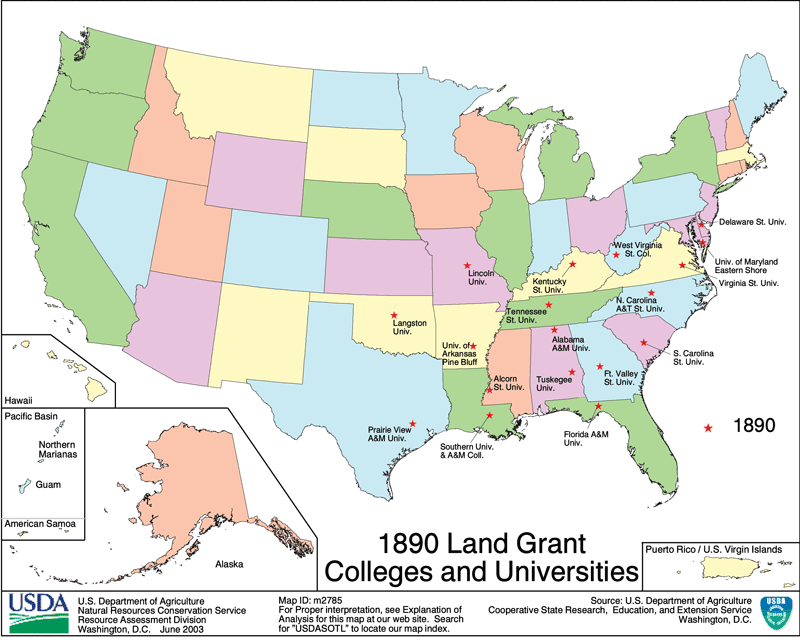
Notably, the agreement re-establishes a task force of department officials and historically Black land-grant university presidents who meet at least twice a year to discuss ways to strengthen the institutions and their historic missions. These 19 universities gained land-grant status under the Second Morrill Act of 1890 to ensure Black Americans had access to agricultural and technical sciences education.
âThis MOU serves as a vehicle to actualize and strengthen the work and partnerships between our institutions and the initiatives supported by USDA,â Nave said. âIt ensures that collaboration is not only sustained, but also more intentional, coordinated and results-driven.â
Ericke S. Cage, president of West Virginia State University and chair of the Council of 1890 University Presidents, said the agreement came through after months of advocacy. The main advantage of having it in place is it provides a âformalized platformâ to âengage directly with the USDA.â
âThis will provide a forum for us to raise up issues that are of significance, of importance, to our 1890 institutions and to find alignment and opportunities within the priorities and funding resources that USDA currently has available,â Cage said. âSo, I think thatâs the big win.â
Hopes for the Future
Historically Black land-grant university leaders hope that the refreshed line of communication will help them to secure more funding and opportunities for their students.
Cage said institutions like his need more funds to devote to campus infrastructure at a time when they struggle with
deferred maintenance backlogs but want to invest in new technology and research to support American agriculture. For example, West Virginia State University is interested in research on how AI and cybersecurity measures could protect farmersâ online operations.
More infrastructure funding would help âensure that our researchers and our students are able to certainly work in best-in-class facilities, which will help us to drive innovations that we can deploy out in the field and help our farmers and our ranchers do the important work that they do,â Cage said. âWe believe that our institutions are well positioned to help tackle the problem of global food insecurity.â
Williams, of TMCF, hopes the task force can help advocate for the
IGNITE HBCU Excellence Act, legislation lawmakers plan to revive after it didnât pass in 2022, though
language from it made it into former president Joe Bidenâs fiscal year 2023 omnibus bill. IGNITE would create a competitive grant process to fund upgrades to HBCU campus facilities and equipment.
Infrastructure money is particularly important to historically Black land-grant institutions after decades of chronic underfunding, Williams said. States are supposed to match federal grants for food and agriculture research to land-grant universities dollar for dollar but historically often neglected to do so for 1890s institutions.
The secretaries of education and agriculture under President Biden concluded that 16 historically Black land-grant institutions were
underfunded by their states a total of $13 billion over three decades and called on governors to pay up. Trumpâs
executive order in support of HBCUs, signed last spring, also committed to âencouraging states to provide the required state matching funds for 1890 Land-Grant Institutions.â
Some states have since partially or fully made up for the missing dollars, but closing the remaining funding gaps will be a âtopâ priority, Williams said.
An Improving Relationship
Historically Black land-grant universities and the Trump administration arguably got off to a rocky start last year when the USDA temporarily suspended the 1890 Scholars Program, which provides federal scholarships to agriculture students at their institutions. But within days, after fierce backlash from lawmakers and higher ed leaders, the federal agency
reinstated the program and reopened applications.
Agriculture Secretary Brooke L. Rollins praised the program in a
January call for applications.
âNow more than ever we need to encourage our young people to join the noble and fulfilling profession of farming and feeding our fellow citizens,â Rollins said in a statement. âPresident Trump has made it a priority to promote excellence at Historically Black Colleges and Universities, and USDA is proud to further these efforts through this important program.â
Cage hopes, through the task force, university leaders can secure more opportunities for their students, whether thatâs an expansion of the 1890 Scholars Program or new internships at the USDA. He acknowledged âsome initial challengesâ under the Trump administrationâincluding some temporary disruptions to his institutionâs federal funds for purported ties to DEIâbut said the USDA has since proved a âsupportive partner.â
âWhat I can say is that the department and the administration have been responsive to our concerns,â he said, noting that
new federal money flowed to HBCUs in the fall and his previously suspended funds were restored after conversations with department officials and lawmakers. âAre there areas where we want to see some more support? Sure. But I think, in general, itâs been a pretty positive relationship.â