

Dr. Narcisse
Veteran
Black people never sold Black people into slavery.
Better said, the idea posited by white supremacy that Black people sold Black people into slavery at the outset of the Transatlantic Slave Trade is an intellectual lie.
African people sold African people into slavery. That much is true. “Black” had nothing to do with it. “Black,” as we know it today, is a unifying diasporic definition that seeks to cement solidarity and foster shared understanding between people of the world who have been impacted by white supremacy.
That didn’t exist then.
It’s true that the idea of “Black” itself was invented with a specific utility in mind. “Black,” as we know it, was invented to designate what is not white, and therefore is subject to being owned by whiteness. In the global capitalist race to colonize and harvest foreign lands for power projection, the designation of “Black” was invented to identify which HUMANS could be harvested to achieve that goal.
But fukk all that. We changed it.
Black, as I understand it, has always been about who I should expect safety from. Black represents the choice of a global people to live freely despite the grotesqueries of invention. The project of the Black diaspora is rebellion. A rebellion that exists to stress the foundation of worldwide white supremacy until the cracks become overwhelming enough for it to crumble, and from that, build something new.
Or better yet, build something new with systems, rules, and traditions all our own. We’ve already done that to a large degree, but I’m talking about something further. I’m talking about power, not safety. You see, in this world, there is no safety without power. If you are constantly asking white supremacy not to hurt you, you’re appealing to its morality. Won’t work. Anyone invested in white supremacy is already immoral; asking them to grow concern is a fool’s errand.
That’s not the way I approach peace. I’d rather be powerful enough to dare someone to hurt me, warning of the consequences after. This appeals to their sense of self-preservation.
When faced with pain or annihilation, peace becomes an easy choice.
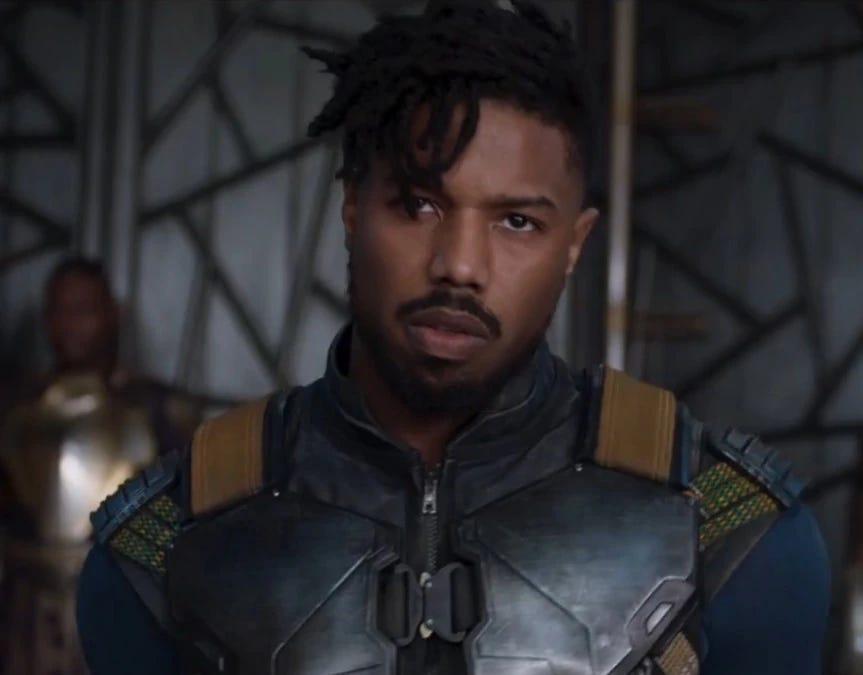
This is why I fukk with Erik Killmonger more than any other hero in the Marvel Cinematic Universe … and I mourn him this Black History Month.
If you’ve seen Black Panther, you know how the story goes. T’Challa, the crown prince of the fictional African kingdom of Wakanda, has ascended to the throne after his father, T’Chaka, was killed by Baron Zemo. T’Chaka got hit the way a lot of dudes in Baton Rouge I know got hit: wrong place, wrong time. It can happen to anyone. Anyway, T’Challa must then head back to Wakanda and stabilize the country politically. This is a fraught assignment for three reasons.
One, T’Chaka has ruled for a long time. A long rule can be good for a kingdom, but there are also negatives. When a king rules for an extended period of time, it can create dilemmas in succession. A longer rule can result in the development of rigid familial and political ties over that time. Factions develop, meaning the new king will have to solidify his claim before his rule even begins. This can be bloody.
Two, Wakanda still has ritual combat to choose leaders. This means anyone with fire hands can become King. You need royal lineage, of course, but if you have that, you’re one left hook away from the throne. We see this in the first act of the movie when T’Challa has to fight a defensive tackle before he can be crowned. The suspense of watching a wide receiver fight Aaron Donald for the captaincy of a nation was incredible. Right after our hero prevails, we learn the third reason his young reign was in trouble …
Wakanda has a secret. That secret is Erik Killmonger.
When we meet Erik Killmonger in Black Panther, we think we know him. We see a young Black man with a questionable hairstyle taking part in a heinous crime. The crime itself is supposed to define Killmonger. He, along with veteran MCU baddie Ulysses Klaue, is robbing a London Museum (that looks EXACTLY like the High Museum in Atlanta) of an ancient artifact. The robbery is bloody; they murder people to get it done. It’s also righteous, because, as Killmonger explains in a fantastic piece of writing, what they are stealing was stolen in the first place. The audience knows, both from history and intuition, that the theft Killmonger is detailing was much more vicious and profound than anything we will witness over the next couple of minutes, so the scene’s brutality is somewhat muted by context. The robbery, because of Killmonger’s politics, feels like just retribution and not pure greed.
To sum up, when Killmonger is introduced to us, he seems like a young man who’s doing the wrong thing for what he thinks is the right reason. Furthermore, no matter how bad it goes, there’s nothing he can do that can match what’s been done to him, or the historical and social situation he was born into.
I know that guy.

Last edited:








 he would kill that bytch again and yall mamas boys would clutch your pearls again