Venezuela’s Giant Lake of Endless Oil Is a Filthy, Lawless Mess
by
Pietro Pitts
August 3, 2015 — 7:01 PM EDTUpdated on August 4, 2015 — 12:50 PM EDT
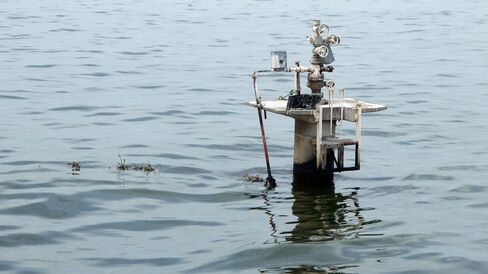
Lake Maracaibo, a 5,097 square mile body of water, is a graveyard for everything from abandoned pipeline to tires. Photographer: Pietro Pitts/Bloomberg
From the moment the diver in red nylon coveralls and blue Chuck Taylor sneakers resurfaces after replacing rusted pipeline on the bed of South America’s largest lake, it’s a race against time. Coated head to toe in dark-black oil, he clambers aboard the service boat, rips off his makeshift uniform and scrambles to hose himself down with a special compound to wash away the contaminants.
For nearly a century, the petroleum deposits beneath giant Lake Maracaibo served as a cash cow for successive Venezuelan governments. In return, especially in the years since the company’s energy industry was nationalized by former President Hugo Chavez, it has received little back but neglect.
The Maracaibo basin is where Venezuela’s enormous energy bounty, including oil reserves that dwarf even those of Saudi Arabia, smacks up against the diminished capacity of the state-owned monopoly producer, Petroleos de Venezuela SA, to manage the twin demands of increased production and environmental protection.
Today, the 13,200 square kilometer (5,097 square mile) body of water, a graveyard for everything from abandoned pipeline and tires to dreams of Venezuelan prosperity, stands as an emblem of a richly endowed resource nation descending into disarray.
Economic Slowdown
The economy began slowing well before the oil price rout of the past year. Growth now is solidly in negative territory, inflation is running above 80 percent a year, the highest in the world, according to Bloomberg News consensus forecasts, and the country’s benchmark bonds trade at about 41 cents on the dollar -- giving them a yield over 20 percent -- compared with a peak price of 129 cents on the dollar back in 2006. Venezuela is more reliant than ever on petroleum revenues, which account for 95 percent of export earnings and nearly half of government revenues, according to the country’s foreign ministry.
Even by the standards of a country as blessed with resource wealth as Venezuela, the Maracaibo basin is a marvel. It has been producing oil for a century, ponying up nearly 43 billion barrels so far. With 19 billion barrels of proven reserves remaining -- more than the total proven reserves for either Brazil or Mexico -- the lake could be providing greater relief if troubled Venezuela was more receptive to outside capital and expertise beyond China and Russia, Antero Alvardo and Carlos Rossi, analysts from Gas Energy Latin America and EnergyNomics, said in separate interviews.
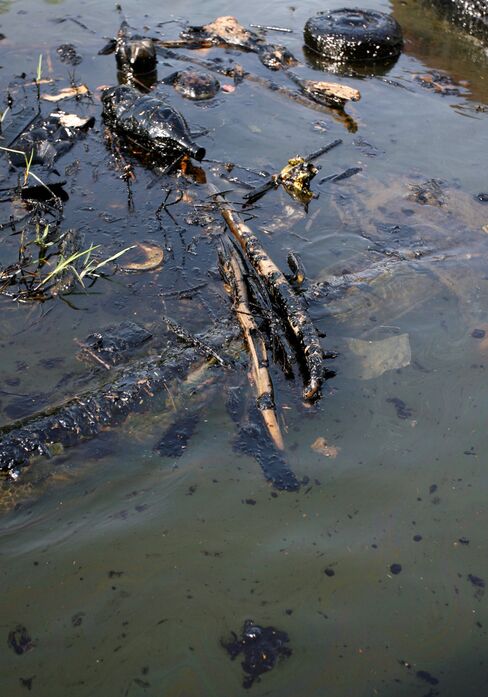
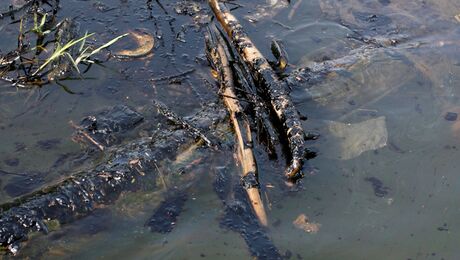
Oil and oil covered debris float in Lake Maracaibo in western Venezuela. Photographer: Reinaldo D'Santiago/AP Photo
Lost Revenue
In 2006, three years after Chavez proclaimed the oil sector securely back under state control, 1.2 million barrels a day was pumped from the Maracaibo basin. But with a large share of proceeds diverted from maintenance and reinvestment to populist social programs -- gasoline is priced at just 6 cents a gallon, costing PDVSA $15 billion a year -- output from the Maracaibo basin had slumped to 745,164 barrels a day by 2014, according to oil ministry figures. That amounts to $8 billion in foregone revenue.
At the same time, the lake has degenerated into a stew of contaminants that include sulphide, fluoride, kjeldahl nitrogen, detergents, residential chlorine and fecal coliform, according to the
website of the Institute for the Control and Conservation of Lake Maracaibo, or ICLAM, a Venezuela government entity created in 1981 and charged with care of the lake.
Government Failings
“There is great governmental irresponsibility, not just from this government but from those from more than 20 to 30 years ago,” said Gustavo Carrasquel, general director of Fundacion Azul Ambientalistas, an environmental and conservation non-profit founded in 1986. “The transnationals destroyed the lake and PDVSA doesn’t have the operational capacity to control the constant oil and gas leaks.”
Officials with PDVSA and Venezuela’s oil ministry didn’t reply to e-mails or phone calls seeking comment about the contamination in Lake Maracaibo and declining production from the basin. On Monday, Brent oil, the global benchmark, closed below $50 for the first time since January.
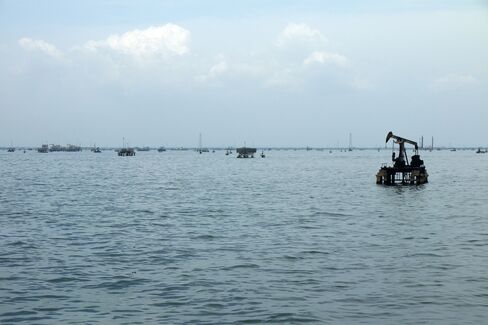
From the deck of a PDVSA service boat, hundreds of rigs dot the horizon, some idle and others extracting their bounty at a leisurely pace. Oil saturated
tree limbs float by. The water is speckled in duckweed, which can choke both the ecosystem and small motorboats.
Twenty-five thousand kilometers of oil and gas pipeline criss-crosses the lake bottom, much of it corroded and leaky. Oil leaching from this underwater labyrinth settles on the surface, looking like vast puddles of motor oil in a driveway after a rainfall.
Leaking Gas
Lake Maracaibo in western Venezuela.
Photographer: Pietro Pitts/Bloomberg
Whirlpools of gurgling water testify to the permeability of the natural gas lines as well, An estimated 50 percent of natural gas transported in Lake Maracaibo is lost due to pipeline breaks or leaks, Gas Energy’s Alvarado said in a phone interview.
Venezuela retains the ability to reverse the production slide and stop the environmental rot, said EnergyNomics President Rossi, but a depleted treasury and the outflow of engineers, technicians and other oil industry veterans are deterring efforts. Despite its vast production potential, Lake Maracaibo is also losing its pride of place, Rossi said, as PDVSA increasingly “is putting all its eggs in one basket” -- the newer Orinoco heavy oil belt on the opposite side of the country.
Downward Spiral
For now, the lake’s downward spiral knows no bounds.
As the sun sets and their boat heads back to shore, the oil services workers smoke cigarettes and play poker. The stench coming off the water and the trash floating by elicits no notice. Then they suddenly tense up as a boat approaches in the distance.
At night, it turns out, the lake is controlled by gun-toting pirates who maraud at will from small boats fitted with outboard motors. They rob crews still on the water of mobile phones and cash and often strip the PDVSA vessels of valuable cables, motors and spare parts.
As the approaching vessel gets closer, allowing the crewmen to see they are not in harm’s way, the tension dissipates. The poker game resumes. This time around, at least, Lake Maracaibo poses no risk.
Venezuela’s Giant Lake of Endless Oil Is a Filthy, Lawless Mess