
How to see the Milky Wayback
Can you see the Milky Way Galaxy from Earth at night with the naked eye?
Yes, in fact, the Milky Way Galaxy is one of the most interesting naked eye sights in the night sky. However, it’s not bright, and it’s not always well placed to be seen. So to see the Milky Way Galaxy from Earth, you will have to meet the following minimum requirements:
‐ Finding a dark clear night sky with no moonlight are the key words here for a best view of the Milky Way in the grand design (you can get an app that will show you the Moon Phases Calendar);
‐ No city lights, no headlights, basically as far as you can from any source of light pollution. You will need to travel far from any city, to a wild area or rural countryside. The best viewing site would be from the middle of the ocean either northern hemisphere or southern hemisphere being so far away from the artificial city lights.
‐ No telescopes, no binoculars, (just eyeglasses if you’re near sighted) and at least one eyeball. TIP: Using binoculars can increase the view experience being able to see other galaxies as Andromeda Galaxy (M31), nebulae and event comets.
‐ Best atmospheric conditions, a misty sky wouldn’t block it completely, nor would humidity. It would make it not as sharp, but still visible.
‐ Give your eyes at least 15-20 minutes to adapt to the darkness though. Your eyes will become more sensitive to low light level.
‐ A little bit of timing in late summer or winter evenings in Northern Hemisphere.
We live in the Milky Way Galaxy, this means that every time we gaze at the night sky we are looking at the Milky Way Galaxy. More exactly the spiral arm closer to the galactic center one part of the year and in the other part we see the near edge of the spiral arm farther from the galactic center. Due to nebula and dust clouds, we can’t see the center of the Milky Way (in visible light) at any time.
What can i see in the Milky Way Galaxy from Earth?
- The summer Milky Way will look brighter in the Northern Hemisphere. Most noticeably you should be able to see the Great Rift in good dark skies. This dark lane in the Milky Way Galaxy between Cygnus and Scutum is where a string of dense interstellar clouds block the view of more distant stars. At longer wavelengths in the infrared, light passes through these clouds more easily and we get a better view of the overall shape of our Galaxy, but there are still enough clouds created a dark reddened lane through the middle of the Milky Way Galaxy.
- The two Magellanic Clouds irregular dwarf galaxies are visible from the Southern Hemisphere which may be orbiting our Milky Way Galaxy.
- Milky Way Northern Hemisphere
Summer
Date Time
Oct 14 8 PM
Sep 29 9 PM
Sep 14 10 PM
Aug 30 11 PM
Aug 15 12 AM
Jul 31 1 AM
Jul 16 2 AM
Winter
Date Time
Feb 10 8 PM
Jan 25 9 PM
Jan 10 10 PM
Dec 26 11 PM
Dec 12 12 AM
Nov 26 1 AM
Nov 11 2 AM- Milky Way Southern Hemisphere
Summer
Date Time
Apr 8 8 PM
Mar 24 9 PM
Mar 9 10 PM
Feb 21 11 PM
Feb 5 12 AM
Jan 22 1 AM
Jan 7 2 AM
Winter
Date Time
Aug 28 8 PM
Aug 12 9 PM
Jul 28 10 PM
Jul 12 11 PM
Jun 27 12 AM
Jun 13 1 AM
May 29 2 AM

You are using an out of date browser. It may not display this or other websites correctly.
You should upgrade or use an alternative browser.
You should upgrade or use an alternative browser.
What cities would look like without lights
- Thread starter tmonster
- Start date
More options
Who Replied?A Photographer’s Guide to the Milky Way
It’s January… the nights are long, the sky is crisp and dark– so why can’t you see the Milky Way very well, much less get those amazing shots you see online? This tutorial will help teach you everything you need to know about when and where to view our galactic home. Let’s dive in.
Understanding the Geometry of the Galaxy
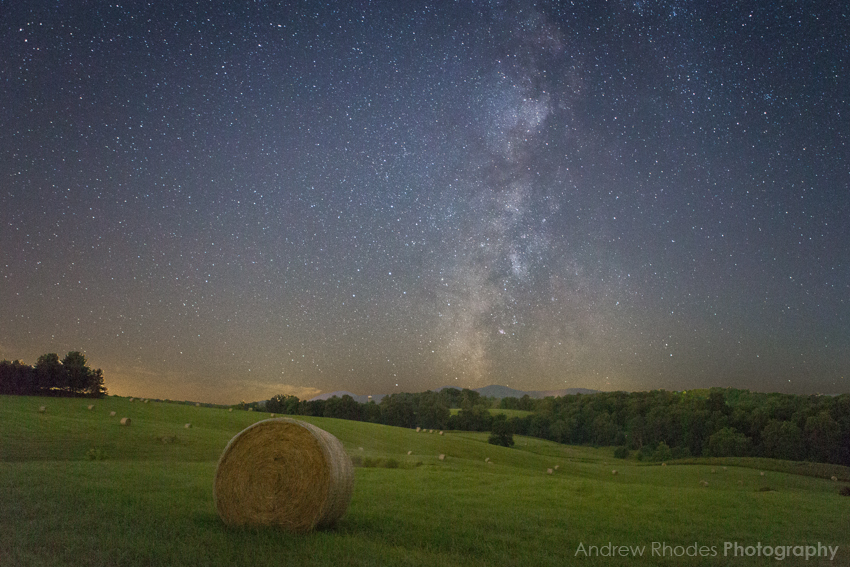
The Milky Way is a disk-shaped structure, centered around a bar-shaped ‘core’ near the center. This is the region you typically see featured in the dramatic astrophotography images that have become popular in recent years, as powerful low-ISO consumer DSLRs have made their way into consumers’ hands. Because of its disk shape, the Milky Way appears as a faint milky-colored band, approximately 30 degrees wide, arching across the sky at just about all times (but visible only at night).
Our Solar System is located in one of the outer arms of the Milky Way, as shown below in this NASA illustration (click to enlarge).

The plane of our solar system is at an approximately 63 degree angle to the galactic plane. So what does that mean and why is it useful? It means that objects in our Solar System are rotating at almost a perpendicular angle compared to the angle of rotation of all the objects in the Milky Way as a whole (including our Solar System). Practically, this means that the Milky Way will appear at different angles in our night sky depending on both the time of night and time of year.
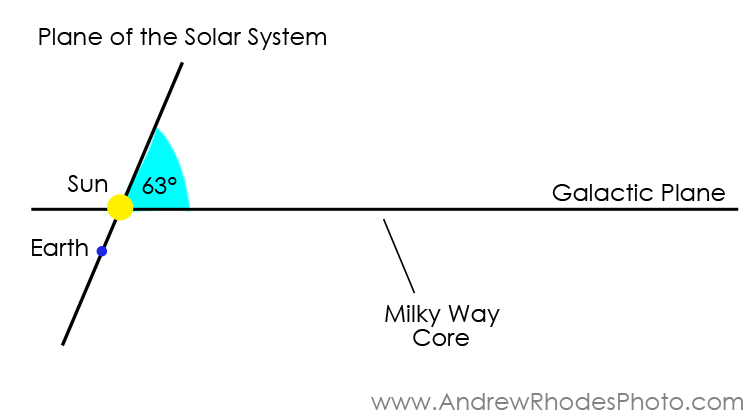
The geometry of the galaxy brings up several important points.
First, since our Solar System is not positioned in the Milky Way core, that means the core only forms a small part of the overall view from Earth. As our gaze moves away from the core (in either direction), the Milky Way begins to fade, since there are fewer visible stars to brighten the band.
The second, and perhaps the most important consideration, is Earth’s relative position to the Sun. Since the Earth rotates around the Sun every 365 days, that means that during part of the year, our view of the galactic core is blocked by the Sun. In other words, the core is only above the horizon during daylight hours for a certain part of the year. So when is this? In the Northern Hemisphere, the core is not visible in most of November, December, January, and the first half of February. On the flip side, this means the best time for viewing is from late May to early August.

Time of Night, Location and Seasonal Factors
Now that you understand the concepts behind the Earth’s orbit around the Sun and the visibility of the core, it follows that the core is only visible at certain times of night during its visible months. In mid-February, for example, the core becomes visible in the pre-dawn hours just before sunrise, and remains above the horizon during daylight hours. Gradually, the core becomes visible for longer and longer each night, peaking in June & July when it is on the exact opposite side of the Earth as the Sun. During this time of year, the core will be viewable all night, with it being at its highest point in the sky around midnight. From July on, the cycle goes in the opposite direction, as core visibility begins to decrease and optimal viewing time moves towards after dusk, until it disappears from our field of view again in the winter months.
The following image depicts the night sky field of view at peak viewing in mid-summer in the Northern Hemisphere.

Viewing Location
When discussing the visibility of the Milky Way, many people reference the hemisphere, but don’t explain how exactly this factors in. The reason that your location in either the Northern or Southern Hemisphere matters is twofold. First, the duration of daylight is different during the time of year when the Milky Way’s core is most visible. The Southern Hemisphere has the built-in advantage of being in the middle of their winter (i.e. short days, long nights) when the core is most visible. Meanwhile, the Northern Hemisphere is experiencing long days and short nights in its summer months, thereby limiting the available viewing (and photographing) time of the Milky Way’s most visible section.
Secondly, your view of the Milky Way is different based on your location as well. The core of the Milky Way is approximately lined up with the constellation Sagittarius, which is situated at a declination of about -30 degrees. This means that both Sagittarius and the Milky Way core are viewable directly overhead to those living at a latitude of -30 degrees. For those of us in North America or Europe, at latitudes between 25 and 50 degrees, this means we will always see the galactic core rising up from the horizon in our southern sky. Now this isn’t all bad news for Northern shooters, since this allows for the easier incorporation of the landscape into our shots, but it does offer some awesome views the further south you travel.
How to Find the Milky Way
Precisely lining up your shot is a matter of trial and error, but some general celestial landmarks will help you locate where you should be looking. As a general rule, if you’re in the Northern Hemisphere, look towards the southern skies to see the galactic core. This can be southeast (Spring), due south (Summer), or southwest (Fall) depending on the time of year. As mentioned above, Sagittarius is found nearest the galactic core. Here is a fantastic map of the Milky Way alongside every constellation by Richard Powell:
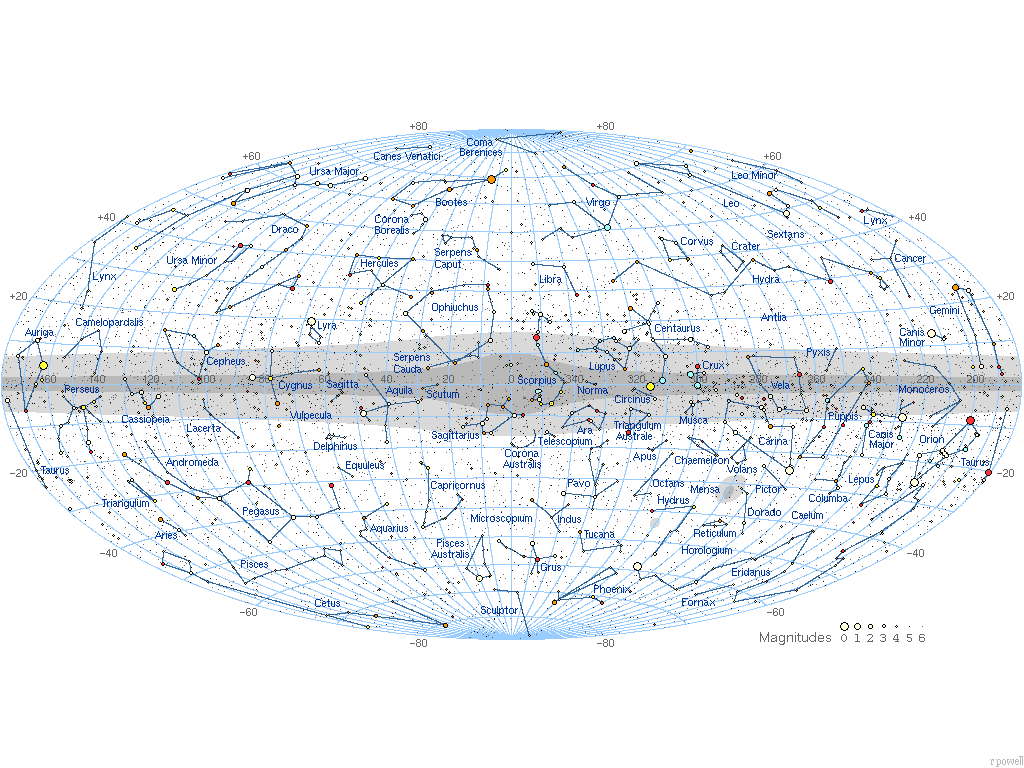
Don’t forget that in the winter months you can still see the Milky Way, just not the core. You can use Orion and Gemini as reference points during these months (The Milky Way goes right between them), as well as Cassiopeia (all year), which cuts right across the faint milky arc at almost due North.
I highly recommend downloading both the Google Sky Map app to your phone for on the go reference, as well as downloading the incredible Stellarium program (free) to your laptop or desktop. The latter allows you to preview the night sky at any given point in time, and is an essential utility when preparing for an astrophotogrpahy expedition.
Final Considerations: Moon Phase, Weather and Dark Skies
As if there weren’t enough factors to consider already, the phase of the moon and the weather are the final two pieces of the puzzle. I can’t tell you how many times I’ve had a free weekend in June, only to be cursed with a full moon or overcast sky. Keep a moon phase calendar handy in your bookmarks or on your calendar, and know when the moon rises and sets each day. You can usually find this information wherever you get your weather online. It goes without saying that you want an almost completely clear sky for optimal star shooting, so keep an eye on the forecast during the days when the moon is not a factor and base your shooting around that.
 Finally, if you’re new to astrophotography, learn where to find dark skies. A handful of resources are available, but I prefer to use Jonathan Tomshine’s Dark Sky Finder website. As you become a more experienced astrophotographer, you will find some favorite spots and learn some tricks to block out light pollution (i.e. shooting towards mountains or the ocean) as you go.
As to the equipment you need and settings to use? That’s an entirely different discussion, and plenty of information exists online to assist. As some general advice, I shoot with a Canon 6D that I can’t recommend enough, along with two f/2.8 L lenses (the 16-35 and 24-70). A rock solid tripod is also a must (I use a Gitzo 2540 with a Really Right Stuff BH-55 ballhead). Your exposure length should never exceed 30 seconds if you want sharp stars (15-20 sec is ideal), shoot wide open at f/2.8, and play with a variety of ISOs to get your ideal exposure (I’ve gone up to ISO 6400 using my 6D with great results).
I hope you’ve found this information useful, and feel free to drop me a message if you have any questions or comments about anything I’ve written! If you get a chance, go check out my astro album: andrewrhodesphoto.com/Portfolio/Astrophotography
-Andrew

i dig it


mbewane
Knicks: 93 til infinity
Reminds me back in CAR when we hould have blackout, we would just hang out in the garden and enjoy the view


Light pollution is a bytch. I know those pics look creepy, but they also kind of look beautiful with the sky like that, as corny as it sounds
I almost cried after living in Vegas for 2 years; I finally took the time to drive out into the desert and just look up.