
You are using an out of date browser. It may not display this or other websites correctly.
You should upgrade or use an alternative browser.
You should upgrade or use an alternative browser.
What Is The Shape of Space? (ft. PhD Comics)
- Thread starter morris
- Start date
More options
Who Replied?
levitate
I love you, you know.
Semi-related, but...I can't wrap my head around the fact that the universe is expanding faster than the speed of light.
If it's expanding faster than the speed of light, then aren't the objects within the universe also moving faster than the speed of light (relative to some stationary point of reference)? Does this not go against matter's light-speed limit?
Also doesn't thet mean that we can never see or visit the edge of the universe as our observation techniques and propulsion methods are limited to the speed of light?
I'm confused, brehs.

If it's expanding faster than the speed of light, then aren't the objects within the universe also moving faster than the speed of light (relative to some stationary point of reference)? Does this not go against matter's light-speed limit?
Also doesn't thet mean that we can never see or visit the edge of the universe as our observation techniques and propulsion methods are limited to the speed of light?
I'm confused, brehs.

Semi-related, but...I can't wrap my head around the fact that the universe is expanding faster than the speed of light.
If it's expanding faster than the speed of light, then aren't the objects within the universe also moving faster than the speed of light (relative to some stationary point of reference)? Does this not go against matter's light-speed limit?
Also doesn't thet mean that we can never see or visit the edge of the universe as our observation techniques and propulsion methods are limited to the speed of light?
I'm confused, brehs.
Read this - How could the universe expand faster than the speed of light? That seems impossible! » Scienceline
The cliffnotes answer is that the speed of light limit applies to matter moving thru space, not to space itself. Also, according to Einstein there's no such thing as a "stationary point of reference", you can only measure how fast something is moving compared to something else.
Edit: Also, there's no such thing as the "edge of the universe" as far as we know.
levitate
I love you, you know.
Read this - How could the universe expand faster than the speed of light? That seems impossible! » Scienceline
The cliffnotes answer is that the speed of light limit applies to matter moving thru space, not to space itself. Also, according to Einstein there's no such thing as a "stationary point of reference", you can only measure how fast something is moving compared to something else.
Edit: Also, there's no such thing as the "edge of the universe" as far as we know.


That makes sense. Thanks.Well, when scientists say the universe is expanding what they really mean is that everything is getting further apart. If you extrapolate that than logically everything used to be much closer together (and much denser), hence the Big Bang Theory. And when they say it's flat they really mean that if you shine two beams of light parallel to each other, they'll never intersect (meaning no positive curvature) and never diverge (meaning no negative curvature).
Basically if the universe is "closed" then it's like the balloon analogy and if you went in one direction far enough you'd get back to where you started. If the universe is flat or open (negative curvature) then that'll never happen and space will just keep going.
Right now it looks like the universe is flat. This would imply that there's no edge and no outside, and the universe is spatially infinite (and has been as long as it's existed), it's just that galaxies are moving away from each other.

We can't know unless and until we have a quantum theory of gravity :kanyebp:


Dafunkdoc_Unlimited
Theological Noncognitivist Since Birth
- Joined
- Jul 25, 2012
- Messages
- 45,062
- Reputation
- 8,020
- Daps
- 122,436
- Reppin
- The Wrong Side of the Tracks
Kaguya said:@acri1 @Dafunkdoc_Unlimited
Do you guys have your own theories about how the universe came into existence?
The simple fact that it BEGAN to exist is mind-boggling enough. Everything we know that comprises 'reality' wasn't always here.
As far as a theory goes, I've read enough science fiction/fantasy and enough actual peer-reviewed literature on the subject to realize I don't know SHYT.
The leading Scientists can't even agree on WTF happened......
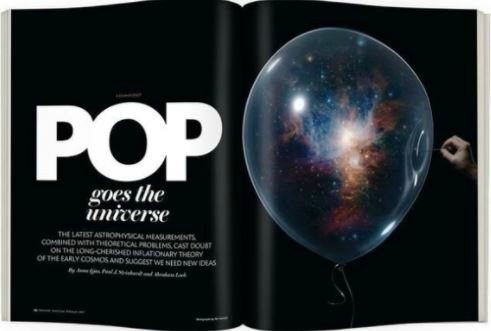
Stephen Hawking And 32 Top Physicists Just Signed a Heated Letter on The Universe's Origin
As far as a theory goes, I've read enough science fiction/fantasy and enough actual peer-reviewed literature on the subject to realize I don't know SHYT.
The leading Scientists can't even agree on WTF happened......
Stephen Hawking And 32 Top Physicists Just Signed a Heated Letter on The Universe's Origin
Sean Carroll said:"We judge theories by what predictions they make that we can test, not the ones they make that can't be tested. It's absolutely true that there are important unanswered questions facing the inflationary paradigm. But the right response in that situation is to either work on trying to answer them, or switch to working on something else (which is a perfectly respectable option). It's not to claim that the questions are in principle unanswerable, and therefore the field has dropped out of the realm of science."
Dafunkdoc_Unlimited
Theological Noncognitivist Since Birth
- Joined
- Jul 25, 2012
- Messages
- 45,062
- Reputation
- 8,020
- Daps
- 122,436
- Reppin
- The Wrong Side of the Tracks
Kaguya said:And at the end we'll all freeze to death OR the balloon will pop and we are crushed to death! What beauty, I wonder which will happen first.
I don't even care since I'll probably be dead before America's Tricentennial in 2076.


Recca Gatsby
LWO
We need more threads like this

Read this - How could the universe expand faster than the speed of light? That seems impossible! » Scienceline
The cliffnotes answer is that the speed of light limit applies to matter moving thru space, not to space itself. Also, according to Einstein there's no such thing as a "stationary point of reference", you can only measure how fast something is moving compared to something else.
Edit: Also, there's no such thing as the "edge of the universe" as far as we know.
the faster something is moving, time slows down right?
that is why we have to make corrections to the clocks on satellites.
so, if everything in the universe is moving at incredible speeds then wouldn't all of the "clocks" be out of sync?
our solar system is orbiting the center of our galaxy.
every thing in the galaxy is but at different speeds.
everything is moving through time at a different pace....it makes my head hurt.
the faster something is moving, time slows down right?
that is why we have to make corrections to the clocks on satellites.
so, if everything in the universe is moving at incredible speeds then wouldn't all of the "clocks" be out of sync?
our solar system is orbiting the center of our galaxy.
every thing in the galaxy is but at different speeds.
everything is moving through time at a different pace....it makes my head hurt.
Well there's no such thing as a universal "sync", that's just human perception. So it's not that "clocks" are out of sync, it's more that time itself is out of sync (since it depends on how fast the observers are moving relative to each other) and clocks just measure it.
It's just that the differences are too small to notice unless you get close to light speed. But it's a real effect that's been measured. For example if you go onto the fastest jet in the world (and take a clock with you) and fly around the world a couple of times, when you get back and compare your clock to somebody who stayed on Earth you'll see that your clock is a few milliseconds behind theirs. It's not that anything in particular happened to the clock itself, it's that time actually passed more slowly for you. All the clock does is measure it.
Well there's no such thing as a universal "sync", that's just human perception. So it's not that "clocks" are out of sync, it's more that time itself is out of sync (since it depends on how fast the observers are moving relative to each other) and clocks just measure it.
It's just that the differences are too small to notice unless you get close to light speed. But it's a real effect that's been measured. For example if you go onto the fastest jet in the world (and take a clock with you) and fly around the world a couple of times, when you get back and compare your clock to somebody who stayed on Earth you'll see that your clock is a few milliseconds behind theirs. It's not that anything in particular happened to the clock itself, it's that time actually passed more slowly for you. All the clock does is measure it.
i know, that is why i put the word "clock" in parenthesis.
our solar system is orbiting the center of our galaxy at 483,000 miles per hour.
any object that is closer to the center is moving faster and an object farther away is moving slower.
i would imagine that the time distortion over long periods of time would be significant.
add onto it that our galaxy it's self is moving at a different speed than other galaxies.
moving on earth distorts time compared to stationary objects.
our planet is moving and distorting time.
our solar system is moving and distorting time.
our galaxy is moving and distorting time.
what is the base for time if there was no motion?
i think that is the best way i can frame my question with my very limited understanding of....everything?
the speed of light is 670 million mph.
our galaxy is moving at 1.3 million mph.
in my opinion that is a significant percentage of light speed that would create a time distortion that would compound over time.
am i talking crazy?
our galaxy is moving at 1.3 million mph.
in my opinion that is a significant percentage of light speed that would create a time distortion that would compound over time.
am i talking crazy?