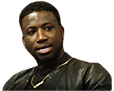
Fredette: The only thing I can think of is in AAU when you would see a team with all black players and then one or two white kids, the joke would be that the ‘white boys’ would always be the shooters. That was me on my AAU team, so I was always spotted as the shooter by other teams.
McDermott: A couple guys [at USA Basketball camp] have joked have been like, ‘Oh, token white guy.’ That’s just the way it is, you know. They assume I’m just floor space, but I feel like I’m showing them that I can do a lot. You know I’ve played with a lot of good players here [at USA camp], and they’ve all been obviously very respectful …
You got to gain a little more respect. I think I first started to get that a little more, I would say, when we [Creighton University] joined the Big East from Missouri Valley [Conference] because, you’re playing a lot more predominantly black teams. You kind of hear in some of the warm-ups, like, ‘Who is this white boy?’ all that stuff. It’s just awesome when you can get through that. And, I think that gave me a lot of confidence, going up against bigger athletic guys before coming in to the NBA.
A lot of African-Americans that have found success in the league have come up from tough backgrounds or long odds to become NBA players. Was that the same the case for you?
Smith: I definitely came from small-town America: Greeley, Colorado. Not too many people know where I came from. My hometown had 1,500 people, if that. I graduated high school with 67 people. I went to Colorado State, which is not a basketball-oriented school, either. I’m really blessed to be where I am today …
The only time I played against African-Americans is the Big Time AAU tournament in Las Vegas. There were a couple AAU tournaments down near Denver. For me growing up, it was a bunch of farm kids.
Fredette: Coming from a small town in upstate New York had its challenges to get noticed. For me, I wasn’t very heavily recruited. BYU [Brigham Young University] was the biggest school that offered me a scholarship, actually. I just didn’t have anyone watching my high school games. I played AAU against the best with the Albany City Rocks, but going into the game college coaches had no idea who I was and mostly were there to watch other players.
Chicago Bulls’ Doug McDermott (No. 3) drives past New York Knicks’ Carmelo Anthony (No. 7) during the first half of an NBA basketball game March 24 in New York.
AP PHOTO/FRANK FRANKLIN II
McDermott: The crazy part about it is, I’m from Iowa. And if you think about the white Americans that played in the NBA, a lot of them, they’ve come from Iowa. So, Raef LaFrentz, Nick Collison, Kirk Hinrich, Kyle Korver, myself. Harrison [Barnes] was one of the only black guys on my high school team. So, it’s crazy how it all works out. The white Americans in the NBA, a lot of them come from Iowa.
Has it been hard for you to discuss the racial tension with your African-American teammates and how to react as a team to the playing of the national anthem?
Redikk: My mother’s side is Swedish. My dad’s side is Irish. They were sold an American dream. They came here voluntarily. African-Americans were the only people that didn’t come here voluntarily. They were forced here. And so culture, it’s just different and been different. For white America, and I include myself because I’m white, it’s interesting to me how we can pick and choose the parts of black culture that are acceptable and not acceptable. It’s interesting to me as a whole that’s what we choose to do.
“For white America … it’s interesting to me how we can pick and choose the parts of black culture that are acceptable and not acceptable.” — J.J. Redikk
I can do my rap music and listen to that, and that’s OK. But we are going to racially profile young black men because they are ‘criminals.’ It’s just a stark divide between perception and reality … It’s just such a rich culture and a rich history. There are so many layers to it.
I would say this with what is going on in our country, the things that Rosa Parks fought for, the things that Martin Luther King was fighting for, there has been progress. In a way, you can make an argument that things are better. But on the other hand there are some other things where they are still starting behind the eight ball. So there is still a lot of progress to make.
Anderson: We’re uniting as a family. The NBA is a family. It’s a tough topic. It’s a tough conversation. We live in a world where you can’t really have an opinion. You can’t really say one side or the other or else you’re against something. We got a great group of guys that want to talk about that stuff, and I want to see change. There are a lot of bad things going on around. It is definitely a scary time, but I think we all want change.
Chandler Parsons (No. 25) of the Memphis Grizzlies high-fives teammates during an open practice on Oct. 1, at the FedExForum in Memphis, Tennessee.
JOE MURPHY/NBAE VIA GETTY IMAGES
Parsons: I’m comfortable talking with them because they’re my friends and my teammates. I wouldn’t be uncomfortable talking with them because of the color of their skin. That doesn’t matter to me. I see them every day. I see us as all equal. Kaepernick, I’m all for protests. Each person has their own individual right. I think it’s a good thing to make people aware and to show that we’re not only just athletes, but we’re leaders. Each person has their own individual right to protest. I just hope that doesn’t make teams or sports or different races even more divided.
Smith: We just wanted to broadcast a sense of unity. That’s what a lot of people are trying to bring notice. This country is kind of broken right now. We’re going against each other way too much … It’s going out of control. We just wanted to come together as a team no matter what race, no matter what background, no matter what religion.
Redikk: The only time I felt white in a black locker room is with the Donald Sterling thing. That was one time where I was like, ‘Ooh, this is different.’ I was more aware all of the sudden. Even when I was a kid, I was not aware. I wouldn’t say I wasn’t the minority, but I was one of the exceptions, I guess, in the locker room or on the team or on the bus. I did say something and I can’t remember quite what I said. We met as a group and we discussed everything. I don’t remember what I said, but I did speak up.
For me, it was hard. You see what he said and as a human you’re appalled by it and disgusted. There was nothing really groundbreaking there. You then kind of, ‘Oh, s—, he’s talking about Blake [Griffin’s] dad. He’s talking about Chris [Paul’s] son.’ I can see why it was so personal. The eye-opening thing to me is when I made it personal, I get why people are so upset beyond him saying something stupid and ignorant. It was personal.
What have you learned about black culture while playing in the NBA?
Anderson: I like hip-hop, yeah. I mean it’s funny because, well, I like all kinds of different music. I think honestly my favorite kind of food is soul food. Like, I love soul food. Like, in college, one of my teammates brought me over to his family, and his mom cooked the best meal of my entire life.
Smith: I like to listen to hip-hop, I like to listen to country and I like to listen to rock. A lot of people think, ‘Oh, a white guy coming from small-town America, he likes to listen to country.’ Being around basketball has opened my eyes to so many different things culturally, whether it be food or music, how people grew up. I’m usually a top-40 type of [music] person. Drake has been my go-to the last couple of years.
Washington Wizards forward Jason Smith (No. 14) takes a shot over Miami Heat forward Udonis Haslem (No. 40) during a preseason NBA game between the Washington Wizards and the Miami Heat at the Verizon Center in Washington, D.C.
DANIEL KUCIN JR./ICON SPORTSWIRE VIA GETTY IMAGES
Fredette: I have met many great friends playing in college and AAU. Some of my best friends in the world are black, including my college roommate of three years. I have definitely picked up on slang, music and food as I have had many different teammates from all over the country and world.
McDermott: I listen to more rap, hip-hop in the locker room. I love being around that culture. It’s very fun to be around, getting to know guys from different backgrounds that maybe didn’t come from as good a background as I did. It makes you realize how blessed you were, you know, growing up.
“The NBA is a collection of some of the most athletic guys in the world. And white guys just aren’t that athletic.” — Chandler Parsons
Why do you think there aren’t more white American NBA players?
Redikk: It does seem there are less and less white Americans. I’d like to know with [Kirk] Hinrich and Steve Blake out this year, how many white guards are there this year in the NBA? Are there even five? If you’re 6-feet-10 inches, can walk, are skilled and can chew gum and all that, defend the rim, you’ll have a job. It doesn’t matter what your skin color is. You’ll have a job.
I don’t know if it’s other sports. Part of it is the game is faster. Players play in space. There is more of an emphasis on shooting. Maybe they are not being taught in suburbia. I don’t know. I don’t know what the answer to that is.
Anderson: It is hard to stop and think there really aren’t a ton of white American basketball players out there. I know a number of my friends that grew up hoping to have this dream of playing in the NBA. A number of white guys, that were point guards or guys that were bigger than me. I was fortunate enough to make it.
McDermott: It is just the European presence in the NBA now. When you see drafts, and there’s white European versus a white American, they’ll probably go for the European. That’s kind of the way it’s gone, you know. I can pretty much name every white American in the NBA. So, I feel blessed and fortunate to be here, but you know it’s just kind of the way it is. It’s the way it’s been, I guess, for a while now. Doesn’t mean there won’t be more, but I’m glad that I’m able to be in the NBA, and follow my dreams …
You look at the Warriors and their two best players [Stephen Curry and Klay Thompson] are — at least last year, the last few years — are two guys that are probably more suburban anyways. Growing up around a suburban area there were a lot of activities for us to do. You know we were privileged enough to play baseball, go to the golf course, tennis, stuff like that. Country club sports that maybe some kids don’t get to enjoy. And a lot of them stick to maybe one sport, and they’re all in on that sport. When a lot of kids that I grew up with were involved in a lot of different things.
Smith: You don’t see a lot of them because it’s hard. If everybody could do it, it would be easy. It’s very, very hard to do what NBA players do because you are not just going against your fellow peer. You are not just going against the guys in college. You have to keep in perspective. There are 450 out of 7 billion people. The odds are against you.
Gordon Hayward (No. 20) of the Utah Jazz shoots the ball against the Portland Trail Blazers during a preseason game on Oct. 3 at the Moda Center in Portland, Oregon.
SAM FORENCICH/NBAE VIA GETTY IMAGES




 hmmmmmm that doesn't fit my bias
 imma ignore this post


 to Lebron for sticking the best white player in the NBA in the corner for 48 minutes a game