menu
DISPATCH RURAL AMERICA
Farmers Reject Nicor's Pipe Dream
Residents of the historic Black farming community of Pembroke, Illinois want an energy upgrade—but they want renewables, not fossil fuels.
ZOE PHARO JANUARY 20, 2022
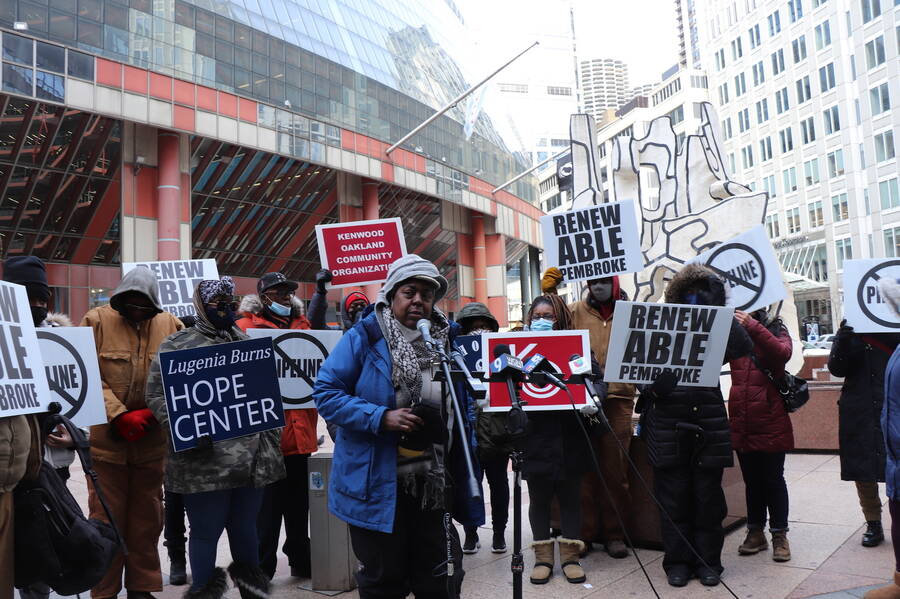
Dr. Jifunza Wright-Carter speaks at a protest on Dec. 7, 2021, in front of the James R. Thompson Center in Chicago, where Gov. J.B. Pritzker's office is located.PHOTO BY ZOE PHARO
PEMBROKE TOWNSHIP, ILL . — At the end of a maze of dirt roads lies a 40-acre teaching farm called
Black Oaks Center, where local residents gathered on a Sunday in November 2021 for a farmland restoration workshop and community gathering. “If you all want to bust wood again, they’re out there,” said Dr. Jifunza Wright-Carter — who runs the center with her husband, Fred Carter — to the newest arrivals. Some joined the group clearing felled trees for off-grid homesteading, while others stayed inside to warm up and chat.
“We’re this close to them installing,” says Wright-Carter, “and nobody knows where it’s going to come in. No one’s seen a map.”
In addition to raising food and hosting classes, Black Oaks has become a hub for organizing against a proposed natural gas pipeline some locals say threatens the area’s farming way of life, which is rooted in environmental stewardship.
Founded in the 1860s by Joseph “Pap” Tetter after he escaped slavery, Pembroke served as a
refuge for others fleeing North and for local Potawatomi people evading displacement to reservations.
It grew into the largest Black farming community in the northern United States. Farmers grew hemp there during World War II and supplied food to Chicago during the Great Migration. Generations of Black farmers have since preserved Pembroke’s rare three-biome ecosystem, known for its black oak savanna habitat.
“Regenerative agriculture was what we did by default, because we couldn’t afford any other method,” says Carter, whose uncle came here from the South in the 1950s and bought five acres.
Now, Nicor Gas is pursuing a $10 million plan to lay more than 30 miles of gas lines to connect hundreds of Pembroke households, despite opposition. Supporters claim the project will kick-start local economic development, while opponents warn it threatens Pembroke’s rich ecosystem and could displace Black farmers.
On Aug. 27, 2021, despite lobbying from Pembroke residents and environmentalists,
Illinois Gov. J.B. Pritzker signed a bill that will allow the company to fund the pipeline in Pembroke, which is designated a “hardship area,” by
raising rates on all Nicor ratepayers. Three weeks later, Nicor filed for a
Certificate of Public Convenience and Necessity from the Illinois Commerce Commission (ICC) to begin installation in Pembroke Township.
Pembroke residents only found out about the request a month later, in October 2021, says Wright-Carter. She helped form the
Pembroke Environmental Justice Coalition (PEJC) shortly after, which moved to intervene in court. But the lost month is emblematic of how the process has played out, Wright-Carter says.
Nicor’s virtual community meetings on
Sept. 8 – 9, 2021, were held in the morning, when many residents were at work, in a community without reliable internet access — noted Gavin Kearney, senior counsel with the
Chicago Lawyers’ Committee for Civil Rights, who represents PEJC. “This is not the process you would create if you were genuinely interested in whether the public wants this, and what their concerns are,” Kearney says.
“We’re this close to them installing,” says Wright-Carter, “and nobody knows where it’s going to come in. No one’s seen a map.”
Meanwhile, Mark Hodge, mayor of nearby Hopkins Park, is promising a
local economic boost from the gas lines, and the Rev. Jesse Jackson, of the Rainbow PUSH Coalition in Chicago,
calls the project a “big deal” and a “new day for Pembroke, a Black farming community that has been left behind.” Jackson adds it “will help bring business to Pembroke, and it will help others do business with Pembroke.
This will go over a lot of nikkas heads because democrats know best..




 White farmers got subsidies the whole goddamn time 45 was in office playing games with China. Black farmers get a bite and this is what happens