Why It's Impossible to Indict a Cop

Mr Uncle Leroy

All Star
Joined
May 19, 2012
Messages
10,363
Reputation
-160
Daps
4,626
if walking to a car...
or running away from a car...
or lying on the floor face down...
or saying your choking...
or raising your hands...

^^^
all "threats"

then...what else?
 

ghostwriterx

Superstar
Supporter
Joined
May 17, 2012
Messages
6,888
Reputation
811
Daps
14,582
I know... I'm just stunned at how people can still argue in favor of state run law enforcement. They are literally killing blacks with impunity at this point.

yeah, because private industry has been so good to black/brown people.:stopitslime:
 

ghostwriterx

Superstar
Supporter
Joined
May 17, 2012
Messages
6,888
Reputation
811
Daps
14,582
:camby:
Their murdering niqqas on cam, in the states and getting away with it. Link me to the private business doing the same with zero repercussion.
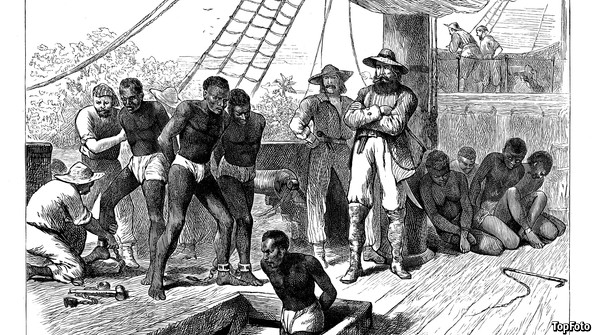
That's not the point breh. What about private industry in the history of this country can black people point to and say, "Yeah that would be better for us."?

You forget, this was "private business" too.
20131221_JWP001_0.jpg
 

Nameischosen

Banned
Joined
Oct 13, 2014
Messages
419
Reputation
30
Daps
1,262
:ohhh: you then we could have black owned police companies for predominantly black areas :obama:

-DMP-
If they receive any funds from federal/state government to run their security companies they will have to be equal opportunity employers. Imposing any preference based on skin color or the like will result in funding being removed. It would have to be run completely private without any state funding.
 

DEAD7

Veteran
Supporter
Joined
Oct 5, 2012
Messages
51,420
Reputation
4,600
Daps
89,684
Reppin
Fresno, CA.
That's not the point breh. What about private industry in the history of this country can black people point to and say, "Yeah that would be better for us."?

You forget, this was "private business" too.
20131221_JWP001_0.jpg
:why: Unless you're suggesting that chattel slavery is a possibility today, how is it relevant? Public law enforcement is executing blacks today... what private industry today is doing the same?

I am proposing a private option today, in favor of todays corrupt and racist govt.


If you're going full retard, the govt. was completely complicit in slavery, and declared on paper that blacks were property. Govt. scores no points over private industry historically.

...:ufdup:and if you want to dig further, Its clear govt. has done worse to blacks than any private company ever has.
 

JahFocus CS

Get It How You Get It
Joined
Sep 10, 2014
Messages
20,461
Reputation
3,755
Daps
82,442
Reppin
Republic of New Afrika
:why: Unless you're suggesting that chattel slavery is a possibility today, how is it relevant? Public law enforcement is executing blacks today... what private industry today is doing the same?

I am proposing a private option today, in favor of todays corrupt and racist govt.


If you're going full retard, the govt. was completely complicit in slavery, and declared on paper that blacks were property. Govt. scores no points over private industry historically.

...:ufdup:and if you want to dig further, Its clear govt. has done worse to blacks than any private company ever has.

Yes, the government was complicit... but I think this shows that this private/public divide is largely artificial. Class society requires the state... :usure: The "haves" will always leverage the state to maintain and advance their position over the exploited class(es).
 

DEAD7

Veteran
Supporter
Joined
Oct 5, 2012
Messages
51,420
Reputation
4,600
Daps
89,684
Reppin
Fresno, CA.
Yes, the government was complicit... but I think this shows that this private/public divide is largely artificial. Class society requires the state... :usure: The "haves" will always leverage the state to maintain and advance their position over the exploited class(es).
:whoa:We're gonna hash that out, but this isnt the thread for it.
 

Mr Uncle Leroy

All Star
Joined
May 19, 2012
Messages
10,363
Reputation
-160
Daps
4,626
Full article: http://m.thenation.com/article/190937-why-its-impossible-indict-cop


The author suggests applying arms control legislation to police and also questions the wisdom of seeing body cams as an end-all-be-all reform.

Decent article on the whole. It'll take a militant working-class to push through the kinds of reforms needed to end this epidemic, since the problem is tied into issues of working-class criminalization, the drug war, the strength of the state, etc. There needs to be things like state and federal legislation requiring local governments to have civilian review boards with subpoena power to oversee police. But stuff like this won't get through without a mass movement.
Full article: http://m.thenation.com/article/190937-why-its-impossible-indict-cop


The author suggests applying arms control legislation to police and also questions the wisdom of seeing body cams as an end-all-be-all reform.

Decent article on the whole. It'll take a militant working-class to push through the kinds of reforms needed to end this epidemic, since the problem is tied into issues of working-class criminalization, the drug war, the strength of the state, etc. There needs to be things like state and federal legislation requiring local governments to have civilian review boards with subpoena power to oversee police. But stuff like this won't get through without a mass movement.

read the bolded parts

Chapter 563 of the Missouri Revised Statutes grants a lot of discretion to officers of the law to wield deadly force, to the horror of many observers swooping in to the Ferguson story. The statute authorizes deadly force "in effecting an arrest or in preventing an escape from custody" if the officer "reasonably believes" it is necessary in order to "to effect the arrest and also reasonably believes that the person to be arrested has committed or attempted to commit a felony…or may otherwise [DOES NOT PRESENT] endanger life or inflict serious physical injury unless arrested without delay."

But this law is not an outlier, and is fully in sync with Supreme Court jurisprudence. The legal standard authorizing deadly force is something called "objective reasonableness."

This standard originates in the 1985 case of Tennessee v. Garner, which appeared at first to tighten restrictions on the police use of deadly force. The case involved a Memphis cop, Elton Hymon, who shot dead one Edward Garner: 15 years old, black and unarmed. Garner had just burgled a house, grabbing a ring and ten bucks. The US Supreme Court ruled that a police officer, henceforth, could use deadly force only [DOES NOT PRESENT] if he "has probable cause to believe that the suspect poses a significant threat of death or serious physical injury to the officer or others." The ruling required that the use of force be "objectively reasonable." How this reasonableness should be determined was established in a 1989 case, Graham v. Connor: severity of the crime, whether the suspect is resisting or trying to escape and above all, whether the suspect posed an immediate threat to the safety of officers or others. All this appeared to restrict police violence—even if, in the end, Officer Hymon was never criminally charged for fatally shooting Edward Garner.

"Objectively reasonable"—what could be wrong with that? But in actual courtroom practice, "objective reasonableness" has become nearly impossible to tell apart from the subjective snap judgments of panic-fueled police officers. American courts universally defer to the law enforcement officer's own personal assessment of the threat at the time.

The Graham analysis essentially prohibits any second-guessing of the officer's decision to use deadly force: no hindsight is permitted, and wide latitude is granted to the officer's account of the situation, even if scientific evidence proves it to be mistaken. Such was the case of Berkeley, Missouri, police officers Robert Piekutowski and Keith Kierzkowski, who in 2000 fatally shot Earl Murray and Ronald Beasley out of fear that the victims' car was rolling towards them. Forensic investigations established that the car had not in fact lurched towards the officers at the time of the shooting—but this was still not enough for the St. Louis County grand jury to indict the two cops of anything.

Not surprisingly then, legal experts find that "there is built-in leeway for police, and the very breadth of this leeway is why criminal charges against police are so rare," says Walter Katz, a police oversight lawyer who served on the Los Angeles County Office of Independent Review until it disbanded in July of this year. According to Erwin Chemerinsky, dean of the UC Irvine Law School, recent Supreme Court decisions are not a path towards justice but rather a series of obstacles to holding police accountable for civil rights violations.

An officer's personal threat assessment is often bolstered by the fact that there are between 270 million and 310 million guns in the United States [DOES NOT PRESENT] a chance that "running" away means they have guns. Take a grand jury's failure to indict the police officers who fatally shot John Crawford III, the black man holding a BB gun in a Walmart in Beavercreek, Ohio. In a country where shooting sprees are a regular occurrence, where guns are widely available at Walmart and where fake guns that look very similar to real guns are sold in the same store, the police officers' fears were deemed reasonable enough for the grand jury to find no probable cause of criminal wrongdoing. That is how the Supreme Court police violence jurisprudence works, and it was firmly on the side of officer Sean Williams, just as it has now been found to be on Darren Wilson's. Given the deference and latitude hardwired into the law, "there is just an underlying assumption that the officer did not engage in criminal activity," says Katz.

The first step to controlling the police is to get rid of the fantasy, once and for all, that the law is on our side. The law is firmly on the side of police who open fire on unarmed civilians.

The sick joke of self-regulation

The lethal use of police force typically sets off an internal police investigation to determine if departmental regulations were violated. The regs and the law are not the same thing. Case in point: the chokehold that NYPD officer Daniel Pantaleo used to strangle Eric Garner, suspected of selling loose cigarettes, on Staten Island last July. (The grand jury bill on that case has still not been decided.) The chokehold is not prohibited by law, but it is by departmental rules. The violation might earn a departmental censure of some kind, from loss of vacation days to getting fired, but they tend to be radically mild, when not nonexistent.

What about internal affairs investigations? On television they are aggressive, dogged, uncompromising. In real life they tend to insulate the police from serious external sanction. "I stopped cooperating with the IAB ten years ago," says Jason Leventhal, a former assistant district attorney in Richmond County, Staten Island who now works as a civil rights litigator, often suing the police. "IA will never, ever credit the claim of police abuse. They hide witnesses, they push witnesses around. The only time I cooperate with them is when I know I have their hands tied behind their back."

Are there any effective civilian oversight systems at any major police department in the US? Nobody I interviewed for this article could name one. New York's Civilian Complaint Review Board occasionally docks vacation days from police officers but the board has no real teeth. Even staffers at the New York Civil Liberties Union have candidly told me that it's more or less worthless. "I don't have any faith in the CCRB or the Internal Affairs Bureau or any other internal mechanism," says Ron Kuby, a civil rights and criminal defense lawyer in New York. Civilian complaints rarely even get in the way of an individual officer's career. In New York, CCRB complaints don't even go in a police officer's file, says Kuby. "The PBA just says that the more aggressive officers will get excessive force complaints."

Firing a police officer with a record of abusive behavior (or worse) is often extremely difficult and can carry a heavy political cost. Patrolmen Benevolent Associations, which have escaped the kind of resentment directed at other public-sector unions, tend to be powerful players in local politics able to inflict pain on any politico who would cross them. (Remember when Sarah Palin struggled to fire a state trooper and ex-brother-in-law who had allegedly acted like a thug towards her sister?)

The reality is, it is extremely difficult to get law enforcement to police itself, and self-regulation is here, just as it is in poultry processing or coal mining, a sick joke.
 

ghostwriterx

Superstar
Supporter
Joined
May 17, 2012
Messages
6,888
Reputation
811
Daps
14,582
:why: Unless you're suggesting that chattel slavery is a possibility today, how is it relevant? Public law enforcement is executing blacks today... what private industry today is doing the same?

I am proposing a private option today, in favor of todays corrupt and racist govt.


If you're going full retard, the govt. was completely complicit in slavery, and declared on paper that blacks were property. Govt. scores no points over private industry historically.

...:ufdup:and if you want to dig further, Its clear govt. has done worse to blacks than any private company ever has.

You're the one going full retard. You keep waving private industry as this magical panacea that's going to heal America's 500+ year history of treating black people as less than human.:snoop:

You think the govt. is not going to be completely in bed with whatever "private industry" solution we come up with?
You think the officers who work for this "private industry" solution are going to somehow be immune to the pervasive racism that still suffocates this country?
You think "private industry" has a good track record of promoting social justice for black/brown and economically disadvantaged people?
Private industry today isn't corrupt and racist?
 
Top
