Any Black Americans that have absolutely NO roots down south?

IllmaticDelta

Veteran
Joined
Jun 22, 2014
Messages
29,438
Reputation
9,910
Daps
83,101


When Lauren Hobby ’10 visited Williams with her family in 1998, it was the first time she could recall setting foot on a college campus. “Afterwards,” she says, “that was how I always pictured college: the red bricks, the snow, the ivy.”

Her family had come to see artist Faith Ringgold’s story quilt celebrating the 100th anniversary of the graduation of the college’s first black student—Hobby’s great-great-grandfather, Gaius C. Bolin. Almost a decade later, Hobby was back on campus, studying art history and American studies, leading tours at the college museum, jogging around Stone Hill in the afternoons and exploring questions of race and belonging.

“There were a lot of conversations at Williams among black students about how we could be more comfortable there,” she says. “But my family had been there for over 100 years. I refused to feel like I didn’t belong in these spaces.”

Hobby’s experience owed much to the man whose image is featured on the story quilt. Bolin arrived in Williamstown in 1885 by way of Poughkeepsie, N.Y., as the first and only black student on campus. His brother Livingsworth joined him a year later.


she descends from a Northern ADOS with slave roots in Poughkeepsie NY (Upstate NY)


6mWeSWI.jpg

Gaius Charles Bolin Sr. (1864-1946)


Geode

All Star
Joined
Apr 18, 2017
Messages
2,018
Reputation
637
Daps
9,260
Them Shinnecock folks are pretty much black now. We know a ton of them. There's other native american- black family groups, such as the Brewsters who are part of the Montauketts.

***


One of the first native groups to inhabit Long Island has received a sign — or rather multiple signs — of recognition.
The Town of Babylon recently installed heritage designation markers on six streets in North Amityville to acknowledge the history of the Montaukett Indian Nation in the community.

"They are recognizing the fact that we are still here and that we have always been here and we’re not going anywhere," said Sandi Brewster-Walker, executive director and government affairs officer of the Montaukett Indian Nation. "We might live in different places right now but this was our land."

The markers display the Montaukett seal, which has the words "We are still here!" on it, a cry that the Native American tribe has been making for decades after a state Supreme Court judge ruled them extinct in 1910. The group continues to push legislative efforts to restore state recognition of their tribe.
In North Amityville, the Montauketts have been fighting a planned condo development on land they say contain native remains. Babylon Town spokesman Kevin Bonner said after an archaeologist hired by the developer submitted a report on the site, the state has now cleared that development to proceed.

Babylon Town historian Mary Cascone said the streets picked by the town bear the names of Montaukett families that have long histories there: Fowler, Hunter, Devine, Brewster, Steele and Miller. Among the most famous family members was Charles Devine Brewster, a Civil War veteran who helped fight for racial integration of local schools and who in 1893 became the first person of color elected in the town, where he served as game constable.
"We want the Montauketts to be able to say, these streets were our ancestral home," Cascone said. "But also we want to show that the Town of Babylon, we won’t forget that this is a part of our history,"

The Montauketts, found throughout Long Island, were self-sufficient and were fishermen, whalers, farmers and business people, Brewster-Walker said. Among the many misconceptions and confusion about the Montauketts and other East Coast Native Americans is that "we never looked like the TV Indians," she said, and come in all shades.

Many of the Montaukett families intermarried over the years, said Brewster-Walker, who grew up on Brewster Lane in North Amityville. In fact, the six families often refer to each other as cousins.

Going to school in Amityville, "every class I took there was always at least one of my cousins in the class whether a Fowler, a Devine or a Brewster," said Philip Capel, 60, of the Bronx, whose mother Christine Hunter grew up on Hunter Court.

Capel said he thinks the markers are needed.
"It’s been a long time coming," he said. "I think it’s really beautiful because a lot of people aren’t aware of the history of Long Island so having these markers is a good way to acknowledge the ancestors of many people."
Brewster-Walker said she couldn’t stop smiling when the markers were unveiled.
"It means a lot," she said. "We’ve been up against colonialism, racism, you name it, but we’re still here."

 

TheKongoEmpire

The First Men
Joined
Jan 3, 2015
Messages
6,360
Reputation
1,521
Daps
15,855
Reppin
The Original Man and the First Gods
:russ: unlike them pretendian Lumbee cats from the South, ODB's people actually show admixture. These people (his relatives) all have the Cuffee surname

his direct great great grandpa (wickham cufee) is the old man sitting down in this photo


xkGvbAq.jpg


others from the same clan

7Q3Rp3X.jpg


qCksBL5.jpg


2ABWFaX.jpg


wW9pfq7.jpg


pU9Dyll.jpg
Yeah but how do I know that? Do you know the family's genealogy?
 

IllmaticDelta

Veteran
Joined
Jun 22, 2014
Messages
29,438
Reputation
9,910
Daps
83,101
Yeah but how do I know that? Do you know the family's genealogy?

All the Cuffe are descended from this guy


and


Vincent Cuffee​

BIRTH24 Mar 1792

DEATH24 Jun 1879 (aged 87)

Shinnecock Hills, Suffolk County, New York, USA

at Shinnecock, June 24, of old age, Deacon Vincent Cuffee, ae 87 yrs. Son of Paul Cuffee - "He (Vincent) was son of probably the most famous and intellectually capable man who ever sprang from that tribe - the late noted preacher and missionary Paul Cuffee."- Long Island Traveler 3 Jul 1879, p. 2 & 3

Obituary - Cuffee - At Shinnecock, 24th inst., Vincent Cuffee, son of the noted Indian preacher Paul Cuffee, aged 87 years, 3 months. (Sag-Harbor express., June 26, 1879, Page 2)


Vincent's son is


age 87, died at the home of his daughter Mrs. (Lulu) Charles Hunter, son of Sarah Bunn and Vincent Cuffee, well known whaler nicknamed "Eagle Eye" for his ability to spot whales at a distance. Grandchildren: Irving and Wilbur Marshall and Mrs. Robert Green attended his funeral. He was reported to be the last native Speaker of the Shinnecock language.

Obituary - Wickham Cuffee, one of the last true blooded Indians of the once numerous Shinnecock tribe on Long Island, died there Saturday. Cuffee, who was 87 years old, died at the home of his daughter, Mrs. Charles Hunter, on the reservation. He leaves his daughter and two sons, Emerson Cuffee of Shinnecock and Cassius Cuffee of Bridgehampton, Long Island.

Wickham wasn't a full blooded Native, He was Afro-Amerindian but he was sometimes described as one of the last "full blooded" Indian examples. They most likely have been admixed w/ blacks since the 1700s

iipsrv.fcgi


"Aunt Mary Ann as she was affectionately known to many people, was an excellent type of Shinnecock Indian. Her forebears were Peter John Cuffee and Reverend Paul Cuffee. For many years she was employed as a cook at the Rogers Boarding House in Sagaponack and her recipes and dishes were quite famous. Pictured beside her in a wooden mortar and pestle, which were once a part of every Shinnecock kitchen. Though mortars are no longer used in Shinnecock homes they are very much in use by Nanticokes of Delaware and by the Rappahannock, Pamunkey, Mattanony, and Chickahiminy Tribes of Virginia.
Mary Ann Cuffee died on February 16, 1923 at the age of 95."


IllmaticDelta

Veteran
Joined
Jun 22, 2014
Messages
29,438
Reputation
9,910
Daps
83,101
old thread but:

Yes. they exist in the North East but most are either the roots of various "Black Amerindian" tribes (Shinneck, Pequot, Lenape, Mohegans, etc..) or blended with ADOS from the South who have been migrating North since the 1700s, who also are foundations to the aforementioned tribes.


Repost
For example, Sojourner Truth spoke Dutch and didn't have anything close to Southern accent. Are there still Dutch speaking New Yorkers left or did they all got assimilated to black Southern culture?

the Afro-Dutch dialect and its speakers, got absorbed into the larger, non-Dutch based, Afram population and/or became the foundation to some of the "Black Indian" tribes around New York/New Jersey where remnants of the dialect may remain


78d7176fd0ec7b613f696f66bf7f6a2c.jpg


Closer to the present, the Ramapough Lenapes or Ramapough Mountain Indians*, a clan of mixed black, Indian and Dutch heritage still live in the Ramapo Hills of New Jersey. They spoke a b*stardized form of Dutch, which still had some 200 speakers in 1910. This Jersey Dutch died out sometime between the 1920s and 1950s, although some Dutch-derived expressions apparently survive among their elders. Researchers in 1910 as well as in recent years found that some of them still knew a nursery rhyme called Trippe Trappe Troontjes, which was also mentioned by Teddy Roosevelt as the one piece of Dutch he remembered learnning from his grandmother; and on one of his African trips Roosevelt discovered that it was also known by the South African boers who had carried it there from Holland 300 years before.

In the early 20th century, Dutch researchers found other surviving pockets of Dutch descended directly from that of the colonial settlers of New Amsterdam, in the Hudson Valley as far north as Schenectady. I have found at least anecdotal evidence of families in the Catskills who spoke Dutch on a daily basis into the 1940s or 50s. So the language survived nearly three full centuries after the end of Dutch influence in North America. And who knows, it seems quite likely that somewhere in New York or New Jersey, there still lives a geezer or two who learned, on their mother’s knee, a smattering of that colonial Dutch.

THE MONDAY EVENING CLUB: Why we don't all speak Dutch: Language extinction and language survival
 

Suge Shot Me

All Star
Supporter
Joined
May 24, 2022
Messages
1,132
Reputation
-7
Daps
4,969
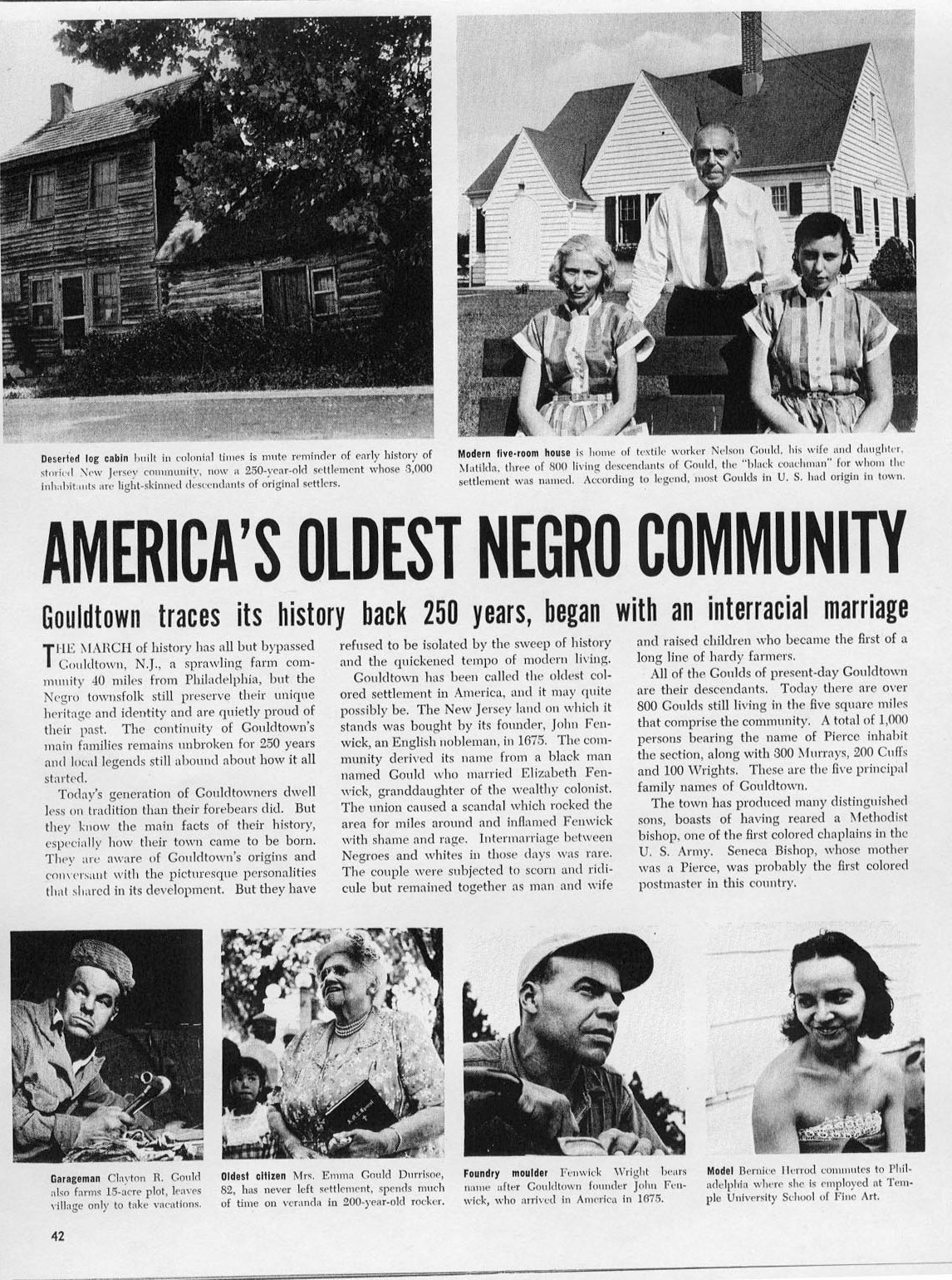
The thread topic reminded me of Gouldtown, New Jersey, a town that was founded by a pawger and his heiress wife in the 18th century. It was called one of the oldest negro communities in the US, and the founders' descendants lived there as late as the 1950s.

EbonyPage42.jpg
 

MoveForward

Veteran
Joined
Dec 19, 2017
Messages
13,560
Reputation
2,975
Daps
75,451
Idk if y’all noticed but a lot of that east coast vs. the south sh-t is kept going by weirdo non ados nikkas. Most Black Americans have southern roots.
 

Laidbackman

All Star
Joined
Jul 9, 2017
Messages
5,433
Reputation
458
Daps
8,516
Reppin
ATL, but rasied in DMV
I use to work with this dark-skinned brother from New York, who said his family doesn't have any roots from the South, and none of them have ever been slaves. That's as far as the conversation ever went. Fast forward to today, he may have been telling the truth.
 

dora_da_destroyer

Master Baker
Joined
May 1, 2012
Messages
67,159
Reputation
17,436
Daps
277,340
Reppin
Oakland
There were free blacks prior to slavery, especially in the north. If your family has roots in NY/Boston, or Canada and made their ways generations ago to Michigan/Ohio/Illinois, it’s definitely possible to be black American without roots in the south or slavery.
 

IllmaticDelta

Veteran
Joined
Jun 22, 2014
Messages
29,438
Reputation
9,910
Daps
83,101
The thread topic reminded me of Gouldtown, New Jersey, a town that was founded by a pawger and his heiress wife in the 18th century. It was called one of the oldest negro communities in the US, and the founders' descendants lived there as late as the 1950s.

EbonyPage42.jpg


These 2 Northern Afram pioneers (they're cousins) came from that community


Benjamin Franklin Lee (September 18, 1841 – March 12, 1926) was a religious leader and educator in the United States. He was the president of Wilberforce University from 1876 to 1884. He was editor of the Christian Recorder from 1884 to 1892. He was then elected a bishop in the African Methodist Episcopal (AME) church, serving from 1892 until his resignation in 1921, becoming senior bishop in the church in 1915.

Benjamin F. Lee was born September 18, 1841 to Abel and Sarah Lee in Bridgeton, New Jersey.[1][2] Among Lee's relatives was Theophilus G. Steward a cousin who would also be an AME church leader.[3]


and


BcEpPpy.jpg

Ghqqre6.jpg


Theophilus Gould Steward (April 17, 1843 – January 11, 1924) was an American author, educator, and clergyman. He was a U.S. Army chaplain and Buffalo Soldier of 25th U.S. Colored Infantry.

Steward was born to James Steward and Rebecca Gould in Gouldtown, New Jersey. The son of free Blacks reared in a family that stressed education, he received his formal education in the Gouldtown public schools.
 
Top