A friend, Yusuf Sampto - a trader with three shops in West Africa's Burkina Faso - pulls up a chair. They excitably describe stuffing suitcases with "literally millions" of US dollars to move their profits back to China once the goods have sold (they declare the cash at customs, they say). African banks can't be trusted, they explain, and it's impossible for a migrant to open a current account in the mainland.
Like most of Guangzhou's successful traders, Issa has a Chinese wife.
"She used to work for a company I ordered from, and we became friends," he says. "We had a Chinese wedding and a Muslim wedding. Her name was Xie Miemie but I renamed her Zena."
Zena is from Hainan Island and Issa was the first African man her family had ever seen.
"Initially, they were unsure about me, but now, when I'm not there, they ask my wife, 'Where is your import husband?'" Issa chuckles.
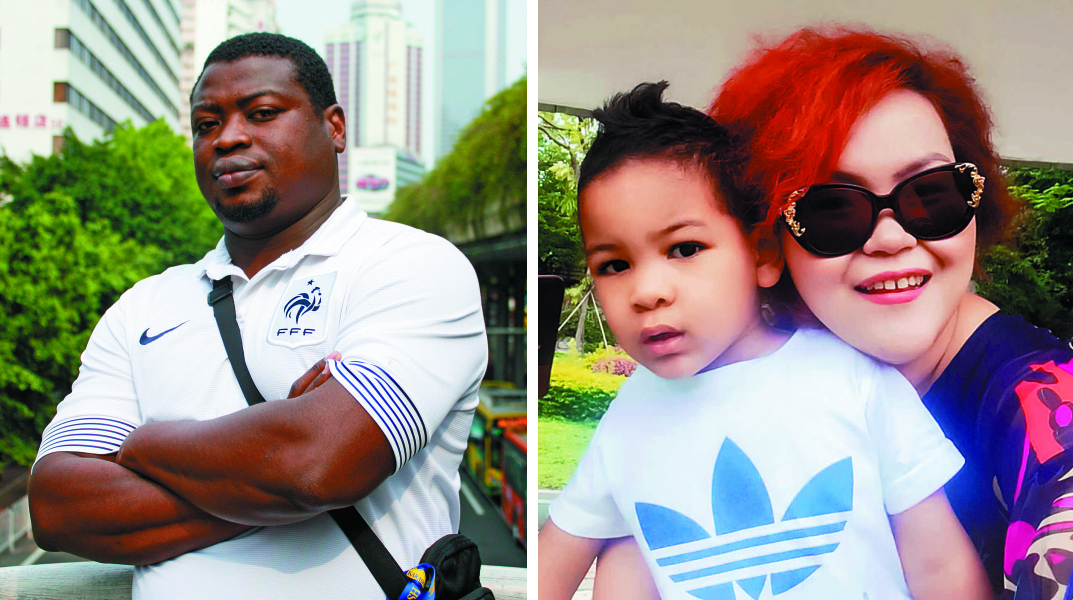
Youssou Ousagna also gets along well with his in-laws. The retired footballer moved from Senegal to Sichuan province in 2005, having been scouted by Chengdu Tiancheng FC. In 2007, after an injury had ended his playing career, Ousagna moved to Guangzhou, where he met his Hangzhou-born wife - she worked at the pharmacy from which he picked up medicine for ongoing football injuries.
“Initially, they were unsure about me, but now, when I'm not there, they ask my wife, 'Where is your import husband?'”
Her parents are both doctors, her sister is a surgeon and her brother a policeman in Guangzhou. This middle-class family have welcomed their Muslim son-in-law.
"With most Chinese, communication is the problem," Ousagna says. "I speak Mandarin, so we understood each other. No problem."
Outside Little Africa, however, racism remains deep-seated, says Gordon Mathews, a professor of anthropology at the Chinese University of Hong Kong who is researching low-end globalisation in Guangzhou.
 Left: former Chengdu Tiancheng FC player Youssou Ousagna. Right: Michelle Zhang Nan with her son, Calvin.
"I know three or four relationships where the couple had expected it to lead to marriage, but as soon as the Chinese family met the African boyfriend, they had to end it," he says. "Marrying a black person is still marrying down in China."
Racial prejudice on the mainland hit the headlines in 2009, when Lou Jing, an Afro-Chinese singer, then 20, appeared on an
American Idol imitation television show, sparking controversy and drawing racial slurs online. "How can a mixed-race contestant become a Chinese idol?" bloggers demanded.
Chinese prejudice against Africans is normally based on three aspects: traditional aesthetic values, an ignorance of African culture and society, and the language barrier.
Furthermore, until the 1970s, foreigners were not permitted to live in the mainland, let alone marry a Chinese. When a child is born, the parents must register its ethnicity with the authorities: of the 56 boxes they can tick, "mixed-race" is not an option.
But there are factors other than racism that might lead a family to reject a mixed marriage.
Linessa Lin Dan, a PhD student at the Chinese University of Hong Kong researching Afro-Chinese relations in Guangzhou, says many African men who propose already have wives in their home countries - Muslims are permitted by their religion to take multiple spouses. Furthermore, Lin has heard tales of husbands returning to Nigeria on a business trip, leaving a mobile-phone number that doesn't connect and disappearing.
"The Chinese wife is left with their children, and shamed for marrying a
hei gui [black ghost]," says Lin.
“Marrying a black person is still marrying down in China”
Generally, though, the African bachelors in Guangzhou are not desperate asylum seekers: they are highly eligible businessmen. Like Ousagna and Issa, they often own a car, have a stable income and speak Putonghua. Forty per cent of African migrants surveyed in Guangzhou for the book
Africans in China (2012), by former University of Hong Kong professor Adams Bodomo, had received tertiary education - some even held a PhD.
As one Congolese merchant tells
Post Magazine, "To start a business in China you have to be quite well-to-do. In the early days, the air ticket alone cost US$2,000."
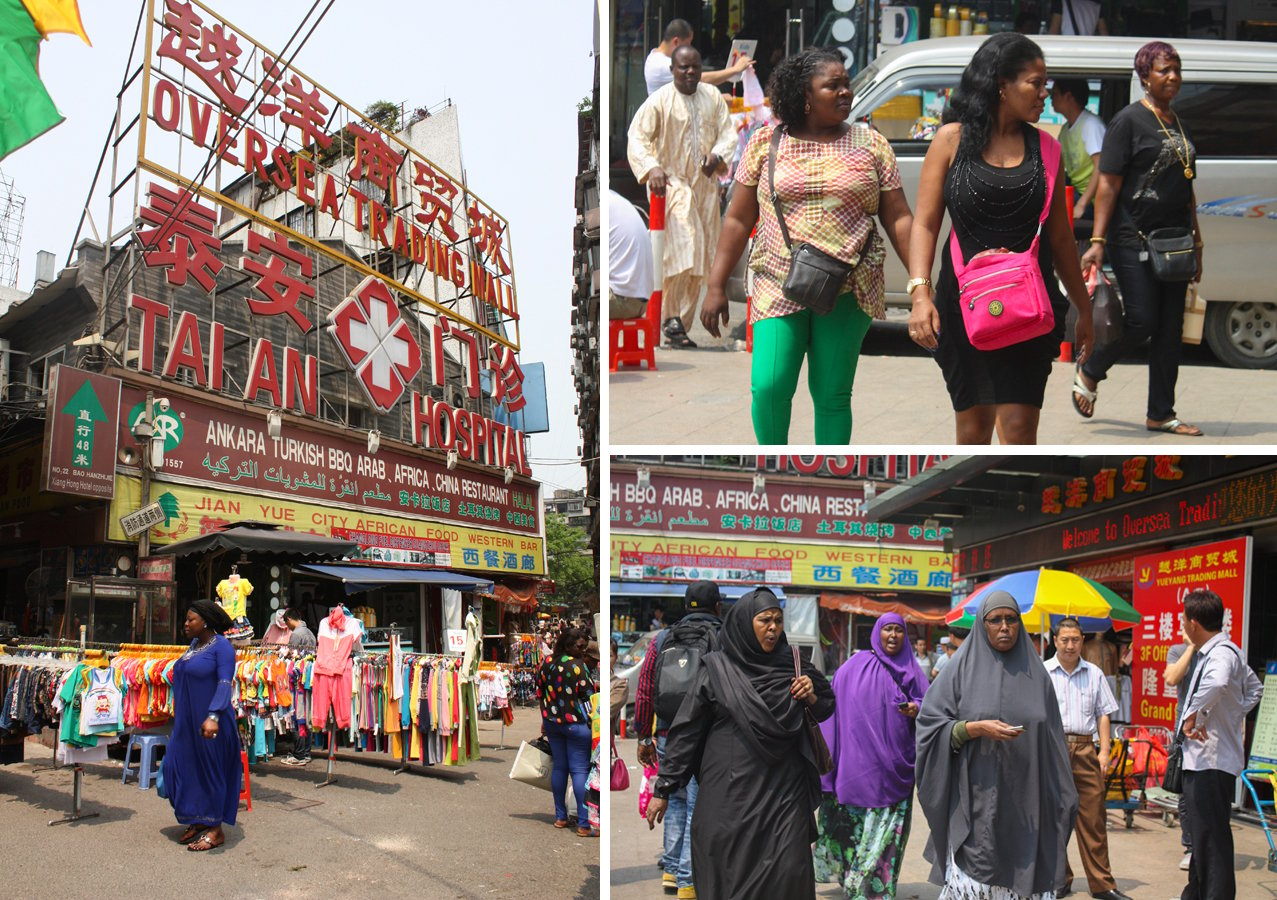
 The Overseas Trading Mall, in Dengfeng village, attracts hordes of African merchants.
Despite their eligibility, most African grooms in Guangzhou marry Chinese economic migrants whose disapproving families reside far from the city. In business terms, it is the ideal merger, says Lin, who believes most Afro-Chinese marriages are a cynical play for better business.
"Opening a shop is very difficult for foreigners," she says. "You need a Chinese passport or the landlord will ask for a bribe. A Chinese wife can speak to suppliers. It's useful to have a Chinese partner.
"Many Chinese women want to marry Africans because they are from poor rural areas, often Hunan or Hubei provinces. Marrying a foreigner is a way to upgrade their social status, because the Africans have money."
Instead of taking a factory job, a Chinese woman who marries an African man often becomes head of his wholesale shop, should he open one, and a key player in his export business.
 Trader and hip-hop artist Pat Chukwuonye Chike, aka Dibaocha Sky. Photo: Robin Fall
Pat Chukwuonye Chike - a garment trader by day and Nigerian hip-hop artist known as Dibaocha Sky by night - has a Chinese wife who doubles as a business partner. But, he says, if African men could legally work in China, many might not take a local wife.
"That is my sacrifice," says the married father-of-two. "My wife cannot cook. My mother-in-law helps look after the children, and she is poisoning them against Africa. She's an old woman, she knows the game she's playing. There is crisis everywhere - terrorists were in Guangzhou last week - it is a sin to make my children scared of Nigeria."
Africans in Guangzhou fall into two groups: those with valid documentation and those whose visas have expired. For those who have overstayed, a Chinese wife is more than a business partner; she is key to survival.
Last August, a major police bust on an African-led drug ring turned life into a daily fight against deportation for overstayers. From dusk till dawn, police checked passports in Guangyuan Xi Lu, the Nigerian annex of Little Africa, where most of the city's overstayers can be found.
"When Nigerians land at Baiyun Airport many throw away their passports," Lin says. "They only get seven- to 30-day visas [less than most other Africans] - it's not enough time to make their fortunes."
“A lot of people are having children now and we need to know their future”
Overstayers face a 12,000 yuan fine and must pay for their 6,000-yuan air ticket out of the country. Those with Chinese wives went underground while their spouses manned their businesses.
"During this period, Nigerians with Chinese wives survived better," says Lin.
While the crackdown proved a Chinese wife's worth, the loyalty displayed points to genuine devotion in Afro-Chinese romances.
Pastor I.G., of the Royal Victory Church, has a Chinese wife, and children. One Sunday I ask him, "Is it love or business?"
The Nigerian sighs. He feels "slighted" by repeated assumptions his eight-year marriage is economically motivated. He met Winnie, a native of Guangdong province, at church and the pair are united in their evangelic mission ("God knows it's China's time," he says). Winnie, 34, is a pastor at the church's 100-worshipper-strong Chinese arm while he leads the larger African congregation. Their tactile body language speaks volumes about their union.
Michelle Zhang Nan, 35, doesn't fit the profile of a trader's wife, either. When we meet at McDonald's, she is dressed in an expensive A-line dress and kitten heels. Her three-year-old son, Calvin, trails behind as she carries a tray of Big Macs and milkshakes.
A university graduate whose parents are government officials, Zhang lives in Guangzhou but has a prized Beijing hukou and owns a phone-battery retail business.
"I liked the way he did business," she says, of falling in love with her South African husband. "If I was married to a Chinese man, I could not be a strong woman like I am today. My husband is 11 years older and he teaches me."
She notes that a Chinese man would benefit equally from taking an African wife, but that is unheard of in Guangzhou. As one bootylicious Liberian hairdresser, who works on the third floor of a tower block, says, "Chinese men aren't manly, they aren't sexual to us." (East African prostitutes working in Little Africa, however, report that 50 per cent of their clients are Chinese men who "want to try it", according to Matthews.)
“Marrying a foreigner is a way to upgrade their social status, because the Africans have money”
But a Chinese wife cannot solve an African migrant's biggest problem: his visa. Happy families can be swiftly torn apart if the PSB denies a continuation on an African husband's temporary documents. The central government pointedly lacks an immigration department, meaning there is no framework for the assimilation of newlyweds such as Okonkwo.
Policy differs from province to province and, compared with those in other Chinese cities, the Guangdong authorities are notorious for their hostile and inconsistent attitude to African migrants.
Throughout the two months I conducted interviews, African husbands reported getting a variety of visas. Nigerian businessman Tony Ekkai - who has two Afro-Chinese children - has a "representative office" of his Hong Kong-registered business in Guangzhou, and therefore is entitled to a coveted one-year, multiple-entry business visa. His Nigerian friend Tony Michael, also married to a Chinese woman, with a two-month-old son, is despondently stuck on three-month visas. Six-month, single-entry visas are all Zhang's husband has seen.
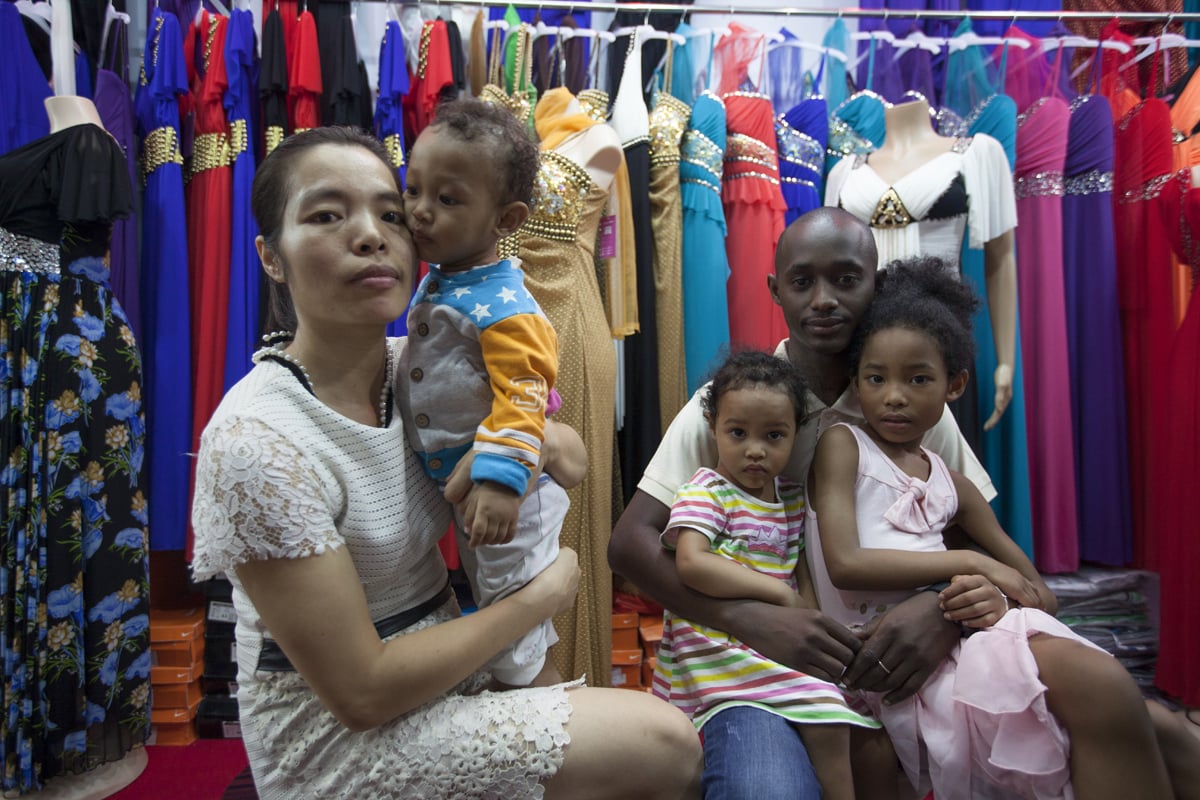
 Guinean trader Cellou with his wife, Cherry, and their children. Photo: Robin Fall
Many, like Ousagna, return to their wives' provinces to renew their visas, to evade the capricious Guangzhou authorities. Others - such as Guinean trader Cellou, who has a one-year residence pass - say their country's good political relationship with Beijing helps their visa applications. Guinea was the first sub-Saharan country to forge diplomatic ties with China, and Cellou, who studied business at the International Islamic University Malaysia, spots the glaring double standard: "If my [Chinese] wife stays in Guinea she can get a Guinea passport."
African states - home to millions of Chinese, also often undocumented - are watching closely to see how their citizens are treated on mainland soil. After a 2012 crackdown in Beijing on African migrants, Nigerian immigration authorities immediately retaliated, arresting 45 Chinese traders in the northern city of Kano.
With so much at stake for Sino-African relations, Beijing is playing a cautious game.
Lan Shanshan, a research assistant professor at Baptist University, claims there is a media edict on the mainland to report favourably on Africans in China, hence the state-owned newspaper
Guangming Daily's three-part special titled "Friends From Africa, How are You Doing in Guangzhou?", in 2012.
“My mother-in-law helps look after the children, and she is poisoning them against Africa”
But a WikiLeaks cable from 2008 revealed that the central government is troubled by the phenomenon, and quietly funded covert research into Africans in Guangzhou, specifically their impact on crime, underground religion and missed tax revenue. The American diplomat who wrote the cable to Washington was not privy to the findings.
In 2011, the government dropped its poker face with the ground-breaking Guangdong Act, which offered rewards to Chinese who snitched on overstayers; made it illegal for employers, hoteliers or educational institutes to serve illegal migrants, and insisted they report all cases to the PSB or face a 10,000 yuan fine; and expanded police powers so that any officer, not just members of the foreign affairs department, could stop foreigners to verify passports.
Even those with valid visas were rattled. A Ugandan told Lan, "A visa is not a 100 per cent guarantee here. When police stop you, if you do not look like a pleasant person to them, they may draw the line on your visa and cancel it. They say, 'China gives, China takes.'"
IN 2010, BODOMO PREDICTED that in 100 years' time "an African-Chinese ethnic minority group could be demanding self-identity and full citizenship rights in the heart of Guangzhou".
But that's already happening.
Ojukwu Emmanuel, 42, is the man spearheading this campaign. A political heavyweight in Guangzhou, he is the elected head of the Nigerian community (each African nation has an informal community representative) and also goes by the ostentatious title of President of Africa in China.
Emmanuel came to Guangzhou in 1997. He has a Chinese wife, a four-year-old son and, in 2012, he formed the Nigerian-Chinese Family Forum, comprised of 200 mixed-race couples and their offspring. His team put together a dossier outlining the contributions to society made by Nigerians and presented it to the PSB, demanding longer and more lenient visas for those with families.
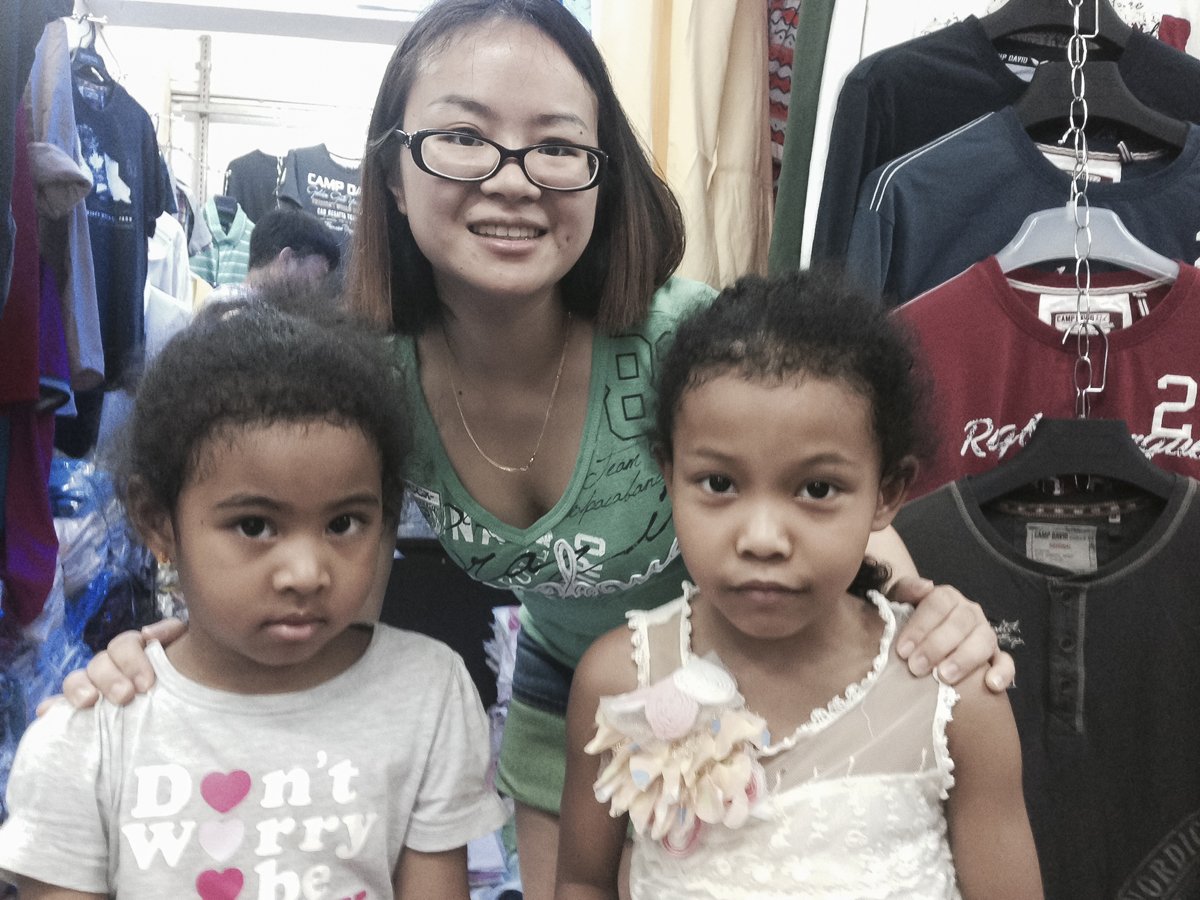
 A trader with her Afro-Chinese daughters at the Tang Qi Arcade, in Guangyuan Xi Lu. Photo: Jenni Marsh


 Police drive though Little Africa in Guangzhou. Photo: Jenni Marsh
 Left: former Chengdu Tiancheng FC player Youssou Ousagna. Right: Michelle Zhang Nan with her son, Calvin.
 The Overseas Trading Mall, in Dengfeng village, attracts hordes of African merchants.
 Trader and hip-hop artist Pat Chukwuonye Chike, aka Dibaocha Sky. Photo: Robin Fall
 Guinean trader Cellou with his wife, Cherry, and their children. Photo: Robin Fall
 A trader with her Afro-Chinese daughters at the Tang Qi Arcade, in Guangyuan Xi Lu. Photo: Jenni Marsh
 Amina Magasaga (right) hugs a friend at the Huiling Integrated Kindergarten, in Baiyun. Photo: Jenni Marsh
 GTFOH with that shyt they marry them to gain control of the wealth and land you should not be consigning that shyt, like the last thing we need is the last available resource we have to slip out of our grip
 Nah homeboy this is Chinese men IN Africa, NOT Chinese men in China...
 I subsequently posted Chinese WOMEN marrying African men.


 It's pretty sad actually. It's like they're annexing entire countries for their fukkery, disease and pollution.


 The negatives outweigh the positives. China was about to reach 2 billion if it were not for that one child policy. That would mean more strain on the state and more poverty because the wealth would be divided amongst more people not to mention labour is in oversupply. Look at India compared to china.
  These poor regions in Africa with 4 plus birth rates need to take note. Im looking at you Ethiopia,
  those nikkas quadrupled their population in 30 years despite bein the poorest country in the world.