

Of course, again, real progress in longevity research requires time and money. Organizations and companies have been trying to tackle this problem for years, and many have been rebuffed. For example, in 2008, pharma giant GlaxoSmithKline shelled out $720 million for a promising drug, SRT501, a modified version of a substance found in red wine that has been linked to anti-aging. Two years later, Glaxo gave up.
But that was five years ago, and this is the company that managed to map the entire planet in a few years. It’s hard to imagine Google will be pumping much money into Calico at first, but if it does, it could make a real difference. For now, sources tell us that Calico will primarily function as an R&D group, exploring the latest in longevity science. However, it won’t rule out the possibility of manufacturing its own products down the line.
At some level, Larry Page, the company — someone in Mountain View — has become convinced that Google needs to help figure out the aging problem. As Bette Davis and most 90-year-olds will tell you, “old age is no place for sissies.” It’s tough. After all, longevity isn’t any fun if one spends the last decade of life wheezing in a hospital bed.
Then again, it’s how life works. As the truisms say, aging is one of the few things in life you can count on.
Hardware: Replacement Organs & Nano Repair Bots
Many people die because one of the vital organs in their bodies stopped working. In recent decades, we’ve dramatically lengthened some lives by simply replacing the faulty part: A heart, kidney, lung, etc.
In the near future, we’ll be able to replace organs at scale with the magic of 3D printing. Scientists have already discovered how to transplant a manufactured kidney, so at some point in the future, heart failure may be just as inconvenient as having to take another trip to Kinkos.

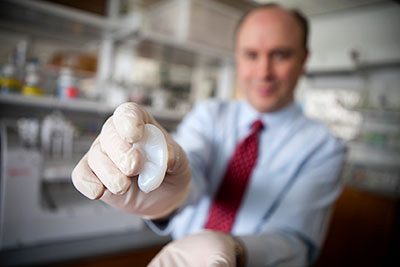
Associate Professor of Biomedical Engineering, Lawrence Bonassar, holds a working, artificial ear created from 3-D printers and injectable molds. Photo by Lindsay France/University Photography
With a colonoscopy costing $7K in New York today, and the average price of a hip replacement in the U.S. being $40K, printing up a new heart would be a welcome change for our wallets. Though until the cost of 3D printing at scale is realized (it’s going to take a while), these kinds of procedures will likely remain on the more expensive side.
And the harsh truth is that fixing organs may not be enough to stave off the effects of old age in the first place. Repairing whole swaths of decrepit tissue and dying cells is likely where science will turn next. Interestingly enough, Google’s Director of Engineering, Ray Kurzweil, believes that an army of nanorobots will eventually do all of our internal tune-ups. The nanobots themselves could mimic the very structure of DNA that is the foundation of our cellular makeup. While the thought is exciting, today this remains in the theoretical realm, i.e. science fiction.
Despite Kurzweil being an authority on immortality, two sources close to the project say that he won’t be working for Calico; instead, he’ll continue focusing on building out his “cybernetic friend” project at Google HQ. That being said, it’s hard to imagine Kurzweil being able to stay away from the project for long, considering how much energy he’s dedicated to thinking about the problem.
Cancer
While Page says that curing cancer won’t be the key to extending the average human lifespan, at some point, Calico and others will have to face it head on. “If a human could live long enough, it is inevitable that at least one of his or her cells would eventually accumulate a set of mutations sufficient for cancer to develop,” explains a team of authors in Molecular Biology of the Cell.
Thus, cancer is an inevitable part of the decay of our cells and, unfortunately, an omnipresent risk as we continue to live longer and longer. One source close to the project says that Google is exploring solutions in the area of genetically personalized medicine. Tailoring drug treatment to the unique biomarkers of the individual, such as the field of Proteomics, is a new path for improving cancer treatment.
BUT WHAT DOES IT ALL MEAN?!?!
There’s a lot of exciting work going on at the intersection of health care and technology. The advancements in computing, mobile technology and data analysis have allowed startups like Neurotrack to help push research on diseases like Alzheimer’s forward, and even predict its onset years before it happens. Companies like Proteus Digital Health are leading the charge into personalized medicine with a pill that can text doctors and family members from inside your body, to paraphrase The Telegraph’s paraphrase.
Startups can change the conversation around innovation in digital health by experimenting, pushing the envelope and staying nimble. However, just having the name of a tech industry giant like Google enter the fray on the digital health front is huge, especially when its chief executives are resolved to help tackle these enormous problems — from diseases like cancer to those pesky age-related wrinkles.
It’s still a bit too early to say how much Google plans to — or will — move the needle in the race for immortality and beautiful skin, but it’s an important step. Throwing its name in the ring will incentivize others to do the same.
Why? As Dr. Katherine Pollard of San Francisco’s Gladstone Institutes explained at TechCrunch Disrupt SF last week, there is still a significant gap between researchers and entrepreneurs — scientists and Silicon Valley. However, at the same time, there are now more opportunities than ever before for both sides to team up to make technological breakthroughs in health care, and, in turn, making those breakthroughs more accessible to the public.
This is important because it’s easy to get wrapped up in the exciting science and technology underlying these problems — and trying to solve the unsolvable — but extending longevity just for the sake of longevity’s sake (while arguably a core element of our survival instinct) is silly. There are 7 billion people on this planet, and if Google and others are going to enable the majority of them to add 10 years to their lives, it will likely create even bigger problems — chiefly in the “resources” department.
Today, more than 1 billion people live without access to the most basic forms of health care. Not to criticize a beautiful thing before it even sets sail — only a cruel, heartless jerk would find fault with a project that deals, in part, with curing cancer, mind you — but this is worth pointing out. There may even be more urgent or salient problems in health care (at large) that a company like Google could help solve; one could argue that bringing basic health care to a billion people needs to come before we worry about extending one person’s life from 95 to 100.
WTF Is Calico, And Why Does Google Think Its Mysterious New Company Can Defy Aging? | TechCrunch
But that was five years ago, and this is the company that managed to map the entire planet in a few years. It’s hard to imagine Google will be pumping much money into Calico at first, but if it does, it could make a real difference. For now, sources tell us that Calico will primarily function as an R&D group, exploring the latest in longevity science. However, it won’t rule out the possibility of manufacturing its own products down the line.
At some level, Larry Page, the company — someone in Mountain View — has become convinced that Google needs to help figure out the aging problem. As Bette Davis and most 90-year-olds will tell you, “old age is no place for sissies.” It’s tough. After all, longevity isn’t any fun if one spends the last decade of life wheezing in a hospital bed.
Then again, it’s how life works. As the truisms say, aging is one of the few things in life you can count on.
Hardware: Replacement Organs & Nano Repair Bots
Many people die because one of the vital organs in their bodies stopped working. In recent decades, we’ve dramatically lengthened some lives by simply replacing the faulty part: A heart, kidney, lung, etc.
In the near future, we’ll be able to replace organs at scale with the magic of 3D printing. Scientists have already discovered how to transplant a manufactured kidney, so at some point in the future, heart failure may be just as inconvenient as having to take another trip to Kinkos.
Associate Professor of Biomedical Engineering, Lawrence Bonassar, holds a working, artificial ear created from 3-D printers and injectable molds. Photo by Lindsay France/University Photography
With a colonoscopy costing $7K in New York today, and the average price of a hip replacement in the U.S. being $40K, printing up a new heart would be a welcome change for our wallets. Though until the cost of 3D printing at scale is realized (it’s going to take a while), these kinds of procedures will likely remain on the more expensive side.
And the harsh truth is that fixing organs may not be enough to stave off the effects of old age in the first place. Repairing whole swaths of decrepit tissue and dying cells is likely where science will turn next. Interestingly enough, Google’s Director of Engineering, Ray Kurzweil, believes that an army of nanorobots will eventually do all of our internal tune-ups. The nanobots themselves could mimic the very structure of DNA that is the foundation of our cellular makeup. While the thought is exciting, today this remains in the theoretical realm, i.e. science fiction.
Despite Kurzweil being an authority on immortality, two sources close to the project say that he won’t be working for Calico; instead, he’ll continue focusing on building out his “cybernetic friend” project at Google HQ. That being said, it’s hard to imagine Kurzweil being able to stay away from the project for long, considering how much energy he’s dedicated to thinking about the problem.
Cancer
While Page says that curing cancer won’t be the key to extending the average human lifespan, at some point, Calico and others will have to face it head on. “If a human could live long enough, it is inevitable that at least one of his or her cells would eventually accumulate a set of mutations sufficient for cancer to develop,” explains a team of authors in Molecular Biology of the Cell.
Thus, cancer is an inevitable part of the decay of our cells and, unfortunately, an omnipresent risk as we continue to live longer and longer. One source close to the project says that Google is exploring solutions in the area of genetically personalized medicine. Tailoring drug treatment to the unique biomarkers of the individual, such as the field of Proteomics, is a new path for improving cancer treatment.
BUT WHAT DOES IT ALL MEAN?!?!
There’s a lot of exciting work going on at the intersection of health care and technology. The advancements in computing, mobile technology and data analysis have allowed startups like Neurotrack to help push research on diseases like Alzheimer’s forward, and even predict its onset years before it happens. Companies like Proteus Digital Health are leading the charge into personalized medicine with a pill that can text doctors and family members from inside your body, to paraphrase The Telegraph’s paraphrase.
Startups can change the conversation around innovation in digital health by experimenting, pushing the envelope and staying nimble. However, just having the name of a tech industry giant like Google enter the fray on the digital health front is huge, especially when its chief executives are resolved to help tackle these enormous problems — from diseases like cancer to those pesky age-related wrinkles.
It’s still a bit too early to say how much Google plans to — or will — move the needle in the race for immortality and beautiful skin, but it’s an important step. Throwing its name in the ring will incentivize others to do the same.
Why? As Dr. Katherine Pollard of San Francisco’s Gladstone Institutes explained at TechCrunch Disrupt SF last week, there is still a significant gap between researchers and entrepreneurs — scientists and Silicon Valley. However, at the same time, there are now more opportunities than ever before for both sides to team up to make technological breakthroughs in health care, and, in turn, making those breakthroughs more accessible to the public.
This is important because it’s easy to get wrapped up in the exciting science and technology underlying these problems — and trying to solve the unsolvable — but extending longevity just for the sake of longevity’s sake (while arguably a core element of our survival instinct) is silly. There are 7 billion people on this planet, and if Google and others are going to enable the majority of them to add 10 years to their lives, it will likely create even bigger problems — chiefly in the “resources” department.
Today, more than 1 billion people live without access to the most basic forms of health care. Not to criticize a beautiful thing before it even sets sail — only a cruel, heartless jerk would find fault with a project that deals, in part, with curing cancer, mind you — but this is worth pointing out. There may even be more urgent or salient problems in health care (at large) that a company like Google could help solve; one could argue that bringing basic health care to a billion people needs to come before we worry about extending one person’s life from 95 to 100.
WTF Is Calico, And Why Does Google Think Its Mysterious New Company Can Defy Aging? | TechCrunch


