‘Jobs may disappear’: Nearly 40% of global employment could be disrupted by AI, IMF says

bnew

Veteran
Joined
Nov 1, 2015
Messages
69,236
Reputation
10,617
Daps
187,127

AI could widen the wealth gap and wipe out entry-level jobs, expert says​


August 5, 20254:08 AM ET

Heard on Morning Edition

By

Steve Inskeep

,

Nia Dumas

A photo taken on January 2, 2025 shows the letters AI for Artificial Intelligence on a laptop screen (R) next to the logo of the Chat AI application on a smartphone screen in Frankfurt am Main, western Germany. (Photo by Kirill KUDRYAVTSEV / AFP) (Photo by KIRILL KUDRYAVTSEV/AFP via Getty Images)


A photo taken on January 2, 2025 shows the letters AI for Artificial Intelligence on a laptop screen (R) next to the logo of the Chat AI application on a smartphone screen in Frankfurt am Main, western Germany. (Photo by Kirill KUDRYAVTSEV / AFP) (Photo by KIRILL KUDRYAVTSEV/AFP via Getty Images)

KIRILL KUDRYAVTSEV/AFP via Getty Images/AFP

Artificial Intelligence continues to grow, forcing companies to find a way to close the gap between innovation and preparation.

Companies have begun integrating AI into their day-to-day operations. Some employers are concerned that this will lead to a complete elimination of their roles within companies.

In a previous Morning Edition video interview, former Secretary of Transportation Pete Buttigieg raised concerns that America is not prepared for the economic downsides of artificial intelligence.

"The economic implications are the ones that I think could be the most disruptive, the most quickly. We're talking about whole categories of jobs, where — not in 30 or 40 years, but in three or four — half of the entry-level jobs might not be there. It will be a bit like what I lived through as a kid in the industrial Midwest when trade in automation sucked away a lot of the auto jobs in the nineties — but ten times, maybe a hundred times more disruptive," Buttigieg said.

Erik Brynjolfsson, senior fellow at Stanford's Institute for Human-Centered Artificial Intelligence and director of the Stanford Digital Economy Lab, told Morning Edition that coding, software engineering and call centers are the jobs that are likely to experience the most change.

Most industries are leaning toward the direction of automation, Brynjolfsson explains.

But there are things that artificial intelligence can't do. Therefore, future jobs may rely on more human skills like communication and creativity — areas where AI can assist but not replace.

"I do think that interacting with humans face-to-face is something that a lot of people prefer — that's something that by definition can only be done by other humans," Brynjolfsson said.

He also warns that while AI can generate wealth, he worries that it will only deepen the divide between those who form technology and those it will displace.

Brynjolfsson spoke to NPR's Steve Inskeep about the urgent areas that need to be addressed when integrating new technologies into the workforce such as job displacement, the need for more human-centered skills and widening the gap of economic inequality.

This interview has been edited for length and clarity

Interview highlights​


Steve Inskeep: First, is Pete Buttigieg right to raise this concern about the very near future?

Erik Brynjolfsson: Yeah, he's spot on. We are seeing enormous advances in core technology and very little attention is being paid to how we can adapt our economy and be ready for those changes.

Inskeep: What are the jobs that are going away partly or entirely?

Brynjolfsson: There's transition in both directions. There are jobs that are disappearing, and there are new jobs being created. Some of the jobs that are changing the most are in coding, software engineering and in call centers — which I've studied. And in those areas, we're already beginning to see some effects, especially on entry level jobs.

Inskeep: I'm also thinking of an auto factory that I visited earlier this year in China. They had some human employees, but robots were doing an awful lot of the work, and I would imagine robots might do more and more of it.

Brynjolfsson: I visited one of those factories over in Shenzhen and I saw the same thing. They're all going to trend in the direction of more automation — that's just more cost-effective. And the people at the factories were telling me it leads to better quality and more consistency as well.

Inskeep: Well, that can be. But of course, there's also the dislocation. So let's focus on that for a second. Pete Buttigieg made that comparison to the industrial Midwest where there were entire communities that were devastated. Could we see that kind of effect?

Brynjolfsson: I think it's a very apt analogy. The ideal thing is that you find ways of compensating people and managing a transition. Sad to say, with trade, we didn't do a very good job of that. A lot of people got left behind. It would be a catastrophe if we made the similar mistake with technology, [which] that also is going to create enormous amounts of wealth, but it's not going to affect everyone evenly. And we have to make sure that people manage that transition.

Inskeep: How would we shape our future in a more positive way?

Brynjolfsson: The first thing a lot of economists, including me, would go to is worker retraining and understanding what are the kinds of skills and tasks that are going to become more important going forward: a lot of interpersonal skills, a lot of management skills. I think as we create these agents, we're all going to become CEOs of our own little fleet of agents. Learning those management skills that apply not just to humans, but increasingly to agents, is something that can be taught. If we each have our own fleet of agents, then we can each be more productive.

Inskeep: You better explain what an agent is for people who aren't familiar.

Brynjolfsson: AI — we are all using LLMs (Large Language Models) increasingly and using them to give us bits of text back to us and give us some advice. Agents is taking that one step further where the large language model doesn't simply give us some text back, but actually takes an action. It goes ahead and makes an airline reservation or buys something for us or carries out some other tasks.

Inskeep: I want to add a note of skepticism about retraining. I understand broadly why it would be a good idea. But I think about the industrial Midwest in the way that people talk about job retraining as old industrial jobs went away. Some of the effects of that included job retraining programs — which sound good but didn't really help people very much — an emphasis on education — which sounds great — but maybe it just increased the price and the demand for education and not everybody ended up with a very fruitful job on the other end. This is hard.

Brynjolfsson: It's hard. There's still a wage premium for people who are more educated versus less educated. And it doesn't necessarily mean retraining to do more of the same. It's often moving in to do new industries — new kinds of tasks. I do think that interacting with humans face to face is something that a lot of people prefer. That's something that by definition can only be done by other humans.

Inskeep: I'm wondering if we have the wrong emphasis on education. We've been trying so hard to bring up STEM fields. Some of those jobs can be replaced. Maybe we should have been emphasizing more of the liberal arts which deal with humanity.

Brynjolfsson: I think it's a "both/and." I absolutely do think there could be a revenge of a lot of humanity's tasks, and there may be opportunities there for more creative, artistic, interpersonal work. At the same time, there are huge premiums for certain kinds of engineering, math, science and coding. You may have seen some of the outsized salaries they're being offered to people who are really good at creating AI.

Inskeep: Yeah, absolutely true. Do you worry that the creative jobs could go away, too? I think about the movie industry, where there's already been a lot of tension and conflict about the idea that maybe you don't even need the actor to be there — the AI can make it up.

Brynjolfsson: It's amazing what's happening in that industry. That's a place where the jobs are going to change a lot. I do think there will be opportunities. For people like you and me to make our own fun little movies I've been using Chat GPT to write poems to my wife and songs that I couldn't have done previously. Maybe next year I'll be making movies.

Inskeep: Somebody's going to be listening and saying, "Wait a minute. You asked ChatGPT to write a poem to your wife?"

Brynjolfsson: Full disclosure, I did tell her where it came from, but somehow she still appreciated it.

Inskeep:: You seem basically optimistic. Is there something that keeps you up at night?

Brynjolfsson: Oh, definitely. I'm optimistic about the potential to create a lot more wealth and productivity. I think we're going to have much higher productivity growth. At the same time, there's no guarantee all that wealth and productivity is going to be evenly shared. We are investing so much in driving the capabilities for hundreds of billions of dollars and we're investing very little in thinking about how we make sure that leads to widely shared prosperity. That should be the agenda for the next few years.

This story was edited by Suzanne Nuyen.
 

bnew

Veteran
Joined
Nov 1, 2015
Messages
69,236
Reputation
10,617
Daps
187,127


The AI Report That’s Spooking Wall Street​


The majority of companies are failing to see any returns on their AI investments, a report finds.

By Bruce Gil Published August 20, 2025 | Comments (55)

𝕏
https://www.facebook.com/sharer.php...facebook&utm_medium=social&utm_campaign=sharehttps://www.reddit.com/submit?url=h... Report That’s Spooking Wall Street&type=LINK https://gizmodo.com/the-ai-report-t...izmodo.com&utm_medium=link&utm_campaign=share

Photo: Spencer Platt
© Spencer Platt (Getty Images)


A new report from MIT is casting doubt on the hype around the financial value AI brings to businesses, and may be triggering a small tech stock sell-off on Tuesday.

The report, The GenAI Divide: State of AI in Business 2025, found that the promised AI gold rush isn’t paying off for most companies yet.

Despite the major push to adopt AI tools in the corporate world, fewer than one in ten AI pilot programs have generated real revenue gains. The rest are having no impact on a company’s bottom line, according to MIT’s report—based on 150 executive interviews, a survey of 350 employees, and an analysis of 300 public AI deployments.

“Just 5% of integrated AI pilots are extracting millions in value, while the vast majority remain stuck with no measurable [profit and loss] impact,” the report said. Meaning that “95 per cent of organizations are getting zero return.”

The eye-opening report spooked investors and sent AI stocks sliding. Nvidia dropped 3.5% on Tuesday, Arm Holdings fell 3.8%, and data analytics firm Palantir took the hardest hit, plunging nearly 9% yesterday and is still sinking this morning.

Aditya Challapally, the report’s lead author, told Fortune the problem isn’t necessarily the AI models themselves, but that most companies don’t know how to use them to their full potential.


“Some large companies’ pilots and younger startups are really excelling with generative AI,” Challapally said. He highlighted startups run by 20-year-olds as good examples of how businesses should use AI. He said these startups “have seen revenues jump from zero to $20 million in a year. It’s because they pick one pain point, execute well, and partner smartly with companies who use their tools.”

Most companies, though, are misplacing their resources. More than half of generative AI budgets are funneled into sales and marketing tools, but MIT found that real returns come from boring back-office automation—things like eliminating business process outsourcing and streamlining operations.

Additionally, buying specialized tools or teaming up with outside vendors works about 67% of the time, while homegrown builds only succeed one-third as often. That’s a big deal in industries like finance, where companies are pouring money into building their own proprietary systems. MIT’s takeaway is that going solo carries more risk for failure.

The report also dropped just days after OpenAI CEO Sam Altman warned that an AI bubble may be forming.

“I do think some investors are likely to lose a lot of money, and I don’t want to minimize that—that sucks,” Altman said, according to the Financial Times. “There will be periods of irrational exuberance. But on the whole, the value for society will be huge.”

Meta shares also dipped after it announced a major shake-up in its AI division, a move some are seeing as a bad sign for the company’s AI ambitions that adds to the worries of an AI bubble.
 

bnew

Veteran
Joined
Nov 1, 2015
Messages
69,236
Reputation
10,617
Daps
187,127

At30wecashout

Veteran
Supporter
Joined
Sep 2, 2014
Messages
38,174
Reputation
19,351
Daps
177,581
Coming from where with everyone unemployed.
If workers aren't buying and circulating money, every economy comes to a complete stop.
Not true if countries stop prioritizing infinite growth. People can still work, things will still get bought, but everyone would get a stipend that makes sure their baseline needs are met. Want to create some product but need time to do it? Quit your job. You have universal healthcare (thats gonna come too) and UBI to float you. Want more than baseline living? Keep working. A guaranteed check makes it so your every waking thought isn't how you are going to make the bills or what will you do to distract yourself since you can't make the bills.
 

CopiousX

Veteran
Supporter
Joined
Dec 15, 2019
Messages
15,167
Reputation
5,308
Daps
74,824
Coming from where with everyone unemployed.
If workers aren't buying and circulating money, every economy comes to a complete stop.
Not really.
In 2025, The vast majority of income in the American GDP comes from just the top 10%. They are primarily selling to themselves and buying from themselves in the current system. They spend insanely small percentage of their income on consumer goods which the general population buys. The vast majority of their spending is between other rich people . If you wanted to get really nihilistic about it , the normal people are honestly a drag on their economy, Not a requirement.


It's been a few years since I checked but i believe the top 10 percent of earners are 75% of the federal tax base by themselves. So the country would still be operating without most of us too on a federal level.

Even more so when you consider that ...
the wealthy get their income from wealth instead of hours labor like normal people. This is significant to my point because the same top 10% of earners hold 70percent of this country's wealth. As an example , picture an old rich white dude who owns a gold mine, which is operated by robots which do the mining ,do the processing , do the packaging , and then put the gold onto automated Tesla trucks. The same gold is sold to that billionaire who owns LVHM to make luxury watches which he would then sell to Musk. Then musk uses the money from the first guy who owns the mine to create more cybertrucks with his factories of robots that he sells to other rich people.


As you can see, This is an entirely closed loop economy which doesn't need normal people. It gets even more morbid when you consider the same 10% also control most of the government contracts. So they still get to eat off the taxpayers (which is mostly themselves).


I think a few companies which specialize in consumer goods may run out of business. But the wealthy will be just fine without the 90% because they lean more on their assets and income from b2b sales. This isn't a radical concept . Lots of humans societies have had this exact setup. I've spoken about it on here before with the example of Rome with slavery. Slavery is a direct parallel to the free labor from AI. Sparta was opperated the exact same way. As was the antebellum South in America, and large chunks of the ottoman empire.
 
Last edited:

Dorian Breh

Veteran
Joined
Jan 14, 2016
Messages
23,380
Reputation
14,099
Daps
115,030
Hilarious that the last news story bnew posts shows that AI ain’t replacing shyt and in fact making companies less efficient. Then more sensationalism…
 

CodeBlaMeVi

I love not to know so I can know more...
Supporter
Joined
Oct 3, 2013
Messages
39,302
Reputation
3,666
Daps
107,841
Not really.
In 2025, The vast majority of income in the American GDP comes from just the top 10%. They are primarily selling to themselves and buying from themselves in the current system. They spend insanely small percentage of their income on consumer goods which the general population buys. The vast majority of their spending is between other rich people . If you wanted to get really nihilistic about it , the normal people are honestly a drag on their economy, Not a requirement.


It's been a few years since I checked but i believe the top 10 percent of earners are 75% of the federal tax base by themselves. So the country would still be operating without most of us too on a federal level.

Even more so when you consider that ...
the wealthy get their income from wealth instead of hours labor like normal people. This is significant to my point because the same top 10% of earners hold 70percent of this country's wealth. As an example , picture an old rich white dude who owns a gold mine, which is operated by robots which do the mining ,do the processing , do the packaging , and then put the gold onto automated Tesla trucks. The same gold is sold to that billionaire who owns LVHM to make luxury watches which he would then sell to Musk. Then musk uses the money from the first guy who owns the mine to create more cybertrucks with his factories of robots that he sells to other rich people.


As you can see, This is an entirely closed loop economy which doesn't need normal people. It gets even more morbid when you consider the same 10% also control most of the government contracts. So they still get to eat off the taxpayers (which is mostly themselves).


I think a few companies which specialize in consumer goods may run out of business. But the wealthy will be just fine without the 90% because they lean more on their assets and income from b2b sales. This isn't a radical concept . Lots of humans societies have had this exact setup. I've spoken about it on here before with the example of Rome with slavery. Slavery is a direct parallel to the free labor from AI. Sparta was opperated the exact same way. As was the antebellum South in America, and large chunks of the ottoman empire.
This is so shortsighted. They grow and pick their own food too? Robots are not there yet.
 

3rdWorld

Veteran
Joined
Mar 24, 2014
Messages
50,380
Reputation
5,202
Daps
148,068
Not true if countries stop prioritizing infinite growth. People can still work, things will still get bought, but everyone would get a stipend that makes sure their baseline needs are met. Want to create some product but need time to do it? Quit your job. You have universal healthcare (thats gonna come too) and UBI to float you. Want more than baseline living? Keep working. A guaranteed check makes it so your every waking thought isn't how you are going to make the bills or what will you do to distract yourself since you can't make the bills.

Infinite growth is a consequence of Capitalism, and Capitalism is America's Operating System.

To stop infinite growth, America would have change its operating system to Socialism or Communism, which America will never allow.

People forget that the business community is not here to do charity or favors, theyre here soley for the money no matter the cost to everyone else.

It's similiar to Trump giving business a massive tax break arguing first would employ more people and it would'trickle down'' to the little man, but those commercial enterprises kept the money and didnt care for the little man.
 

Chrishaune

Veteran
Joined
Jun 28, 2012
Messages
39,260
Reputation
2,672
Daps
95,154
Reppin
Huntsville
Not true if countries stop prioritizing infinite growth. People can still work, things will still get bought, but everyone would get a stipend that makes sure their baseline needs are met. Want to create some product but need time to do it? Quit your job. You have universal healthcare (thats gonna come too) and UBI to float you. Want more than baseline living? Keep working. A guaranteed check makes it so your every waking thought isn't how you are going to make the bills or what will you do to distract yourself since you can't make the bills.

People really think the government cares about them like that and won't just try to kill them off?

They are going to call you to the office one day and figure out how they can try to get you up out of here.
 

CopiousX

Veteran
Supporter
Joined
Dec 15, 2019
Messages
15,167
Reputation
5,308
Daps
74,824
This is so shortsighted. They grow and pick their own food too? Robots are not there yet.
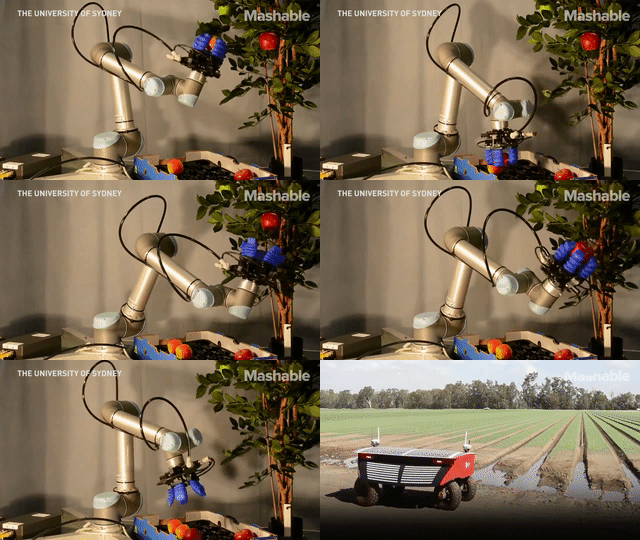
Your're kidding right? we've been here since 2015 :pachaha:

B9YpGm.gif


modern-agriculture-weeding-robot-1mvquq6ymf7zndgt.gif


ezgif.com-optimize.gif


The only reason these farming drones aren't standardized is because farming is still aimed at the poor consumer, who is soon going to be cut out of the supply chain entirely. An automated future is radically different. There will not be direct to consumer products. Once again food is an inconsequential percentage of a rich person's income. These are people that don't give a flying fck how high the egg prices are. So the premium that comes from all of this machinery is meaningless to them.


So in a world where they silo themselves away from the poor people in the general society, They genuinely do not need us in their economy.
 
Last edited:
Top