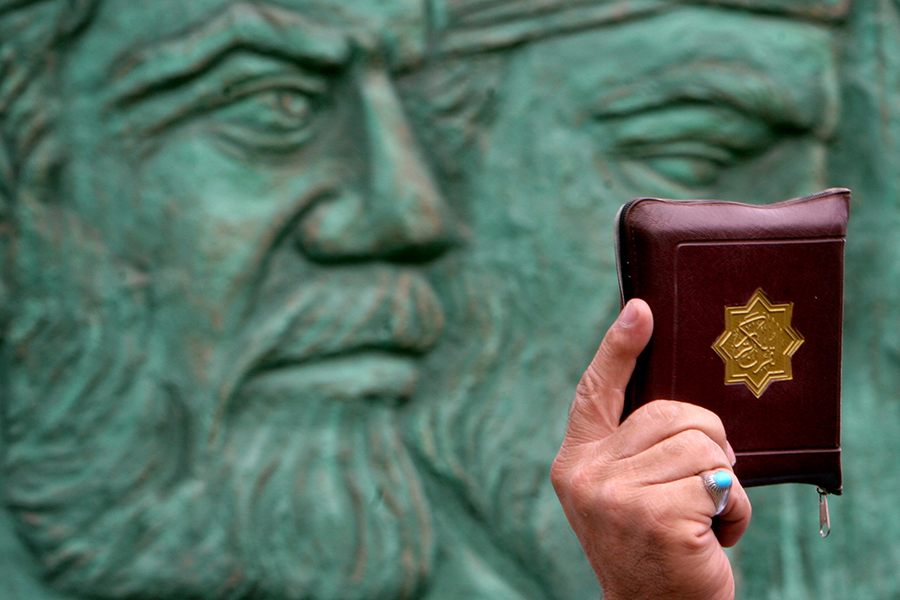
The Supreme Leader is not an automaton and his power isn't uncheckable. Like the Pope, just because he is at the head of the hierarchy doesn't mean the factions beneath are superficial window dressing. The IRI isn't a single celled organism, it's a complex and nuanced political entity.
The Supreme Leader has the power of the judiciary, executive, legislature and is commander and chief of the military. As well as control over state media.
So no, not very much like the pope at all.
Who checks the power of the Supreme Leader? The Guardian Council could potentially unseat the Supeme Leader if he doesn’t project sufficient piousness.
Who appoints the Guardian Council? The Supreme Leader.
Not good Bob.
The fact that different heads of government from different factions are elected and pursue different internal and external policies under the same Ayatollah should indicate to you that there is more going on here than just the whims and wishes of a single man or faction.
The Supreme Leader of Iran can technically be challenged and removed by the Assembly of Experts—a body of 88 elected clerics—if deemed unfit, just, or pious, according to the constitution.
In practice, however, the Supreme Leader wields near-absolute power, as the Assembly is vetted by the Guardian Council, which is appointed by the leader himself, making a challenge highly unlikely.
Key details on challenging the Iranian Supreme Leader:
Constitutional Mechanism: Article 111 of the Iranian constitution gives the Assembly of Experts the power to supervise, elect, and dismiss the Supreme Leader.
Practical Reality:
Because the Guardian Council disqualifies candidates for the Assembly of Experts, the body is heavily skewed in favor of loyalists, creating a system that protects the leader.
Past Behavior:
Throughout its history, the Assembly of Experts has never publicly challenged or overseen the decisions of the supreme leader, maintaining a, "life-long" tenure.
Exceptions: Challenges generally arise in the form of mass public protests or in times of acute regime crisis rather than through institutional, legal channels.
Sorry, my puny Western brain can’t understand the intricacies of the oriental mind. Quite clearly this is the noblest government ever conceived. How has it never not been tried before to have authority over the only body that could potentially overthrow you? Truly a masterful bit of statecraft. Checks and balances, who the hell needs em I say.
Literally never said that Israel and the US are targeting the "good guys". I said they are pursuing a policy of destabilization through eliminating moderate factions
Do these factions have a name? The wear a Hawaiian shirt on Wednesday faction?
I don't know how you can consider this a cartoonish conspiracy theory when it is explicitly the same policy they have pursed to great effect in the Occupied Palestinian Territories. You must think very poorly of the Israeli and American intelligence apparatus if you think they're looking at the Iranian political landscape with your same glassy-eyed oversimplification of "they're all just dirty brown terrorists". Even Trump has admitted to "accidentally" killing the better leadership alternatives the IC had identified. So yeah, there are people in the intelligence community who have dedicated their professional lives to running the numbers on this.
“Dirty brown terrorists” ok buddy we get it, you don’t need to lay it on quite so thick?
Let’s dig into this “we are killing all the hippies so the Reaganites can get into power” charge
During the 2022-2023 “woman, life, freedom,” protests, rumors about rifts among Iran’s political elites regarding the appropriate governmental response gradually grew louder. A notable example was Khamenei's alleged encouragement of the police force to repress protests more harshly when some other senior leaders would counsel restraint. Given the opaque nature of Iran’s political system and the complex relationships between its elites at various levels of power, reports about elite infighting should be approached with a degree of caution. Even so, shifts in elite relationships were visible before protests erupted.
The 2021 Iranian parliamentary elections heralded a decisive turn towards hardline factions gaining dominance in the governance of Iran, despite the fact that public disillusionment ran high and voter turnout reached only 42,57%. The presidential elections of the same year confirmed hardline ascendency by installing the conservative hardliner Ebrahim Raisi as President by means of a rigged procedure. Before 2021, Iran’s conservative and hardline elite factions already exercised substantial influence behind the façade of a more moderate and pro-reform administration however, to the point of enjoying a de facto veto. After 2021, hardline and conservative factions have been unequivocally in charge. But their domination of parliament and the presidency did not bring political stability about, as some have suggested it would. Instead, reformist elite factions were demoted and competition increased between hardline elite factions themselves.
….
Since the start of Raisi’s presidency, foreign relations have been a major area of discord between reformist and hardline elite factions. Even before his tenure, and his network critiqued the foreign policy of former president Rouhani and his Foreign Minister Mohammad Javad Zarif, accusing them of selling Iran out to the West on the nuclear issue. They argued the US could be coerced into rejoining the JCPOA on Iran’s terms, including assurances and compensation.
However, two years into his term, the Raisi administration has not only failed to revive the JCPOA, but it has also presided over surging tensions with the West. Of late, the course of the nuclear negotiations has fueled divisions among ruling hardline elite factions as well. Pro-reform news website Entekhab detailed how ultra-hardliners, especially the “Front of Islamic Revolution Stability” (or the “Stability Front,” as it’s often referred to – a radical political faction deeply influenced by the ideology of the late hardline cleric Ayatollah Mohammad-Taqi Mesbah Yazdi), obstructed the revival of the nuclear agreement against the wishes of the Raisi administration – even though it is also ‘hardline. For example, when Iran and the West were on the brink of reviving the JCPOA in the summer of 2022, Stability Front members proposed delaying the agreement by asserting that Europe’s impending “harsh winter” – due to the Ukraine conflict and the shortage in Russian gas supply to Europe – would force the West to accept Iran’s terms. In March 2022, a member of parliament affiliated with the Stability Front leaked details of a potential agreement between Iran and the West, claiming it was not favorable to Iran. Naturally, this move damaged the draft’s prospects substantially. Note that the Stability Front has representatives in both the parliament and Raisi’s cabinet. For example, Saeed Jalili, a former secretary of Iran’s Supreme National Security Council (SNSC) and chief nuclear negotiator during Mahmoud Ahmadinejad’s presidency, is linked with the Front. It was Jalili who allegedly advocated to increase uranium enrichment to 90 percent (ultimately rejected by the Supreme Leader).
In brief, the consolidation of control in the hands of hardline factions since 2021 over Iran’s foreign policy has neither produced a consensus that can enable a breakthrough in the nuclear negotiations, nor has it generated a foreign policy that is more coherent as a whole. It did, however, produce a shift of diplomacy and trade towards ‘the East’, as well as greater confrontation with the West (see blog #2 of ‘Iran in transition’).
….
In conclusion, intra-elite relations are fluid at the surface and plenty of change seems afoot. Below the surface, reformist factions have been demoted and relegated to the sidelines of Iran’s political arrangements while hardline factions remain both in control and united in their deeper views of the Islamic Republic. Progressive change will remain a scarce commodity in the near future. The next blog in our series ‘Iran in transition’ will appear towards the end of September after what we hope will be a good summer break for many of you.
By Hamidreza Azizi and Erwin van Veen

www.clingendael.org
So the article claims there are only hardliners in power who are only challenged by the super duper hardliners. Now let’s cross check this with what we know about Iranian foreign policy
1. Gave billions to Assad and sent soldiers to Syria to help quash rebellion
2. Gave billions to Hesbollah and Hamas and Houthi’s
3. Gave military support to Russias invasion of Ukraine
4. Maximum state repression
Yep. Not seeing a lot of reform.
Again, calling the IRI a "Muslim doomsday cult" is pretty textbook Orientalism. Perhaps the reason the Ayatollah despises the modernizing Gulf States is because they present a check against their regional power or projection of state ideology. Just because they have beards doesn't mean they're incapable of the same realpolitik that all the actors in this situation have been deploying. This "they hate us for our freedoms" shyt is so incurious and idiotic.
Shia millenarianism, the ideological fuel of many insurgent movements in early Islamic history, was expanded but contained in Twelver Shia theology with an end-of-times divine manifestation: the Shia Mahdi. Belief in the eventual advent of the Mahdi has been central to a quietist, even fatalist, Shia Islam. But twentieth century Shia reconsiderations have challenged this religious abstention from political action. At one end of the spectrum, espousing a Muslim Brothers – like militant approach, Muhammad Baqir al-Sadr and Muhammad Husayn Fadlallah dissociated the long-term expectation of the Mahdi from today’s imperative of social and political action. At the other end, an ecstatic Mahdism, occasionally yielding schismatic movements, has posited that the current era is already that of the Mahdi’s revelation. Ayatollah Khomeini’s “Rulership of the Jurisprudent” combines elements from both ends, by delegating to the Supreme Guide aspects of the authority of the Mahdi.
Mahdism flourished in Shia-majority Iraq even under Saddam Hussein’s despotic Sunni rule. For many Mahdists, the fall of the regime was understood as a confirmation of millenarian expectations. With guidance from Iran, the main Iraqi Shia Islamist forces have navigated a delicate path, capitalizing on Mahdist fervor while striving to consolidate power in more mundane fashion. As the open Iranian proxy in Lebanon, Hezbollah sought to implement a similar process.
The July 2006 war with Israel provided Hezbollah with the means to test and enhance this dual formula. Hezbollah presented its inconclusive confrontation with Israel as a “Divine Victory” (Nasrun min Allah, in an all but explicit reference to the Hezbollah leader Hasan Nasrallah). Nasrallah used charged language of (divine) “promise,” while supporters’ accounts of miraculous events and legions of angels joining the fight were allowed to flourish. While Hezbollah maintained a rational and “moderate” discourse directed outwardly, its inward message to the Shia community was more imbued with sectarianism, and repurposed ecstatic imagery.
Militant Shia millenarianism has been deployed at full throttle as part of Iran’s efforts to rescue the Syrian regime. The primary narrative device is the collapse of history into the sequence of the traumatic martyrdom of Imam Hussein ― the seventh century event at the heart of Shiism ― and the subsequent battle setting the stage for the return of the Mahdi. Sunni Syrians are thus recast as the spawn of the Umayyad Caliph Yazid. Seemingly innocuous details, such as the town of Daraa witnessing the first episode of anti-Assad unrest, are depicted as ominous signs; one Mahdist tradition seemingly references Daraa as the place from which al-Sufyani, the Mahdi’s arch-enemy, would spark his movement. By many accounts, the Mahdi will have divinely ordained precursors, the most notable being al-Yamani ― identified with Hasan Nasrallah in some circles.