
xXOGLEGENDXx
Veteran
President of a foreign poor country tells me to leave and gives an oddly specific time period to do so...
Me:

Me:



"They have the ambition for oil, gas and gold. We tell them: these riches are not yours, they are for the people of Venezuela and that's how it will be forever," Nicolas Maduro warned on Wednesday, Jan. 23, in the Venezuelan capital Caracas shortly after opposition lawmaker Juan Guaido illegally declared himself "interim president" and received support for his unconstitutional move from the U.S., Canada and other right-wing governments in the region
A deeper look into the reasons behind such right-wing flood to support the parliamentary coup reveals that the objective behind such endorsement of an internationally illegal act is behind the publicly stated humanitarian reasons and in fact about robbing the country of its riches after two decades of progressive and sovereign policies by the Bolivarian government that limited Washington's access to such resources.
Oil
According to the CIA World Factbook, as of Jan. 1, 2017, Venezuela had the largest proven oil reserve estimate of any country, including Saudi Arabia.
As of November 2017, the South American nation had 300,900,000,000 barrels of proven reserves in the "Hugo Chávez" Orinoco Oil Belt. After the inauguration of Nicolas Maduro for a second term, Donald Trump government began to consider expanding its sanctions on Venezuelan crude to add pressure against the constitutional president.
Oil analysts have indicated that the objective, beyond preventing the sale of oil to China, is to ensure a stable source of oil to serve the U.S. market that is increasing and that its own current production can not supply. On Jan. 16, the U.S. Department of Energy revealed that its reserves decreased by 2.7 million barrels, reaching 437.1 million.
In terms of proven gas reserves, Venezuela had 198.3 trillion cubic feet in 2017, according to the Ministry of Petroleum. The new proven reserves are distributed in 2.3 trillion cubic feet of the traditional areas of Maracaibo, Maturin, Barcelona, Cumana and Barinas, and 718.7 trillion that lie in the blocks of the Oil Belt.
Mining resources
Venezuela has denounced the international campaign promoted by the United States against the Mining Arc where the reserves of gold, diamonds and other minerals such as coltan are concentrated.
The campaign against the Mining Arc has sought to increase the levels of economic suffocation in Venezuela by presenting Venezuelan gold as a product of trafficking and corruption.
In 2018 Venezuela advanced in the certification of more than 30 gold fields in the country, with which it aimed to establish itself "as the second largest gold reserve on the planet".
During 2018 and despite the sanctions, the South American nation received a 200 percent increase in its non-oil exports compared to 2017, mainly gold sold to Holland, Portugal, Spain, Sweden, Switzerland, the United States, the United Kingdom and especially to Turkey. In the first months of 2018, Venezuela exported 23.62 tons of gold to the Eurasian nation, valued at US$900 million.
By representing an alternative to oil and one of the largest proven gold reserves in the world, the U.S. has renewed its interest in appropriating this mineral and obstructing the commercial exchange that Venezuela maintains with Russia and Turkey in the Mining Arc.
As President Nicolas Maduro denounced Wednesday, Washington's real objective in Venezuela is to seize the immense natural and mineral resources of the South American nation.
Political Beacon in Latin America
In 1998, commander Hugo Chavez Frias had a pivotal electoral triumph that changed the fate of Latin America for around 20 years, from that time to this date, there have been up to 15 progressive democratically elected governments in the region.
Commander Chavez and Nicolas Maduro first as foreign affairs minister and then as president have been crucial in the integrationist efforts in Latin American, guided by the ideals of Simon Bolivar of a united continent. With the cooperation of other countries and presidents such as Luiz Inacio Lula da Silva, Dilma Rousseff, Rafael Correa, Evo Morales, Nestor Kirchner, Cristina Fernandez de Kirchner, Manuel Zelaya, Fernando Lugo, Daniel Ortega, Fidel Castro, Raul Castro, Venezuela pushed forward for the regional integration of the continent.
During these years some bodies of regional integration bodies were created such as the Community of Latin American and Caribbean States (CELAC), the Bolivarian Alliance for the Peoples of Our America (ALBA), The Union of South American Nation (UNASUR), The Bank of the South, the News Network teleSUR, and the Southern Common Market to enforce South American trade bloc (MERCOSUR), all organizations that sought to create a more unified and independent Latin American and the Caribbean community.
From that moment a series of efforts began, in order to destabilize these governments. Soft coups against progressive presidents started, the first one against Chavez in 2002 which failed, then another against Honduras' Manuel Zelaya in 2010, followed by a parliamentary maneuver against Paraguay's Fernando Lugo, and partially ending with a parliamentary coup against Brazil's Dilma Rousseff in 2016.
These processes have been defined as "lawfare", such as the current legal wrangling against Lula, to which we can add the more recent ones against Rafael Correa and Jorge Glas in Ecuador and a very similar process against Cristina Kirshner in Argentina.
The domino effect rising of right-wing governments in Latin America, and defeating the "National Popular governments" continues in the region, and Venezuela is one of the last standing defenses, along with Bolivia, Nicaragua, Cuba, and El Salvador.
This is why a destabilization mediatic and a political and economic campaign has been unleashed against Venezuela, and all the "National Popular governments" of Latin America, for years. Defeating Venezuela, one of the first progressive countries and governments in the region, is so important for the U.S. and the local right-wing oligarchies. It would be a defeat to progressivism in the region.
They could be the sacrifice that starts armed conflict smh



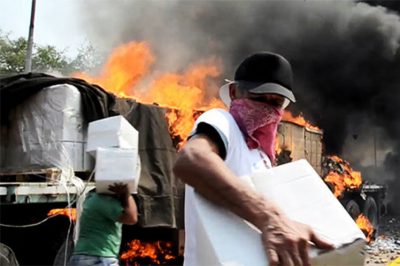
An article signed by journalists of the newspaper in Colombia and New York states that the video ‘casts doubt’ on the culpability imputed to Venezuelans.
Senior US officials said Nicolás Maduro‘s regime burned an aid convoy last month. Our exclusive video contradicts that claim and shows how this unverified information was spread through Twitter and television, the Times says.
Vice President Mike Pence wrote that ‘the tyrant in Caracas danced’ while his henchmen ‘burned food and medicine’, says the New York newspaper.
The State Department published a video that said Maduro ordered the trucks burned. And Venezuela’s opposition has halted images of burning aid, reproduced on dozens of news sites and television screens throughout Latin America, as evidence of the alleged cruelty of the Venezuelan leader, the newspaper said.
US-backed Opposition Activists Caught on Video Throwing Molotov Cocktails at Aid Truck on Venezuela Border
‘But there is a problem’, he clarifies, ‘the opposition itself, not Maduro’s men, seems to have set the load on fire accidentally.’
The unpublished images obtained by The New York Times and the previously published films, including the images shown by the Colombian government, which blamed Maduro for the fire, allowed a reconstruction of the incident.
He suggests that a Molotov cocktail thrown by an anti-government protester was the most likely trigger for the fire, he stresses.
Describes the publication that at a given moment, a homemade bomb made of a bottle was thrown at the police blocking a bridge that connects Colombia and Venezuela to prevent the aid trucks from arriving.
But, the rag used to light the Molotov cocktail is separated from the bottle by flying towards the help truck. Half a minute later, that truck is on fire, he details.
The same protester can be seen 20 minutes earlier, in a different video, hitting another truck with a Molotov cocktail, without setting it on fire, he adds.
The burning of the aid last month, reason for a broad condemnation to the Venezuelan government, arguments that today arouse doubts and that the video attributes to people linked to actions that the White House promoted to justify an aggression against Venezuela.
The Times article questions the validity of several of the arguments used to attack Maduro’s government, including actions to prevent the entry of drugs.
The Times notes that the United States Agency for International Development, the main provider of aid on the bridge, did not include medicines among its donations.
Many right-wing South American governments that are supporting Trump's effort to oust Venezuela's President Maduro have their own legitimacy issues, such as Brazil and Honduras. Others are deeply dependent on the US, such as Argentina and Colombia. CEPR's Mark Weisbrot analyzes the coalition

Then came 2016. Too late, the ruling class realized that the powers they had harnessed after 9/11 to shred the Constitution and impose police-state totalitarianism could not be taken for granted and might even have escaped their control, particularly with the rise of social media facilitating the dissemination of alternate narratives even as it enabled the unprecedented growth of the surveillance state.
In an effort to stop reality from poisoning the narrative, President Barack Obama authorized the establishment of a Ministry of Truth (the Center for Information Analysis and Response) as he walked out the door in December 2016, his parting gift to a government in the throes of utter existential panic – but it was too little, too late.
With Abrams at the helm, we know what’s next. There will be no graceful extrication.
Trump has said over and over that there’s no going back, and the loss of face after such a public coup attempt would make him a laughingstock among his neocon pals, if not his dwindling base.
Abrams’ Central American genocides of the 1980s are not forgotten, and the same old script is playing out – Venezuelan authorities have already caught a CIA-linked airline unloading crates of weapons bound for the opposition in Valencia.
Buying elections is not an option – Venezuela’s electoral system is markedly less corrupt than the American model, and the slickly-produced Juan Guaido – who might as well have been grown in a vat at Langley – would never prevail in an electoral contest.
The Lima Group – a body created with the sole purpose of de-legitimizing Maduro’s government! – will not green-light the military invasion the US is so desperately itching to conduct as its regime-change operation melts down. Even Brazil – whose leader, Jair Bolsonaro, served under the last crop of military dictatorships imposed on the country and prefers such a model to democracy – has categorically refused to allow US forces to use its borderlands as a staging ground for invasion.
A UN resolution calling for Maduro to step down was blocked last week. Absent a spectacular false flag – not really Abrams’ specialty – only a sustained, high-level propaganda campaign can win the hearts and minds of the “broad coalition” Bolton now says the administration wants.
One must give the establishment media credit for working with the few scraps of plausibility they’re thrown – CNN has featured entire segments on Venezuelan military defectors who are neither Venezuelan, nor in the military. We are told again and again they are eating dogs, they are eating zoo animals, they are eating rats (the “babies flung out of incubators” Wag the Dog myth of the 21st century).
Wikipedia, Facebook and Instagram all stamped their seal of approval on Guaido the moment he became the Emperor Norton of the southern hemisphere – sometimes before. Richard Branson was pressed into service, bringing his (uneaten) dog-and-pony show to town as soundtrack to the Standoff On The Bridge that was supposed to be Maduro’s Waterloo. The myth unraveled quickly as the opposition was caught on film fire-bombing a USAID truck, then trying to blame the conflagration on Maduro’s forces.
Maduro staged his own musical intervention to drown out Branson’s sparsely-attended PR stunt. Colombian hirelings and provocateurs threw rocks and Molotov cocktails at the looming squadron of US aid delivery vehicles (cluelessly labeled USAID – as if everyone in South America isn’t aware of what it means when USAID shows up in your country) while Guaido’s “human avalanche” evaporated into a trickle when the Boy Wonder himself vanished at the height of the action. The Abrams brigade was caught disguising themselves as Red Cross workers, lest a distinct brand lead to White Helmets-style infamy if one were to be caught mid-atrocity.
Venezuelan foreign minister Jorge Arreaza accused the US of staging the bombing of the aid convoy and exposed the “humanitarian” fraud for what it is – a pastiche of photo-ops, “crumbs” of spoiled food, expired medicine, barricade-construction materials, and weapons for the opposition framed as manna from heaven; the Venezuelan regime depicted as selfish and self-sabotaging, valuing their pride over the full bellies of their people. Meanwhile, millions of dollars in aid continues to pour in from Russia, Turkey, China, and other countries that aren’t interested in installing a pliable puppet to plunder petroleum. The Potemkin aid supply operation – complete with fake crowd numbers for Branson’s concert, fake atrocities to protest against, even fake terrorist collaborators (watch Rapture Mike Pompeo bloviate about Hezbollah) – would have been laughable if it were not so deadly serious.
Narrative supremacy has become such a crutch for our foreign and domestic policies that the country is no longer capable of functioning if when we say jump! the rest of the world does not obediently shout how high?
Thus, what was supposed to be a morale-boosting quickie regime-change operation to cheer up the rank and file on the road to Tehran – the overthrow of Nicolas Maduro’s sanctions-starved socialist state in Venezuela, the oil-rich fly in the ointment of “our own backyard” – has become just another entry on a long list of ignominious failures.
Even the truest of true believers can no longer pretend that the US is in the business of spreading democracy – not when all the evidence and information available points the other way. The only remedy left for the “sole superpower” is to cut off the flow of information entirely and build an informational Iron Dome, an epistemological missile shield capable of withstanding all truth.
Who are you going to believe, me or your lying eyes?
Lazy propaganda is largely to blame for the lapse in narrative superiority. The same tawdry psy-ops are recycled again and again, as we see now in Venezuela, where Iran-Contra felon and smirking genocide enthusiast Elliott Abrams has been wheeled out of cold storage to work his death-squad magic on a population we’ve already tried and failed to hypnotize with the promises of neoliberalism.
Just as the one-two punch of fake Iranian revolutions made the fatal error of running the same script twice in most “protesters’” lifetimes, the attempt to overthrow Maduro comes less than two decades after the US-backed effort to overthrow Chavez – also led by Abrams – and it’s not fooling anyone.
It doesn’t help that the total nobody they picked to lead the charge was a stranger to 80% of all Venezuelans, or that John Bolton couldn’t even keep from blurting out the truth – that this entire pantomime of humanitarian intervention is being conducted to pillageVenezuela’s sweet, sweet oil, which has the gall to sit beneath one of the last socialist holdouts in the western hemisphere.
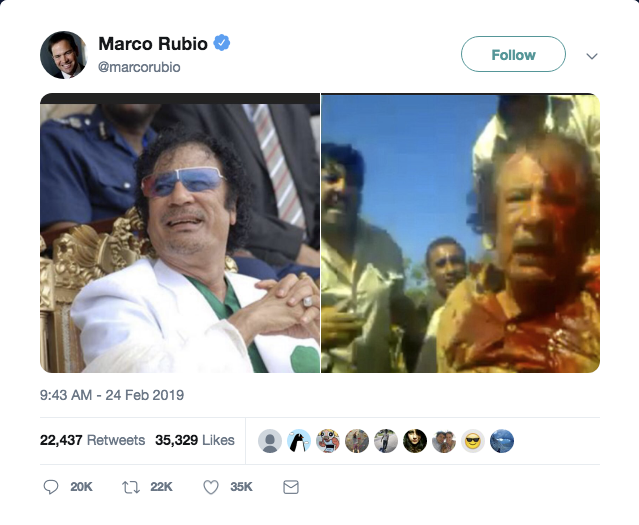
The Kissinger Chicago School-style, “make the economy scream” model that worked so well in Chile and Argentina fell flat in Venezuela in 2002 – the people did not trust an opposition movement willing to tank the economy in order to take over, and refused to vote for the barbarians at the gate, no matter how slickly produced their “revolution.” With even Washington’s subservient allies in the Lima Group refusing to back military action, elections would be Trump’s only way to climb out of this hole gracefully, short of Libya-style indiscriminate slaughter – and that option is far too tempting for a country whose very existence is an affront to neoliberalism, as evidenced by the chillingly sociopathictweets of Marco Rubio.
The UN human rights rapporteur Alfred De Zayas has exposed the fraud that is the Venezuelan “humanitarian crisis,” demanding the US answer for its own violations of international law in creating the situation.
“I see human rights more and more being instrumentalized to destroy human rights,” he told Abby Martin – not the UN, which isn’t interested in hearing his recommendation to haul the US before the International Criminal Court for the sanctions he calls a “crime against humanity” as well as its violation of Venezuela’s sovereignty.
This is to say nothing of Venezuela’s stolen gold, a crime which bodes ill for every other country that has ever stored its bullion with the Bank of England. Even Australia, one of the Five Eyes, has never been permitted to fully audit its gold reserves there, raising the question: does the City of London no longer care, with the dollar due to collapse at any minute, whether its customers find it trustworthy? Or has the gold long since been sold or traded to points east?
“Progressive” stooges are deployed at home to sell this war to Americans, and the 2020 hopefuls (except Tulsi Gabbard) have all scored media points shilling for regime change. Bernie Sanders, whose last act as a 2016 candidate was to sell his supporters out to his erstwhile enemy Hillary Clinton, has dragged his feet jumping on the regime-change bandwagon, but at the same time refuses to support Maduro – despite ostensibly sharing his socialist values. Even Alexandria Ocasio-Cortez, the progressives’ Great Brown Hope, has been less than forthcoming in her support for Maduro and the poor Venezuelans whose interests he represents.
But then, she’s more Guaido’s hue anyway. Not even the most virulently anti-Trump US lawmakers are willing to publicly question the idea that putting a loaded gun to a country’s head and demanding they swear fealty to a total stranger is “democracy.” Twitter, ever the helpful servant of the ruling class, deleted thousands of pro-Maduro accounts in January in an effort to manufacture consent while permitting doxxing and hacking attacks on pro-regime entities and even the Venezuelan currency itself by a dodgy group of Venezuelan expats called DolarToday – the very “coordinated inauthentic behavior” Maduro’s supporters are blamed for. Facebook and Instagram signed off on Guaido’s legitimacy with blue check-marks they withheld from Maduro – and Wikipedia declared Guaido President before Guaido had a chance to do it himself. The propaganda operation is running at full capacity, 24/7 – so why isn’t it working?
While Venezuela struggled with the most massive blackout in its history, president Maduro said there is evidence that a US cyber-attack caused the blackout. Meanwhile, Trump administration officials continue the offensive against Venezuela and the NYT uncovers false reporting
Hausmann, for example, attempted to pass off dubious assertions that Venezuelan opposition leader “Juan Guaidó is not right wing,” and that he “did not just declare himself president” of the country. She also claimed that President Nicolas Maduro “made up” the National Constituent Assembly, neglecting to mention that that governing body was clearly defined in the country’s 1999 Constitution, and was ratified by 71.8 percent of the country through a democratic vote.
Hausmann’s performance ended with a teary-eyed appeal for sympathy: “On a personal level… my father is exiled from going back home.” For a video dedicated to “just the facts,” Hausmann’s rant omitted an especially pertinent piece of information: her exiled father and the rest of her family are no ordinary Venezuelans, and are, in fact, key players in the bid to bring down the elected government.
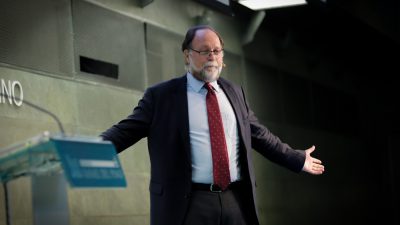
Much of Hausmann’s script echoed talking points outlined by her father, Ricardo Hausmann, in a 2018 article ominously entitled “D-Day Venezuela.” The piece amounted to a plea for the U.S. to depose Maduro by force, with Hausman arguing that “military intervention by a coalition of regional forces may be the only way to end a man-made famine threatening millions of lives.”
But Ricardo Hausmann is much more than a prominent pundit. He is one of the West’s leading neoliberal economists, who played an unsavory role during the 1980s and ’90s in devising policies that enabled the looting of Venezuela’s economy by international capital and provoked devastating social turmoil.
Hausmann emerged among a group of neoliberal economists gathered around the Instituto de Estudios Superiores de Administración (IESA), a private university in Caracas. They came to be known in Venezuela as “the IESA Boys,” a not-so-affectionate reference to the Chicago Boys who had been “imported” into Chile from the Economics Department of the University of Chicago and who in 1973 played a role in devising shock-therapy economic policies for Augusto Pinochet and his military junta.
The popular rejection of the IESA Boys’ agenda began with the Caracazo of 1989, a massive revolt that consumed the capital of Caracas when poor and working-class Venezuelans rioted in protest of an IMF package that mandated harsh austerity. Thousands of dead civilians and three years later, Hausman entered government to impose more shock therapy on the most vulnerable Venezuelans, making the rise of Hugo Chávez as president in 1998 practically inevitable.
While unknown to most Venezuelans, Hausmann remains a key player in his country’s tumultuous politics. During a talk at the World Affairs Council of Greater Houston in November 2018, he eerily predicted Guaidó’s self-proclaimed presidency, telling the crowd “the international community is now focused on the idea that… January 10th is the end of the presidential period of Nicolás Maduro.”
“On January 11th, Nicolás Maduro will not be recognized as… the legitimate president of Venezuela,” Hausmann anticipated. “I think that’s an important date.”
On January 11th, when Juan Guaidó declared his preparedness to become president of Venezuela, the Harvard professor’s prophecy was fulfilled.
Almost two months later, Guaidó appointed Hausman to serve as his representative at the Inter-American Development Bank. This was perhaps the best signal of what lies in store for Venezuela if Guaidó and his benefactors in the Trump administration achieve their goal of regime change. Hausmann’s return to power spells the restoration of the IESA Boys’ agenda, bringing neoliberal austerity back with a vengeance. A detailed look at his history is a preview of what lurks on the horizon for the poor and working-class Venezuelans whose lives improved the most throughout the era of Chavismo.
The neoliberal Venezuelan economist Juan Cristóbal Nagel described the neoliberal economics plan he favored for his country during the late 1980’s as “your basic Washington Consensus recipe.” Nagel said the plan consisted of the following ingredients: an end to price controls on basic goods and subsidies for gasoline; the privatization of state utilities; a decision to float the country’s exchange rate; and the lowering of tariffs. The recipe was popularly known as “El Gran Viraje,” or the Great Turn, to radical free-market capitalism.
While campaigning for Venezuela’s 1988 presidential elections, Carlos Andrés Pérez of the social-democratic Acción Democrática Party (AD) slammed the International Monetary Fund as a “neutron bomb that killed people but left buildings standing.” Immediately upon taking office, however, Pérez filled the IMF’s toxic economic prescription for Venezuela’s ailing economy, accepting a massive loan that completed the “Gran Viraje.”
The reforms led to a 30 percent hike in bus fares, announced in February 1989, prompting masses of workers to flood the streets in cities nationwide to publicly reject the bitter pill Pérez was forcing down their throats. Pérez opted to violently suppress the uprising, known as the “Caracazo,” declaring a national emergency and deploying the military to extinguish the revolt. By the time the it was over, anywhere between 300 to 3,000 people were dead, with piles of bodies discovered in mass gravesoutside of Caracas, the casualties of execution-style killings.
Ricardo Hausmann entered Venezuela’s government under Pérez, serving as his Planning and Finance Minister from 1992 to 1993 while sitting on the board of the country’s Central Bank. Hausman has claimed that he was at Oxford University when the Caracazo erupted, though he had already made his mark on the government’s economic policies.
“Hausmann will tell you that he was abroad at Oxford during the Caracazo rebellion,” says George Ciccariello-Maher, author of We Created Chávez: A People’s History of the Venezuelan Revolution.
“While this may be true” explained Ciccariello-Maher, “[Hausmann] had already spent years in a number of government positions going back to the mid-1980s, and as a key ‘IESA boy,’ spreading neoliberal doctrine from his professorship at the Institute.”
Indeed, before Pérez tapped Hausmann to serve as planning minister, the economist had worked also as a professor at the IESA.
“It was a classic bait-and-switch,” said Ciccariello-Maher. “Pérez had just been elected using anti-neoliberal rhetoric, but he immediately appointed an IESA-dominated cabinet and did the opposite.”
In his book Windfall to Curse: Oil and Industrialization in Venezuela, economist Jonathan Di John wrotethat “Pérez was greatly influenced” by IESA academics, characterizing them as “an elite group… who had no party affiliation and were champions of radical, neoliberal reform.”
According to Di John, this group initiated “rapid liberalization reforms,” specifically in trade policy, including reducing the maximum tariff “from 135 percent, one of the highest in the region, to 20 percent by 1992.” A year later, that rate would fall to 10 percent. In other words, Pérez, Hausmann, and the “ISEA Boys” had opened up Venezuela for a free run by multinational corporations while gutting whatever was left of the welfare state.
In 1994, Hausmann received his golden parachute with a post as chief economist for the Inter-American Development Bank in Washington. This institution, which claims to “improve lives in Latin America and the Caribbean” by providing “financial and technical support to reduce poverty and inequality,” is just another mechanism for imposing the Washington consensus. The U.S. controls 30 percent of the bank’s voting power over financial decisions even though it is not situated in Latin America, where the bank is supposed to do its work. Meanwhile, all 26 Caribbean and Latin American member states carry only a 50 percent sway over the bank’s decisions.
While Hausmann perpetuated his brand of neoliberalism from Washington, a movement was building in the barracks and barrios of Venezuela to exert popular control over the economy. It was led by a charismatic military man named Hugo Chávez.
During the late 1980s, as Lt. Col. Chávez watched the wholesale ravaging of his country’s economy by foreign capital, he formed a cadre of populist officers called the Bolivarian Revolutionary Movement 200. In 1992, Chávez led the officers in an attempted military coup against the government of Pérez, hoping to ride the wave of popular resentment for the neoliberal policies enforced by Hausmann and his fellow IESA boys. Though he initially failed, Chávez captured the mood of the Venezuelan public, including sectors of the middle class, and emerged as a national folk hero.
Even mainstream U.S. media conceded that Chávez had a point. At the time, the Washington Postidentified him as the leader of a popular movement challenging Perez “for not instituting a viable democracy and stewarding an economic program that has not served the country’s poor.”
In contrast to the Post’s contemporary coverage of Venezuela, which reads like an information-warfare campaign on behalf of the anti-Chávez opposition, the Post at that time freely conceded public dissatisfaction with the IESA reforms: “Many people around Caracas banged on pots and pans today and shouted out of their windows in support of the rebels,” the paper noted.
It added:
Venezuela, the third-largest producer in the Organization of Petroleum Exporting Countries cartel, has been wracked by unrest. Critics accuse the government of not distributing oil riches to the public, citing corruption as a cause.”
For its part, the New York Times reported:
The coup attempt followed violent protests and labor unrest arising from a growing disparity between rich and poor in Venezuela. The Government has admitted that only 57 percent of Venezuelans are able to afford more than one meal a day.”
The Guardian also described the military insurrection as a popular insurgency against the ruthless austerity program of Pérez’s IESA Boys:
The underlying cause of the military unrest is undoubtedly the widespread social discontent. When he came back to power three years ago, President Pérez was expected to repeat the expansionist policies of his first term of office in the late 1970s when Venezuela was one of the richest countries in the developing world, enjoying the easy wealth brought by its huge oil reserves.
But Mr. Pérez overnight adopted the liberal economic policies dominant in most of the Western world. He cut back heavily on government spending, opening up the economy to market forces and international competition.”
Across the board, mainstream media identified the economic program imposed under the watch of Hausmann and his colleagues as the force driving Pérez’s unpopularity. Though Chávez failed to take control of the state in 1992, calling for his comrades to lay down arms following his failed revolt, he declared that “now is the time to reflect,” promising “new situations will come.”
“The same month that Chávez led a failed coup against the Pérez government, Hausmann officially joined the government as planning minister,” recalled Ciccariello-Maher, adding:
It’s not clear to me whether it’s better to have been in charge when the government instituted a brutal neoliberal reform package, or to willingly join that same government after it had massacred hundreds, if not thousands, who resisted the reforms.”
Six years later, Chávez won democratic elections for president, convening a national assembly and referendum to rewrite the country’s constitution and alter the character of the Venezuelan state in a dramatic fashion.
By this time, Hausmann and his wife, Ana Julia Jatar, who also served in the Pérez administration, had left for high-flying careers Washington, where Hausmann took over as Chief Economist at the Inter-American Development Bank. While her husband worked at the bank, Jatar was a Senior Fellow at the Inter-American Dialogue, a think-tank primarily funded by Chevron, the Ford Foundation, USAID, and her husband’s employer.
In 2000, Hausman took a professorial job at Harvard’s John F. Kennedy School of Government, watching and waiting for an opportunity to return to power in his home country.
“Neoliberalism is the path to hell”
Back in Venezuela, the Bolivarian Revolution ushered in by Chávez provided an antidote to the IESA method that had produced so much social damage to Venezuela’s majority.
“The Bolivarian Revolution was an indirect response to neoliberalism, born of mass resistance in the streets,” claims Ciccariello-Maher, observing that while “in power, it remained largely faithful to that mission.”
Ciccariello-Maher added that “it would be difficult to exaggerate the impact Chavismo has had on Venezuelan society,” because for the first time in its history “oil was put at the service of the people. …Most important, however, the poor – so long excluded – became ‘protagonists’ in the political life of Venezuela, and active participants in local direct democracy.”
Chávez moved to nationalize not only the country’s prosperous oil resources, booting ExxonMobil and ConocoPhillips from the field, but also centers of agricultural production, telecommunications, and mineral mining. Considering Venezuela sits atop the largest oil reserves in the world, as well as sizeable gold stocks, this achievement was no small feat.
In his 1998 inaugural address, Chávez cited Pope John Paul II as having described capitalism as “savage,” using the words of His Holiness to highlight the social damage left behind by Hausmann and his colleagues. Chavez declared:
It is savage that in a country like ours more than half of preschoolers are not going to preschool. It is savage to know that only one out of every five children who enter preschool, only one in five finishes elementary school. That is savage because that is the future of this country.”
In 2002, just one month after facing down a U.S.-backed coup attempt, Chávez addressed a conference in Madrid declaring “neoliberalism is the path to hell.” Unlike Pérez, Venezuela’s new leader would not sell out his promise to reject the IMF’s austerity agenda.
During the Chávez era, the Hausmann family was not content to sit on the sidelines and watch him build a “21st-century socialism.”
Joanna’s mother, Ana Julia Jatar, assumed a position as executive director of Súmate, a U.S.-backed “civil society group” formed by right-wing darling María Corina Machado in order to “build democracy” in Venezuela.
In 2003, Súmate received $53,400 from the National Endowment for Democracy “to work on referendum and general electoral activities,” accordingto a U.S. diplomatic cable released by WikiLeaks.
The initiative represented Jatar and Machado’s attempt to remove Chávez from power through popular recall. Yet the public rejected the referendum by a whopping 59 percent margin, in results certified by the Carter Center and Organization of American States.
Seeking to defend his wife’s failed project, Ricardo Hausmann co-authored a paper that he insisted“open[ed] the door to… hypotheses of fraud” marring the vote. His argument was thoroughly rebuked in an extensive study issued by the Center for Economic and Policy Research, which determined Hausmann and his co-author, M.I.T’s Roberto Rigobon, “provide no evidence of fraud.”
Súmate’s subsequent efforts to label the vote as fraudulent were also rebuffed in a comprehensive report released by the Carter Center, which concluded: “the Aug. 15 vote clearly expressed the will of the Venezuelan electorate.” The Carter Center concluded that it “did not observe, and has not received, credible evidence of fraud that would have changed the outcome of the vote.”
Despite Súmate’s failures, President George W. Bush welcomed Machado to the White House in 2005. In the Oval Office, Bush heralded her efforts “to defend the electoral and constitutional rights of all Venezuelan citizens” and monitor the country’s elections.
Sociologist William I. Robinson told Venezuelanalysis that Súmate was part of “a full-blown operation, a massive foreign-policy operation to undermine the Venezuelan revolution, to overthrow the government of Hugo Chávez, and to reinstall the elite back in power in Venezuela.”
Such elites include multiple members of Joanna Hausmann’s clan.
“My extended family, they go out on these protests,” the YouTube comedian declared in her video. “My uncle is in jail for simply being a journalist.”
Image on the right: Ana Julia Jatar and her father, Braulio Jatar Dotti. Photo | NotiEspartano
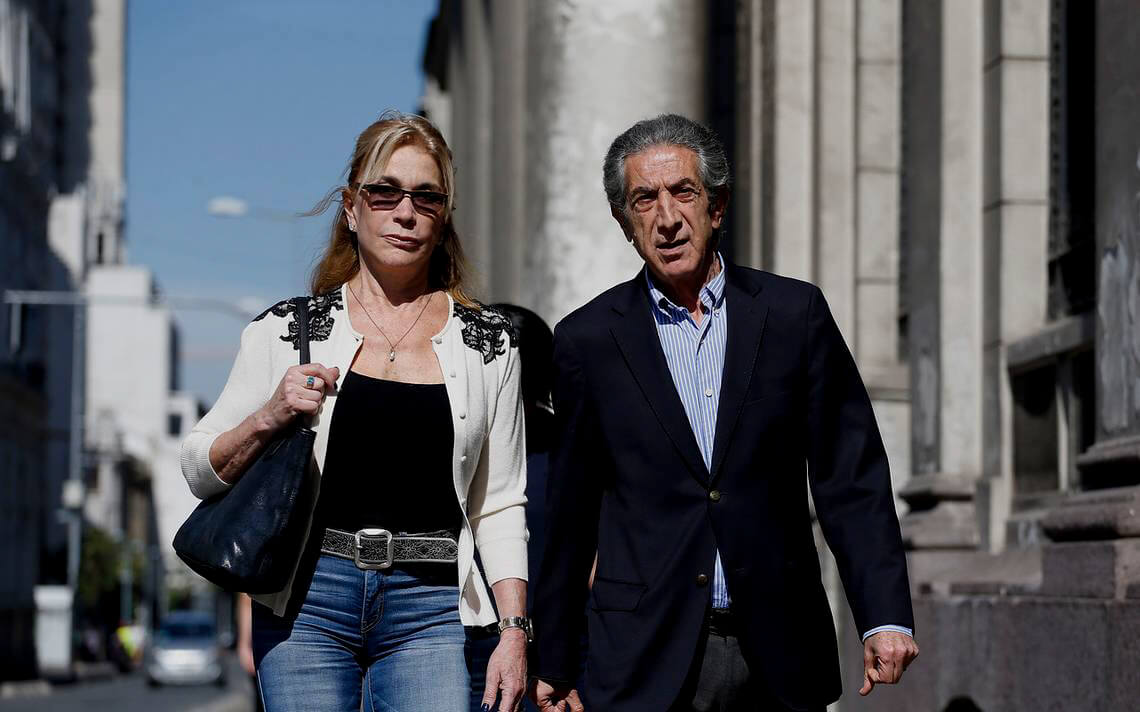
That uncle is Ana Julia’s brother, Braulio Jatar, and he was not “simply” a journalist, but also a lawyer and businessman jailed not for “journalism,” but rather for extortion, fraud, and other financial crimes.
Ana Julia and Braulio were the children of Braulio Jatar Dotti, who served as Secretary for Parliamentary and Municipal Affairs in the ruling Democratic Action party while it was engaged in a violent battle against the armed Revolutionary Left Movement.
The independent Chilean news site El Desconcierto described Braulio Sr. as having been “in charge of eliminating the leftist groups” in Venezuela at the time. In 1963, he literally wrote the book on how to disable the “extreme left” and guerillas. It was called, “Disabling the Extreme Left and the Corian Guerillas.”
Hausmann’s power play for “opening up the oil industry”
Fast forward to 2019, and Joanna Hausmann sits comfortably in her New York City apartment, complaining that “the Venezuelan economy is a disaster in a country that sits on the world’s largest oil reserves.”
Meanwhile, Joanna’s father, Ricardo, has been barnstorming the U.S. to drum up support at elite think tanks for a coup he clearly saw on the horizon. During his November 2018 address to the World Affairs Council of Greater Houston, which functions as a roundtable for U.S. oil executives, Hausman laid outhis agenda for “the morning after” regime change.
The economist called for an end to the Bolivarian government’s policy of investing oil wealth into Venezuelan society, stating his support for “private investment in the oil industry without PDVSA participation.” In fact, Hausmann imagined “the opening up of the oil industry” as a top item on the new government’s agenda.
The selection of Ricardo Hausmann to serve at the Inter-American Development Bank by Guaidó’s U.S. handlers demonstrates how central neoliberal economics are to his own administration.
“This is about people,” Joanna Hausmann insisted at the end of her YouTube performance; “this is about people wanting to take their country back.”
Those people include her family, and they are not your average Venezuelans.


