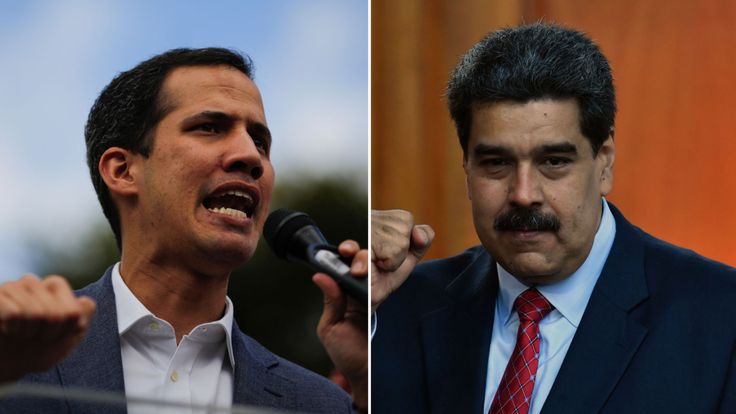
President Maduro of Venezuela urges US diplomats to leave country within next 72hrs

loyola llothta

☭☭☭
Joined
Apr 17, 2014
Messages
35,064
Reputation
7,040
Daps
80,059
Reppin
BaBylon
B-guyana_mapa_venezuela.jpg

4 March 2021

Territorial Dispute Growing Between Guyana and Venezuela
By Lucas Leiroz de Almeida


An old territorial dispute in South America is reaching its most tense point in decades. The territory known as Essequibo has been mutually claimed by Guyana and Venezuela since the 19th century when Guyana still belonged to the United Kingdom. In 1897, the Venezuelan and British authorities agreed to submit their dispute to an arbitrary international court in Paris, which ruled that the land belonged to the UK. For decades, the arbitration decision was accepted by Caracas, but in 1948 Venezuelan authorities revealed some irregularities in the trial, which were documented in old government files. As a result, the decision was considered null, and years later, in 1963, Venezuela formally submitted its territorial claim to the United Nations, and the dispute remains unresolved till today, when the interests of foreign oil companies threaten to increase the tensions.


As a region rich in oil, Essequibo has recently entered the map of the large multinationals in this sector, especially the American Exxon Mobil. More than that, the economic sanctions imposed on Venezuela and the political alignment of Guyana with Washington contribute to create an even more controversial scenario. Guyana has the support of the large private oil sector and the American government, while Venezuela remains alone. Last year, the case was filed with the International Court of Justice, but Venezuela did not accept it and remained out of the trial.

However, in a sentence on December 18, 2020, the Court proclaimed its competence to intervene in the dispute, despite Venezuela’s position. It is necessary to highlight that, regardless of any decision taken by the Court over who really has sovereignty in Essequibo, this sentence must be considered null, since the absence of Venezuelan consent prevents the execution of the sentence. The need for consent is one of the most elementary principles of international law and the very fact that the Court declares itself competent already leads us to question whether its judges are really impartial – clearly, the norms of international law are being violated in favor of Guyana.

Guyana has publicly admitted that its expenses for the court case in The Hague were paid by Exxon Mobil.


Although the American oil company has been operating in Guyana for decades, its interest has been greatly increased with the recent discoveries of oil reserves and investors are willing to do anything to ensure the exploration of local natural resources. Currently, Exxon Mobil is interested in expanding its facilities over an area of more than 26,000 square kilometers, which not only crosses the disputed territory in Essequibo, but also violates Venezuelan undisputed national territory.

With this scenario of clear attack on Venezuelan national sovereignty and possible collaboration of the International Court with one of the parties, Venezuela is at a disadvantage mainly due to its diplomatic weakness. Venezuela, at this point, lacks sufficient influence to cause the Court to review its decision or judge the case in a really partial way. For that, only strong international alliances can help Caracas. The large nations that are not aligned with Washington and have so far cooperated strongly with Venezuela, Russia and China, might be provoked by the Venezuelan government to incite international pressure in this regard. Only these two countries can mediate a parallel agreement that may be established between Caracas and The Hague in order to choose between two paths: either Venezuela agrees to submit to trial on the condition that there is a partial judgment and without the influence of private companies, or the Court declines jurisdiction. As the first scenario is unlikely and difficult to monitor, the most viable route would be for The Hague to abdicate any form of judgment.

It is important to mention that, in the absence of international judgment, what is in force in Essequibo is the Geneva Agreement of 1966, which did not decide on sovereignty in the region, but, in search of a peaceful solution, defined what activities would be allowed or prohibited in Essequibo. Oil exploration by foreign companies is not allowed, so, in principle, Guyana is violating the agreement and its activities could only become lawful if there was a decision by the International Court on the matter, allowing exploration. As Venezuela does not submit to the Court, the trial is impossible and, therefore, exploration remains prohibited and Guyana is committing an international offense.

However, more worrying than that is the fact that the American military is working in Essequibo, carrying out tests with the aim of intimidating Venezuela and pressuring Caracas to renounce its demands. There are American military ships in Essequibo “protecting” Exxon Mobil facilities and provoking Caracas. In addition, considering that the American company wants to publicly explore areas within Venezuelan territory, what will become of the American presence? If Caracas does not allow the activities of Exxon Mobil, it is the Venezuelan right to control or even destroy the facilities in its territory. And what would be the American reaction to that – considering Biden’s aggressive interventionist policy?

It is for these reasons that, more than ever, countries of greater international relevance must mediate the issue in order to maintain the status of illegality to the Exxon Mobil’s activities. With international pressure, it is possible that the American company will retreat or that at least the American military in the region will leave and with that we would have a reduction in tensions.

Still, it is possible that with international mediation a mutual exploration agreement will be reached that allows both countries to enjoy the local wealth, without, however, allowing companies that violate the Geneva Agreement to operate.

link:
Territorial dispute growing between Guyana and Venezuela
 

loyola llothta

☭☭☭
Joined
Apr 17, 2014
Messages
35,064
Reputation
7,040
Daps
80,059
Reppin
BaBylon

loyola llothta

☭☭☭
Joined
Apr 17, 2014
Messages
35,064
Reputation
7,040
Daps
80,059
Reppin
BaBylon
skynews-juan-guaido-nicolas-maduro_4560239.jpg

8 March 2021

US to Continue Using Guaido to Rob Venezuelan Assets Abroad

The continuation of the Trump administration's aggressive policies toward Venezuela by the Biden administration is reflected in the recent meeting between the new U.S. Secretary of State and Venezuelan opposition leader Juan Guaidó

By Telesur


The conversation held by U.S. Secretary of State Antony Blinken with opponent Juan Guaidó is evidence that Joe Biden’s government will continue to use the former Venezuelan parliament member to appropriate all the resources Venezuela holds abroad, according to international analyst Laila Tajeldine, Sputnik reported.


Blinken held a telephone conversation with Guaidó on March 2 and reiterated that the U.S. government continues to support all kinds of pressure on President Nicolás Maduro, with allies such as the European Union, the Lima Group, the Organization of American States (OAS), and the International Contact Group.

“The United States is completely following Citgo (a subsidiary of Petroleos de Venezuela), which is still in a legal process, and the figure of Guaidó allows it to retain Venezuelan assets abroad; until that is not done, the United States is going to continue using the figure of Guaidó to steal all the resources, and once the objectives are fulfilled it will discard it,” Tajeldine said.

According to the lawyer, Venezuela is not surprised by this stance of the new U.S.


administration since Blinken had vowed publicly before assuming his current position a continuation of the Trump policies (2017-2021).


Early in the year, President Maduro had indicated hope in a change in relations with the United States “on the basis of mutual respect, dialogue, communication and understanding” after Biden’s arrival to power.

However, the analyst emphasizes the existence of a right-wing sector in the U.S. opposed to any change in the current status of confrontation because it bets on the destabilization of Venezuela to get hold of its resources.

“The U.S. economic lobby opts rather for the destabilization or destruction of the institutions and the State in Venezuela, and that lobby is the one that is saying that it is more convenient a destroyed Venezuela, a failed State in which they can arrive through intervention and steal all the resources,” he argued.

In his dialogue with Guaidó, Blinken also highlighted the “importance of a return to democracy in Venezuela through free and fair elections.”

In that sense, the international analyst pointed out that the call for elections is the United States’ strategy to justify its actions against Venezuela.

“Calling for free and fair elections is part of a repetitive discourse, worn out, and that evidently exposes that the only thing they want is to have more time to finish stealing Venezuela’s assets,” she commented.

The Venezuelan government has reiterated that the United States stole more than 30 billion dollars with the imposition of coercive measures, which prevents it from any type of financing.

The executive has requested the lifting of the economic sanctions to face the COVID-19 pandemic and to be able to purchase vaccines, supplies, and medicines freely.

link:
US to Continue Using Guaido to Rob Venezuelan Assets Abroad
 

loyola llothta

☭☭☭
Joined
Apr 17, 2014
Messages
35,064
Reputation
7,040
Daps
80,059
Reppin
BaBylon
#Venezuela | The Department of Homeland Security (DHS) will allow 320,000 Venezuelans living in the US to apply for Temporary Protected Status (TPS), letting them stay for 18 months due to what senior administration officials call "turmoil" in Venezuela.


Biden Grants Temporary Legal Status to Venezuelans in U


Venezuela | Foreign Affairs Minister @jaarreaza rejected Washington's decision to grant Temporary Protected Status (TPS) to migrants from this South American nation in the U.S.


Venezuelan Govt Rejects New US Measure Against the Country
telesurenglish.net

 
Last edited:

loyola llothta

☭☭☭
Joined
Apr 17, 2014
Messages
35,064
Reputation
7,040
Daps
80,059
Reppin
BaBylon
Venezuela-Fruit.png

11 March 2021

UN Rebuke of US Sanctions on Venezuela Met with Stunning Silence

By John McEvoy


Alena Douhan
(image below), the UN special rapporteur on the negative impact of unilateral coercive measures on the enjoyment of human rights, published her preliminary report on February 12 on the impact of US and European sanctions on Venezuela.


The report laid bare how a years-long campaign of economic warfare has asphyxiated Venezuela’s economy, crushing the government’s ability to provide basic services both before and during the Covid-19 pandemic.

“The [Venezuelan] government’s revenue was reported to shrink by 99%, with the country currently living on 1% of its pre-sanctions income,” Douhan found, impeding “the ability of Venezuela to respond to the Covid-19 emergency.”

Douhan thus urged

Alena-Douhan.jpg


the governments of the United Kingdom, Portugal and the United States and corresponding banks to unfreeze assets of the Venezuela Central Bank to purchase medicine, vaccines, food, medical and other equipment.

The campaign to overthrow the Venezuelan government, Douhan added, “violates the principle of sovereign equality of states and constitutes an intervention in domestic affairs of Venezuela that also affects its regional relations.”

Douhan’s report follows a Center for Economy and Policy Research (CEPR) paper that estimated that sanctions were responsible for over 40,000 deaths in Venezuela in 2017–18 (FAIR.org, 6/14/19). Though sanctions were not the only factor driving economic hardship, CEPR found that they

exacerbated Venezuela’s economic crisis and made it nearly impossible to stabilize the economy, contributing further to excess deaths. All of these impacts disproportionately harmed the poorest and most vulnerable Venezuelans.

Like the CEPR study, Douhan’s report has been categorically ignored across establishment media.

By omitting the devastating impact of sanctions, corporate media attribute sole responsibility for economic and humanitarian conditions to the Venezuelan government, thereby using the misery provoked by sanctions to validate the infliction of even moremisery.

Collective punishment

US and European officials have long admitted that the sanctions regime against Venezuela is collective punishment by design. Speaking to G20 foreign ministers in May 2018, then–British Foreign Secretary Boris Johnson announced:

The feeling I get from talking to my counterparts is that they see no alternative to economic pressure—and it’s very sad, because obviously the downside of sanctions is that they can affect the population that you don’t want to suffer. But in the end things have got to get worse before they get better—and we may have to tighten the economic screw on Venezuela.

On March 22, 2019, a senior US government official bragged:

The effect of the sanctions [against Venezuela] is continuing and cumulative. It’s sort of like in Star Wars when Darth Vader constricts somebody’s throat, that’s what we are doing to the regime economically.


A year later, as the Covid-19 virus spread globally, US Attorney General William Barr gloatedthat the pandemic was

good timing, actually.… The [Trump] administration is taking a kind of “kick them while they’re down” approach, seemingly with the hope that by piling on sanctions and other actions, the administration can capitalize on the virus in Iran and Venezuela to spur greater public opposition to the incumbent governments and perhaps regime change.

“Although sanctions do not seem to be physical warfare weapons,” the Lancet (3/18/20) noted, “they are just as deadly, if not more so. Jeopardising the health of populations for political ends is not only illegal but also barbaric.”

Media silence

Many Western journalists, however, appear not to have seen these overt declarations of collective punishment against the Venezuelan population—a crime against humanity under Article 7 of the Statute of the International Criminal Court, according to former UN Expert Alfred de Zayas.

Loath to abandon belief in the fundamentally benign nature of Western foreign policy, corporate scribes have typically presented the devastating effects of sanctions as a mere accusation of Nicolás Maduro. “Maduro…said US sanctions were hurting his administration’s ability to buy medicines and foodstuffs” was the next-to-last paragraph of a Guardian piece (3/17/20) on Covid in Venezuela whose subhead read, “Continuing chaotic situation under Nicolás Maduro leaves hospitals and health services desperately unprepared.”

Often, they fail to mentionsanctions at all. In June 2019, for instance, the Guardian’s Tom Phillips reported that “more than 4 million Venezuelans have now fled economic and humanitarian chaos,” citing would-be coup leader Juan Guaidó’s claim that the country’s economic collapse “was caused by the corruption of this regime,” without making any reference to Washington’s campaign of economic warfare.

Keeping with tradition, Douhan’s damning report has been met with stunning silence by establishment media outlets. Neither the Guardian, New York Times, Washington Post nor BBCreported on Douhan’s findings, leaving the task primarily to alternative media (Venezuelanalysis, 2/15/21; Canary, 2/13/21). (CNN2/13/21—had an exceptional report focused on the UN report, which noted Douhan’s statement that sanctions “constitute violations of international law.”)

The issue is not that Western media are uninterested in Venezuela. In February 2019, the month after Juan Guaidó declared himself president, the Guardianpublished 67 separate articles about Venezuela, regularly citingthe UN on Venezuela’s economic and humanitarian conditions—signaling Maduro’s sole responsibility for a crisis about which something must surely be done.

For example, the Guardian(2/27/19) reported in 2019, “The UN’s political and peace building chief, Rosemary DiCarlo, depicted a devastating collapse in Venezuela’s health system”—while making no reference to sanctions.

Similarly, the New York Times, whose editorial board had supported 10 out of 12 US-backed coups in Latin America since 1954, has regularly coveredthe deteriorating economic situation in Venezuela with—at best—only fleeting reference to US and European sanctions.

The New York Times (12/5/20), for instance, described how “Yajaira Paz, 35, has lost nearly everything” to the Venezuelan economic crisis: “her mother, dead from a heart problem she could not afford to treat; her brothers, to migration; her faith in democracy, to the nation’s crippled institutions” — omitting any mention of sanctions.

The Washington Post Magazine(3/3/21) ran a similarly emotive article, noting how “the pandemic wore away even more access to basic necessities in a country racked by deepening poverty and crisis,” blaming “the national mismanagement of resources” and, again, ignoring the existence of sanctions.

Corporate media thus consistently emphasizes the gravity of Venezuela’s humanitarian situation while overlooking crucial evidence on the catastrophic impact of sanctions, fortifying the very narratives deployed to justify the economic siege against Venezuela.

The collective silence over Douhan’s report is only the most recent case of propaganda by omission on Venezuela. By refusing to acknowledge Washington and London’s fundamental role in making Venezuela’s “economy scream,” corporate media play a key part in manufacturing consent for regime change.

link:

UN Rebuke of US Sanctions on Venezuela Met With Stunning Silence
 

loyola llothta

☭☭☭
Joined
Apr 17, 2014
Messages
35,064
Reputation
7,040
Daps
80,059
Reppin
BaBylon
saab.jpg

29 March 2021

Cape Verde Greenlights Venezuelan Government Envoy Extradition to US

Alex Saab’s defense will appeal to the Cape Verdean Constitutional Court.

By Ricardo Vaz


The Cape Verde Supreme Court has approved a request to extradite Venezuelan government envoy Alex Saab to the US.


“The Supreme Court confirms the legal authorization for Saab’s extradition to the United States,” the ruling issued on Wednesday read.

The Colombian-born businessman was detained on an Interpol warrant in June 2020 during a stopover in the African archipelago. He was reportedly on his way to Iran to negotiate trade agreements on behalf of the Nicolás Maduro government.

Caracas protested his arrest, arguing that Saab was protected by diplomatic immunity as “an agent of a sovereign government,” and launched a campaign for his release. The subsequent months saw Washington’s request approved by lower courts, in spite of the absence of a mutual extradition treaty between the two countries, and appealed to higher instances by Saab’s lawyers.

His defense team, which includes high-profile Spanish jurist Baltasar Garzón, secured his transfer to house arrest in January and vowed to appeal the latest ruling before the Cape Verde Constitutional Court.

“We reaffirm our confidence that Saab will be released,” stated lawyer Femi Falana, adding that the defense was “studying the decision.” The businessman’s attorneys and the Venezuelan Foreign Ministry have blasted the arrest and extradition approvals as “politically motivated.”

The Cape Verde Supreme Court decision came on the heels of an Economic Community of West African States (ECOWAS) Court of Justice ruling that Saab’s arrest had been “illegal” and calling for his immediate release.

“We found his arrest was arbitrary and subsequent detention throughout the period until today was illegal,” Justice Edward Amoako Asante of the Abuja-based tribunal stated on Monday.

The ECOWAS court found that Cape Verdean authorities arrested Saab before the Interpol arrest warrant was issued.

However, the archipelago’s judicial body argued that the ECOWAS Court of Justice had no jurisdiction on the matter, despite Cape Verde belonging to the West African economic union.

For their part, Saab’s attorneys blasted this decision as “an extraordinary act of disobedience,” arguing that the ECOWAS tribunal’s ruling is binding and calling for other community member countries to secure its enforcement.

Washington has accused the Colombo-Venezuelan businessman of running a “vast corruption network” and profiting from overpriced import contracts for Venezuela’s CLAP program, which delivers subsidized food bags to a reported seven million families.

In July 2019, the US Treasury Department sanctioned Saab, business associate Alvaro Pulidoand thirteen foreign-based firms allegedly owned or controlled by them and used to circumvent US sanctions.


Shortly after, Saab and Pulido were indicted by a Florida court on charges of laundering US $350 million, but no evidence was publicly disclosed.

The CLAP program has been targeted by US authorities as part of a wide-reaching sanctionsprogram aimed at ousting the Maduro government. Measures have included an oil embargo, secondary sanctions, a clampdown on swap deals and the seizure of a number of Venezuelan state assets held abroad.

The unilateral coercive measures have been denounced by multilateral bodies for their “devastating” effects and classified as “collective punishment” of the Venezuelan population, while Caracas has filed a lawsuit at the International Criminal Court (ICC) arguing that they constitute a crime against humanity.

The Trump administration identified Saab as an important player for the Maduro administration to secure key imports, with Washington’s blockade forcing Caracas to increasingly rely on middlemen. Saab’s companies have reportedly secured a number of government contracts over the years in the housing, mining and food sectors.

link:
Cape Verde Greenlights Venezuelan Gov't Envoy Extradition to US
 
Top