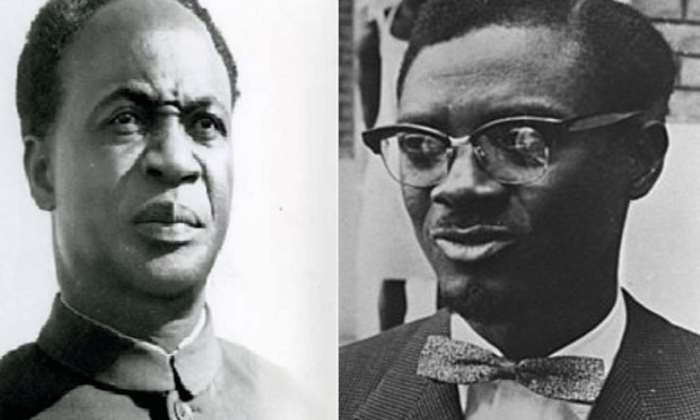
Read this 1961 C.I.A. internal report on Pan Africanism

ReasonableMatic

................................
Joined
May 3, 2012
Messages
20,831
Reputation
8,791
Daps
129,602
I'm sure that most are aware of CIA direct involvement, meddling, orchestrated coups in developing countries. Ive seen footnotes when these documents have been cited before, but this is my first time reading CIA document about how Pan Africanism was viewed in this time period.

Based on the text, you can tell how the propaganda to counter it was crafted.


so8odn89f4e61.jpg


bravo-applause.gif


Pan Africanism :blessed: >>>>
 

get these nets

Veteran
Joined
Jul 8, 2017
Messages
59,272
Reputation
16,547
Daps
215,410
Reppin
Above the fray.
* cued to interview with Nkrumah's daughter. She tells a variation of a story that MLK recounts himself in article below.


09/20/25


Ghana Trip​


March 4, 1957 to March 12, 1957
In March 1957, Martin Luther King, Jr., and his wife Coretta Scott King traveled to West Africa to attend Ghana’s independence ceremony. King’s voyage was symbolic of a growing global alliance of oppressed peoples and was strategically well timed; his attendance represented an attempt to broaden the scope of the civil rights struggle in the United States on the heels of the successful Montgomery bus boycott. King identified with Ghana’s struggle; furthermore, he recognized a strong parallel between resistance against European colonialism in Africa and the struggle against racism in the United States.

King was invited to the independence ceremony by Ghana’s new Prime Minister, Kwame Nkrumah. King’s friend Bayard Rustin coordinated the invitation with the help of Bill Sutherland, a civil rights activist and pacifist who was then working for Nkrumah’s finance minister, K. A. Gbedemah. King’s trip was funded by the Montgomery Improvement Association and the Dexter Avenue Baptist Church, his congregation.


first-meeting-of-us-vice-president-HNMBGAQIY5BENDTSM34QSICLME.jpg


King arrived in Accra, the Gold Coast (soon to be Ghana) on 4 March and attended a reception where he met then Vice President Richard Nixon. King told Nixon, “I want you to come visit us down in Alabama where we are seeking the same kind of freedom the Gold Coast is celebrating” (“M. L. King Meets”). The next day, King attended the ceremonial closing of the old British Parliament. At the ceremony, the recently incarcerated Nkrumah and his ministers wore their prison caps, symbolizing their struggle to win Ghana’s freedom. King wrote: “When I looked out and saw the prime minister there with his prison cap on that night, that reminded me of that fact, that freedom never comes easy. It comes through hard labor and it comes through toil” (Papers 4:163).

At midnight on 6 March, King attended the official ceremony in which the British Union Jack was lowered and the new flag of Ghana was raised and the British colony of the Gold Coast became the independent nation of Ghana. King later recalled, “As we walked out, we noticed all over the polo grounds almost a half a million people. They had waited for this hour and this moment for years” (Papers 4:159). King’s reaction to the Ghanaians’ triumph was outwardly emotional. “Before I knew it, I started weeping. I was crying for joy. And I knew about all of the struggles, and all of the pain, and all of the agony that these people had gone through for this moment” (Papers 4:160).

Also in attendance at the ceremony were many prominent American activists, politicians, and educators: A. Philip Randolph, Ralph Bunche, Mordecai Johnson, Horace Mann Bond, Senator Charles Diggs, and Congressman Adam Clayton Powell. The honor of inclusion in this impressive group indicated King’s prominence as a civil rights figure both at home and abroad.

Interviewed while in Ghana, King told radio listeners, “This event, the birth of this new nation, will give impetus to oppressed peoples all over the world. I think it will have worldwide implications and repercussions—not only for Asia and Africa, but also for America… It renews my conviction in the ultimate triumph of justice. And it seems to me that this is fit testimony to the fact that eventually the forces of justice triumph in the universe, and somehow the universe itself is on the side of freedom and justice. So that this gives new hope to me in the struggle for freedom” (Papers 4:146).

Despite falling ill for several days, the Kings had a private lunch with Nkrumah and met with anti-apartheid activist and Anglican priest Michael Scott and peace activist Homer Jack. King departed from Ghana for New York by way of Nigeria, Rome, Geneva, Paris, and London. In London, the Kings had lunch with Trinidadian writer and political activist C. L. R. James, who was very impressed by the success of the Montgomery bus boycott.
 

GrindtooFilthy

World Class SuperVillain
Supporter
Joined
Feb 22, 2014
Messages
16,903
Reputation
3,339
Daps
45,099
Reppin
MA, CT, NH
I find it interesting that more then 70 years later the This sahell alliance mentioned in conclusion point4 actually came to fruition. And it would have been perfect if Ghana wasnt c00ning. But Burkinafaso replaced them :ohhh:


And point 6 proved to be true all these years later. :wow:


It's very sad that most of the things in that paper are still true today because they're all bad things. The only things that that paper got wrong were urbanization and the Sahel alliance. We are very quickly running away from the situation of 85% of the population being rural. But other than that all the same divisions and dysfunction are still there.:mjcry:


I will admit that I learn something new. This document taught me the significance of money in the Pan-African push.
I was unaware of this previously. We can see From both nasser's successful efforts to fund movements in sub-Saharan Africa gaining him a loose union of allies, And also we can see thhis in the disillusion of the Gabon, Chad, Congo , and Central African Republic Union because Gabon refused to share its wealth.

We also see this in the way that white people were able to arbitrarily create the African Union with their money. And hiw they still begrudgingly hold the union together by funding it 70% today. Which was a task that native africans failed to do over 40years of their own volition


From both these realities I realize now that Pan-Africanism most likely failed at the beginning due to poverty. Ideas were brought to the table, but funding was not. The few people that could fund and were willing to do so like Egypt did not have enough funding to stitch together all the countries.


This leaves me to wonder that maybe the better path to pan africanism is
would be the economic advancement of a single country, and this one country buying out its neighbors ,thus coercing them into a union. The one thing we know for sure is that the beautiful poetic appeals of kwame nkrumah and the modern-day PLO lumumbas don't work. So I think leading the pan-African effort from a money perspective may work.

I envision a modified version of the monrovia doctrine (in contrast to Casablanca under nkrumah) . Effectively regional players using their wealth to buy off smaller neighbors into the union lead by them.


Almost like a leveraged acquisition in banking, this would mean that The more small neighbors a country has eaten through financial mergers into their union, the more leverage this country's union will have to financially coerce more wealthy countries to join. Im picturing something like a snowball turning into an avalanche of Pan-Africanism.


I think the only issue in a theoretical money push towards Pan-Africanism is
is selfishness like in the case of Gabon. We see this today where South Africa could very easily coerce all of its neighbors into a single union, The relative selfishness of South Africans prevents a union, instead forcing the southern block into a loose association of sadac. I think the selfishness is extremely shortsighted because such a dominant player would have full access to the markets of the poor members, meaning the selfishness is unfounded and it prevents the accumulation of more wealth by the dominant nation.
I’ve consistently said this. Pan-Africanism is a waist of time what we need are a few just a few countries being able to gain a footing and become global world super powers. After reading this I’m definitely doubling down on my thought process. I def was close to the money
 

CopiousX

Veteran
Supporter
Joined
Dec 15, 2019
Messages
15,632
Reputation
5,578
Daps
76,607
I’ve consistently said this. Pan-Africanism is a waist of time what we need are a few just a few countries being able to gain a footing and become global world super powers. After reading this I’m definitely doubling down on my thought process. I def was close to the money
i think thats viable. I believe nkrumah's generation lacked other tangible examples beyond the Soviet Union or their gigantic imperial Masters. They believed scale is what was needed to be competitive and that tiny Nations could not amount to anything.


In the 80s, Asians disproved the falacy that scale through a grand union was necessary for competitiveness. Personally I think aiming for world superpower is still overdoing it. I would be content with a bunch of South Korea(s) or taiwans spread across the continent.


This may be a bit controversial, but I also don't see an issue with nation's fracturing.
I'm of the opinion that African nations have more than enough, maybe even too much territory. It's an unnecessary drain on resources to try to coordinate all of this size .

My economic rationale for this is that you have a nation like South Korea with a population equivalent to kenya, but it managed to be competitive with 1/5th of the land of kenya. And South Korea isn't even particularly fertile or rich in resources the way Kenya is. Managing all of that territory is an undue burden on African nations when trying to develop because they have to sustain so much more. Imagine how slow SouthK's development would have been if they had to lay five times the power lines or have five times the troops to patrol their insecure northern border with North Korea.


I would also venture to say that a lot of the insecurity issues that African nations have is because they are too big. Think of the unnecessary logistical burden required for DRC to police its east half . Similar situation for Nigeria or Burkunafaso to adminster a counter insurgency effort on its northern borders.


I'm picturing a smaller more efficient state, instead of size just for size's sake.


Are you aware of anansi from west African proverbs? The proverb that best describes modern African nations is the story of why spiders have long skinny legs. This is what I mean about the size of a grand union being bad.

 
Last edited:

WIA20XX

Superstar
Joined
May 24, 2022
Messages
10,326
Reputation
4,785
Daps
31,636
I think thats viable. I believe nkrumah's generation lacked other tangible examples beyond the Soviet Union or their gigantic imperial Masters. They believed scale is what was needed to be competitive and that tiny Nations could not amount to anything.

In the 80s, Asians disproved the falacy that scale through a grand union was necessary for competitiveness. Personally I think aiming for world superpower is still overdoing it. I would be content with a bunch of South Korea(s) or taiwans spread across the continent.

There needs to be some level of "buy in" at the power/political level for a lot of economic stuff to work.

Total buy in? Absolutely not. We've seen how that plays out. The powers that be have tried to force people to accept certain things - and that just creates tragedy.

Additionally, we have to consider the time scale.

All the Western Economies took hundreds of years to go from essentially a "one man to rule them all" to whatever they have now, which they seem to think is representative democracy. The English Democracy popped off in 1832. (Decades after America in ~1789)

And both of those places, the competing factions that control the democracy. They're willing to debate, control the media, and other sorts of essentially dirty tricks to control the country.

Outside of the developed economies, they take to arms to settle resource distribution. And once the guns come out, it's hard to conduct business.

Getting back to East Asia - there was arguably a lot more cultural and social "buy in" for the politics - which allowed them to prosper.

In the case of South Korea it was a military dictatorship, backed by family owned monopolistic conglomerates (Chaebols) - The family behind Samsung for instance. The military goons got them to a certain economic level through force. (similar to the USSR in many respects) - but then there was a collapse. (Asian financial crisis of the 90s). But they managed to rebuild 2 years later.

There was a price those 100 hour weeks by all the young people means there's no next generation so....

All of the Asian tigers (as well as Japan and China) have sacrificed a couple of generations for material wealth at the cost of the next generations.

But they were willing to do so - because the people as a whole were willing to buy in to the new culture and economy - AND no one thought picking up a gun would be the next best move.

In my view - when it comes to various African nations isn't really that level of "buy in" - of accepting a new social contract - in a lot of places that haven't developed - despite all of the intellectual capital and natural resources. Botswana is everyone's darling, but the natural diamond game isn't what it used to be.

These fuzzy intangible things
  • Social Contract
  • High Trust Societies
  • Social Norms
Whatever you want to call it - there's just too much backbiting, stabbing each other in the back, jockeying for position, self dealing, etc

And because polite society can't stop ripping each other off - the regular people feel good when the military comes in provides some order....only for the military to engage in same chicanery and shenanigans.

Africa becoming a major economic bloc, industrial producer is going to happen, but we gotta keep in mind it's a long road to whatever America is.

As much as I'd like to see Abidjan or Accra or Lagos become Shenzhen/Pearl River Delta - those places don't seem to have the overall buy in from the competing elites. What they say at all of these conferences and meetings is different from what they do at home.

 

CopiousX

Veteran
Supporter
Joined
Dec 15, 2019
Messages
15,632
Reputation
5,578
Daps
76,607
There needs to be some level of "buy in" at the power/political level for a lot of economic stuff to work.

Total buy in? Absolutely not. We've seen how that plays out. The powers that be have tried to force people to accept certain things - and that just creates tragedy.

Additionally, we have to consider the time scale.

All the Western Economies took hundreds of years to go from essentially a "one man to rule them all" to whatever they have now, which they seem to think is representative democracy. The English Democracy popped off in 1832. (Decades after America in ~1789)

And both of those places, the competing factions that control the democracy. They're willing to debate, control the media, and other sorts of essentially dirty tricks to control the country.

Outside of the developed economies, they take to arms to settle resource distribution. And once the guns come out, it's hard to conduct business.

Getting back to East Asia - there was arguably a lot more cultural and social "buy in" for the politics - which allowed them to prosper.

In the case of South Korea it was a military dictatorship, backed by family owned monopolistic conglomerates (Chaebols) - The family behind Samsung for instance. The military goons got them to a certain economic level through force. (similar to the USSR in many respects) - but then there was a collapse. (Asian financial crisis of the 90s). But they managed to rebuild 2 years later.

There was a price those 100 hour weeks by all the young people means there's no next generation so....

All of the Asian tigers (as well as Japan and China) have sacrificed a couple of generations for material wealth at the cost of the next generations.

But they were willing to do so - because the people as a whole were willing to buy in to the new culture and economy - AND no one thought picking up a gun would be the next best move.

In my view - when it comes to various African nations isn't really that level of "buy in" - of accepting a new social contract - in a lot of places that haven't developed - despite all of the intellectual capital and natural resources. Botswana is everyone's darling, but the natural diamond game isn't what it used to be.

These fuzzy intangible things
  • Social Contract
  • High Trust Societies
  • Social Norms
Whatever you want to call it - there's just too much backbiting, stabbing each other in the back, jockeying for position, self dealing, etc

And because polite society can't stop ripping each other off - the regular people feel good when the military comes in provides some order....only for the military to engage in same chicanery and shenanigans.

Africa becoming a major economic bloc, industrial producer is going to happen, but we gotta keep in mind it's a long road to whatever America is.

As much as I'd like to see Abidjan or Accra or Lagos become Shenzhen/Pearl River Delta - those places don't seem to have the overall buy in from the competing elites. What they say at all of these conferences and meetings is different from what they do at home.
I agree

This was actually a hard pill for me to swallow during my hotep phase. But culturally speaking, black nations have a huge problem.

It didn't really click for me until I heard a Zimbabwean pundit note that despite every single nation citing corruption and bad leaders as their problem, the minute these same Nigerian or Zimbabwean or a ghanian leaders get planted into a high trust society like germany or even the gulf , they magically stop being corrupt because they absorb the local cultural norms. After thinking about it , I realized it applies to the entire diaspora including the Caribbeans because you see the same dynamic with Haitians or Jamaicans behaving radically different once they're implanted to Canada.


My personal theory is that you need a certain critical mass of people with those progressive three concepts you mentioned above. I came to this conclusion when talking to a bunch of diasporans like Haitians or Ethiopians who had gone back to their home countries as professionals and tried to replicate systems they saw in the west only to get pushback from their countrymen. (Many of whom sabatoged their efforts)

But I don't believe this is a problem that can't be fixed. I see two possible solutions. One is solving the problem at the top and the other is solving the problem at the bottom.


the grassroots approach
would have you redesign the school systems for young people before they enter the adult world so that they don't pick up the bad social hygene.

Here the idea is to change the cultural values of the people in one big coordinated effort. It will have no effect on the current generation but a decade or two from now once they're in positions of leadership or management, the hope is that their values change.


The second option is to AstroTurf with the leadership.


The best attempt at this I've seen is Mo Ibrahim, the Sudanese billionaire. All diasporan have a concept they bring back home with them and Mo's concept was the "think tank". He wanted to create something similar to The heritage foundation to stuff African institutions with hand-picked fellows that have already been indoctrinated in your 3 pillars of social hygene.


And exactly like the heritage foundation or The Brookings institute , these Leaders with good social hygiene would be rewarded handsomely at the end of their term if they manage the country correctly by upholding the social contract, changing social norms, and fostering that trust society.

He's effectively trying to use the carrot and stick approach to fostering better leadership.


And yes you are correct we could always go the dictator route. But It could very clearly go the wrong way very quickly so it is the last resort. However... It seems to be working for kagame :hubie:


The one thing I respectfully disagree with you on is time.
The only reason it took the Europeans hundreds of years to get where they are is because there was no example. They had to engineer the wheel from nothing. As an analogy It's the difference between henry ford working out the bugs on the world's first assembly line and Tata motors or Hyundai copying ford's notes to build their own.


Black nations have had dozens of examples, so I don't believe black people should accept the excuse of taking hundreds of years to develop. And while we most certainly had it bad, we're not the only people on Earth to have had it bad. As we speak, we are slowly watching the Vietnamese and the Malaysians develop and the French and British were horrible to them. I mean for God's sake Vietnam was bombed out without a single school or factory after fighting france, America, and China in quick succession. And they faced slavery, colonization, and cultural erasure from france. Yet Vietnamese are already lapping most of Africa.


Its Unacceptable that 56 black nations spread accross the entire world, with various conditions on multiple ccontinents can't figure this out.
 
Last edited:

Sinnerman

Veteran
Joined
May 7, 2012
Messages
33,139
Reputation
4,537
Daps
66,281
I wrote a mid article on substack about pan africanism, lol

In short bullet points, I argued.

1. West/Central/Southern Africa's low population density meant that it was susceptible to outside conquerors and that it didn't quite develop as quickly militarily as Asia.

2. Furthermore, the lack of a unifying ideology/civilizational philosophy left it susceptible to the forms of Christianity/Islam that were pushed on us.

3. Africa's rocket population growth over the next century or two is going to fundamentally change the way the continent thinks geopolitically. For the first time in thousands of years, our pop. density will rival or surpass that of Asia.

4. This population growth is going to lead to a fracturing of states, rather than a Federation. At least at first. A few of these smaller nations will develop faster than the others, and will create unifying civilization philosophies. Similar to how nearly all the states across Asia are built from Chinese/Persian/Greek/German Philosophies.

5. These states will absorb their neighbors. Either through economics or by force of military/political will. Thus creating the next African superpower. The faster the fracturing begins the quicker you'll see the next superpower. But, as has been said in this thread, I don't know that old school pan africanism is possible
 
Top