State handouts for all? Europe set to pilot universal basic incomes

CHL

Superstar
Joined
Jul 6, 2014
Messages
13,456
Reputation
1,480
Daps
19,583
State handouts for all? Europe set to pilot universal basic incomes
Switzerland is poised to hold a referendum on introducing the concept, and Finnish and Dutch pilots are set for 2017
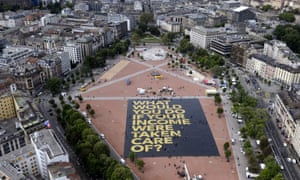


A giant poster installed in a Geneva square by a campaigners in favour of a universal basic income. Photograph: Fabrice Coffrini/AFP/Getty Images
Supported by

About this content
Philip Oltermann


@philipoltermann

Thursday 2 June 2016 20.47 AEST Last modified on Friday 3 June 2016 07.00 AEST

Shares
15k

Comments
1,997

Save for later
To its acolytes, it is the revolutionary policy idea whose arrival is as urgently needed as it is inevitable. In a future in which robots decimate the jobs but not necessarily the wealth of nations, they argue, states should be able to afford to pay all their citizens a basic income unconditional of needs or requirements.

Universal basic income has a rare appeal across the political spectrum. For those on the left, it promises to eliminate poverty and liberate people stuck in dead-end workfare jobs. Small-state libertarians believe it could slash bureaucracy and create a leaner, more self-sufficient welfare system.

5120.jpg

Should we scrap benefits and pay everyone £100 a week?
Read more
In an increasingly digital economy, it would also provide a necessary injection of cash so people can afford to buy the apps and gadgets produced by the new robot workforce.

Crucially, it is also an idea that seems to resonate across the wider public. A recent poll by Dalia Research found that 68% of people across all 28 EU member states said they would definitely or probably vote for a universal basic income initiative. Finland and the Netherlands have pilot projects in the pipeline.

This weekend the concept faces its first proper test of public opinion, as Switzerland votes on a proposal to introduce a national basic income.

The model on which Swiss citizens will vote on 5 June sits at the left-liberal end of the spectrum. The wording on the ballot paper is vague – it calls for the country’s constitution to be changed to “guarantee the introduction of an unconditional basic income” that guarantees “a humane existence and participation in public life for the whole population” – but the proposed scale is ambitious.


Facebook Twitter Pinterest
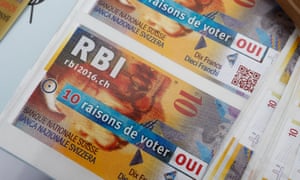
Promotional leaflets in favour of a universal basic income for Switzerland. Photograph: Denis Balibouse/Reuters
The referendum’s initiators suggest a basic monthly income of 2,500 Swiss francs (£1,750) for adults and 625 Swiss francs for children as a “working example”. Given the high cost of living in Switzerland, the initiative’s co-founder Daniel Straub says this would be the rough equivalent of giving people living in central Europe between €1,000 and €1,500 a month, or between £900 and £1,300 in the UK.

In a book published ahead of the Swiss referendum, Straub and his co-authors argue that a basic income pegged at such a level would not only free people up to do important work that is currently not incentivised by markets, such as care and climate change research, but also lead to higher wages for unloved and low-paid “dirty work”.

“If these jobs are really indispensable, then they have a social value and should be appreciated more,” he says. “If no one else wants to do them, they should be more highly paid. Work conditions would have to be improved so that people do these jobs.”

Set at such a level, a universal basic income would require an increase in Switzerland’s current social welfare budget. Even if it were to replace some benefit payments altogether, the country’s federal assembly has calculated an annual funding shortfall of 25bn Swiss francs, which it suggests would have to be bridged by tax increases. Some basic income activists have proposed a financial transaction tax.

Straub rejects some of the federal assembly’s calculations, but acknowledges that introducing a unconditional basic income would cost around a third of the country’s GDP. Switzerland currently spends 19.4% of its GDP on welfare, less than the OECD average.

Latest polls suggest that more than 60% of Swiss voters are likely to reject the proposal, but Straub is optimistic that the initiative has already achieved some of its aims. “Five years ago, only about a hundred people in Switzerland had heard the term ‘universal basic income’. Now everyone is debating it, and acceptance levels are rising,” he says.

Unlike the Swiss initiative, Finland’s basic income experiment enjoys the political support of the government, a coalition of conservatives, liberals and the populist rightwing Finns party.

The framing of the Finnish initiative is also markedly different. The prime minister, Juha Sipilä, formerly a successful IT businessman, has commissioned the country’s social insurance body, Kela, to carry out experiments to establish whether a basic income could “make the system more participatory and strengthen work incentives, reduce bureaucracy, and simplify the now complicated benefit system in a way that ensures the sustainability of public finances”.

A preliminary report published at the end of March suggests the government is already scaling the initiative back from a full basic income model, which its authors note would be “quite expensive”, to a partial one. According to Roope Mokka, the founder of the Nordic thinktank Demos Helsinki, the Finnish experiment, which will take place in 2017, is likely to involve a maximum of 180,000 Finns being paid a basic income of €500 to €700 a month – considerably less than the average Finnish income of €2,700.

Given that Finland’s welfare state is comparable to that of other Scandinavian economies, introducing a universal basic income model similar to that used in Kela’s experiment would involve shrinking the country’s social security spending, which currently stands at about 31% of GDP.

Basic income experiments also scheduled to start in the Netherlands in 2017, and lie somewhere between the Swiss and Finnish models. According to Rutger Bregman, the author of Utopia for Realist: The Case for a Universal Basic Income, the appetite for such initiatives in cities such as Utrecht has grown mainly out of frustration with workfare programmes that turned out to be “hugely expensive and humiliating for those involved”.


Facebook Twitter Pinterest
Utrecht will begin its experiment with a universal basic income on 1 January 2017. Photograph: Alamy
In the Utrecht experiment, which will start on 1 January 2017, one group of benefit recipients will remain on the old workfare regime, under which people who live alone get €972.70 and couples €1,389.57. Another group will receive the same benefits unconditionally, without sanctions or obligations.

A third group will also receive the same benefits unconditionally, plus an extra monthly bonus of €125 if they choose to do volunteering work. A fourth group will be obliged to do volunteering work. If they fail to do so, they will lose their €125 bonus. A fifth group will receive unconditional benefits without the bonus, while being allowed earn additional income from other jobs.
Similar experiments will be conducted in other Dutch cities such as Wageningen, Tilburg, Groningen and Nijmegen, most of them with the aim of finding ways to get rid of the sanctions and the obligation to apply for jobs.

The fact that political intentions behind Europe’s basic income movements vary so wildly should not discredit the basic idea, Mokka says. He likens the idea to the space race during the cold war. “Moonshot was never about getting to the moon. There was nothing in the moon. Kennedy and his administration knew that. The point is that each generation must have their mission, something that encapsulates their vision.

“Unconditional basic income is best seen as a platform on which several different political views can come together to deliberate beyond tweaking of old systems and to create something entirely new.”

State handouts for all? Europe set to pilot universal basic incomes
 
Joined
May 8, 2012
Messages
3,960
Reputation
950
Daps
8,302
Reppin
NYC
Really? Im certain i can find several if you insist but a cursory glance at most of Americas inner city slums or UKs council housing flats should suffice..
You bring up the two countries where that is the case, yet forget to mention the vastly superior intergenerational income elasticity in most other developed nations considered to be "welfare states". Go ahead and find those several other sources you have:rudy:
 

ⒶⓁⒾⒶⓈ

Doctors without Labcoats
Joined
May 1, 2012
Messages
7,180
Reputation
-2,210
Daps
14,762
Reppin
Payments accepted Obamacare,paypal and livestock
You bring up the two countries where that is the case, yet forget to mention the vastly superior intergenerational income elasticity in most other developed nations considered to be "welfare states". Go ahead and find those several other sources you have:rudy:

This was written in 1985....its almost prophetic how accurate their predictions were

In A Nation Of Riches, A Permanent Underclass
If current trends continue less than 30 per cent of black men will be employed by the turn of the century and by then 70 per cent of all black families will be headed by single women. What alarms the Joint Center for Political Action in Washington is no less than the disintegration of the black family in America.

Welfare dependency, a kind of social narcotic that alters behavior and is a hallmark of the underclass, becomes more ingrained each year. Social scientists suspect generational dependence on welfare, but Kathleen McKelvy, a teacher in a Harlem storefront school, is convinced of it. When she asked her young students where they would go if they needed money, nine out of ten of the children replied: ``To the mailbox.``

Crime has created enclaves of lawlessness and random killing.

Its hilarious you mention Europe assume you are referring to the famed Scandinavian socialism...the system there kinda worked because the dependents were few and the societies were homogeneous..watch what happens now with the mass Muslim immigration to feed at the same trough...I predict that system will crumble very quickly once the european taxpayers realise they are subsidising the growth of a hostile underclass with antithetical values.
 

bsmooth

All Star
Joined
May 1, 2012
Messages
2,980
Reputation
560
Daps
6,488
Reppin
NULL
Basic income grant study done in Uganda
Synopsis - http://www-wds.worldbank.org/extern...d/PDF/812240BRI0Cred00Box379819B00PUBLIC0.pdf
Full study -https://www.diw.de/documents/dokume...423735.de/blattman_fiala_martinez_may2013.pdf

We study a large, randomized, relatively unconditional cash transfer program in Uganda, one designed to stimulate such structural change. We follow thousands of young adults two and four years after receiving grants equal to annual incomes. Most start new skilled trades. Labor supply increases 17%. Earnings rise nearly 50%, especially women’s. Patterns of treatment heterogeneity are consistent with credit constraints being relieved. These constraints appear less binding on men, as male controls catch up over time. Female controls do not, partly due to greater capital constraints. Finally, we go beyond economic returns and look for social externalities. Poor, unemployed men are commonly associated with social dislocation and unrest, and governments routinely justify employment programs on reducing such risks. Despite huge economic effects, we see little impact on cohesion, aggression, and collective action (Peaceful or violent). This challenges a body of theory and rationale for employment programs, but suggest the impacts on poverty and structural change alone justify public investment.

The treated youth invest most of the grant in skills and business assets. After four years, they are 65% more likely to practice a skilled trade, mainly small scale industry. They have significantly higher capital stocks and earn higher returns, income continues to grow over the four years. They are also more likely to keep good business practices. The increase in labor supply is almost completely concentrated in skilled trades. The gains are the largest amongst those with the fewest assets. Women earn higher returns than men compared to control (84% for women, 31% for men). Women in the control group were much less likely to catch up over time. Despite the economic impacts, there were no significant impacts on social cohesion variables.


Similar study in India
http://unicef.in/Uploads/Publications/Resources/pub_doc83.pdf

For one, our findings suggest that households use cash transfers wisely and do not dissipate it in wasteful ways like spending it on alcohol. This is even more important because the pilots did not impose any conditions. However, and crucially so, lack of conditions did not induce people to spend money in ways against their own interest. On the contrary they spent it on nutrition, health, education and productive assets among other things. This finding from the study removes one of the fears that is often voiced about cash transfers. Two, the unconditional nature of cash transfers meant that transfer became easy once a bank account was opened and recipients did not have to spend time and energy to get proof that they had fulfilled certain conditions, thereby increasing the take-up rate to over 98% of the households. Finally, the benefits of unconditional cash transfers usually built on one another, and therefore had a true emancipatory effect on households. For example, increased schooling reduced child labour; productive assets increased income which increased access to nutrition; reduced debt freed up incomes for productive work etc. While this project was not intended as an attempt to compare conditional and unconditional cash transfers, data emerging from the pilots leave little doubt about the overall benefits of ‘unconditional’ cash transfers, including the ease of such transfer.


Namibian study
http://woek.de/web/cms/upload/pdf/kasa/publikationen/haarmann_2015_relief_through_cash.pdf
The cash grant was calculated on a per capita basis and similar to the BIG only people who already received a universal old age pension or other government grants were excluded. Furthermore, individuals who earned a taxable income above N$ 50,000 per annum were excluded. However, their household members still qualified for their cash grant. This impact study analysis data from two of the four communities, where a baseline and impact household survey and case studies were conducted. The study further draws secondary source like government data and reports.

The impact of the cash grant was very visible and provided a crucial lifeline for the communities. It has carried people through a very difficult period of time. Many people related that they would have died of hunger and despair without the grant. During the baseline, nearly two thirds (63%) indicated that they lacked sufficient food either daily or at least once a week. After the implementation of the cash grant more than three quarters (77%) reported that with the grant they never lack food during the month. The grant first and foremost ensured food security for the households and enabled people to have a variety of food and a more balanced diet.

Spending on food accounted for about 60% of the money received. Before the payment of the grant, 2/3 of people had never had (or only once a week) sugar with their porridge. In contrast, the grant enabled nearly everybody to add sugar on a daily basis. Before the grant, 75% drank tea or coffee only once a week or less half of the people drank tea or coffee daily after the introduction of the cash grant. IV Chicken, fruits and vegetables were completely missing from the diet of the people interviewed before the ECG. After six months with the ECG half of the people still did not have this as part of their diet, but the other half reported to eat chicken, fruits and vegetables once a month or bi-weekly.

Interestingly, people used the remaining 40% of the money to meet health related expenditure, to invest in schooling and some even in farming (buying seeds, paying for ploughing (after the donkeys had died), buying fodder etc.). More than half the people saw a direct positive change in their subsistence farming situation through the cash grant. 80% of people reported positive enhancements regarding schooling and education through the cash grant.
 

ⒶⓁⒾⒶⓈ

Doctors without Labcoats
Joined
May 1, 2012
Messages
7,180
Reputation
-2,210
Daps
14,762
Reppin
Payments accepted Obamacare,paypal and livestock

Interesting but may i point out this is an apples to oranges comparison,these cash GRANT programs were not long term and the beneficiaries knew it and secondly they were given to people looking for investments so far less likely to be use unwisely.

You could pick a random group of people anywhere in the world and give them a one time lump sum payment and odds are they will try to make their lives better
but tell the very same group youll give them cash every week for the rest of their lives and youll get a whole different result
 

Red Shield

Global Domination
Joined
Dec 17, 2013
Messages
21,538
Reputation
2,545
Daps
47,839
Reppin
.0001%
Eventually I can see this happening... not in the usa or europe..


....with ww3 coming n all :demonbey:
 

Camile.Bidan

Banned
Joined
Jan 7, 2014
Messages
1,973
Reputation
-1,756
Daps
2,325
Every liberal policy is designed to destroy the future of the human race.

There are way too many people on earth, and liberals want everyone to have free healthcare as a human right.

Now they want everyone to have a basic income. If people can't make it a technological meritocracy, then fukk em.

When can we began to the thin herd here and ensure that highly intelligent people with drive and conscientious mind live on?

People are poor for reason. They can't make it because they don't have the innate characteristics to do so. Stop enabling these people and polluting the earth.
 
Top