
100% The Truth.If he’s acquitted, it’s over. Country will explode.

I'll die behind it.
For MY PEOPLE.

100% The Truth.If he’s acquitted, it’s over. Country will explode.
Facts young BrothaEvil ass crackas... We aren't even wired to do no bullshyt like that to them.


If he gets off, basically cac law would mean he was justified..and has set a president.
So if I'm a cop and I arrest anyone, I can weight my knee on your neck for extended periods till you pass out and die.

Convict him of what exactly?They have to convict him, because this country can't deal with riots and a pandemic at the same time.

it was a ruling on 8 separate incidents from Chauvin's past that the State sought to admit; also rulings on incidents from George Floyd's past, introduced by the defense [they wanted to mention his old robbery conviction in Texas], ALL denied except 2 of Chauvin's incidents [plus the judge later went back and allowed a portion of George Floyd's 2019 arrest to be shown]
so, the judge actually allowed information from two of Chauvin's past incidents to be introduced. you'll probably see that come out next week
the two past incidents:
1)Chauvin was involved in an arrest of an emotionally disturbed person, the entire team was later given life saving awards for getting him into the rescue position as soon as he was handcuffed, and getting medical help, and was told that the guy could have died if they didn't get him into the right position and get him medical attention. the state (if it first presents evidence that Chauvin heard those statements) is going to be allowed to show that Chauvin knew how to properly deal with someone who was freaking out, knew the possible consequences of keeping someone in a position like he kept George Floyd in, and that what he did to George Floyd was done in spite of knowing the right way to handle the situation.
2)an incident where Chauvin manhandled a woman then ordered her to be hogtied, after she stopped resisting. the state will be allowed to use this to show Chauvin has a tendency to go beyond what is required of a situation, and to leave people handcuffed in a prone position even after resistance has stopped. there is body camera footage.

How the fukk did the prosecution let 8 white people be jurors in this trial

Senior Police Officer Says Chauvin's Neck Restraint Of Floyd Was 'Uncalled For'
Updated April 2, 20212:10 PM ET
BILL CHAPPELL
YouTube
The officer with the most seniority on the Minneapolis Police Department said on Friday that he's never been trained to put his knee on someone's neck, noting that doing so could kill someone.
The senior officer, Lt. Richard Zimmerman of the department's homicide unit, also testified that putting someone in handcuffs brings the threat level "way down" – and he said anyone who is cuffed while facedown on the ground should be moved immediately.
The trial of former officer Derek Chauvin on murder charges has entered a more technical phase, centering on officers' application of police policy and George Floyd's medical status in the final minutes of his life.
Zimmerman was called to the scene outside the Cup Foods in south Minneapolis last May, hours after Chauvin kept his knee on Floyd's neck for around nine minutes. Chauvin was arrested days after Floyd died in police custody.
In court Friday morning, Zimmerman said that restraining Floyd in the way the officers did and for as long as they did was "uncalled for." He added, "I saw no reason why the officers felt they were in danger, if that's what they felt."
paramedics, Chauvin's former police supervisor, and his girlfriend.
Zimmerman's testimony
In defense attorney Eric Nelson's follow-up questioning of Zimmerman, he emphasized that he is not regularly on patrol or in uniform. He also asked Zimmerman when he was last involved in a physical confrontation. The lieutenant said it was in 2018. Nelson then asked Zimmerman about police tactics and how they've evolved. He then established that Zimmerman does not train or teach officers.
Nelson also said that Zimmerman had only spent a couple of hours at the scene after Floyd had died. But Frank, the prosecutor, noted that Zimmerman had reviewed body camera footage from the scene, including recordings of bystanders.
When Frank asked the homicide lieutenant if he saw anything to make him think the crowd posed "an uncontrollable threat to the officers at the scene," Zimmerman replied, "No."
The crowd doesn't matter, he said, "as long as they're not attacking you."
And while Frank had earlier highlighted Zimmerman's seniority due to his joining the force in the 1980s, Nelson noted that practices have changed since then – and Frank later reiterated that Zimmerman undergoes yearly training.
Returning to the topic of the prone position during follow-up questions, Frank asked if it's well-known as being dangerous.
"Absolutely, yes," Zimmerman replied. He added, "That hasn't changed" in the department's training on the use of force.
Nelson said that another part of police officers' responsibilities after being called to a scene is to evaluate the area and consider their own security and that of their fellow officers. Nelson asked if someone who is rendered unconscious might be more violent after regaining consciousness. And the attorney said, "In a fight for your life, you as an officer are allowed to use whatever force is reasonable and necessary."
Zimmerman agreed with Nelson when he said such force can include improvisation.
Nelson also sought to clarify the idea of an officer putting a knee on someone's neck. Under his questioning, Zimmerman acknowledged that his training did include the process of placing a knee on someone's shoulder as they handcuffed them.
Zimmerman also agreed that people are sometimes held in a restrained position while awaiting an ambulance.
As for whether someone in handcuffs could still pose a threat, Zimmerman said, "I suppose they could."
Nelson mentioned that the person could still attempt to kick an officer or thrash around. Under Frank's follow-up questions, Zimmerman said he had seen no sign that Floyd had kicked the officers.
Circling back on Nelson's mention of holding someone for emergency medical services, Frank asked if that process excuses officers from providing medical care in which they've been trained. "No, it doesn't," Zimmerman said.
The prosecutor then asked if Zimmerman's review of the footage had found "any need for officer Chauvin to improvise by putting his knee on Mr. Floyd for nine minutes and 29 seconds?"
"No, I did not," Zimmerman said.
Friday's first witness: Sgt. Jon Edwards
The first witness called Friday morning was Minneapolis police Sgt. Jon Edwards, who has previously worked in community liaison roles. He's now a patrol sergeant working the overnight shift in the 3rd precinct, although he is currently on leave.
Edwards was working on the night of May 25, coming on duty at 8:30. On that day, he said, he got a phone call around the start of his shift from Chauvin's former supervisor, retired Minneapolis police Sgt. David Ploeger, who worked the preceding shift.
In Edwards' telling, Ploeger told him he was at the hospital with a male subject who may or may not live. He said he later learned the man's name was George Floyd.
Edwards said Ploeger asked him to report to 38th Street and Chicago Avenue in south Minneapolis and make contact with officers there, because the scene "had the potential to be a possible critical incident" due to officer-involved violence.
Edwards arrived around 9:35 p.m., wearing his body-worn camera. Under questioning from prosecutor Steve Schleicher, Edwards said he saw then-officers Thomas Lane and J. Alexander Kueng in their patrol vehicle across the street from Cup Foods. He told them to turn on their body-worn cameras and put up crime scene tape around the area where police had been working.
Edwards told Lane and Kueng to leave their belongings in their squad vehicle. Afterward, he said, a team from the state Bureau of Criminal Apprehension told him they would take both the police vehicle and Floyd's SUV into custody.
Zimmerman, from the homicide unit, arrived around 10 p.m., according to police video recordings. About an hour later, agents from the Bureau of Criminal Apprehension took control of the scene, Edwards said.
The crime scene was cleared and the caution tape was removed around 3:30 a.m., according to the time stamp on the recording from Edwards' body camera.
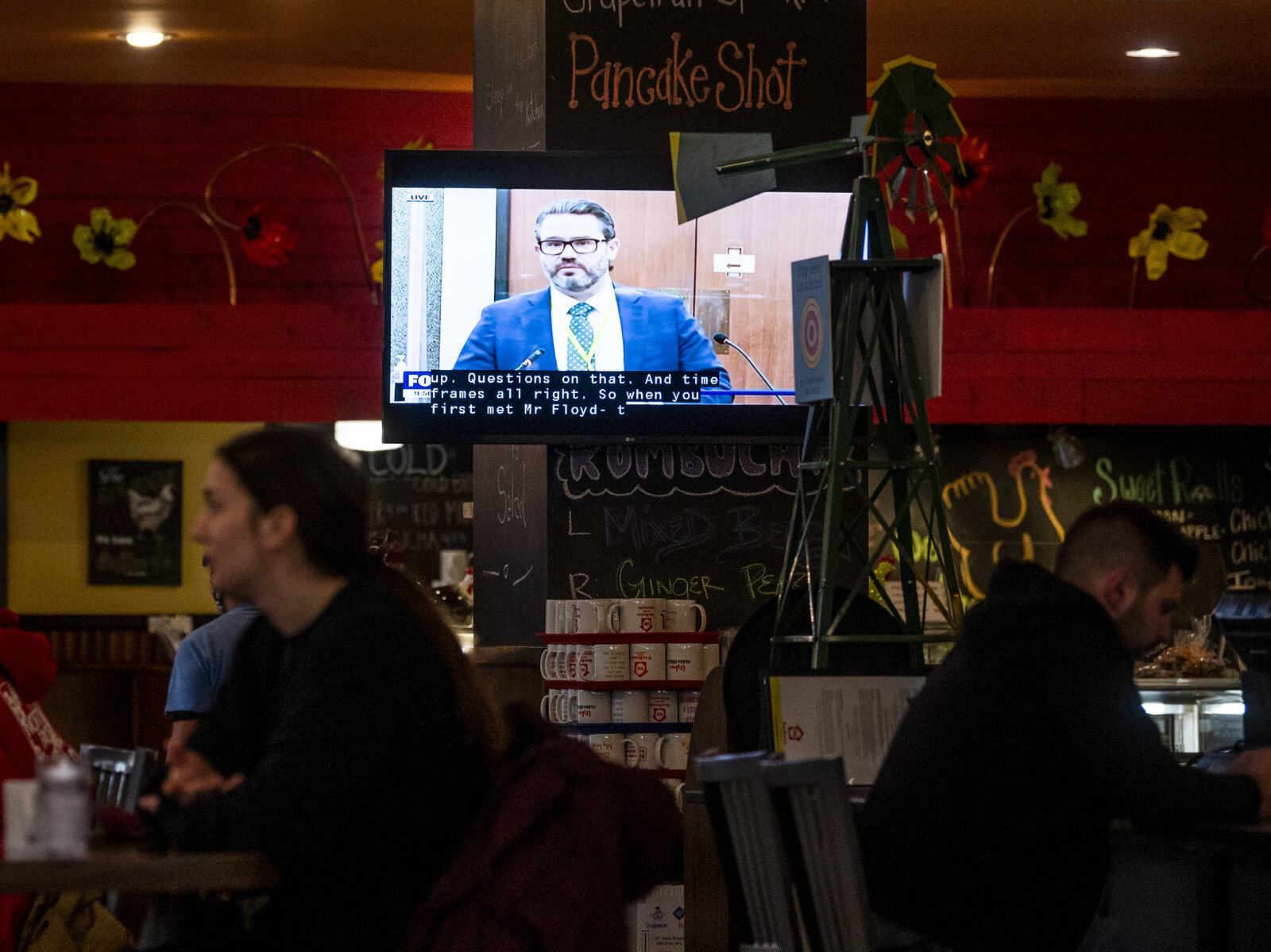
The trial of former officer Derek Chauvin has completed its fifth day of witness testimony. Here, a Minneapolis restaurant shows the trial on TV in its dining room Thursday.
Stephen Maturen/Getty Images
A week of testimony
The first week of the trial brought days of intensely emotional testimony from eyewitnesses who watched police pin Floyd to the asphalt and heard his final words as he pleaded with the officers to get off him.
More than a dozen witnesses have already testified this week, and Friday's court session was cut short as lunchtime approached. Hennepin County Judge Peter Cahill said on Thursday that because of the fairly rapid progress in moving through the prosecution's witness list, the jury would be released early on Friday.
On Thursday, Ploeger told the jury about the phone call he made to Chauvin about the struggle with Floyd. Ploeger was alerted to the situation by 911 dispatcher Jena Scurry, who testified Monday that she became alarmed as she watched live video footage of the arrest.
"When Mr. Floyd was no longer offering up any resistance to the officers, they could have ended the restraint," Ploeger said. If an officer puts his knee on someone's neck, he said, that position should only be held until the subject is handcuffed and not resisting any longer.
Also on Thursday, two paramedics who were called to the scene outside Cup Foods described how Floyd was unresponsive when they arrived and "limp" as they placed him on a gurney. Their ambulance's cardiac monitor showed he had "flatlined," Hennepin County paramedic Seth Bravinder said.
The Hennepin County medical examiner's office ruled Floyd's death was a homicide, saying his heart and lungs stopped functioning "while being restrained" by police. But it also noted "other significant conditions," including fentanyl intoxication and recent methamphetamine use as well as heart disease.
Prosecutors say Chauvin was directly responsible for Floyd's death. But the officer's defense attorney disagrees, saying Floyd was overdosing on fentanyl when he died.
Chauvin, 45, is facing three criminal charges, as listed in court documents:
- second-degree murder — unintentional — while committing a felony;
- third-degree murder — perpetrating eminently dangerous act and evincing depraved mind;
- second-degree manslaughter — culpable negligence creating unreasonable risk.

Convict him of what exactly?
He’ll most likely get a second degree manslaughter conviction. The murder charges will be dropped.
He’ll spend maybe 3-5 years on a potential 10 year sentence, get out on good behavior, and’ll be set for the rest of his life as a free white man. He will 1000% be protected in prison as well.
That’s not justice. It’s a fukking concession - and people will take that bullshyt with open arms.

Death by firing squad and generational restitutionIf you had the power how would you punish him? Death penalty? Instant death?


