
Rakim Allah
Superstar

, friends.


It's sad that a cac male points the finger in the correct direction when Black people point the finger at each other.


I've heard this and not only does it sound ridiculous to me, it is a horrible take on black women.


50 years ago $500 isn't as paltry as you think.I've heard this and not only does it sound ridiculous to me, it is a horrible take on black women. Basically what it says is that black women exchanged the father of the family for less than $500 a month. If that's all it took there was never a family to begin with. I think it's more likely the family had already broken down and welfare was a band-aid to help the situation.

So what. What does this have to do with black families in that timeframe? Riddle me this, if black families were broken back then like 2023 families… how was the black women earning money to support at least 2 kids minus a nikka in the house?
Most of the federal oversight, which would have promised equal treatment to applicants regardless of race or marital status, was removed. Administration of the program was transferred from the U.S. Children’s Bureau to the Social Security Administration, which lacked the Children’s Bureau’s commitment to poor children and their mothers. The initial appropriation for the program was reduced from $120 to $25 million.
Ironically, the casework provisions for supervision created an effect virtually opposite to the intention of the designers. A provision in the law that authorized ADC assistance only to “suitable homes” functioned, in the program’s first three decades, to reduce the number of eligible children (in 1960 when 79 of every 1000 children were in need, only 30 received assistance) and, particularly, to inhibit coverage of “illegitimate” children and children of color. Local ADC policy frequently discontinued coverage during seasons when low-wage labor was short in fields or homes, thus forcing poor mothers into such labor.
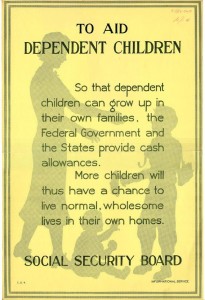
 socialwelfare.library.vcu.edu


50 years ago $500 isn't as paltry as you think.
They were working AND relying on the support of other family members (just as they are today).

Extended family. Did you not read my prior post? Look at the census records in the south prior to 1940 for your family, go over it with a family member from that time, you will commonly discover extended family members in households of black families, and I'm talking beyond Grandparents and grandchildren, but cousins, nieces and nephews, especially in rural communities. That family member will also point out how someone listed as a sibling was actually a cousin or nephew. My hypothesis is Black communities were simply closer knit back then. Hell, my father grew up in a community named after his family, because most of the community were all related. I hope you don't think all the light-skinned family members of yours from the south weren't through marriage.So what. What does this have to do with black families in that timeframe? Riddle me this, if black families were broken back then like 2023 families… how was the black women earning money to support at least 2 kids minus a nikka in the house?
They were working AND relying on the support of other family members (just as they are today).
Black people were getting by by supporting each other.
here's some history about the welfare you believe Black women traded their partners for.
Aid To Dependent Children: The Legal History
For its first three decades, AFDC operated much like a private charity, with its case workers given discretion in investigating clients, cutting off benefits to those determined to be unsuitable, a…

Extended family.
Does it say negro or black anywhere ?
Everyone looking for a smoking gun. It was a system that manifested itself into a social abnormality.


