
You are using an out of date browser. It may not display this or other websites correctly.
You should upgrade or use an alternative browser.
You should upgrade or use an alternative browser.
USA ends 2025 with largest 1 yr drop in murkin!! Do you trust the numbers?
More options
Who Replied?


People literally stopped paying rent dur to eviction moratorium. Alot People were making more money on unemployment then while they were employed. Work from home. PPP/SBA. It was so much money in the streets it was almost like the dope era in the 80s/90sThis is a gross exaggeration.
You're acting like there wasn't a massive social and economic disruption during COVID. People's jobs disappeared, schools were shut down, services evaporated, people were isolated, and suffering from stress and trauma. A couple of stimulus checks and temporary unemployment boosts didn't offset that, nor did they create broad material stability, especially for the people most affected by violence.
Yes People died and there was trauma and stress from that But the vast majority of them fell into 3 categories
1)Elderly
2)Obese
3)Preexisting conditions
If you weren't either if those three you were pretty much guaranteed to get through Covid.
As far as isolation most of these wierd fukks wax eloquently about being locked in their homes ordering shyt off of Amazon prime while wfh or collecting an unemployment check.
I was being polite. They were actually worse.
Your claim that "homicide were like we were back in the 90s" is an exaggeration too. Yes, here was a sharp, unusual spike during the peak of COVID disruption, but they never reached 90s levels.
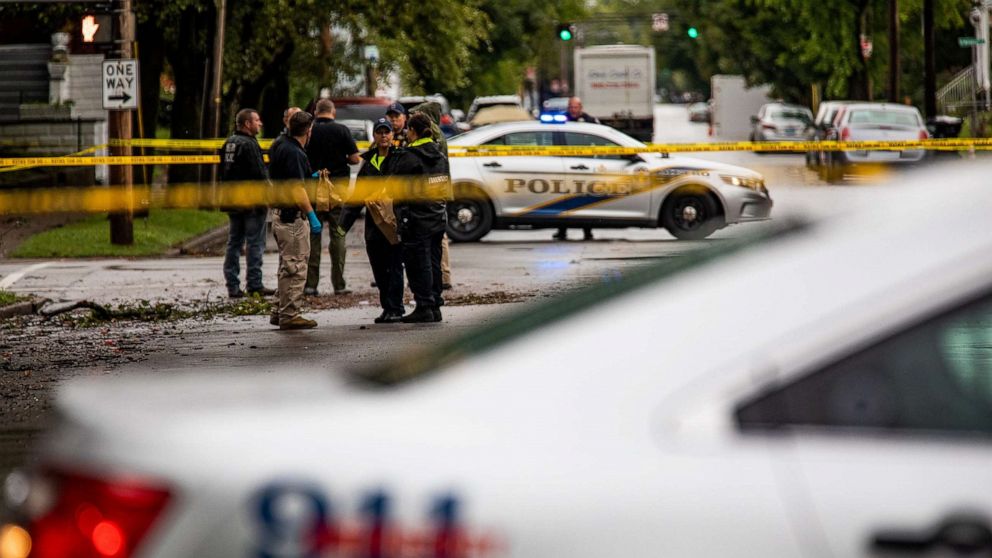
'It's just crazy': 12 major cities hit all-time homicide records
At least 12 major U.S. cities have broken annual homicide records in 2021 -- and there's still three weeks to go in the year.
 abcnews.go.com
Last edited:

Elim Garak
Veteran
Now thecoli believes the crime statistics again. 

Pull Up the Roots
Breakfast for dinner.
This is exactly the problem with your "argument." You're cherry-picking things and then trying to turn them into a universal experiences that don't really hold up under examination.People literally stopped paying rent dur to eviction moratorium. Alot People were making more money on unemployment then while they were employed. Work from home. PPP/SBA. It was so much money in the streets it was almost like the dope era in the 80s/90s
Yes People died and there was trauma and stress from that But the vast majority of them fell into 3 categories
1)Elderly
2)Obese
3)Preexisting conditions
If you weren't either if those three you were pretty much guaranteed to get through Covid.
As far as isolation most of these wierd fukks wax eloquently about being locked in their homes ordering shyt off of Amazon prime while wfh or collecting an unemployment check.
I was being polite. They were actually worse
'It's just crazy': 12 major cities hit all-time homicide records
At least 12 major U.S. cities have broken annual homicide records in 2021 -- and there's still three weeks to go in the year.
Eviction moratoriums didn't erase rent, they just delayed evictions. Those unemployment boosts were temporary, didn't apply evenly, and didn't reach everyone. PPP money overwhelmingly went to businesses and owners, not the people or neighborhoods where the violence was concentrated. Again, that's not "money in the streets," that's fragmented emergency aid during chaos.
And go somewhere with that COVID death minimization.
Violence responds to disruption, instability, fear, institutional retreat, not just who technically "survives." A lot of valuable services slowed or disappeared completely. And that matters.
The idea that the COVID-era crime spike was worse than the 1990s is misleading. Nationally, the homicide rate in the early 1990s peaked around 10 per 100,000 people, while the 2020 spike only reached about 7.8 per 100,000. The ABC News article, as sensationalized as it is, just points out that some cities set local annual homicide records. That doesn't mean crime nationwide exceeded the levels of the 1990s. You also can't ignore that many of these cities have bigger populations today, so raw counts aren't the same as rates.
The pandemic saw a historic jump in homicides compared to the year before, but the overall levels were still below the 1990s peak. Using city-specific records to claim the COVID-era spike was "worse" than the 1990s ignores how these stats are calculated.
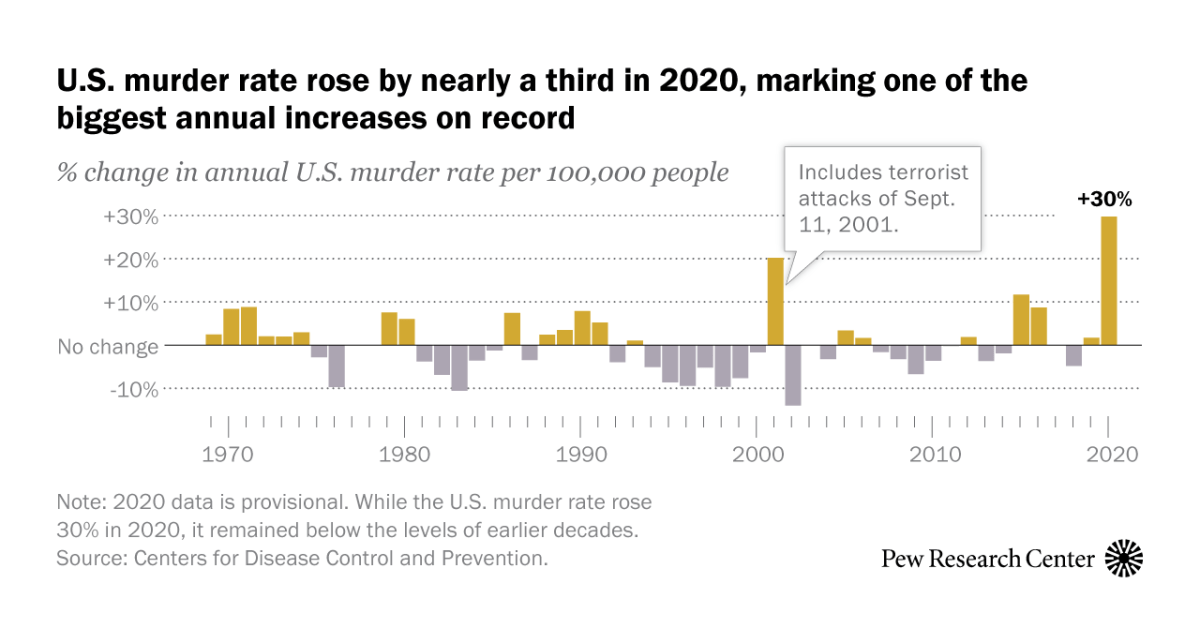
What we know about the increase in U.S. murders in 2020
The U.S. murder rate rose 30% between 2019 and 2020 – the largest single-year increase in more than a century.
 www.pewresearch.org
This section focuses on the violent crime and homicide rates from 1990 to 2020. As demonstrated in Figure 1, the national violent crime rate (blue line) peaked in 1991 at 758.2 violent crimes per 100,000 people. The violent crime rate has generally decreased since 1991. There was an increase in this rate in 2005 and 2006, after which it continued decreasing until 2014. The violent crime rate increased from 2014 to 2016, from 361.6 to 397.5 per 100,000; decreased between 2017 and 2019; and increased again from 2019 to 2020. During the most recent increase, the violent crime rate rose from 380.8 in 2019 to 398.5 per 100,000 in 2020. The rate observed in 2020 was still below the peaks observed in the early 1990s and the increase in the mid-2000s, but was close to the rate of 397.5 per 100,000 measured in 2016.
Similarly, during the years considered, the national homicide rate (red line) peaked during 1991 at 9.8 homicides per 100,000 people. The rate generally decreased from there, with small increases in some years during the 2000s but never exceeding more than an 0.2% uptick in consecutive years. Similar to the violent crime rate, the national homicide rate began to show an increase beginning in 2015, growing from 4.9 per 100,000 in 2014 to 5.4 in 2015. The homicide rate remained in a range of 5.0 to 5.4 per 100,000 until 2020 when it increased to 6.5 homicides per 100,000 people.

Boy do I got some news for you.....PPP money overwhelmingly went to businesses and owners, not the people or neighborhoods where the violence was concentrated

This is why ass intelligent as you are, I can't have a logical discussion because your not intertwined with the culture on a hood level to accurately diagnose the fukkery aspect in our community.
Therefore you discuss matters in the community as a white liberal would, you even mirror the terminology and talking points.
And I never said the national murder rate exceeded that of the 90s, I said some cities were historically worse during Covid then even the 90s as they broke their own homicide records
You good peoples though
Last edited:


