
:grannycac:
Last edited:

Two forces actually, gravity and dark energy. Dark energy, which repels gravity and expands space within the universe. Thats allows for universes to eventually touch each other. Gravity, well because it is a God. It is built into spacetime and warps time and matter. Hell its creates new matter from the extreme pressure and temperature it generates. I would argue that how hydrogen is the key components of stars, gravity is the key component to all universes.Are they expanding?
and which field? EM? gravity?
Why are the fundamental forces not the same? is this something you imagine or do you have some objective basis for it?
 . Try to overcome the strong nuclear force and split an atom with your hands. Impossible. Yet a you can get a magnet right now, pick up a nail and overcome the force of the ENTIRE earths mass pulling on it. How is that possible, if all forces are the same as you say?

are the separate universes expanding?Two forces actually, gravity and dark energy. Dark energy, which repels gravity and expands space within the universe. Thats allows for universes to eventually touch each other. Gravity, well because it is a God. It is built into spacetime and warps time and matter. Hell its creates new matter from the extreme pressure and temperature it generates. I would argue that how hydrogen is the key components of stars, gravity is the key component to all universes.
The fundamental forces are not the same
Yet that same 'weak' force of gravity can make a star swallow itself and rip the fabric of spacetime. What would the mass of two universes colliding create?
See while I respect your opinion breh, the one key difference is the theory you do not agree with. String theory. M-Theory. Am I right?
I believe that gravity lost within this universe can exist in stronger ranges within other universes. I also believe that gravitons do exist and we will find them. And maybe that quantum force will change the world as we know it. But thats just me
They would vary because it's possible that the fundamental forces would not be same
further example

Saturn's hexagon: An amazing phenomenon
Date:
April 8, 2014
Source:
University of the Basque Country
Summary:
An unusual structure with a hexagonal shape surrounding Saturn's north pole was spotted on the planet for the first time thirty years ago. Nothing similar with such a regular geometry had ever been seen on any planet in the solar system. Astronomers have now been able to study and measure the phenomenon and, among other achievements, establish its rotation period. What is more, this period could be the same as that of the planet itself. Saturn is the only planet in the solar system whose rotation time remains unknown.
Share This

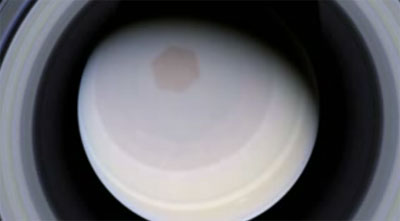
This colorful view from NASA's Cassini mission is the highest-resolution view of the unique six-sided jet stream at Saturn's north pole known as "the hexagon."
Credit: NASA/JPL-Caltech/SSI/Hampton
[Click to enlarge image]
An unusual structure with a hexagonal shape surrounding Saturn's north pole was spotted on the planet for the first time thirty years ago. Nothing similar with such a regular geometry had ever been seen on any planet in the Solar System. The Planetary Sciences Group has now been able to study and measure the phenomenon and, among other achievements, establish its rotation period. What is more, this period could be the same as that of the planet itself. Saturn is the only planet in the Solar System whose rotation time remains unknown.
Related Articles
In 1980 and 1981 NASA's Voyager 1 and 2 space probes passed for the first time over the planet Saturn, located 1,500 million km from the Sun. Among their numerous discoveries they observed a strange, hexagon-shaped structure in the planet's uppermost clouds surrounding its north pole. The hexagon remained virtually static, without moving, vis-à-vis the planet's overall rotation that was not accurately known. What is more, the images captured by the Voyager probes found that the clouds were moving rapidly inside the hexagon in an enclosed jet stream and were being dragged by winds travelling at over 400 km/h.
Thirty years later -- the equivalent of one Saturn year, in other words, the time the planet takes to go all the way around the Sun -- and over more than six consecutive years, researchers in the UPV/EHU's Planetary Sciences Group, in collaboration with astronomers from various countries, were able to observe Saturn's northern polar region in detail once again and confirmed that the hexagon continued in place. After measuring the positions of the hexagon vertices with great precision, they determined that its movement remains extremely stable, and on the basis of the cloud movements, that the jet stream inside it remains unchanged. For this study the researchers used images taken from Earth between 2008 and 2014; they used, among others, the astronomical cameras PlanetCam (developed by the Planetary Sciences Group itself) and Astralux, fitted to the telescopes of the Calar Alto Observatory in Almería (Spain); in addition, they used the very high resolution images obtained by t he Cassini spacecraft, which has been orbiting Saturn since 2004.
Due to the tilt of approximately 27º of the planet Saturn, its polar atmosphere undergoes intense seasonable variations with long polar nights lasting over seven years, followed by a long period of 23 years of variable illumination. However, the seasonal variations do not affect the hexagon and its jet stream at all, so both are part of an extensive wave, deeply rooted in Saturn's atmosphere. The UPV/EHU researchers suggest that the hexagon and its stream are the manifestation of a "Rossby wave" similar to those that form in the mid-latitudes of Earth. On our planet the jet stream meanders from west to east and brings, associated with it, the system of areas of low pressure and anticyclones which we have been seeing regularly on weather maps.
On Saturn, a hydrogen gas planet, ten times the size of Earth, cold in its upper clouds, without a solid surface, and with an atmosphere as deep as that of an ocean, "the hexagonal wavy motion of the jet stream is expected to be propagated vertically and reveal to us aspects of the planet's hidden atmosphere," pointed out Agustín Sánchez-Lavega, Head of the Planetary Sciences research group. "The movement of the hexagon could therefore be linked to the depths of Saturn, and the rotation period of this structure, which, as we have been able to ascertain, is 10 hours, 39 minutes and 23 seconds, could be that of the planet itself," he added. Saturn is the only planet in the Solar System whose rotation period is not yet known.


Voyager 1's approach to Jupiter over a period of 60 days
NASA launched the two Voyager spacecraft to Jupiter, Saturn, Uranus, and Neptune in the late summer of 1977. Voyager 1's closest approach to Jupiter occurred March 5, 1979. Voyager 2's closest approach was July 9, 1979.

First close-up view of Jupiter from Voyager 1. (Click on the image for a larger view)
Photography of Jupiter began in January 1979, when images of the brightly banded planet already exceeded the best taken from Earth. Voyager 1 completed its Jupiter encounter in early April, after taking almost 19,000 pictures and many other scientific measurements. Voyager 2 picked up the baton in late April and its encounter continued into August. They took more than 33,000 pictures of Jupiter and its five major satellites.
Although astronomers had studied Jupiter from Earth for several centuries, scientists were surprised by many of Voyager 1 and 2's findings. They now understand that important physical, geological, and atmospheric processes go on - in the planet, its satellites, and magnetosphere - that were new to observers.
Discovery of active volcanism on the satellite Io was probably the greatest surprise. It was the first time active volcanoes had been seen on another body in the solar system. It appears that activity on Io affects the entire Jovian system. Io appears to be the primary source of matter that pervades the Jovian magnetosphere -- the region of space that surrounds the planet, primarily influenced by the planet's strong magnetic field. Sulfur, oxygen, and sodium, apparently erupted by Io's volcanoes and sputtered off the surface by impact of high-energy particles, were detected at the outer edge of the magnetosphere.
Particles of the same material are present inside Io's orbit, where they accelerate to more than 10 percent of the speed of light. It is clear to scientists from a comparison of data from Pioneers 10 and 11 (which flew past Jupiter in late 1973 and 1974) and the Voyagers that something changed in the four and one-half years between the Pioneer and Voyager encounters.
It is not entirely clear just how far-reaching those changes are, or what brought them about. They may be related to Ionian activity. It is difficult to imagine, however, that at least some of Io's volcanoes were not erupting when the Pioneers flew past; it is also, the Voyager scientists say, difficult to believe the Pioneers' instruments failed to see magnetospheric concentrations of sulfur detected by both Voyager spacecraft (Voyager 1 saw greater concentrations than
http://voyager.jpl.nasa.gov/science/jupiter.html
 *
*
Two forces actually, gravity and dark energy. Dark energy, which repels gravity and expands space within the universe. Thats allows for universes to eventually touch each other. Gravity, well because it is a God. It is built into spacetime and warps time and matter. Hell its creates new matter from the extreme pressure and temperature it generates. I would argue that how hydrogen is the key components of stars, gravity is the key component to all universes.
The fundamental forces are not the same
Yet that same 'weak' force of gravity can make a star swallow itself and rip the fabric of spacetime. What would the mass of two universes colliding create?
See while I respect your opinion breh, the one key difference is the theory you do not agree with. String theory. M-Theory. Am I right?
I believe that gravity lost within this universe can exist in stronger ranges within other universes. I also believe that gravitons do exist and we will find them. And maybe that quantum force will change the world as we know it. But thats just me
Which goes to show our world is integrated with other worlds where laws are so different that it affects others.
 how?
how?
Watch the first 11 or 12 minutes dude explains it.


The first part of that video is a demonstration from the 50s, and all follow from Maxwell's Equations.
The next part is taking Susskind out of context and imagining that the editors of Wikipedia are being manipulated by shadowy figures behind the scenes.
The last third I didn't bother watching.
The first part of that video is a demonstration from the 50s, and all follow from Maxwell's Equations.
I didn't want the reader to watch the entire video just the science topic

