Catherine Hoskins, 58, gets some sleep at the encampment.
City Councilwoman Monica Rodriguez, whose district includes Pacoima, said City Atty. Mike Feuer’s office obtained orders for 10 people involved in sex trafficking and drugs to stay away. In March, Samuel Crenshaw, a 60-year-old black man, died after a stabbing among or near the tents.
The LAPD HOPE team of police and city sanitation workers has repeatedly moved the residents. It was the team who told the first members of the camp to leave a cul-de-sac in Pacoima, and they settled under the Ronald Reagan Freeway underpass about three years ago, residents said.
“The HOPE team was trying to find the least-populated area,” Rodriguez said.
Many in the encampment also said the team threw away their belongings, including an urn containing the ashes of resident Jessica Quinn’s son. The leader of the HOPE team did not return a call for comment.
Rodriguez said she has brought an array of homeless services to her district, including bridge housing, a winter shelter, a homeless services hub and the only safe parking lot in the city for people to sleep in their RVs.
“I can’t think of a box I haven’t checked,” she said.
‘We live here’
Pierfax has a keen awareness of the historical forces that washed him under the bridge. His mother’s family fled Mississippi for Pacoima, which was then largely dirt roads and open fields. Some of the first arrivals, ironically, lived in tents and Quonset huts.
His family helped form what became the center of African American life in the San Fernando Valley.
“It was thriving, especially for African Americans,” Pierfax said. “My sister bought a Camaro. Everybody bought GM products.”
His stepfather, a tool-and-die man, lost an eye in an industrial accident, but refused a settlement offer and followed Lockheed Martin to Lancaster. Pierfax said his sister took a buyout from General Motors, but the money only lasted so long and soon she had to find another job.
“Instead of finding yourself a home, now you have an apartment,” Pierfax said.
Beatrice Hart, left, gives a high-five to Edwin Williams as Michelle Vaughn watches. Hart recently moved into an apartment in Sunland but returns often to the camp, where she's the unofficial den mother.
Pierfax attended Pacoima schools with mostly Latino and black students, but in the 1970s, was transferred to the west San Fernando Valley for high school as part of L.A.’s school busing debacle. He remembers climbing off the bus and seeing a racial slur splashed across the quad, where administrators must have noticed it.
“It was the worst first day of high school ever,” he said.
Pierfax played baseball in college and one of his sisters got a PhD. When things got tough, Pierfax said, he started selling illegal substances.
“I did what I had to do to survive,” he said. “I was the oldest of 13, I had to carry the load. I don’t like where I’m at, but I’m surprised I am not in a mental ward and that I’m still living.”
Pacoima’s African American population dropped from 75% in the 1970s to 10% 20 years later as Mexican immigrants, later joined by Salvadorans and Guatamalans, arrived. Joe Louis Homes and other tracts where black teachers, pastors and businesspeople once lived are now primarily occupied by middle-class Latinos.
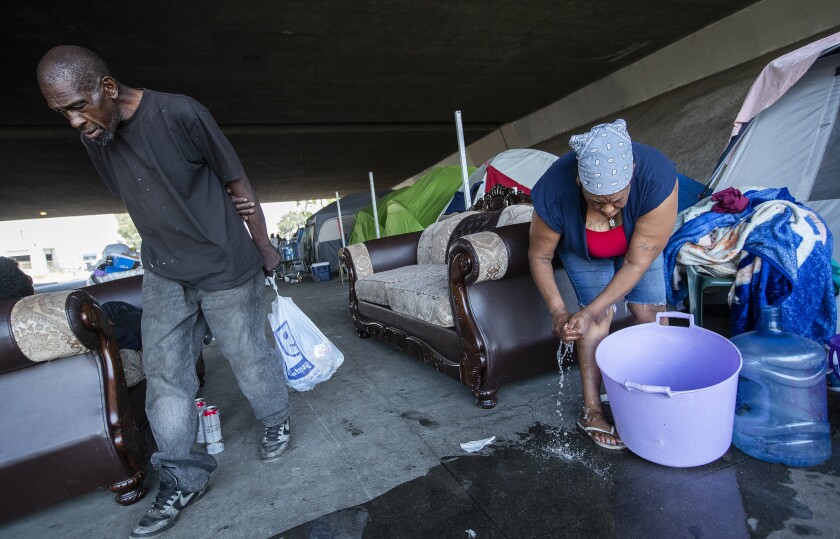
The camp residents may stay in tents, but they are still very much part of the Pacoima community. Sisters, friends and pastors drop by regularly with food, water, dog food, eyeglasses and McDonald’s gift cards.
For a while, several pregnant women lived at the encampment. They moved out just before they gave birth. The residents collectively care for a litter of mop-topped puppies that scamper underfoot, and a dog that died there is buried in the freeway embankment under a grave marker.
Sharrell Williams, 52, right, prepares to do her laundry at the encampment.
One woman, Sandra Wilson, has come to the encampment by bus, train and bus again from her home in the desert town of Mojave to gather residents for a prayer circle.
“Those were my friends and they’re still my friends,” said Wilson, 61.
Hart, the unofficial den mother, said a neighbor and her daughter brought a Christmas tree to the encampment over the holidays and decorated it.
With the help of homeless service workers, Hart recently moved into an apartment in Sunland, but most days she’s back at her friends’ tents under the freeway, helping to cook and maintain order. Caltrans’ metal fenceposts still mark the encampment’s boundaries.
“We all grew up together,” Hart said. “Our parents passed and the houses got sold. Where are we all going to go? We live here.”
Locked out of L.A.'s white neighborhoods, they built a black suburb. Now they're homeless


only problem here in NYC is that long island isn't cheap it's kinda expensive too so you commuting to work but paying these property taxes just cause you don't want to live near the negros in the hood... White flight built long island now they are paying for it literally...