A Coronavirus Explosion Was Expected in Japan. Where Is It?
A Coronavirus Explosion Was Expected in Japan. Where Is It?
By
Gearoid Reidy
March 19, 2020, 4:10 AM EDT Updated on March 19, 2020, 1:00 PM EDT
-
Two months after its first case, Japan hasn’t seen virus surge
-
Infections well below G-7 members such as the U.S. and Germany
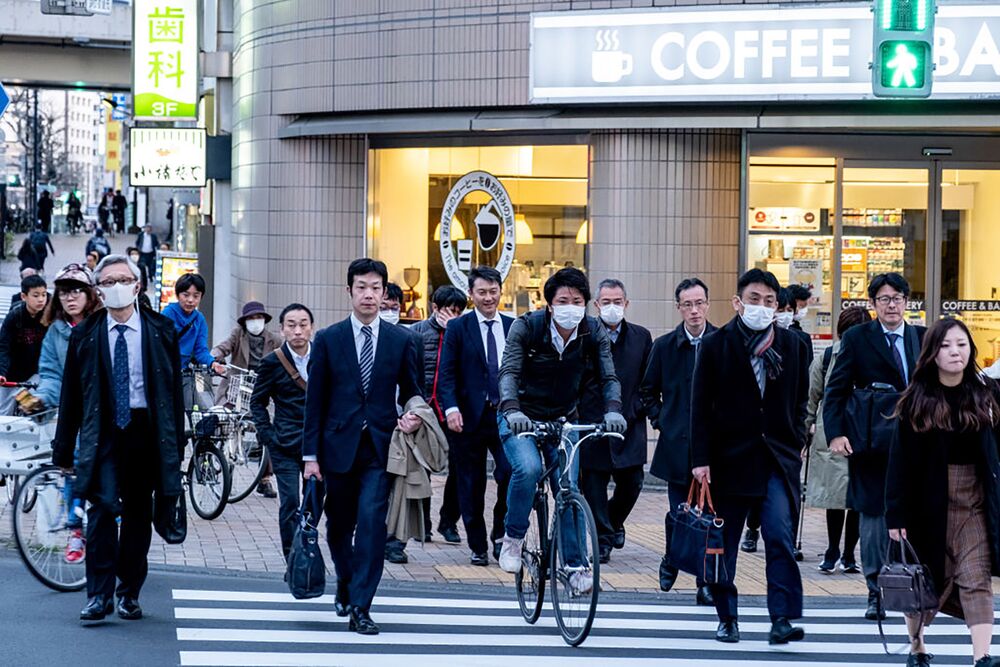
People wearing face masks as a preventive measure, cross the street after work during the corona virus pandemic, in Tokyo, on March 18. Photographer: Viola Kam/SOPA Images/LightRocket via Getty Images
In this article
2394Z
KING'S COLLEGE LONDON
Private Company
We’re tracking the latest on the coronavirus outbreak and the global response.
Sign up here for our daily newsletter on what you need to know.
Japan was one of first countries outside of China hit by the coronavirus and now it’s one of the least-affected among developed nations. That’s puzzling health experts.
Unlike China’s draconian isolation measures, the mass quarantine in much of Europe and big U.S. cities ordering people to
shelter in place, Japan has imposed no lockdown. While there have been disruptions caused by school closures, life continues as normal for much of the population. Tokyo rush hour trains are still packed and restaurants remain open.
The looming question is whether Japan has dodged a bullet or is about to be hit. The government contends it has been aggressive in identifying clusters and containing the spread, which makes its overall and per capita number for infections among the lowest among developed economies. Critics argue Japan has been lax in testing, perhaps looking to keep the infection numbers low as it’s set to host the Olympics in Tokyo in July.
Limited Virus Testing in Japan Masks True Scale of Infection
Japan’s initial slow response to the virus, its handling of the Diamond Princess cruise ship -- where about one in five people aboard became infected while it was quarantined in Yokohama -- and the decision not to initially block travel from China left the nation open to
criticism it could become home to a “
second Wuhan.” Steps taken to contain the virus -- such as shutting schools and calling off large events -- now look tame in comparison to what others have done.
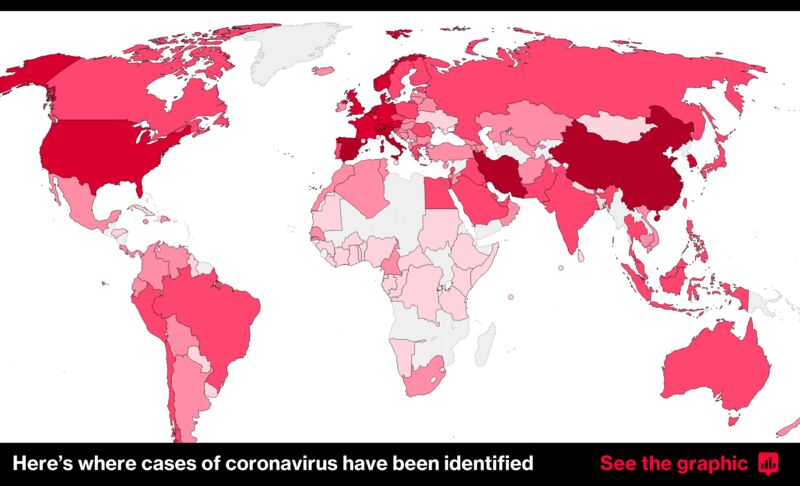
Mapping the Coronavirus Outbreak Across the World
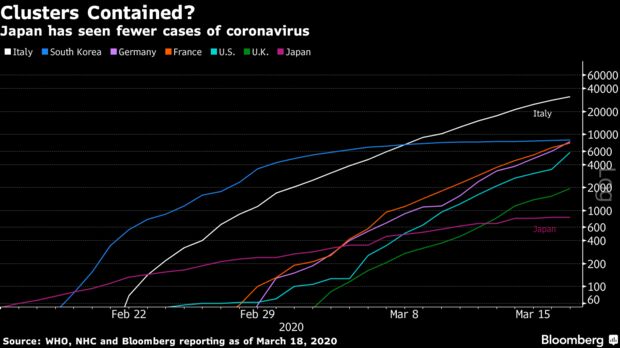
But as of March 18, Japan has only had a little more than 900 confirmed cases -- excluding the cruise ship. The U.S., France and Germany were all above 7,000 cases and Italy was nearing 36,000. Neighbor South Korea, which tested aggressively amid a surge of confirmed infections from late February, was at about 8,500 cases but its new infections are now tapering off.
In Tokyo, among the world’s most densely packed metropolitan areas, cases made up 0.0008% of the population. The northern main island of Hokkaido, the skiing destination that was Japan’s worst-hit area, is already
lifting a state of emergency as new cases have slowed.
Kenji Shibuya, a professor at King’s College London and a former chief of health policy at the World Health Organization, sees two possibilities: that Japan has contained the spread by focusing on outbreak clusters, or that there are outbreaks yet to be found.
“Both are reasonable, but my guess is that Japan is about to see the explosion and will inevitably shift from containment to delay-the-peak phase very soon,” he said. “The number of tests is increasing, but not enough.”
Early Alarm
Japan’s proximity to China may have helped in raising the alarm when the disease was in a more controllable phase. In late January, shortly after Japan’s
first infection of a person who had not been to China, hand sanitizers starting popping up in offices and stores, mask sales spiked and people began to accept some basic steps to protect public health. This may have also helped Japan flatten the curve for infections.
“Japan has been fortunate that only a small number of cases of SARS-CoV-2 were brought into the country, and they seem to have remained concentrated in finite areas, easy to control,” said Laurie Garrett, an American global health writer, referring to the technical name of the coronavirus.
Despite the infectiousness of the virus, a March 9
report by a government-appointed panel said that about 80% of the cases identified in Japan didn’t pass on the infection. But there’s little consensus over why and skepticism over whether the same government that was issued a
rare rebuke by U.S. health authorities for letting the Diamond Princess outbreak get out of hand is getting it right on coronavirus.
FOR MORE ON JAPAN’S RESPONSE:
“Many infection clusters have been identified at a comparatively early stage,” the panel said in a report this month. Prime Minister Shinzo Abe cited those findings when he said Saturday that Japan didn’t yet need to declare a state of emergency.
Japan may have some built-in advantages, such as a culture where handshakes and hugs are less common than in other G-7 countries. It also has rates of hand-washing
above those in Europe.
data shows that influenza cases this year are well below normal levels, with nationwide cases at the lowest, according to data going back to 2004.
Concentrated Areas
Japan has ramped up its capacity but has tested only around 5% the number of people as in neighboring South Korea, despite a larger population. But the situation in Italy, which tested extensively only to see hospitals overwhelmed, has also given some pause.
“Italy’s mortality rate is almost triple Japan’s,” said Yoko Tsukamoto, a professor of infection control at the Health Sciences University of Hokkaido. “Part of the reason is if you get tested, you get quarantined, so it means that they don’t have enough beds for relatively non-severe patients.”
Japan has tested more than 15,000 people as of Wednesday, and despite discouraging checks on those who don’t have symptoms or contact with a carrier, the infection rate lies at 5.6%. That compares to around 3% in South Korea, but 18% in Italy. But Japan still faces an uphill battle to contain the infection.
“It is really difficult to identify every case, because so many infections are mild. Containment has been working in Hong Kong and Singapore by aggressive case-finding,” said Ben Cowling, said Ben Cowling, an epidemiology professor at the University of Hong Kong. “I would expect a gradual increase in cases in Japan because of silent transmission in the community.”
Japan officials say they’re confident in their testing regimen. “We don’t see a need to use all of our testing capacity, just because we have it,” Health Ministry official Yasuyuki Sahara said at a briefing Tuesday. “Neither do we think it’s necessary to test people just because they’re worried.”
Should Japan see a jump, it may be better suited than many peers to handle the surge. It has about 13 hospital beds per 1,000 people, the highest among Group of Seven nations and more than triple the rate for Italy, the U.S., U.K. and Canada, according to World Bank data.
Even if Japan may not be counting all those infected, hospitals aren’t being stretched thin and there has been no spike in pneumonia cases, health officials said. While the prime minister has stepped up border controls, his government is mulling whether to ease restraint at home, such as allowing students back to class when the new school year starts in April.
“We will do all that is possible to end the coronavirus outbreak,” Prime Minister Abe told his ruling party this week.
— With assistance by Lisa Du, Shiho Takezawa, Isabel Reynolds, and James Mayger